If you are an MSU student dealing with an injury, or you are a parent trying to help from home, the medical bills can feel more stressful than the accident itself. You may have gone to Olin Health Center, an urgent care in East Lansing, University of Michigan Health-Sparrow in Lansing, or McLaren Greater Lansing in Okemos. Then the paperwork starts arriving. One bill says insurance is pending. Another says you owe now. A third looks like it should have been covered but was not.
That confusion is common around Michigan State University because student injuries do not all follow the same billing path. A car crash on Grand River Avenue raises different insurance issues than a fall at an apartment near Cedar Village, a scooter collision near Bogue Street, or an injury at a student job. The first question is not always, “How much is the bill?” The first question is, “Who is supposed to pay this first?”
If you act quickly, keep records, and push the right claim to the right insurer, you can avoid a lot of damage. Late notices, collections, and out-of-pocket payments often grow from small mistakes in the first few days.

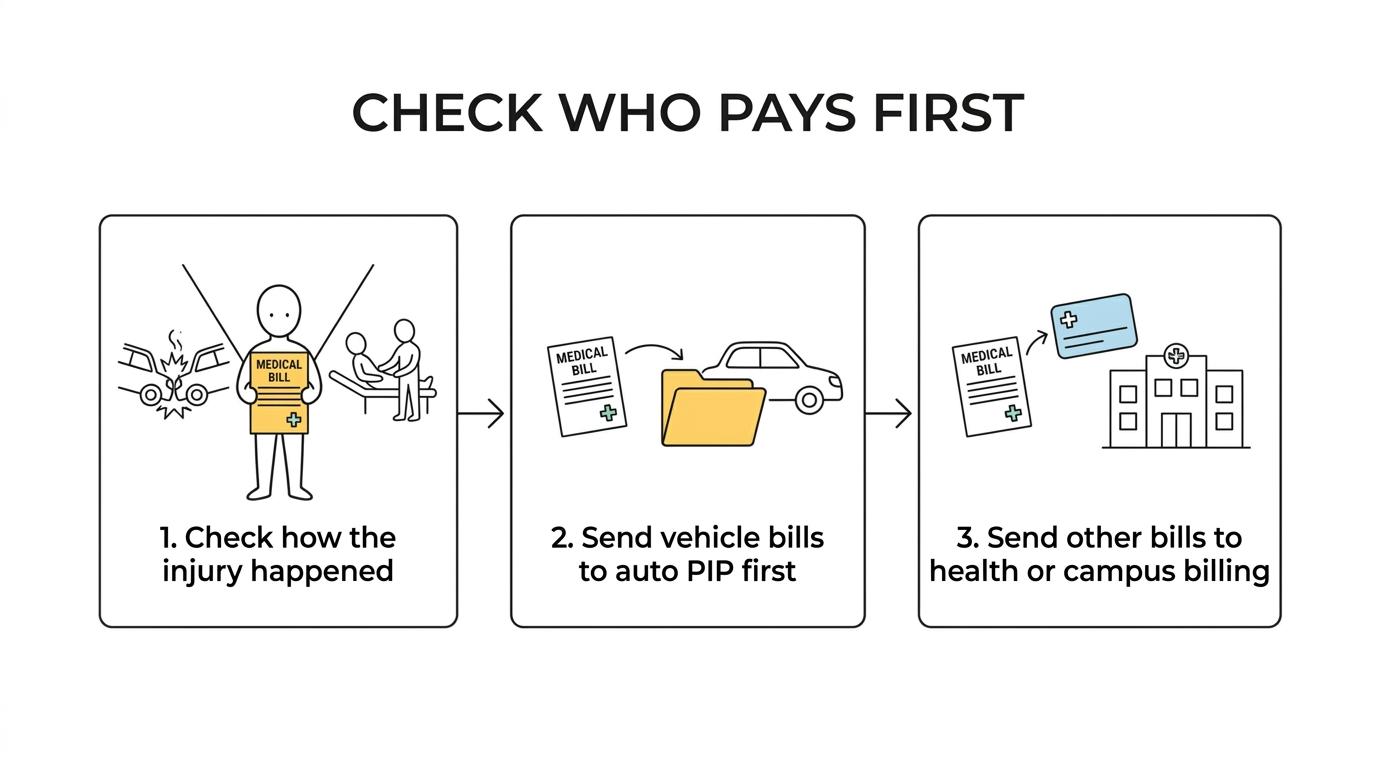
Visualization: A simple way to think about post-injury billing is to separate car-related injuries, health-insurance-based treatment, and campus billing through MSU health services.
Why MSU student injury medical bills get confusing fast
Students around East Lansing often move between several systems at once. You may have your own health insurance, remain on a parent’s plan, carry MSU student coverage, or have auto insurance that applies because a motor vehicle was involved. If you were hurt near Spartan Stadium on game day, crossing Harrison Road, riding with friends from downtown East Lansing, or walking near MAC Avenue and Albert Avenue, the facts of the accident can change which insurance gets billed first.
Campus care adds another layer. Michigan State University’s Campus Health Services at Olin Health Center can bill private U.S. insurance, and enrolled students get three free medical office visits per academic year. That sounds simple until you realize that the visit itself is not the whole bill. Labs, x-rays, prescriptions, immunizations, supplies, and later visits can still be billed separately.
Parents usually see the problem only after the mail or portal alerts start piling up.
Who may pay medical bills after an MSU student injury
The answer depends on how the injury happened, where treatment occurred, and what insurance coverage was in place on the day of the accident.
If a motor vehicle was involved, Michigan no-fault Personal Injury Protection, often called PIP, may be central. If it was not a motor vehicle case, private health insurance may pay first, with you responsible for deductibles, co-pays, or uncovered services. If treatment happened at MSU’s health system, some parts of the care may be handled through campus billing rules before insurance finishes processing.
Here is a practical breakdown for students and parents in the MSU area:
| Injury situation near MSU or East Lansing |
Likely first source of payment |
Common extra charges students miss |
What you should do right away |
| Car crash on Grand River, Hagadorn, Trowbridge, or US-127 area |
Michigan no-fault PIP may apply first, depending on coverage setup |
Ambulance, imaging, specialist follow-up, physical therapy |
Open the auto claim immediately and keep all treatment records |
| Pedestrian or bicyclist hit by a car near campus |
PIP may still apply even if you were not driving |
ER bill, orthopedic consults, rehab |
Report the claim and ask which insurer is responsible |
| Rideshare injury in East Lansing or Lansing |
Auto coverage may be involved, with health insurance issues mixed in |
ER balance, out-of-network bills |
Get the rideshare trip record and claim numbers |
| Fall at a dorm, apartment, Greek house, or local business |
Health insurance often pays first; a separate injury claim may exist |
Imaging, urgent care, follow-up visits, missed class or work losses |
Photograph the scene and report the incident in writing |
| Sports or recreation injury not caused by a vehicle |
Health insurance or student insurance |
MRI, bracing, specialist care |
Confirm network status before non-emergency treatment |
| Treatment at Olin Health Center |
Campus billing plus insurance billing rules |
Labs, x-rays, prescriptions, fourth visit and later visits |
Review your student account and insurance explanation of benefits |
Michigan no-fault PIP for MSU student car, bike, and pedestrian accidents
If your injury involved a car, truck, bus, rideshare vehicle, or another motor vehicle, do not assume your regular health insurance is the whole answer. Michigan no-fault law can affect who pays medical bills, and the details matter. That is true whether you were driving, riding as a passenger, walking near Farm Lane, or biking across campus when a car hit you.
A big timing rule matters here. Michigan’s Department of Insurance and Financial Services states that PIP claims, including medical bills, are overdue if they are not paid within 30 days after the insurer receives satisfactory supporting documentation. That means the insurer may not owe payment the moment you tell them there was a crash. They usually want records, bills, and other proof of treatment. If nobody sends the paperwork correctly, the clock may not start when you think it does.
This is where students get stuck. You may assume the hospital sent everything. The provider may assume your insurer already has what it needs. Your parent may think your health plan handled it. Meanwhile, the bill ages.
Qualified health coverage also matters. Michigan’s insurance rules allow different no-fault medical coverage choices, and those choices can affect whether PIP pays medical bills or whether health insurance becomes the main payer for medical treatment. MSU notes that its employee, retiree, graduate assistant, and student health plans qualify as qualified health coverage. That does not mean every student’s auto policy was set up the same way. It means you should verify the actual policy elections rather than guess.
If your injury involved any vehicle at all, get the auto claim opened the same day. A short delay can turn into months of billing problems.
How private health insurance and MSU student insurance affect student medical bills
Many MSU students are still covered under a parent’s private health insurance plan. Others carry student-focused coverage through the university. MSU states that international, veterinary, and medical students are required to have insurance and are automatically enrolled in the MSU Aetna student health insurance plan, though waiver options can apply in some programs when other coverage exists.
That matters because Campus Health Services says it will bill other private U.S. insurance companies and bill the patient for charges not covered by insurance. So even when you have insurance, you may still see patient responsibility show up on your account. That can include co-pays, deductibles, non-covered items, or charges from providers outside your network.
If you are a parent, do not assume “student insurance” means every injury bill disappears. It usually means there is a plan in place, not that every provider, ambulance service, scan, or prescription is fully covered.
Before you pay anything, verify these points:
- Insurance card on file: Make sure the provider has the correct current card, member ID, and policyholder information
- Motor vehicle involvement: If a car, bus, or rideshare was involved, ask whether auto no-fault should be billed before health insurance
- Network status: Check whether the hospital, urgent care, imaging center, or specialist is in network
- Student plan rules: Confirm whether the student is on the MSU Aetna plan, a parent plan, Medicaid, or another policy
- Explanation of benefits: Wait for the EOB when possible so you can see what was processed and what was denied
What Olin Health Center charges can still show up after “free” student visits
MSU’s official billing guidance is helpful, but students often read only the first sentence. Enrolled students are not charged for the first three medical office visits of each academic year. That is useful, especially when you need quick care close to your residence hall, apartment, or class buildings near the Red Cedar River corridor.
The catch is that the free office visit does not include many common services. MSU says lab tests, x-rays, prescriptions, immunizations, surgery-related procedures, medical supplies, and the fourth and later visits are not part of those free office visits. That means an injured student who goes to Olin for an exam, gets x-rays, receives a brace, and picks up medication can still end up with multiple charges.
That surprises a lot of families, especially after what looked like a simple sprain from a fall near Berkey Hall, IM East, or an off-campus apartment entrance.

Visualization: Students often receive treatment in more than one place, including Olin Health Center, local urgent care centers, and regional hospitals in Lansing and Okemos.
Steps to take in the first 72 hours after an MSU student injury
The first three days matter more than most people realize. If you handle the paperwork early, you have a much better shot at keeping the bills organized and protecting any injury claim that may exist.
Use this checklist right away:
- Get treatment first and worry about fault later. Your health comes first.
- Report the incident. Tell campus police, East Lansing Police, apartment management, a business owner, or the auto insurer depending on what happened.
- Photograph everything. Save pictures of the scene, bruising, vehicles, sidewalks, stairs, spilled liquid, broken handrails, or damaged bikes and scooters.
- Ask every provider for an itemized bill. A simple balance statement is not enough.
- Keep every discharge paper, diagnosis note, prescription receipt, and imaging report.
- Open the correct insurance claim immediately. If a vehicle was involved, do not wait to notify the auto insurer.
- Start one folder for everything, including texts, emails, portal screenshots, and missed class or work records.
Common MSU student injury situations that create billing problems
Car accident medical bills for MSU students
Crashes around East Lansing are common during the school year, especially near Grand River Avenue, Harrison Road, and the Frandor corridor heading into Lansing. Students may be drivers, passengers, or pedestrians. When a car is involved, billing often stalls because no one confirms whether PIP, health insurance, or both need to be notified.
If you were in a friend’s car, your own auto insurance may still matter. If you do not own a car, another policy in the household may matter. If you are a parent, this is where one phone call to the auto insurer can save weeks of confusion.
Pedestrian, scooter, and bicycle injury bills near campus
Students cross busy streets all day. They ride scooters near residence halls, cross intersections near the Breslin Center, and bike between north campus and downtown East Lansing. When a car hits a student on foot or on a bike, families sometimes misclassify the incident as a standard health insurance matter. That can be a serious billing mistake if no-fault benefits should have been triggered.
Slip and fall bills at apartments, student housing, and local businesses
A fall at an apartment complex in East Lansing, a parking lot in Okemos, a restaurant on Grand River, or a house used for student gatherings can lead to urgent care, orthopedic treatment, and physical therapy. Those bills usually go through health insurance first, but there may also be a claim against the property owner or another responsible party.
That does not mean you should stop treatment while the liability side gets sorted out. It means you should document both tracks from day one.
Assault-related injury treatment and billing
Some student injuries happen after fights, crowd incidents, or unsafe conditions outside bars, parties, or apartment buildings. The medical bills still need to be handled even when a police report exists or a criminal case may follow. Treatment records can also become important evidence about how the injury happened and how serious it was.
If you are getting bills after an East Lansing accident and no one has explained which insurance should be paying, contact Ben Hall Law for a case review before you start paying balances that may not be yours.
What to do when a medical bill looks wrong, duplicated, or overdue
Wrong bills are more common than people think. You may get a statement before insurance finishes processing. You may receive separate bills from the facility, the physician group, the radiologist, and the ambulance provider. You may even see charges that should have gone to auto insurance or a student plan.
Federal guidance also recognizes that surprise medical billing can happen when a provider, facility, or air ambulance provider bills a patient for an unexpected outstanding amount. Some disputes fall under a federal process, but many student billing issues are solved earlier by checking coding, payer order, network status, and claim submission.
Watch for these warning signs:
- Bill says insurance information is missing
- Same date of service billed twice
- Auto accident noted in records but no auto claim listed
- Out-of-network charge you did not expect
- Collection notice before insurance review is complete
- Old balance rolled into a new statement
If a Michigan no-fault insurer has the records it asked for, remember the state rule: PIP medical claims are overdue if not paid within 30 days after the insurer gets satisfactory supporting documentation. That does not mean every late bill proves bad faith, but it does mean you should not sit back and assume delay is normal.
How students and parents should divide the work after an injury
Students usually know what happened. Parents usually know how to organize insurance paperwork. The best results come when both sides take a clear role.
If you are the student, focus on treatment, preserving evidence, and saving every message or bill. If you are the parent, confirm policy details, claim numbers, billing addresses, and the status of pending charges. Since many students are legal adults, some providers may need the student’s permission before discussing details with a parent. Handle that early so nobody gets locked out of the process halfway through.
This is also a good time to monitor the student’s MSU account, health portal, and personal email. Bills can arrive in more than one place.
When legal help matters for MSU student injury medical bills
Not every injury needs a lawyer. Some do.
If the injury happened in a crash, a dangerous property condition, a rideshare incident, a negligent security situation, or any event where another person or business may be legally responsible, legal help can protect more than the injury claim. It can also help keep medical billing from drifting into collections while liability and insurance issues are still being sorted out.
That matters for students living near campus, in Greek housing, in apartments off Abbot Road, or commuting from Haslett, Holt, or Okemos. A serious injury can interrupt classes, internships, part-time work, athletics, and graduation timing. The money side is only part of the problem, but it is the part that often gets worse while you are trying to recover.
A strong legal review can help answer questions like these:
- Who should pay first: auto insurer, health insurer, student plan, or a property/liability carrier
- What records matter most: itemized bills, treatment notes, denial letters, and proof of missed income or school impact
- When delay becomes a real problem: unpaid PIP bills, improper denials, or account balances moving toward collections
You do not need to guess your way through East Lansing injury billing. Reach out to Ben Hall Law if you want help sorting out insurance, documentation, and the next legal step.
FAQ about MSU student injury medical bills
Does MSU automatically cover injury treatment just because you are a student?
No. MSU provides access to Campus Health Services, and enrolled students receive three free medical office visits each academic year, but many services are billed separately. Lab work, x-rays, prescriptions, supplies, and later visits can still create charges.
If your child is hurt in a car accident near MSU, should health insurance or auto insurance pay first?
It depends on the policy setup and whether Michigan no-fault PIP applies. In many motor vehicle cases, auto coverage is a major part of the billing picture. Do not assume the hospital sent the bill to the right place. Confirm it yourself.
What is “qualified health coverage,” and why does it matter?
In Michigan, qualified health coverage can affect what no-fault medical coverage was chosen on an auto policy. MSU says its employee, retiree, graduate assistant, and student health plans meet the qualified health coverage standard. That can affect how medical bills are routed after a crash.
Can Olin Health Center bill private insurance?
Yes. MSU states that Campus Health Services can bill private U.S. insurance companies and bill the patient for charges insurance does not cover.
What if the no-fault insurer keeps delaying payment?
Michigan’s Department of Insurance and Financial Services states that PIP claims are overdue if not paid within 30 days after the insurer receives satisfactory supporting documentation. If treatment records and bills were sent and payment still is not happening, get help quickly.
Are surprise bills possible after emergency treatment in Lansing or East Lansing?
Yes. You may receive separate charges from the hospital, emergency physician group, radiology, or ambulance provider. Review the EOB, compare it to the itemized bill, and dispute errors early.
Should students pay a medical bill right away just to stop the calls?
Not always. Paying too soon can create other problems if the wrong insurer should have been billed first. Review the bill, the EOB, and any claim correspondence before paying large balances.
What if the injury happened at an apartment or fraternity house near campus?
Your health insurance may cover treatment first, but there may also be a separate injury claim against the property owner, management company, or another responsible party. Keep photos, witness names, and written reports from the scene.
Can parents talk directly to the provider and insurer?
Often yes, but providers may need the student’s permission because the student is usually an adult. Get that permission set up early so the parent can help with billing and insurance communication.
If you want clear answers about who should be paying the medical bills after an MSU-area injury, contact Ben Hall Law. You can get help reviewing the insurance path, the records you need, and whether another party should be held responsible.
 877-Ben-Hall