


Published: June 13, 2026
By: Ben Hall | Attorney and Owner of Ben Hall Law | Marine Corps and Iraq War Veteran | Former Police Officer | Former Prosecutor
If you are an MSU student and police want to talk to you about a fraternity or sorority hazing complaint, your next move matters more than you may realize. A call from the MSU Department of Police and Public Safety, East Lansing Police, or another investigator can sound casual. It rarely is.
For many students, the first instinct is to “clear things up.” For many parents, the first instinct is to get the full story from the chapter group chat and hope the issue stays inside the university. Both reactions can create real damage. In a hazing investigation, a complaint can move from a complaint to witness interviews, phone evidence, chapter discipline, and criminal charging decisions very quickly, especially around Michigan State University where campus police resources are substantial and Greek life issues often draw immediate attention.
A report tied to a house near Grand River Avenue, a retreat outside East Lansing, or a social event involving pledging activity can ripple far beyond one night. Your academic standing, your chapter status, your reputation, and your criminal record can all be in play at the same time.

Visualization: one complaint can trigger police review, MSU conduct action, chapter discipline, and public reporting on separate tracks.
MSU fraternity hazing investigations often begin before anyone is charged
A lot of students picture a criminal case starting with handcuffs or a formal charge. In hazing cases, that is often not how it starts. A complaint may come from a new member, a roommate, a parent, a resident assistant, a hospital visit, a university employee, or another student who saw photos or videos. At MSU, the issue may also reach Fraternity & Sorority Life staff, student conduct offices, the MSU Department of Police and Public Safety, and national chapter leadership at nearly the same time.
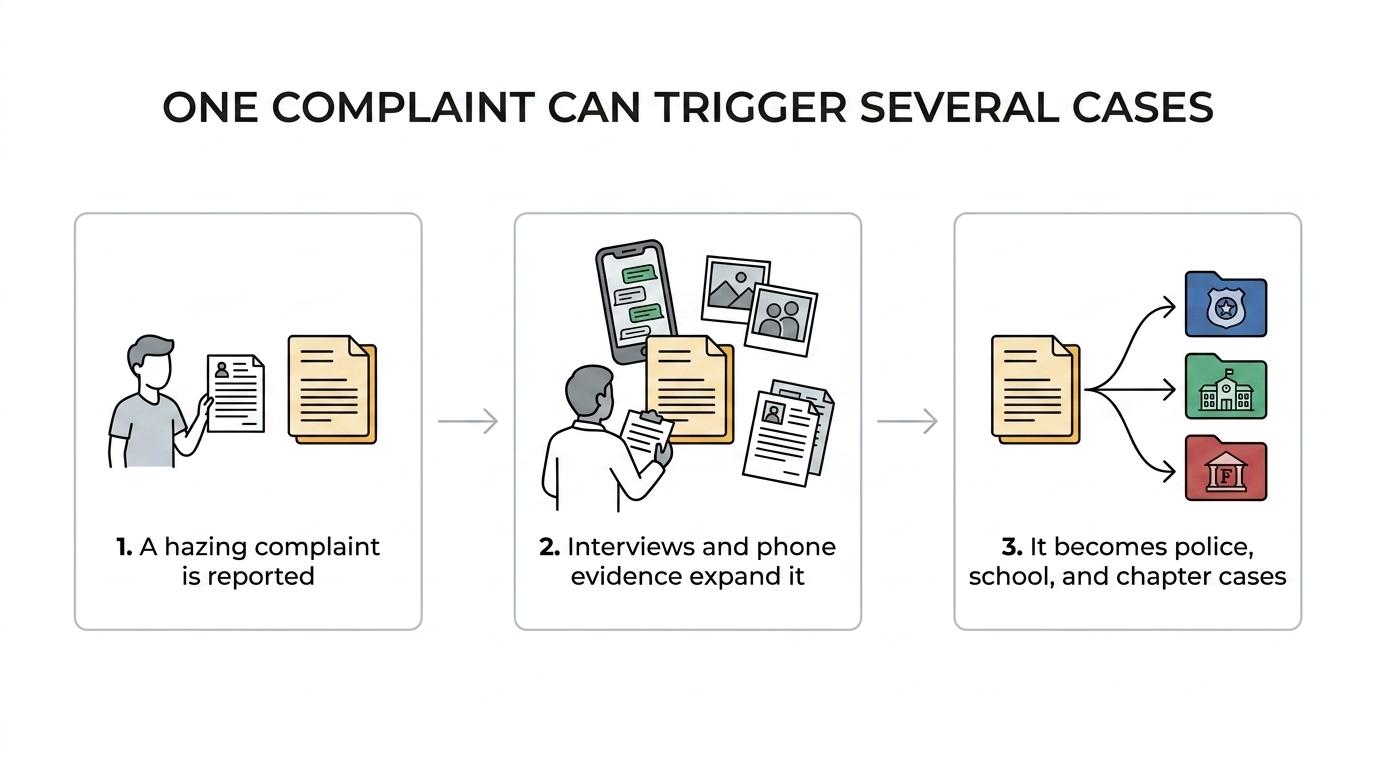
That split matters.
The campus setting makes these cases move fast. A student can be contacted while walking back from class near Beaumont Tower, leaving the library, heading past Spartan Stadium, or sitting in an apartment off Abbot Road. A parent in Okemos, Haslett, or Grand Ledge may hear about it only after police already called.
Many early investigations begin with one of these triggers:
- Emergency medical treatment
- Photos or videos on phones
- Group chat screenshots
- Anonymous reporting
- New member complaints
- Statements from roommates
- Social media posts
- A related alcohol or assault report
When police contact begins, officers may say they only want your side. They may ask whether you know certain students, attended a specific event, helped plan activities, drove anyone, collected money, or were present during initiation-related conduct. Those questions are not neutral. They are often built to pin down admissions, timing, and your role in the group.
Michigan hazing law under MCL 750.411t and what it means for MSU students
Michigan treats hazing at educational institutions as a crime under MCL 750.411t, often referred to as part of Garret’s Law. The law applies to people who attend, work for, or volunteer at an educational institution. For MSU students, that means alleged conduct tied to fraternity or sorority life can carry criminal exposure even when the people involved claim it was tradition, voluntary, or “just part of pledging.”
One of the most important points in the statute is simple: consent is not a defense. If someone agreed to take part, that does not end the case. Students get this wrong all the time. So do parents who hear, “But everyone wanted to be there.”
The penalty range can change sharply based on harm:
| Alleged result under Michigan law | Possible charge level | Exposure |
|---|---|---|
| Physical injury | Misdemeanor | Up to 93 days |
| Serious impairment of a body function | Felony | Up to 5 years |
| Death | Felony | Up to 15 years |
That range explains why police may push hard for statements early. The same event can look very different depending on what the state can prove about planning, coercion, physical effects, alcohol use, injuries, and who was responsible for what. In one case, investigators may be looking at alleged humiliation or coercive conduct. In another, they may be tying an initiation activity to hospitalization, long-term injury, or worse.
At MSU, those facts do not stay contained inside one chapter house. A complaint can affect housing, chapter recognition, student status, and whether an incident appears in a Campus Hazing Transparency Report or related university reporting process. Criminal exposure and campus fallout are separate problems, and each one can make the other worse.
What to do before talking to police about a hazing complaint at MSU
If police reach out, your first priority is not explaining yourself. Your first priority is protecting yourself.
That means slowing the situation down before you give investigators evidence they did not already have. Many students think silence makes them look guilty. It does not. It shows self-control. In a hazing investigation, a single text explanation, one “helpful” interview, or one attempt to protect a friend can give police admissions they can use later.
If an officer calls, messages you, or asks you to come in, take these steps first:
- Stay calm: Do not answer on impulse just because the number says MSU, East Lansing, or Ingham County.
- Get the basics: Ask for the officer’s name, agency, callback number, and whether they are asking you to come in voluntarily.
- Do not explain facts: No timeline, no apology, no “I was only there for part of it.”
- Do not consent to a phone search: Your device may hold texts, photos, videos, location data, and chat history that reshape the entire case.
- Save evidence: Keep texts, call logs, group chats, photos, calendars, and location information exactly as they are.
- Call defense counsel first: Early legal help can stop a bad interview from becoming the center of the case.
If police have already reached out to you or your son or daughter at MSU, act today, not after the interview is over. Early defense work often matters most before charges are filed, because that is when statements are still being gathered and decisions are still being made.
Students often ask whether it is okay to “just tell them I do not want to talk right now.” Yes. Be respectful and clear. You do not need to argue. You do not need to fill silence. You do not need to guess what police know.
Miranda warnings and custodial interrogation in MSU hazing cases
A lot of students and parents believe police must read Miranda rights before asking any question. That is not how the rule works.
Miranda warnings matter most during custodial interrogation, which means questioning while you are in custody or under restraints similar to formal arrest. If police question you in custody without proper warnings and waiver, those statements may be kept out of the prosecution’s case-in-chief. If you clearly ask for a lawyer during custodial interrogation, police are generally not allowed to restart questioning on their own.
But many hazing cases begin outside that setting.
A phone call from an investigator, a request to stop by the station, a conversation outside a residence hall, or a “voluntary” interview may happen before custody exists. Students hear no Miranda warning and assume the interview does not count. It can count a great deal. Voluntary statements can still be used. That is why “I was never read my rights” is often not the protection people think it is.
Here is the safer way to think about it: do not wait to see whether a situation turns custodial. Protect your rights before the interview starts.
Visualization: Miranda is not the main question at the start. The first question is whether you should be talking at all without counsel.
Why MSU student conduct and criminal charges must be handled as separate cases
One of the biggest mistakes in Greek life hazing matters is treating the university process as if it were the criminal case, or treating the criminal case as if it were only a campus problem. They are not the same.
MSU states that hazing is prohibited by university policy and by state law. Reports involving a crime, emergency, or imminent threat may be directed to police right away. At the same time, the university can run its own reporting, safety, and disciplinary processes. Your chapter may also face action from its council, national organization, or housing corporation. A case can grow in three directions before you ever set foot in 54B District Court.
This is why students get trapped by mixed messaging. A chapter adviser may want a written account. A university office may want a meeting. Police may ask for “just a few minutes.” A national organization may push for internal cooperation. Each request creates a new statement. Each statement can later be compared against the others.
Here is how those tracks usually differ:
| Who contacts you | What they want | Risk if you talk too soon | Smart first move |
|---|---|---|---|
| Police or investigators | Facts, admissions, digital evidence, names | Criminal exposure grows fast | Speak with defense counsel before any interview |
| MSU conduct staff | Student or organization response | Statements can be shared or used later | Get legal guidance before meetings or written responses |
| Chapter or national leadership | Internal facts, damage control | Pressure to protect the group can hurt you | Avoid group-crafted statements |
| Friends or pledge class members | Story coordination | Can look like witness influence or obstruction | Stop discussing facts in chats |
If you are a parent, this is the point to remember: a clean university explanation does not guarantee criminal safety. In some cases, it creates the criminal evidence.
Early criminal defense strategy for fraternity and sorority hazing investigations
A good early defense plan is not built around panic. It is built around control.
The first job is to lock down the facts before anyone else shapes them for you. That means identifying what actually happened, who was there, what records exist, whether medical care was involved, what police may already have, and whether your statements or your chapter’s statements created new problems. In campus-centered cases, digital evidence often matters as much as witness memory. Group messages, Snapchat content, shared albums, ride history, payment apps, and location data can all become part of the file.
The second job is to stop unforced errors. Many students make their case harder by deleting messages, trying to clean up social media, calling every friend who might talk, or agreeing to “informal” interviews that are anything but informal. Those choices can turn a defensible case into a worse one.
A strong early strategy often includes these moves:
- Preserve the record: Keep phones, screenshots, messages, event plans, and calendars intact.
- Separate your position from the chapter line: What helps the house may hurt you personally.
- Identify pressure points: Injury allegations, alcohol issues, prior complaints, and planning roles all matter.
- Screen for statement problems: One bad sentence can become the phrase quoted in court.
- Prepare for parallel proceedings: Police, MSU, and chapter action may all move on different timelines.
If your chapter event, pledge activity, retreat, or off-campus gathering is under review, getting defense counsel involved before the first formal interview can change the course of the case. Ben Hall Law helps MSU students respond early, protect their rights, and avoid the kind of admissions that prosecutors later build around.
What not to do after a hazing complaint at MSU
Students under pressure tend to do too much.
That is especially true when the complaint involves close friends, chapter officers, or older members telling everyone to “get on the same page.” Police and prosecutors know that group loyalty shapes these cases. They also know fear makes people text things they never should have written.
After a hazing allegation, avoid these moves:
- Deleting chats or photos
- Posting “your side” online
- Calling witnesses to fix details
- Returning police calls without counsel
- Turning over your phone on the spot
- Signing a written statement for the chapter
- Assuming a “voluntary” meeting is low risk
Even well-meant contact can be painted as pressure, coordination, or concealment. If you want to help yourself, stop talking about the facts in texts, DMs, and side conversations.
What parents of MSU students should do after police contact
Parents often become the real decision-makers within hours of the first call. That is normal. Your college student may be scared, embarrassed, or convinced the issue will disappear if they just sound cooperative. In East Lansing, where campus life, Greek housing, and student conduct systems overlap so closely, delay is expensive.
Start with a simple goal: protect your student from making the first big mistake.
You do not need to solve the facts that night. You do need to stop your student from giving a statement before getting legal advice. That may mean telling them not to return calls, not to attend a “quick” interview, and not to answer written questions from a chapter leader or school office until counsel can weigh the risks.
A parent response should look like this:
- Pause the panic: Your student does not need to talk just because an officer reached out.
- Preserve everything: Phones, texts, screenshots, direct messages, and calendars should stay intact.
- Stop group coordination: No chapter-wide statement drafting and no witness coaching.
- Get legal help fast: Early counsel can manage police contact and reduce avoidable damage.
If your son or daughter is at MSU and police want a statement about fraternity or sorority hazing, call for legal guidance before the next conversation happens. Waiting until after the interview often means the key evidence is already locked in.
Fraternity and sorority hazing cases can expand beyond the original complaint
One of the least appreciated parts of these investigations is how often they widen. What begins as one allegation may lead investigators to look at prior pledge activities, event planning, transportation, spending records, housing access, or injuries that nobody reported at the time. Officers may also compare statements from multiple students and look for who organized, approved, or enforced an activity.
That means the student who thinks, “I did not lay a hand on anyone,” may still face risk based on planning, participation, or alleged encouragement. The chapter officer who never attended the event may still be pulled into questions about notice, communication, or approval. The new member who thinks he or she is only a witness may end up making admissions about other conduct while trying to be helpful.
Around MSU, that kind of expansion can happen quickly because of the concentration of student housing, campus policing resources, and the speed at which photos and rumors move between East Lansing, Lansing, and nearby communities like Okemos and Haslett. What was said outside a chapter house one night can turn into interview requests from several directions by the next week.
That is why early defense work is not only about saying less. It is also about seeing the full map of risk before investigators define it for you.
Why former police and prosecutor insight matters in an MSU hazing investigation
When police look at a hazing complaint, they are not simply asking whether something happened. They are sorting people into roles. Who planned it? Who knew? Who enforced it? Who tried to hide it? Who is most likely to cooperate? Who will make admissions if approached alone?
A defense strategy built with that in mind is stronger from the start. It focuses on how statements are gathered, how reports are written, and how prosecutors decide whether to charge individuals, several members, or nobody at all. It also focuses on whether the government can actually prove the elements that matter under the statute.
Ben Hall Law approaches criminal cases with firsthand knowledge of investigations, charging decisions, and courtroom pressure. For MSU students and parents facing a hazing investigation, that experience matters most at the front end, when a case is still being built and before a careless interview becomes the centerpiece of it.
If police have contacted you, if MSU wants a meeting, or if your chapter says the matter is under review, now is the time to get a defense plan in place. A fast, disciplined response can protect your record, your future, and your position far better than a rushed explanation ever will.
FAQ about MSU hazing investigations and police interviews
Can police charge an MSU student with hazing even if the event happened off campus?
Yes. A case does not have to happen inside a residence hall or on university property to create criminal exposure. If the alleged conduct involves students and fits Michigan’s hazing law, off-campus locations in East Lansing, Lansing, or elsewhere can still be part of the investigation.
If the new member agreed to the activity, does that end the case?
No. Under Michigan law, consent is not a defense to hazing. Students often assume that willingness or tradition settles the issue. It does not.
Should my student go to the interview just to hear what police want?
That is usually a bad idea without legal advice first. Investigators may say the meeting is informal or voluntary, but the purpose is still to gather statements and evidence. Once your student talks, the damage may be hard to undo.
What if police already got a statement from another student?
You still should not rush to give one. Police commonly use “someone else already talked” as a pressure tool. That does not mean you should fill in gaps, correct details, or defend the chapter on your own.
Do Miranda warnings have to be read before every police question?
No. Miranda warnings generally matter during custodial interrogation, not every contact with law enforcement. A voluntary interview or phone call may still produce usable statements even without warnings.
Can MSU discipline a student or chapter even if no criminal charge is filed?
Yes. University and chapter processes are separate from the criminal case. A student or organization can face campus consequences even if prosecutors do not file charges, and the reverse can also happen.
Should students delete old group chats if they contain embarrassing jokes or event planning?
No. Deleting evidence can create a much bigger problem. Preserve phones, messages, photos, and social media content exactly as they are, then get legal advice about how to respond.
What is the smartest first move for parents after police contact?
The smartest first move is to stop the interview from happening before counsel is involved. Get the officer’s name and agency, preserve all digital evidence, and speak with a criminal defense lawyer who handles MSU-related cases before your student says anything more.