

Published: June 2, 2026
By: Ben Hall | Attorney and Owner of Ben Hall Law | Marine Corps and Iraq War Veteran | Former Police Officer | Former Prosecutor
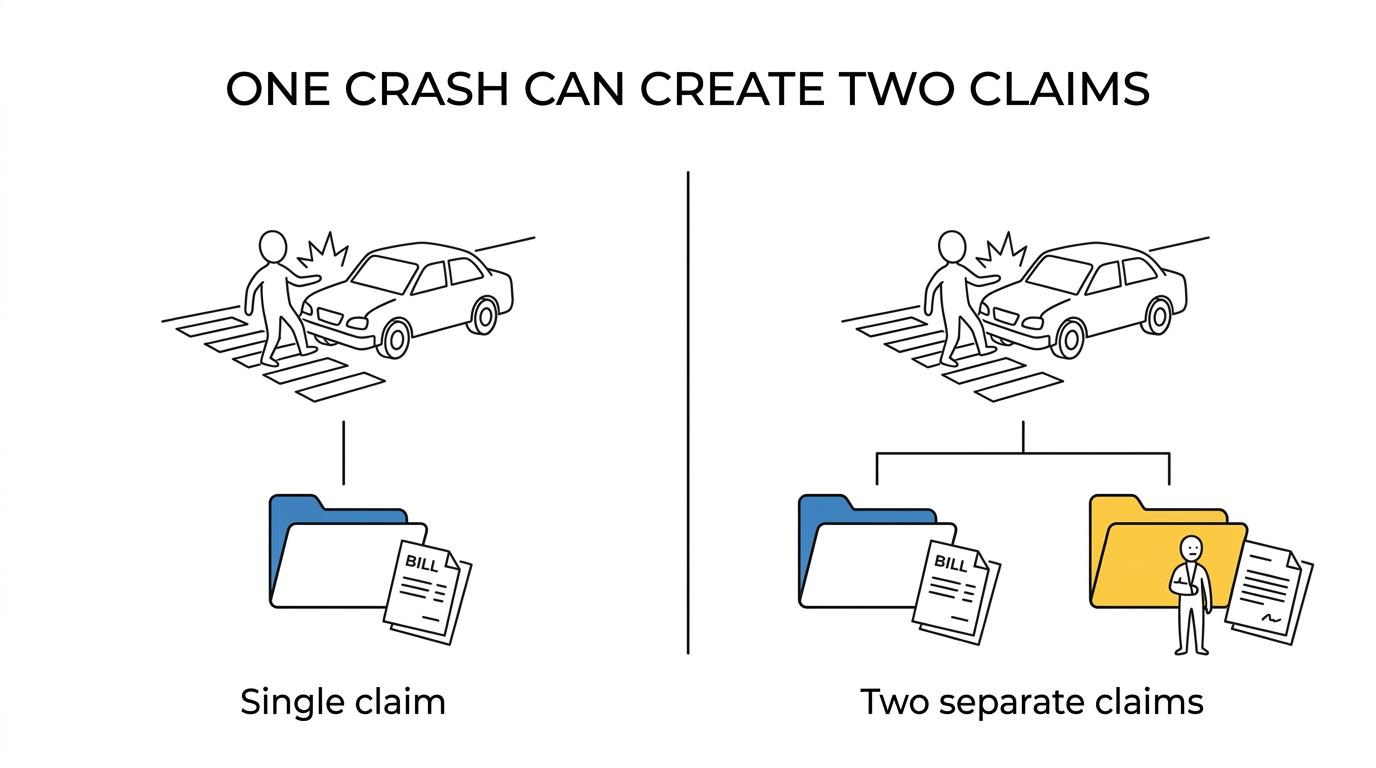
If you are an MSU student who was hit by a car while walking in East Lansing, or you are a parent trying to figure out what happens next, the short answer is yes: you may be able to recover damages. In Michigan, that often means two separate paths. One path involves no-fault benefits that can help with medical care and other covered losses. The second path may involve a claim for pain and suffering if the injuries meet Michigan’s legal threshold for a serious impairment of body function.
That distinction matters around Michigan State University because pedestrian crashes near campus are rarely minor. Students cross busy corridors every day near Grand River Avenue, Farm Lane, Shaw Lane, Harrison Road, Bogue Street, Hagadorn Road, and the downtown East Lansing blocks around M.A.C. Avenue. You are dealing with dense foot traffic, buses, rideshares, bikes, late-night visibility issues, and drivers who may be distracted or unfamiliar with student-heavy crossings.
Parents usually want a clear answer right away: Will insurance cover this, and can my student bring a claim? Students usually want a different answer first: Am I going to be stuck with medical bills, miss class, or lose my independence for the semester? Both questions are fair. Both need real answers fast.
Need help right now after a pedestrian crash near MSU? If you or your student was hit near campus, downtown East Lansing, Cedar Village, or a student apartment area, contact Ben Hall Law for a free case review and immediate guidance on the next step.

Why MSU pedestrian accidents often cause serious injuries
Pedestrian crashes are different from many other traffic cases because your body absorbs the impact. According to the Michigan State Police, more than 80% of the time a pedestrian struck by a vehicle is killed or seriously injured. The same agency reports that Michigan had 2,281 pedestrians involved in 2,131 motor vehicle crashes in 2024, with 158 deaths and 1,809 injuries.
Those numbers feel even more real in a college town. At MSU, students are constantly on foot between residence halls, academic buildings, parking lots, bus stops, campus events, and downtown businesses. Walking from Wells Hall to the MSU Union, from Brody to class, from Cedar Village to Grand River restaurants, or from an apartment off Hagadorn back to campus can put you at multiple crossings in a single trip.
State data also show pedestrian crashes cluster at night and peak in October. That lines up with student life. Fall semester brings football weekends at Spartan Stadium, busy sidewalks near Beaumont Tower and the Broad Art Museum, crowded evenings downtown, and shorter daylight hours. Add rain, early ice, or a driver rushing past a crosswalk, and the risk rises fast.
Michigan drivers have specific duties around pedestrians. When traffic signals are not in place or not operating, a driver must yield the right-of-way to a pedestrian in a crosswalk when that pedestrian is on the driver’s half of the roadway, or close enough from the opposite half to be in danger. At the same time, the rule says a pedestrian cannot suddenly leave a curb or other place of safety and move into the path of a vehicle that is too close to yield. In real cases, insurers use both sides of that rule.
Michigan no-fault benefits for an injured MSU pedestrian
If you are hit by a car in Michigan, your case does not begin and end with the driver’s fault. Michigan’s no-fault system may provide Personal Injury Protection benefits, often called PIP. That can matter a lot to students because medical treatment starts long before a lawsuit resolves.
A pedestrian claim often has two tracks running at the same time. One track is the insurance claim for no-fault benefits. The other is the injury claim against the at-fault driver if the injuries are serious enough. Many students and parents are surprised by this. They assume the only question is whether the driver did something wrong. In Michigan, your claim is usually more layered than that.
This becomes even more confusing when the injured student lives in a dorm, drives a car registered somewhere else, or is still covered under a parent’s auto policy. Those policy questions need attention early because they can affect where benefits come from and how quickly bills get submitted.
| Type of recovery | What it may cover | What you should know |
|---|---|---|
| No-fault PIP benefits | Medical care and other covered no-fault losses | These benefits may be available even before fault is fully sorted out |
| Third-party injury claim | Pain and suffering and other legally allowed damages | You usually need to meet Michigan’s serious injury threshold |
| Out-of-pocket loss documentation | Co-pays, transportation costs, records tied to treatment and recovery | Good records make a big difference when insurers question losses |
Michigan’s Department of Insurance and Financial Services says PIP claims, including medical bills, are overdue if not paid within 30 days after the insurer receives satisfactory supporting documentation. That means paperwork matters. If treatment records, bills, and crash details are incomplete, the insurer may delay payment while saying it still needs more proof.
For students, this is where a case can start slipping off track. You may be trying to keep up with classes, move around campus on crutches, coordinate appointments, and answer questions from an insurer at the same time. Parents are often trying to help from another city while also sorting out policy details and medical billing.
If insurance is already asking questions, do not guess your way through it. A quick legal review can help you identify the right insurer, protect the records that matter, and stop small paperwork problems from turning into bigger claim delays.
flowchart TD
A[Pedestrian crash near MSU or East Lansing] --> B[Get medical care and report the crash]
B --> C[Open no-fault insurance claim]
B --> D[Preserve evidence of fault and injuries]
C --> E[Submit bills and supporting documentation]
D --> F[Review whether injuries meet serious impairment standard]
E --> G[Request payment of covered no-fault benefits]
F --> H[Potential claim for pain and suffering damages]
When an MSU student can seek pain and suffering damages
No-fault benefits are only part of the picture. If you want to recover noneconomic damages, which usually means pain and suffering, Michigan law requires more. Michigan court materials state that a plaintiff may recover noneconomic damages only when the person suffered death, serious impairment of body function, or permanent serious disfigurement.
For most student pedestrian cases, the key issue is serious impairment of body function. Michigan court materials describe that as an objectively manifested impairment of an important body function that affects your general ability to lead a normal life.
That phrase can sound abstract until you apply it to campus life.
If a crash leaves you unable to walk to class, carry a backpack, stand through labs, practice with a club sport, work your campus job, or live independently in a third-floor apartment, the effect on your normal life may be significant. If you miss a semester, need surgery, use a brace, struggle with a traumatic brain injury, or cannot return to your previous routine, those facts may support a claim beyond no-fault benefits.
The insurance company will not take your word for it. It will look for records. It will compare pre-injury life with post-injury limits. It may review class attendance records, medical imaging, physical therapy notes, work schedules, and statements from people who saw the change in your daily life.
Crosswalk facts also matter. A student hit in a marked crosswalk near Grand River, Abbot, or a residence hall entrance may have a stronger liability picture than someone crossing mid-block in a poorly lit area. That said, every case turns on details. Camera footage, witness accounts, skid marks, vehicle speed, weather, traffic signals, and sight lines can all change how fault is viewed.
What to do after a pedestrian accident near Michigan State University
The first hours after a crash are chaotic. You may be in pain, embarrassed, scared, or convinced that you are “probably fine.” Do not minimize what happened. Pedestrian injuries often get worse after the adrenaline fades.
The smartest next steps are practical and immediate.
- Get medical care first: Go to the ER, urgent care, or a physician as soon as possible, especially if you hit your head, back, hips, knees, or shoulders.
- Report the crash: Depending on where it happened, MSU Police, East Lansing Police, or another agency may respond. Make sure there is a report.
- Photograph the scene: Capture the crosswalk, curb, traffic signal, vehicle position, lighting, weather, and your visible injuries.
- Identify witnesses: Students, bus riders, delivery drivers, and nearby business employees often leave quickly unless someone gets their contact information.
- Do not give a polished statement to the insurer: Basic notice is one thing. A recorded statement without preparation is something else.
- Save everything: Medical records, class absence emails, rides to appointments, prescriptions, and damaged clothing all help tell the story of the crash.
If you are on campus when it happens, use the resources around you. MSU says campus safety services include late-night transport, 24-hour emergency telephones, lighted pathways and sidewalks, and controlled residence hall access. Those systems are designed for safety, but they may also help confirm time, place, and conditions after an incident. If your crash happened near a blue-light phone, residence hall entrance, parking structure, CATA stop, or a heavily monitored corridor, there may be useful footage or logs.
Parents should also know that MSU says parents and guardians can subscribe to MSU Alerts for emergency notifications. While those alerts do not replace a crash report, they are part of the broader campus safety picture and can help families stay informed when serious incidents affect the area around campus.
Evidence that helps an MSU pedestrian injury claim
Strong claims are built on details, not assumptions. That is especially true when the defense says the student was distracted, crossed outside the crosswalk, wore dark clothing, or stepped into traffic too quickly.
The good news is that East Lansing and campus areas often produce more evidence than people expect. Businesses on Grand River, apartment complexes near student corridors, residence halls, parking ramps, buses, and university facilities may all capture part of the event or the moments right after it.
Useful evidence often includes:
- Crosswalk photos
- Traffic signal timing
- CATA bus camera footage
- Residence hall or business surveillance
- Cell phone photos taken by friends
- Torn clothing and damaged backpack contents
- ER records from University of Michigan Health-Sparrow or nearby providers
- Class absence records
- Text messages sent right after the crash
A good file also shows how the injury changed your routine. That may include withdrawal from classes, limits on walking from Brody to academic buildings, missed shifts at a restaurant on Grand River, or canceled plans around campus events like football weekends, club meetings, or intramural games.
The earlier you act, the easier it is to preserve proof. Video gets deleted. Witnesses graduate, move, or forget details. If your student was hit near MSU, ask for a case review before key evidence disappears.
East Lansing and MSU locations where pedestrian crashes raise extra concerns
Not every campus road creates the same risk. Some spots combine heavy foot traffic, turning vehicles, bus activity, poor night visibility, and the stop-and-go pressure of class changes. Around MSU, that often means the most dangerous areas are not remote roads. They are the places students use every day.
Grand River Avenue is the obvious example. Students move between campus and downtown East Lansing nonstop, often near restaurants, coffee shops, apartments, parking areas, and rideshare pickup points. Add M.A.C. Avenue and Abbot Road to that mix, and you get dense vehicle movement with pedestrians who are often in a hurry.
On campus, corridors around Farm Lane, Bogue Street, Harrison Road, Shaw Lane, Wilson Road, Trowbridge Road, and Hagadorn Road deserve close attention. The same goes for routes near the MSU Union, Beaumont Tower, Wells Hall, the Breslin Center, Spartan Stadium, and residence hall zones with evening foot traffic. When classes let out or events end, the volume changes quickly.
The Red Cedar River cuts through campus, and the connected paths and roads can create awkward crossings where visibility and driver expectation do not match pedestrian behavior. During winter, snowbanks, slush, and early darkness can make a familiar crossing far less safe than it looks on a sunny afternoon.
Michigan’s Department of Transportation says not crossing at an intersection is the deadliest action pedestrians take before a crash and accounts for 34% of pedestrian fatalities. That does not mean every non-intersection crash is legally unwinnable. It does mean the defense will look hard at where the student crossed, what the driver could see, and how much time either person had to react.
What parents should know after your student is hit near campus
If you are a parent getting this call, you are probably trying to do four things at once: make sure your student is safe, find out who has the insurance information, sort out medical care, and figure out whether you need a lawyer. That reaction is normal.
Your role matters because students often do not know what records to keep, what insurer is responsible, or how to describe the impact of the injury on school and daily life. A parent can help organize treatment records, gather policy information, preserve receipts, and keep the claim moving while the student focuses on recovery.
What parents should focus on first:
- Medical follow-up: Make sure your student keeps appointments and reports all symptoms, including headaches, dizziness, pain with walking, and sleep problems.
- Insurance paperwork: Keep every letter, claim number, bill, and explanation of benefits in one place.
- School impact: Save emails with professors, disability accommodation requests, dropped classes, and missed exams.
- Daily life changes: Track the help your student now needs with transportation, errands, stairs, and basic routines.
- Early legal review: A short consultation can answer who should be paying benefits and whether the facts support a third-party claim.
MSU’s campus safety system can also matter in indirect ways. If a crash happened on or near campus, there may be police involvement, emergency-notification records, transportation resources, or location data tied to the event. Those items will not prove every case by themselves, but they can help frame what happened and when.
Parents do not need to sort this out alone from another city or state. If your student was struck near MSU, Ben Hall Law can review the facts, explain the insurance issues in plain language, and help protect the claim before avoidable mistakes set it back.
FAQ about MSU pedestrian accident claims
Can an MSU student recover damages even if the crash happened off campus?
Yes. A student’s right to pursue a claim does not depend only on whether the crash happened on campus property. Many serious pedestrian crashes happen just off campus in East Lansing, especially near Grand River Avenue, M.A.C. Avenue, Abbot Road, and student housing areas. What matters most is the insurance picture, the facts of the crash, and the extent of the injuries.
Does being in a crosswalk make the case easier?
Often, yes. A crosswalk can make liability clearer because Michigan rules require drivers to yield to pedestrians in many crosswalk situations when signals are not in place or not operating. Still, the full picture matters. Vehicle speed, lighting, signal status, witness statements, and video footage can all affect the claim.
What if the driver says the student stepped out suddenly?
That is a common defense. Michigan’s pedestrian rule says a person cannot suddenly leave a curb or place of safety and move into the path of a vehicle that is too close to yield. This is exactly why scene photos, timing evidence, witness accounts, and video are so valuable.
Can you recover pain and suffering after a pedestrian accident in Michigan?
Yes, but not in every case. To recover noneconomic damages in Michigan, the injury must meet the legal threshold. In many pedestrian claims, that means showing a serious impairment of body function that affects your general ability to live your normal life.
Will no-fault insurance pay medical bills right away?
It should pay covered benefits once the insurer receives satisfactory supporting documentation. Michigan DIFS says PIP claims, including medical bills, are overdue if not paid within 30 days after that documentation is received. Delays often happen when insurers say the paperwork is incomplete or the policy issues are still being reviewed.
What if the student was hit at night after leaving downtown East Lansing?
That does not block a claim. Nighttime crashes are a serious issue in Michigan pedestrian data, and they are common in student areas. The case will likely focus on lighting, visibility, driver attention, speed, the crossing location, and whether there were witnesses or cameras nearby.
Should a student talk to the driver’s insurance company?
Be careful. You may need to report the claim, but a detailed recorded statement can create problems if you do it before you know the full extent of the injuries or the key facts. Students often minimize pain or guess about details while still in shock. A lawyer can help protect against that.
What if the student initially thought they were okay but felt worse the next day?
That happens often in pedestrian crashes. Adrenaline can hide symptoms. Get medical care as soon as possible and make sure the new symptoms are documented. Delayed treatment gives insurers room to argue that the injury was minor or came from something else.
When should you contact a lawyer after an MSU pedestrian accident?
Sooner is better. Early action can help preserve camera footage, witness information, and insurance records. It can also help you sort out no-fault benefits while the student is still trying to return to class, work, and daily life.