By: Ben Hall | Attorney and Owner of Ben Hall Law | Marine Corps and Iraq War Veteran | Former Police Officer | Former Prosecutor
Published: July 8, 2026
If you ride a bike in East Lansing, you already know how quickly a normal trip can turn tense. One minute you are heading down Grand River Avenue toward Michigan State University, crossing MAC Avenue near downtown, or cutting through campus by the Red Cedar River. The next, a driver turns across your lane, opens a door into your path, or passes far too close.
When that happens, the legal questions pile up fast. Who pays your medical bills? Does Michigan no-fault cover you even though you were on a bicycle, not inside a car? Can you still bring a claim against the driver? What if you are an MSU student from out of state and the insurance policy is in a parent’s name?
Those questions matter because bicycle crashes in East Lansing are different from many other injury cases. You have a city built around a major university, dense traffic near student housing, busy crosswalks, CATA buses, food delivery vehicles, rideshare traffic, and a lot of people moving between campus, apartments, and downtown on two wheels. Add Michigan’s unusual no-fault system, and you are dealing with a set of rules that can feel confusing right when you need answers most.
This page gives you a clear look at how Michigan no-fault usually applies when a motor vehicle hits a bicyclist in East Lansing, what student riders should watch for, and what steps can protect your claim from day one.
If you were hurt in an East Lansing bicycle crash involving a car, truck, SUV, bus, or rideshare vehicle, do not assume the insurance system will sort itself out. A quick review of the facts and the available policies can make a major difference early in the case.
flowchart TD
    A[East Lansing bicycle crash] --> B{Did a motor vehicle contribute to the crash?}
    B -->|Yes| C[Michigan no-fault may apply]
    B -->|No| D[No-fault may not apply]
    C --> E{Is there an applicable auto policy?}
    E -->|Yes| F[PIP benefits may cover medical care and other allowed losses]
    E -->|No or unclear| G[Assigned Claims Plan may need review]
    C --> H{Are your injuries serious?}
    H -->|Yes| I[You may also have a claim against the at-fault driver]
    H -->|Not yet clear| J[Medical records and facts matter]
East Lansing bicycle crashes often happen where campus traffic and city traffic overlap
East Lansing is not just a college town. It is a place where campus streets, residential neighborhoods, and commercial corridors constantly feed into each other. That mix creates conflict points. You may have students rushing to class on Farm Lane, drivers trying to turn off Harrison Road, buses moving through Bogue Street, and delivery traffic sliding along Albert Avenue and Grand River at the same time.
That local layout matters because bike crash risk is often tied to visibility, speed, turning movements, and bad assumptions. A driver leaving a parking structure near downtown East Lansing may not expect a cyclist moving through the lane. A rider coming off a sidewalk into a crossing may be hard for a turning driver to see. Near Spartan Stadium, the Breslin Center, or student apartment blocks west of campus, traffic patterns can shift fast around events, move-in days, and weekends.
Michigan State Police states that bicycles on Michigan roadways have the same rights and responsibilities as motor vehicles. The same source says motorists must leave bicyclists at least 3 feet of space when passing, and bicyclists must ride with traffic and follow the rules of the road. Those are not casual safety tips. They can become key fault issues after a crash.
Some East Lansing trouble spots come up again and again because they combine heavy traffic, turning vehicles, and frequent bike use.
- Grand River Avenue near campus crossings
- Bogue Street by the Red Cedar River
- Farm Lane and Auditorium Road
- Abbot Road and downtown East Lansing
- MAC Avenue and Albert Avenue
- Apartment-heavy corridors near Hagadorn Road
Michigan State University has also reported a striking fact: about 90% of bicycle crashes on campus happen on sidewalks. That should get your attention whether you are a student or a local resident who rides through campus. MSU has invested in bike infrastructure, including 20.5 miles of on-street bicycle lanes, two secure bike parking facilities, and eight do-it-yourself repair and air stations. Even with that setup, sidewalk riding remains a major crash pattern on campus.
pie title Reported MSU Bicycle Crash Pattern on Campus
    "Sidewalk crashes" : 90
    "Other locations" : 10
That sidewalk-heavy pattern matters for both safety and liability. If a crash happened on or near an MSU sidewalk, the insurance company may try to argue that you were outside the expected traffic flow, harder to see, or partly at fault. That does not end your case. It does mean the scene, the sight lines, and the precise movement of both you and the driver become very important.
Michigan no-fault insurance for East Lansing bicyclists hit by motor vehicles
Michigan no-fault does not only matter when two cars collide. If you are riding a bicycle and a motor vehicle hits you, Personal Injury Protection, often called PIP, may be available. The Michigan Department of Insurance and Financial Services explains that a mandatory Michigan no-fault policy includes three parts: Personal Injury Protection, Property Protection Insurance, and Residual Liability Insurance.
For injured bicyclists, PIP is usually the starting point. DIFS explains that the PIP portion pays for necessary care if a person is hurt in an auto accident. If your bike crash involved a motor vehicle, no-fault may cover medical treatment and other allowed losses under the applicable policy. That can matter right away if you need emergency care, imaging, follow-up visits, rehab, or ongoing treatment.
This is the part that surprises many riders in East Lansing: you do not need to have been driving a car to trigger no-fault. If a motor vehicle caused the crash, the system may still apply to you as the bicyclist.
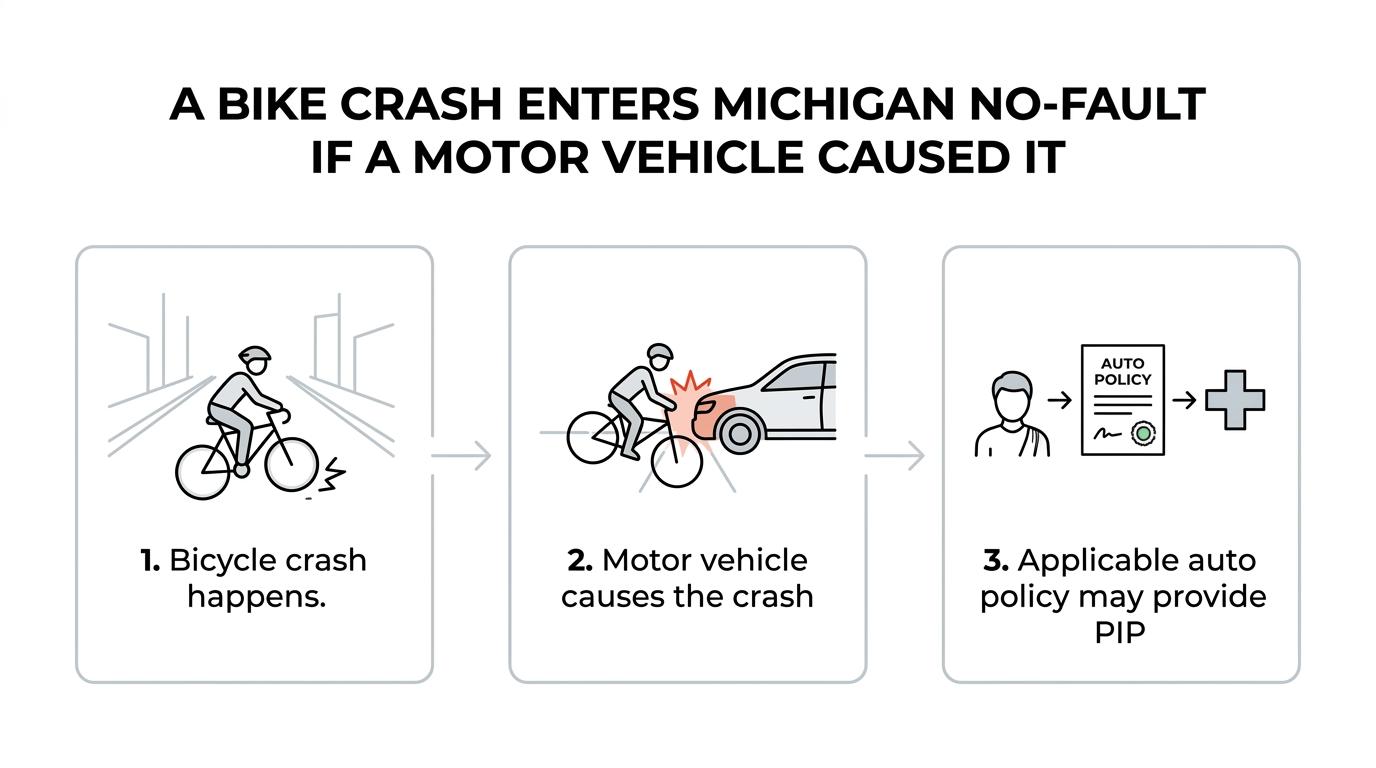
The table below gives you a practical way to think about the main claim types that may come up after a bicycle crash involving a motor vehicle.
| Claim type |
What it may pay |
When it usually applies |
Main issue |
| PIP no-fault claim |
Medical care and other allowed no-fault benefits |
A motor vehicle was involved in the bicycle crash |
Which policy applies and what PIP level exists |
| Third-party injury claim against driver |
Pain and suffering, excess economic loss in some cases |
The driver was at fault and your injuries meet Michigan’s legal threshold |
Proving fault and serious impairment |
| Property damage claim |
Bike damage, gear, phone, helmet, other property losses |
Another party is legally responsible |
Value of the property and proof of loss |
| Health insurance claim |
Medical care subject to your health plan terms |
Often used along with or after no-fault issues are sorted out |
Coordination of benefits and reimbursement issues |
Michigan’s no-fault reform also changed the PIP medical coverage options that drivers may choose. DIFS says there are six PIP medical coverage levels and that the chosen level is the most an auto insurer will pay per person per accident for covered expenses. That point can affect bicyclists too. If your applicable no-fault policy has reduced or limited PIP medical coverage, that policy choice can shape the benefits available after the crash.
When Michigan no-fault benefits apply after a bicycle crash in Michigan
The biggest question is often simple: does no-fault apply at all?
The short answer is that no-fault usually comes into play when your bicycle crash involves a motor vehicle. That includes many collisions with cars, pickups, SUVs, vans, buses, and commercial vehicles. It can also include situations where the vehicle did not fully run you over but still caused the impact or forced evasive action that led to injury. The exact facts matter.
What no-fault does not automatically cover is every bicycle injury of every kind. If you fall because of a pothole, wipe out on your own, or collide only with another cyclist, the no-fault system may not be your main path for coverage. You may be looking at health insurance, premises liability issues, road defect issues, or another route entirely.
A good way to separate these cases is to ask whether a motor vehicle was actively involved in causing the crash.
- Usually yes: A car turns left across your path on Grand River Avenue.
- Usually yes: A driver passes too closely and clips your handlebars.
- Usually yes: A rideshare vehicle pulls to the curb near campus and you strike the opened door.
- Maybe, depending on facts: A motorist forces you off the road without direct contact.
- Usually no: You crash after hitting a curb with no motor vehicle involvement.
- Usually no: You collide only with another bicycle or a pedestrian.
This is where many people make a costly mistake. They assume that if the driver’s insurer has not called, or if the police report is vague, there is no no-fault claim to open. That is not a safe assumption. Early case review can identify whether there is an applicable auto policy, whether notice needs to be given quickly, and whether the facts support both a PIP claim and a fault-based injury claim.
East Lansing students and local residents face different no-fault insurance questions
If you are an MSU student, your insurance picture may be less obvious than you think. You may not own a car. You may be insured under a parent’s Michigan auto policy. You may be from Illinois, Ohio, New Jersey, or another state and living in East Lansing only during the school year. You may have health insurance through a parent, your own job, or the university, while the auto policy sits in someone else’s name.
That can make the first few days after a bicycle crash messy. You need to identify all potential insurance sources, but you also need to avoid giving conflicting statements before the coverage picture is clear. Students often wait because they are worried about cost, class schedules, parents, or whether the injury is “bad enough.” That delay can hurt.
Local residents usually have a different problem. You may have your own Michigan auto policy, but you may not remember what PIP level you selected during no-fault reform. Some drivers chose unlimited PIP medical. Others chose capped amounts. Some coordinated medical coverage or made other policy elections. Those choices can matter when you are the injured cyclist.
If you are a student, a parent of a student, or a Mid-Michigan resident trying to sort out a bicycle crash claim, getting the insurance side mapped out early can save weeks of confusion and help protect your right to benefits.
East Lansing bicycle crashes near Michigan State University raise special liability questions
Campus-adjacent crashes often involve more than one layer of facts. A collision near a dorm, parking ramp, student apartment tower, or CATA stop may involve private cameras, university-area traffic controls, and witnesses who leave quickly. If the crash happened near Farm Lane, Shaw Lane, Bogue Street, or a protected bicycle path, the exact location may shape both liability analysis and insurance arguments.
MSU’s own safety messaging is useful here because it reflects a real local pattern. With sidewalks accounting for about 90% of bicycle crashes on campus, insurers and defense lawyers know those facts. If you were riding on a sidewalk, expect questions. You still may have a strong claim, especially if a driver failed to yield, turned carelessly, or violated the 3-foot passing rule. But your case will benefit from prompt scene documentation.
Who pays first under Michigan no-fault after a bicycle collision
Michigan no-fault has a priority system. In plain English, that means the law has rules about which insurer is supposed to pay first. For bicyclists, the order can become technical fast, especially if you do not own a car or if several households and policies are involved.
In many East Lansing bicycle cases, the review starts with the injured rider’s own auto insurance or a policy available through the rider’s household. If there is no obvious policy there, the focus may shift to the insurer connected to the involved motor vehicle or, in some situations, the Assigned Claims Plan.
A practical starting point often looks like this:
- Your own auto policy: If you have Michigan no-fault coverage, that may be the first place to check.
- A household family policy: If you live with a spouse or resident relative who has an applicable auto policy, that policy may matter.
- The insurer for the involved motor vehicle: If no personal or household policy applies, the vehicle’s insurer may come into play.
- Assigned Claims Plan: If no applicable policy can be found, another route may exist, though eligibility and benefit issues need close review.
This is one of the most common pressure points in student cases. A student may say, “I do not have car insurance,” but still have access to a policy through a parent or household arrangement depending on the facts. A local renter may have recently moved and not realize the address issue affects the insurer’s position. A driver’s insurer may point somewhere else and delay the file. That is why coverage review needs to happen early, not after the medical bills stack up.
What compensation may be available beyond PIP benefits after an East Lansing bicycle crash
No-fault is often the first chapter, not the whole book.
PIP benefits can help with immediate losses tied to the crash, but they do not replace every category of harm. If a driver was at fault and your injuries meet Michigan’s legal threshold, you may also have a third-party claim for pain and suffering. In Michigan, that usually means proving a serious impairment of body function, a permanent serious disfigurement, or death.
For a bicyclist, that threshold issue can be very real even when there are no broken bones at the scene. A concussion, shoulder injury, knee injury, pelvic injury, nerve symptoms, or back injury can disrupt school, work, exercise, and daily life for months. What matters is not only the diagnosis on day one, but how the injury affects your normal life over time.
That extra claim can matter a lot if your crash happened on a busy East Lansing corridor with clear driver fault, like a bad left turn near Grand River, a dooring event by a parked vehicle near downtown, or a distracted driving collision close to campus apartments. It can also matter if a commercial vehicle was involved. Delivery vans, utility vehicles, and rideshare traffic tend to generate extra digital evidence, but they may also bring more aggressive insurance defense.
If your bicycle, helmet, phone, laptop, backpack, or other gear was damaged, those losses may also be part of the case. Save the damaged items if you can. Do not rush to repair or replace everything before you have good photos and a value record.
What to do in the first 24 hours after an East Lansing bicycle crash
What you do right away can shape the insurance claim, the fault case, and your medical record.
A lot of injured cyclists try to “shake it off,” especially students worried about class, work shifts, or not making a big deal out of it. That is risky. Adrenaline hides symptoms. Mild brain injury symptoms often show up later. So do neck, shoulder, and hip issues. If a driver’s insurer sees a long gap before treatment, it will use that gap against you.
Take these steps as soon as you can after the crash:
- Get medical care: Urgent care, ER, primary care, or another appropriate provider. Make sure the record says this was a bicycle crash involving a motor vehicle if that is what happened.
- Report the crash: Call police if possible and get the report number.
- Photograph everything: Your bike, helmet, clothing, road position, skid marks, debris, damage, and the vehicle involved.
- Identify witnesses: Names, phone numbers, student contact info, apartment staff, delivery drivers, or nearby workers who saw the crash.
- Protect your statements: Give basic facts to police, but do not guess about speed, distance, or whether you are “fine.”
- Do not discard damaged gear: Your broken helmet and bent wheel may become evidence.
- Review insurance quickly: Your policy, household policies, and the driver’s insurance information all matter.
One more point deserves emphasis. If you are contacted by an insurance adjuster within hours or days, do not assume the call is routine or harmless. The questions are often aimed at pinning down fault, injury severity, and coverage defenses before you know the full extent of your injuries.
If the crash happened near MSU, downtown East Lansing, or on a busy corridor like Grand River or Abbot Road, asking for legal guidance before a recorded statement is a smart move, not an aggressive one.
Evidence that can strengthen an East Lansing bicycle injury claim
Bike cases are won or lost on details.
You want more than a police report that says “vehicle struck bicyclist.” You want the lane position, the direction of travel, the cross street, the weather, the traffic control, the sight lines, and the statements made at the scene. If the crash happened near East Lansing businesses, student housing, a parking structure, or a university facility, there may be camera footage that disappears quickly unless someone requests it fast.
Medical records are just as important. A common defense tactic is to say the bicyclist was not badly hurt because there was no ambulance ride, no immediate fracture, or no dramatic vehicle damage. That argument falls apart when the records show a consistent timeline of symptoms, follow-up care, functional loss, and the effect on school, work, and daily living.
For students, school records can matter too. Missed labs, dropped classes, academic accommodations, and limits on walking across campus can help show how the injury affected your normal life. For local workers in Lansing, Okemos, or Haslett, wage records and job-duty limits may help establish both no-fault losses and the seriousness of the injury.
East Lansing bicycle crash evidence often disappears fast
Surveillance systems overwrite footage. Witnesses graduate, move out, or forget details. Road markings change. A damaged bike gets repaired. A phone with photos gets replaced.
That is why timing matters in these cases. The closer you get to the crash date, the easier it is to lock in the facts before they drift.
FAQ about East Lansing bicycle accidents and Michigan no-fault
Do you get no-fault benefits if a car hits you while you are riding a bike in East Lansing?
Often, yes. If a motor vehicle was involved in the crash, Michigan no-fault may provide PIP benefits through the applicable auto policy. Which policy applies depends on the facts and the available insurance.
What if you do not own a car?
You still may have access to no-fault benefits. A household family policy or the insurer for the involved motor vehicle may matter. If no policy applies, the Assigned Claims Plan may need review.
Can you sue the driver who hit you?
Yes, in many cases you may have a third-party injury claim against the at-fault driver. In Michigan, you usually need to show that your injuries meet the legal threshold for pain and suffering damages.
Does no-fault cover a solo bicycle fall?
Usually not. If no motor vehicle was involved, Michigan no-fault may not be the main source of recovery. The facts may point instead to health insurance, a property owner claim, or another legal path.
What if the crash happened on an MSU sidewalk?
You may still have a valid claim, but the location will matter. MSU has reported that many campus bicycle crashes on campus happen on sidewalks, so insurers often focus hard on rider position, visibility, and right-of-way in those cases.
Does the driver have to leave 3 feet when passing your bike?
Yes. Michigan law requires motorists to leave bicyclists at least 3 feet of space when passing on the roadway. A violation of that rule can become strong evidence in a fault case.
What if the driver says you were not riding with traffic?
That issue may affect comparative fault, but it does not automatically end your case. Michigan State Police says bicyclists must ride with traffic and follow road rules, yet many crash cases still turn on the driver’s failure to yield, poor lookout, speed, distraction, or unsafe passing.
Does no-fault pay for your damaged bicycle?
Not usually through PIP. Property damage is generally handled separately from medical and wage-related no-fault benefits. Keep photos, receipts, and repair or replacement estimates.
How long should you wait to get legal help after a bicycle crash?
As little as possible. Michigan no-fault and injury claims involve deadlines, notice issues, and evidence that can disappear quickly. Early review helps you avoid preventable mistakes.
If you are dealing with medical bills, missed work, or insurance confusion after an East Lansing bicycle crash, you do not need to sort it out alone. Ben Hall Law helps injured people in East Lansing, Lansing, Okemos, Haslett, and across Mid-Michigan take control of the process and push back when insurers try to minimize a claim.
 877-Ben-Hall