

Published: May 16, 2026
By: Ben Hall | Attorney and Owner of Ben Hall Law | Marine Corps and Iraq War Veteran | Former Police Officer | Former Prosecutor
The strength of your Michigan personal injury case is usually decided by the quality of your evidence, not by how strongly you feel that the other side was wrong. You may know exactly what happened in a crash, a fall, or another injury event. The insurance company will still look for gaps, inconsistencies, and missing proof.
That matters across Mid-Michigan, whether your injury happened near Michigan State University in East Lansing, on I-496 through downtown Lansing, along Grand River Avenue, or in a parking lot near Eastwood Towne Center, Frandor, or Lake Lansing Road. Busy roads, heavy student traffic, winter weather, and commercial trucking routes all create cases where evidence disappears fast.
If you want your claim to carry weight, you need more than a story. You need records, images, witnesses, and facts that hold up when an adjuster, defense lawyer, or jury starts asking hard questions.
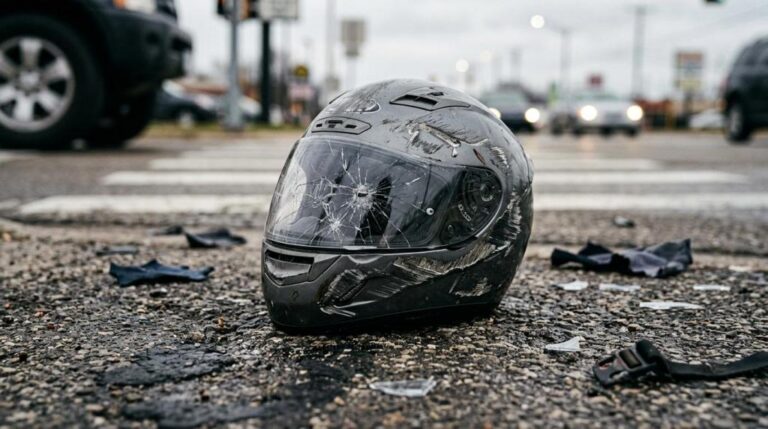
 Visual: Crash-scene evidence can include vehicle positions, road markings, traffic controls, and weather conditions.
Michigan personal injury evidence that carries the most weight
Michigan injury cases are often built from several layers of proof. One piece may show how the incident happened. Another may show what injuries you suffered. Another may show how those injuries changed your ability to work, drive, sleep, study, or care for your family.
In auto cases, Michigan law makes objective proof especially important. If you are seeking pain and suffering damages after a crash, you generally need evidence of a serious impairment of body function, permanent serious disfigurement, or death. That is why medical imaging, physician findings, treatment history, and documented restrictions often matter more than a simple statement that you are still hurting.
| Evidence type | What it helps prove | Why it matters in Michigan |
|---|---|---|
| Medical records | Injury, treatment timeline, objective findings | Strong support for serious impairment and causation |
| Photos and video | Scene conditions, damage, visible injuries, hazard presence | Often persuasive because they capture conditions close in time |
| Police or incident reports | Parties involved, location, initial observations | Useful starting point, but not always final proof |
| Witness statements | Fault, timing, conditions, post-incident behavior | Helpful when consistent and independent |
| Expert opinions | Causation, crash mechanics, future losses | Often needed when facts are disputed |
| Digital evidence | Dashcam, surveillance, black-box data, phone records | Can show speed, braking, distraction, and timing |
The strongest claims usually combine these categories. A case with ER records from Sparrow Hospital or McLaren Greater Lansing, photos from the scene, surveillance from a nearby business, and a clear treatment timeline will usually stand on firmer ground than a case built only on memory.
Michigan medical records and treatment evidence in injury claims
Medical evidence does more than show that you saw a doctor. It ties your symptoms to a timeline, documents what trained professionals observed, and gives the insurer less room to argue that your condition came from something else.
If you were hurt in a crash on US-127, in a slip and fall in Okemos, or in a store incident near Meridian Mall, your first records often become the base of the entire case. Emergency room notes, urgent care records, imaging, orthopedic evaluations, physical therapy notes, prescriptions, and specialist referrals all help tell a coherent story.
Consistency is a major issue. If your records say your neck pain began right after the collision, then your later records should make sense with that history. If there is a long gap in treatment, the insurance company may argue that your injuries were mild or unrelated.
Your medical proof is often strongest when it includes several kinds of documentation:
- Initial treatment records: ER, urgent care, ambulance, or first doctor visits
- Objective findings: X-rays, MRI results, CT scans, neurological findings, surgical notes
- Ongoing care: Physical therapy, pain management, specialist follow-up, work restrictions
- Functional impact: Notes showing limits on lifting, walking, sleeping, driving, or job duties
This is also why you should be careful about minimizing your symptoms in treatment. If you tell your doctor you are “fine” because you want to be polite or optimistic, that language can later be used to shrink your claim. You do not need drama. You need accuracy.
Michigan accident reports, photos, and video evidence after an injury
A police report matters, but it is rarely the last word.
In Lansing and East Lansing, officers may respond to crashes near the Capitol loop, Grand River, Trowbridge Road, or the busy corridors around campus. They usually do valuable work, but they often arrive after the event. That means parts of the report may rely on what drivers or witnesses said rather than on firsthand observation.
Insurance companies still pay close attention to those reports. If the report is incomplete, gets a lane position wrong, misses a witness, or fails to note debris or damage patterns, that can affect settlement value. Good photos and video can correct those problems fast.
Right after an incident, visual proof can preserve details that may be gone within hours:
- Skid marks
- Ice, water, or broken pavement
- Store floor conditions
- Vehicle crush damage
- Bruising and swelling
- Traffic lights and sightlines
Video can be even stronger. A dashcam clip, nearby business camera, apartment surveillance system, or intersection footage may show speed, lane changes, distracted driving, or exactly how a fall happened. Around shopping centers, apartment complexes, restaurants, and office buildings tied to major local employers like Auto-Owners, Jackson, or GM facilities in the Lansing area, footage may exist only for a short time before it is overwritten.
 Visual: A strong case often follows a simple chain: incident, immediate treatment, consistent care, preserved digital evidence, and documented life impact.
Michigan witness statements, expert opinions, and digital evidence
When liability is disputed, independent witnesses can change the direction of a case. A neutral driver, pedestrian, store customer, or delivery worker may have no stake in the outcome, which makes their account more persuasive than the statements of the people already in conflict.
Digital evidence has become just as important. Modern vehicles may store event data. Phones may show whether a driver was texting or moving at the time of impact. Surveillance metadata may confirm timing. In a serious case, that kind of information can do what memory cannot.
Expert analysis also becomes important when the facts are technical. A crash reconstruction professional may study damage, rest positions, roadway markings, and electronic data. A medical expert may explain why a disc injury, concussion, or shoulder tear fits the mechanics of the event. In Michigan, expert opinions need to be based on reliable methods, so solid records underneath that opinion still matter.
If your case involves disputed fault, disputed causation, or high damages, this evidence often moves the case from weak to trial-ready:
- Independent witnesses: People who saw the event and can describe it clearly
- Black-box data: Speed, braking, throttle input, and seatbelt information
- Cell phone records: Timing that may support a distraction claim
- Expert review: Reconstruction, medical causation, vocational loss, future care needs
Common Michigan personal injury evidence mistakes that can hurt your claim
A good claim can lose value quickly if you wait too long or leave gaps that the insurer can exploit. That is true whether your case arose near Lake Lansing, in downtown East Lansing, or on a snowy stretch of I-96.
Some mistakes show up again and again. People fail to photograph the scene. They do not collect witness names. They give a recorded statement before they know the full scope of their injuries. They stop treatment early. They post on social media as if the case does not exist. Then the defense uses those gaps to say the injury was minor, unrelated, or exaggerated.
You put yourself in a much stronger position when you move early and stay organized.
That usually means saving every record, every bill, every referral, and every image from the start. If you miss work, keep wage information. If you can no longer do things you used to do, track those changes in a simple journal. Your case is not just about the moment of impact. It is about the effect on your daily life.
How a Michigan personal injury lawyer uses evidence to build pressure
Strong evidence does two jobs at once. First, it helps prove your case in court if that becomes necessary. Second, it puts pressure on the insurance company before trial because the adjuster can see the file is built to withstand scrutiny.
That is why an evidence-focused approach matters. Reviewing reports line by line, preserving surveillance before it disappears, comparing witness statements to physical damage, and checking whether the medical timeline actually supports the injury claim can make a major difference. In a region like Ingham County, where student traffic, commuter routes, construction zones, and commercial travel all intersect, details decide cases.
You do not need perfect facts to bring a claim. You do need proof that is organized, credible, and ready to answer the defense when the defense starts pushing back.
FAQ about Michigan personal injury evidence
What is the most important evidence in a Michigan personal injury case?
Usually, the most important evidence is objective medical proof combined with evidence showing how the incident happened. In an auto case, records that support a serious impairment of body function can be especially important under Michigan law.
Is a police report enough to win a Michigan injury case?
No. A police report is helpful, and insurers often rely on it heavily, but it is not always conclusive. Photos, video, medical records, witness statements, and expert review may all be needed to correct or strengthen the report.
How soon should you gather evidence after an accident in Michigan?
As soon as possible. Surveillance footage may be erased, skid marks may fade, snow or ice may melt, and witnesses may become harder to find. Early action protects your case.
Can you still have a case if you were partly at fault?
Possibly, yes. Michigan uses comparative fault rules. Your share of fault can reduce your recovery, and in some cases it can affect whether you can recover noneconomic damages. That makes liability evidence especially important.
What if your injuries did not seem serious on the first day?
That happens often. Some injuries, especially soft tissue injuries, concussions, and back problems, become clearer over time. You should still seek medical care promptly and make sure your symptoms are documented accurately as they develop.
Do photos from your phone help a Michigan personal injury claim?
Yes, they can help a lot. Photos can capture vehicle damage, weather, floor conditions, traffic controls, visible injuries, and the overall scene before anything changes. Clear, time-linked images often add real value to a claim.