


Published Date: July 2, 2026
By: Ben Hall | Attorney and Owner of Ben Hall Law | Marine Corps and Iraq War Veteran | Former Police Officer | Former Prosecutor
A backyard fireworks complaint in Michigan can look minor at 9:30 p.m. and look very different by midnight.
If you live in East Lansing, Lansing, Okemos, Haslett, or anywhere across Mid-Michigan, you have probably seen how fast a neighborhood disagreement can build. One person says the fireworks are legal. Another says the noise is out of control. Someone walks across a property line. Someone records on a phone. Police arrive. By that point, the issue may no longer be about fireworks at all.
That shift matters. A Michigan fireworks dispute may stay in the lane of a local ordinance ticket or a state civil infraction. It can also turn into allegations of disorderly conduct, assault, assault and battery, trespass, or public disturbance when tempers take over. If you know where the line is, you give yourself a much better chance of staying out of court, or defending yourself effectively if charges are already pending.
Michigan fireworks laws and local ordinance rules you need to know
Michigan law gives local governments real authority over consumer fireworks, but not unlimited authority. Under the Michigan Fireworks Safety Act, a local unit of government may regulate the ignition, discharge, and use of consumer fireworks, including the hours when they may be used. That means your city, township, or village may have its own discharge hours.
There is also a limit on what a local ordinance can do during protected holiday periods. State law preserves certain windows when local ordinances cannot restrict 1.4G consumer fireworks after 11 a.m. Those windows generally include the weekend before Memorial Day, June 29 through July 4, parts of July 5 depending on the calendar and state guidance, the weekend before Labor Day, and December 31. If you assume your city can ban all fireworks all day on July 3, you may be wrong.
That does not mean anything goes.
You still cannot use consumer fireworks on public property, school property, church property, or another person’s property without express permission. Under Michigan law, that property rule is a state civil infraction, and the fine can be up to $500. Using fireworks while under the influence of alcohol or controlled substances can also be a state civil infraction, with a fine of up to $1,000.
In practical terms, your legal analysis usually starts with two questions: where were the fireworks used, and what was happening around them?
| Situation | Likely legal issue | Possible result |
|---|---|---|
| Fireworks in your own yard during a protected holiday window | Check local hours and safety rules | Possibly lawful, depending on time and ordinance |
| Fireworks after local discharge hours | Local ordinance violation or noise complaint | Citation, warning, police contact |
| Fireworks on a neighbor’s lawn or driveway without permission | State civil infraction | Fine up to $500 |
| Fireworks while intoxicated | State civil infraction | Fine up to $1,000 |
| Shouting match in the street with safety concerns | Disorderly person or public disturbance allegation | Misdemeanor exposure |
| Threats, pushing, grabbing, or swinging at someone | Assault or assault and battery allegation | Criminal charge, court date, possible arrest |
flowchart TD
    A[Fireworks complaint starts] --> B{Where were the fireworks used?}
    B -->|Your property| C{Were local hours followed?}
    B -->|Public, school, church, or neighbor property| D[Possible state civil infraction]
    C -->|Yes| E{Did the dispute stay verbal and calm?}
    C -->|No| F[Possible ordinance or noise citation]
    E -->|Yes| G[Likely stays non-criminal]
    E -->|No| H{Any threats, contact, or safety risk?}
    H -->|Yes| I[Possible disorderly conduct or assault charge]
    H -->|No| J[Police warning or report]
When a Michigan fireworks complaint stays civil and when it turns criminal
Most fireworks complaints begin with noise, smoke, debris, pets, kids, or timing. In neighborhoods near Lake Lansing, the streets around Michigan State University, downtown East Lansing, Old Town Lansing, or packed subdivisions in Meridian Township, people are close enough together that one person’s celebration can become another person’s emergency call in a hurry.
That first layer is often civil or ordinance based. A neighbor may complain that ashes landed in a pool, fireworks were lit too late, or bottle rockets crossed into a yard. Police may write a citation, document the complaint, or warn the person who set them off. If the facts stop there, you may be dealing with a local rule problem instead of a criminal case.
The problem is that people rarely stop there.
A complaint becomes riskier when the people involved stop arguing about the law and start acting on emotion. Walking into a neighbor’s yard, screaming in the street, blocking a driveway, throwing debris back over the fence, grabbing a phone, shoving someone, or stepping toward a person in a threatening way can move the case into criminal territory very quickly.
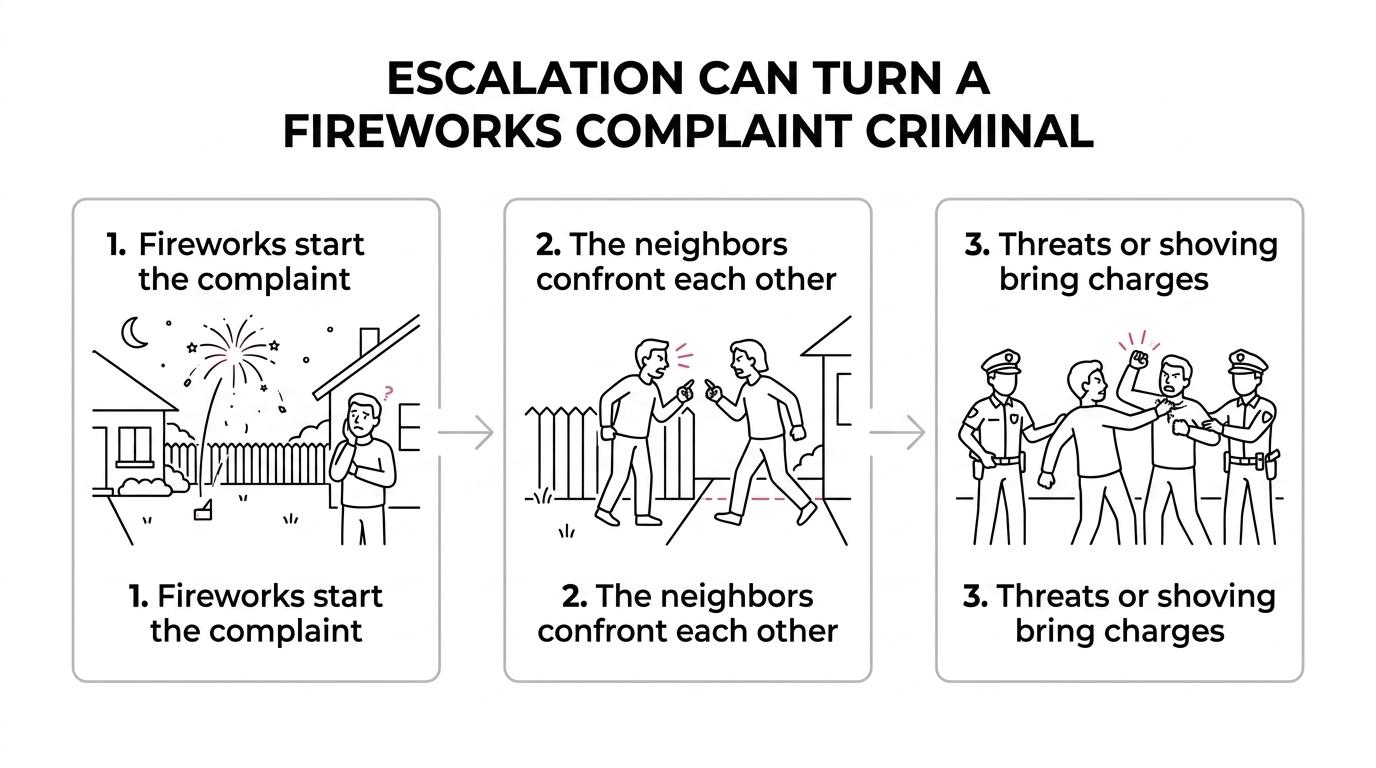
After that point, officers are not just asking whether the fireworks were legal. They are deciding whether someone became a disorderly person, caused a public disturbance, or committed assault and battery.
Here are common triggers that cause that shift:
- Late-night shouting match
- Crossing a fence line or driveway edge
- Fireworks launched toward a home
- Open alcohol use during the dispute
- Physical contact
- Kids pulled into the argument
- Ring camera or phone video capturing threats
Disorderly conduct, public disturbance, and assault in Michigan fireworks disputes
Michigan’s disorderly-person statute can come into play when conduct creates a public disturbance or endangers safety. A street argument outside an apartment complex off Grand River Avenue, a scene in a cul-de-sac in Okemos, or a drunken confrontation outside a lake house near Haslett can all be described very differently depending on the police report. If officers believe someone’s behavior became disruptive enough, a fireworks complaint can become a misdemeanor case.
That matters because disorderly conduct allegations often start with broad descriptions. “Yelling.” “Causing a scene.” “Refusing to calm down.” “Interfering.” Those phrases sound vague, but they can still support a charge when police think the conduct created a public disturbance. If alcohol is involved and safety is at risk, the exposure can rise.
Assault cases are even more common than people expect in neighbor disputes. Under Michigan law, simple assault or assault and battery is a misdemeanor punishable by up to 93 days in jail, a fine of up to $500, or both. A person does not always need a serious injury for police to make an arrest or for prosecutors to issue a charge. A shove, a grab, a swing that misses, or conduct that makes another person fear immediate physical contact can be enough to start the case.
This is where many people get caught off guard. They think, “I was defending my property,” or “I only touched him because he was in my face.” That may or may not become part of a valid defense, but it does not stop an arrest in the moment.
If you were accused after a neighborhood fireworks confrontation in East Lansing, Lansing, Okemos, or Haslett, do not assume the charge will disappear on its own. A fast legal review can make a real difference in how the case is framed from the start. Contact Ben Hall Law before you give a detailed statement or try to explain the incident away on your own.
Mid-Michigan fireworks disputes often follow a predictable pattern
Local context matters. Fireworks conflicts in Mid-Michigan are rarely random. They tend to happen in places where people live close together, traffic is tight, and summer weekends bring guests, alcohol, and later nights.
Around MSU, student rentals and duplexes can turn a small celebration into a multi-house complaint. Near Spartan Stadium, Bailey, or neighborhoods off Hagadorn and Grand River, what begins as a July holiday gathering can lead to both a police response and student conduct issues. Parents often learn about the criminal case only after the student has already talked to officers.
In Lansing, dense blocks near Frandor, REO Town, the Eastside, or neighborhoods close to the Lansing River Trail can produce repeated calls because sound carries and parking turns front yards into gathering spaces. In Meridian Township, Okemos, and Haslett, the disputes are often less about party crowds and more about proximity, children, pets, docks, decks, and who thinks a property line was crossed. In Delta Township or near large employers like GM Lansing Grand River Assembly, Auto-Owners Insurance, or Jackson National, shift work can also add tension when people are trying to sleep and fireworks continue late into the night.
Geography changes the facts, but not the legal pattern.
What officers usually look at is simple: who started the contact, who escalated it, whether anyone entered property without permission, whether intoxication was involved, and whether the scene made neighbors feel unsafe.
flowchart LR
    A[Noise or debris complaint] --> B[Neighbor confrontation]
    B --> C{People stay calm?}
    C -->|Yes| D[Warning, citation, or report]
    C -->|No| E[Property line crossed]
    E --> F{Threats or contact?}
    F -->|No| G[Possible disorderly complaint]
    F -->|Yes| H[Possible assault or assault and battery charge]
    H --> I[Arrest, arraignment, bond conditions]
What police and prosecutors often use as evidence in fireworks neighbor cases
If police are called, the case will usually turn on evidence gathered in the first hour. That evidence is often stronger than people expect. A quiet suburban block near Hawk Island, a condo complex in East Lansing, or a lakefront street near Lake Lansing may have more cameras and witnesses than you think.
Phone videos are common. Doorbell footage is common. Text messages sent during or after the argument are common. So are 911 recordings, body camera footage, social media posts, and witness statements from people who only saw the final thirty seconds but describe it as if they watched the whole event.
The details matter:
- Property location: where the fireworks were launched and where debris landed
- Timing: whether the discharge happened inside a protected holiday window or outside local hours
- Permission: whether you had express permission to be on the property
- Contact: whether anyone pushed, grabbed, blocked, or cornered another person
- Intoxication: whether alcohol or drugs were part of the scene
- Statements: what you said on the phone, to neighbors, online, and to police
In many cases, the strongest defense is not a dramatic courtroom moment. It is a careful reconstruction of what actually happened, who was where, and whether the complaint matches the video, the timeline, and the law.
What you should do if police respond to your fireworks dispute in Michigan
When officers show up, your first goal is not to win the argument on the sidewalk. Your first goal is to avoid making the situation worse.
Stay calm. Put away fireworks. Do not keep talking over your neighbor. Do not walk toward the other property owner to “show” where the line is. Do not hand over your phone and start narrating every grievance you have had since last summer. A person who seems reasonable often gets treated differently than a person who appears committed to continuing the fight.
If officers want your identification, provide it. If they ask safety-related questions, answer calmly. If they move from basic scene control into questioning that could expose you to a criminal charge, use your right to remain silent and ask for a lawyer. That is not an admission. It is smart.
Take these steps right away:
- Stop the conduct: no more fireworks, no more arguing, no more videos aimed as taunts
- Protect your words: do not guess, exaggerate, or volunteer extra facts
- Save your evidence: videos, texts, photos, timestamps, neighbor messages
- Avoid retaliation: no online posts, no fence-line comments, no return visit
- Get counsel early: a quick legal strategy can shape what happens next
If police cited you, arrested you, or told you they are sending the report to the prosecutor, reach out to Ben Hall Law promptly. Early defense work can help you protect your record, identify weak spots in the complaint, and prepare for court in 54B District Court, 54-A District Court, or 55th District Court depending on where the incident happened.
What to do if you are the neighbor making the complaint
You also need a plan if you are the person bothered by fireworks. Many people hurt their own position by confronting the other side too aggressively. That is especially true when kids are present, pets are panicking, or you are already angry because this has happened before.
Keep the issue focused on safety and location. If fireworks are being used on public property, school property, church property, or your property without express permission, that matters. If it is a nuisance or noise issue, Michigan guidance points people to local or county police, not the state fireworks complaint line, which is for illegal retail sales.
Document what you can from your own property. Record the time. Record the direction. Save debris if it landed in your yard. Avoid threats. Avoid stepping onto the other person’s property. Avoid touching anyone or blocking anyone’s path. A valid complaint can get diluted fast when both sides give police a reason to write reports.
If you believe the other person made false claims about you after a fireworks argument, get legal advice before responding in detail. A measured response beats an emotional one every time, and early counsel can help you avoid turning a bad night into a criminal record.
Michigan fireworks law issues for MSU students and parents
Students are especially vulnerable in these cases because they often think the matter is “just neighborhood drama.” It may not feel serious when everyone is still in party clothes and standing in the yard, but a student complaint can turn into a citation, an arrest, or a referral that follows the student beyond the summer.
If you are an MSU student, off-campus conduct can still affect housing, student discipline, internships, scholarships, and future job applications. If you are a parent, you should pay attention to the first call, not the first court date. By the time a case reaches 54B District Court in East Lansing, the police report is already written, witnesses may already be locked in, and the student may already have made statements that are hard to undo.
The most common student mistakes are easy to spot:
- Talking too much because they think honesty alone will fix it
- Posting videos or jokes online after the dispute
- Contacting the complaining neighbor to “clear it up”
- Ignoring a citation because it seems minor
- Forgetting that roommates and guests become witnesses
A disciplined response usually puts you in a stronger position than a reactive one.
A quick look at common fireworks dispute scenarios in Michigan
Not every dispute fits neatly into one box, but these examples show how police and courts often view them.
| Scenario | Likely issue | Why it matters |
|---|---|---|
| Fireworks set off at legal hours in your yard, but noise annoys neighbors | Complaint or warning | Being annoying is not automatically criminal |
| Fireworks fired from your driveway into the street or toward another lot | Civil infraction, ordinance issue, safety concerns | Location changes everything |
| You walk next door and scream threats over debris | Disorderly conduct or assault allegation | The argument becomes the case |
| You shove a neighbor who is filming you | Assault and battery | Physical contact can support a criminal charge |
| A friend lights fireworks while drunk at your party | State civil infraction, wider police scrutiny | Intoxication raises risk fast |
| You report illegal retail sales to the wrong agency | Delay in help | Nuisance complaints go to local or county police, not the state sales hotline |
FAQ about Michigan fireworks disputes and criminal charges
Can fireworks be legal in Michigan and still lead to a criminal case?
Yes. The fireworks themselves may be legal under state law and local timing rules, but your conduct during the dispute can still support criminal allegations. If the conflict involves threats, physical contact, public disturbance, or property entry without permission, police may focus on those actions instead of the fireworks.
Is using fireworks on a neighbor’s property always a criminal offense?
Not by itself. Using consumer fireworks on another person’s property without express permission is generally a state civil infraction under Michigan law. It can still become part of a criminal case if the facts also include trespass-type conduct, disorderly behavior, or assaultive acts.
Who should you call for a fireworks noise complaint in Michigan?
For nuisance and noise ordinance complaints, Michigan guidance directs residents to local or county police. The state fireworks complaint line is used for illegal retail sales of consumer-grade and low-impact fireworks, not ordinary neighborhood noise complaints.
Can you be charged with assault if you never punched anyone?
Yes. An assault allegation does not always require a landed punch. A shove, a grab, a swing that misses, or conduct that causes someone to fear immediate unwanted contact can lead to a charge, depending on the facts.
What if both neighbors were yelling?
Police still may decide one person escalated things further. They often look at who crossed the property line, who made threats, who touched whom first, whether anyone appeared intoxicated, and whether videos support or contradict the statements.
Do local fireworks ordinances override Michigan law on holidays?
Not entirely. Michigan law allows local governments to regulate fireworks use, including hours, but local ordinances cannot restrict consumer-fireworks use after 11 a.m. during the holiday windows preserved by statute. You should still check your city or township’s current rules because local timing outside those windows can matter a lot.
What court handles a Michigan fireworks-related misdemeanor in the Lansing area?
That depends on where the incident happened. In the greater Lansing area, cases may land in courts including 54B District Court in East Lansing, 54-A District Court in Lansing, or 55th District Court for other parts of Ingham County. The location of the incident usually controls where the case is filed.
Should you talk to the police if you know you did nothing wrong?
You should be careful. Many people believe a full explanation will clear things up, then learn that their own words filled the gaps in the police report. If the questioning may expose you to a criminal charge, it is wise to remain calm, say little, and speak with a defense lawyer first.
Get help quickly when a fireworks complaint is no longer just a complaint
A neighborhood dispute can move from “annoying” to “chargeable” in a matter of minutes. If your case involves fireworks, police contact, a citation, or allegations of disorderly conduct or assault in East Lansing, Lansing, Okemos, Haslett, or nearby communities, act early and protect your position. Ben Hall Law handles criminal cases with a trial-ready approach and a clear view of how police reports and charging decisions are made.