


Published: June 28, 2026
By: Ben Hall | Attorney and Owner of Ben Hall Law | Marine Corps and Iraq War Veteran | Former Police Officer | Former Prosecutor
If you live in Michigan, you have probably seen how fast a backyard celebration can turn into a police call. A few bottle rockets in a subdivision. Roman candles behind an apartment complex. Fireworks going off near campus housing in East Lansing, near Lake Lansing, or outside a neighborhood party in Okemos. What feels normal on the Fourth of July can still bring a ticket, a court date, or a criminal charge when the wrong facts are present.
Michigan law does allow many fireworks that were once harder to find. That does not mean everything is legal, and it definitely does not mean you can use fireworks anywhere, at any time, or in any condition. The rules depend on the type of firework, your location, your age, your sobriety, and whether you have permission to use them on the property where they are being lit.
If police contacted you after a fireworks complaint in Lansing, East Lansing, Haslett, Okemos, or anywhere in Mid-Michigan, you should treat it seriously from the start. A fireworks incident can begin as a civil infraction and still grow into something much bigger when property damage, injuries, alcohol, or a confrontation are part of the story.
Visualization: Michigan law separates fireworks into low-impact fireworks, consumer fireworks, and display fireworks, and each category is treated differently.
Michigan fireworks categories: low-impact, consumer, and display fireworks
Michigan’s Fireworks Safety Act uses category-based rules. If you want to know what is legal, start there.
Low-impact fireworks are the smaller ground and handheld sparkling devices. Consumer fireworks are the larger backyard products most people think of during July 4 celebrations, including items that leave the ground or produce stronger visual effects. Display fireworks are the professional-grade products used in permitted public shows, like the kinds you might see near Adado Riverfront Park, over Lake Michigan beach towns, or at major community events across the state.
That distinction matters because the law does not treat a sparkler like a bottle rocket, and it does not treat a bottle rocket like a city-run fireworks display.
| Fireworks category | Basic description | Typical legal use |
|---|---|---|
| Low-impact fireworks | Ground and handheld sparkling devices | Generally smaller personal-use items |
| Consumer fireworks | Backyard fireworks that create visible effects by combustion, including many items that leave the ground | Legal to buy and use if state and local rules are followed |
| Display fireworks | Professional-grade fireworks | Usually require permits, trained operators, and event-level compliance |
A simple way to think about it is this: if the product is sold for ordinary backyard use, it may still be legal in Michigan, but only if you use it in a legal place, during allowed times, and without creating a separate offense.
What fireworks are legal in Michigan and where local rules still matter
Michigan law allows the sale and use of many consumer fireworks. That is the part most people know. The part they miss is where local governments still have power.
Cities, townships, and villages generally cannot regulate the sale, display, storage, transportation, or distribution of fireworks covered by the act in the same way people often assume. State law largely preempts that area. Still, local governments can regulate the ignition, discharge, and use of consumer fireworks. That means your city can control hours and usage limits even if it cannot broadly shut down fireworks sales just because neighbors complain.
In practical terms, this matters a lot in places like East Lansing, Lansing, Meridian Township, and other Mid-Michigan communities where dense neighborhoods, student rentals, and apartment complexes lead to frequent complaints. You may be standing in a place where fireworks are sold lawfully nearby, yet your actual discharge of those fireworks may violate local rules if the date or time falls outside the allowed window.
Michigan law also protects certain holiday windows. If a local government regulates consumer fireworks use, it still has to allow use after 11 a.m. on specific holiday dates, including June 29 through July 4 until 11:45 p.m. That is why you often hear fireworks across neighborhoods near Grand River Avenue, Frandor, and suburban streets during that period even in communities with tighter general rules.
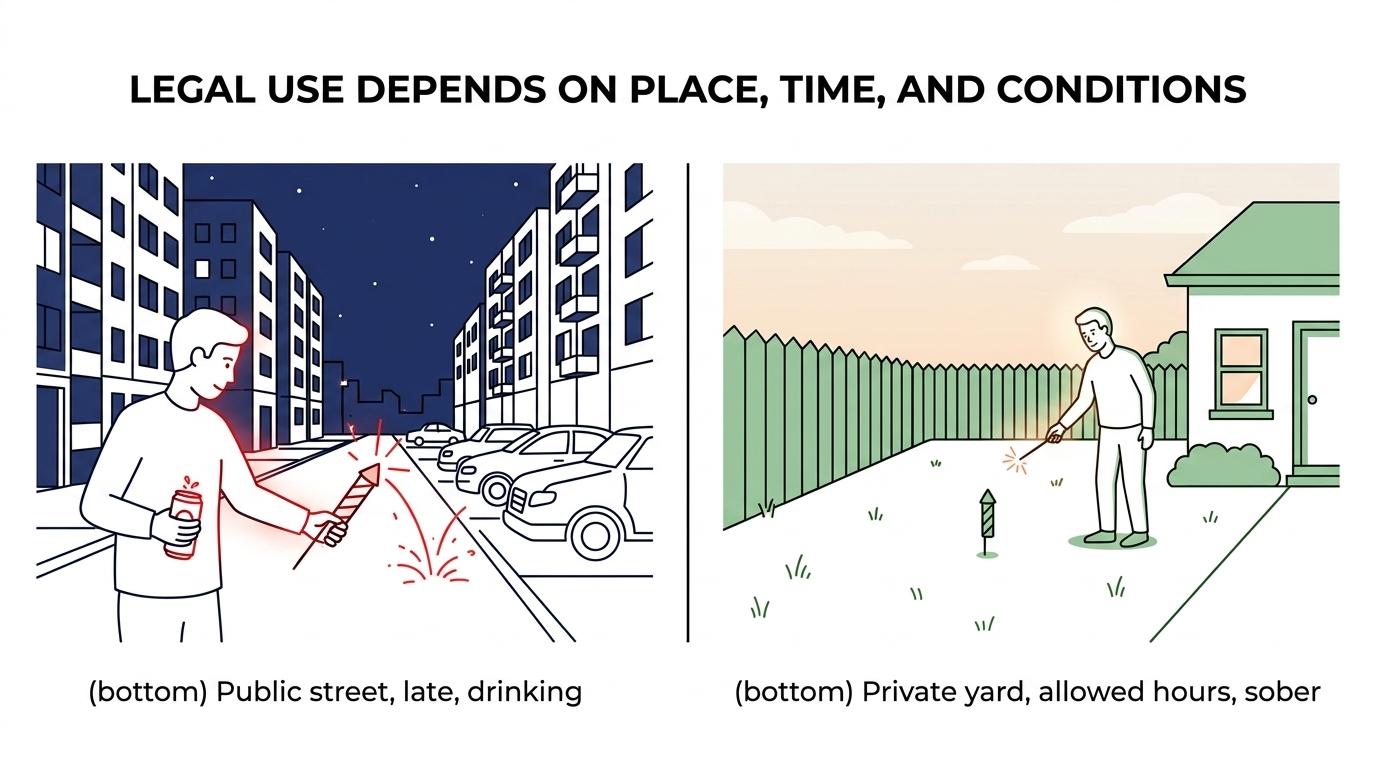
After those protected times end, the risk goes up fast.
Here are the core rules many people get wrong:
- Public property is not fair game
- School grounds are off-limits without permission
- Church property is off-limits without permission
- Your neighbor’s yard is not your launch site
- Local ignition hours still matter
What conduct gets you ticketed or charged under Michigan fireworks laws
The biggest trap in Michigan fireworks law is property use. State law says you may not ignite, discharge, or use consumer fireworks on public property, school property, church property, or another person’s property unless you have express permission.
That rule is broader than many people expect. It can apply when fireworks drift onto a neighboring lot, when a group starts launching from a parking area they do not control, or when someone uses an open field that “looks public” without realizing it is city land or school property. In East Lansing, that could mean a vacant-looking area near campus housing. In Lansing, it could mean a park-adjacent space or lot near a neighborhood event. In lake communities, it often shows up around docks, public access areas, and shoreline property lines.
A first violation of that property-permission rule is a state civil infraction with a fine of up to $500. That may sound small, but it can come with court involvement, seized fireworks, and extra problems if police believe the conduct damaged property, injured someone, or created a public safety risk.
You also cannot use consumer fireworks while under the influence of alcohol or drugs. That is one of the most common fact patterns behind fireworks-related enforcement because complaints spike late at night, often after parties, cookouts, or student gatherings. If officers arrive and think alcohol is part of the scene, the fireworks issue may become only one piece of what they investigate.
Retail and seller conduct matters too. Selling consumer fireworks to a minor is prohibited. Repeated violations can bring substantial civil penalties and a suspension of the seller’s consumer fireworks certificate.
The law also allows seizure of fireworks. If you are found guilty, responsible, or liable for a violation, you can be ordered to pay the actual costs of storage and disposal.
Common legal triggers include:
- Using fireworks on someone else’s property: Express permission is required, and a first violation can be a state civil infraction with a fine of up to $500
- Using fireworks on public, school, or church property: These locations are specifically restricted unless permission exists
- Using fireworks while intoxicated: Alcohol or drug use can turn a holiday complaint into a much more serious case
- Selling fireworks to a minor: Retailers can face steep fines and certificate consequences
- Selling without a consumer fireworks certificate: A first violation can carry a civil fine of up to $5,000, with much higher penalties for repeat conduct
If police already called you, cited you, or took fireworks from your home, car, stand, or party location, get legal advice before you explain the situation in detail. A short call early can protect you from making the case easier to prove.
Common fireworks-related criminal charges beyond the Fireworks Safety Act
A fireworks case does not always stay a fireworks case.
If a device damages a car in a parking lot near Michigan State University, cracks a window in a neighborhood off Hagadorn Road, hits a person during a block party in Lansing, or starts a grass fire near a commercial property, officers may look beyond the Fireworks Safety Act. Depending on what happened, prosecutors may [review property damage offenses, assault-related charges, reckless behavior, disorderly conduct, or fire-related crimes.](https://www.benhalllaw.com/property-crimes-defense/)
That is especially true when there is video, a named complainant, or a heated confrontation after the fireworks were lit.
 One bad decision can turn into several allegations at once.
You should also remember that student cases carry a second layer of risk. If you are an MSU student, a fireworks incident may lead to more than a court date. It can trigger housing issues, student conduct review, or pressure from a landlord if the event happened in an apartment complex, rental house, or fraternity setting near campus. A complaint near Spartan Stadium, Cedar Village, or Grand River Avenue may start with neighbors, but it often ends with police paperwork.
Some of the most common charge patterns look like this:
- Property damage: Broken windows, burned siding, damaged cars, scorched decks
- Disorderly conduct: Loud late-night behavior, fights, public disturbance, refusal to cooperate
- Assault-related conduct: Throwing or aiming fireworks at another person
- Fire-related allegations: Brush fires, garage fires, dumpster fires, or reckless ignition near structures
A prosecutor does not need to accept your view that it was “just fireworks” if the facts suggest something more dangerous.
Visualization: The legal risk rises fast when fireworks involve alcohol, someone else’s property, injuries, or retail violations.
Michigan fireworks laws for businesses, seasonal tents, and retailers
If you sell fireworks, the law is not casual about it.
A person may not sell consumer fireworks in Michigan without first obtaining and maintaining a consumer fireworks certificate from the state. That applies to permanent retailers and seasonal operations alike. A first violation for selling without that certificate can lead to a civil fine of up to $5,000, with much higher penalties for repeat violations.
This is where businesses get into trouble. Pop-up fireworks tents and seasonal sellers often focus on inventory and staffing, but the legal risk is broader. The state also uses safety and licensing standards that connect to fire code and storage rules, including standards tied to NFPA 1124. If you are selling in high-traffic areas near shopping corridors like Eastwood Towne Center, Meridian Mall, or highway retail strips outside Lansing, inspectors are not just looking at cash sales. They may also be reviewing storage, layout, separation distances, and certificate compliance.
Retailers should keep a tight grip on a few non-negotiables:
- Certificate status: Make sure your consumer fireworks certificate is active and current every season
- Age screening: Do not sell consumer fireworks to a minor
- Storage rules: Follow fire code and display requirements, not just basic common sense
- Staff training: Train employees on product categories, ID checks, and prohibited sales
- Documentation: Keep records that show you are operating within state requirements
You may also see the term fireworks safety fee in Michigan. That fee structure is part of how the state regulates the industry, and it sits in the background of the broader licensing and compliance system.
If your business was cited, inspected, or threatened with a certificate suspension, do not wait to see what happens next. Regulatory problems can grow into costly enforcement issues very quickly.
What to do if police cite you after a fireworks incident in Michigan
Your first instinct may be to explain everything on the spot. That is usually not your best move.
If an officer shows up after a complaint in East Lansing, Lansing, or a nearby township, the facts may still be developing. Neighbors may be angry. Someone may have recorded only part of the event. Police may not know who actually lit the fireworks. The more you guess, fill in gaps, or take blame for a group, the harder it becomes to defend the case later.
Use this approach instead:
- Stay calm and identify the issue: Find out whether you are being warned, cited, or investigated for a criminal offense.
- Do not volunteer broad statements: You can provide identifying information without giving a full narrative that locks you into damaging facts.
- Save evidence early: Keep videos, texts, photos of the property, proof of permission, receipts, and names of witnesses.
A small detail can change the case. Maybe you had express permission from the property owner. Maybe the fireworks were low-impact devices and not consumer fireworks. Maybe the complaint came outside the actual location where the devices were used. Maybe the person accused of lighting them was not you at all.
If your ticket or charge is headed to 54B District Court in East Lansing, a Lansing-area district court, or another Mid-Michigan court, the right defense work often starts before the first appearance.
If you want a clear read on your risk, contact Ben Hall Law for a case review. Early strategy matters when a fireworks complaint is mixed with alcohol, student discipline, injury allegations, or property damage.
Local fireworks enforcement in Lansing, East Lansing, and Mid-Michigan
Enforcement is always local, even when the statute is statewide.
That means the same fireworks box bought legally in Michigan can lead to very different results depending on where you use it. Dense student housing near Michigan State University gets quicker complaints than rural acreage. Apartment complexes in East Lansing, condos in Okemos, and neighborhoods near Lake Lansing often produce calls based on noise, safety, debris, or vehicles parked close together. In downtown Lansing or Old Town, the presence of sidewalks, public streets, and nearby businesses makes the property rule even more important.
During holiday weeks, police and fire departments are watching for predictable patterns. Fireworks launched from roadways. Devices used in parking lots after bars close. People shooting into the air from multi-family housing. Fires started in dry grass near trail systems, parks, or commercial corridors. When these incidents happen, officers are not limited to asking whether the firework itself was sold legally.
That is why local relevance matters. A student near MSU may face a different practical problem than a homeowner in Haslett. A retailer near a large shopping corridor may deal with state inspection issues that a backyard user never sees. A complaint after an event at Jackson Field or a holiday gathering by the Grand River can also involve crowd conditions, traffic, or public property restrictions.
One mistake many people make is assuming that “everyone was doing it” is a defense. It is not. Police usually act on specific complaints, specific damage, or specific safety risks. If your group became the one that drew the call, you are the one in the file.
If you are worried about a fireworks-related citation, charge, or student-linked issue in Mid-Michigan, call Ben Hall Law. You want to know whether you are facing a civil infraction, a misdemeanor risk, a property damage claim, or all three at once.
FAQ about Michigan fireworks laws
Can you legally use fireworks in your own backyard in Michigan?
Yes, sometimes. It depends on the type of fireworks, whether your city or township regulates ignition times, and whether you are using them during a permitted period. Your own property is usually the starting point, but local time restrictions still matter.
Can you light fireworks on a street, sidewalk, park, or school parking lot?
Generally, no. Michigan law prohibits igniting, discharging, or using consumer fireworks on public property, school property, church property, or another person’s property without express permission.
What does express permission mean under Michigan fireworks law?
It means real permission from the property owner or person with authority over the property. Do not assume a friend’s invitation to a party means you have authority to launch fireworks from that yard or lot. If the location is disputed later, proof matters.
Is it illegal to use fireworks while drinking in Michigan?
Yes. The state says consumer fireworks may not be used by someone under the influence of alcohol or drugs. If police arrive at a late-night party and think alcohol is involved, the legal risk rises quickly.
Can a fireworks ticket turn into criminal charges?
Yes. The fireworks issue itself may begin as a state civil infraction, but the surrounding conduct can lead to criminal exposure if there is property damage, injury, reckless behavior, a fight, or a fire.
Can stores sell fireworks to minors in Michigan?
No. Selling consumer fireworks to a minor is prohibited. Repeat seller violations can lead to significant fines and suspension of the seller’s consumer fireworks certificate.
Do Michigan cities like Lansing or East Lansing control fireworks hours?
They can regulate the ignition, discharge, and use of consumer fireworks, including hours. Still, if a local government regulates use, it must allow use after 11 a.m. on certain statutory holiday dates, including June 29 through July 4 until 11:45 p.m. Check your local ordinance for the rest of the calendar.
What court handles fireworks charges near Michigan State University?
That depends on where the incident happened. Many East Lansing matters go through 54B District Court, while nearby jurisdictions have their own district courts. The exact location of the event matters.
What should you do if fireworks were seized by police?
Do not ignore it. Seized fireworks may be stored, destroyed, or used for training under the act, and a person found responsible for a violation may have to pay the actual storage and disposal costs.
If you are facing a fireworks-related citation or charge in East Lansing, Lansing, Okemos, Haslett, or anywhere nearby, contact Ben Hall Law. A practical defense starts with the facts, the location, and what police believe happened before the report becomes the whole story.