

You go to a Michigan campground to relax, not to leave with a broken ankle, a concussion, or a child in the emergency room. Yet injuries happen every season at private campgrounds, RV parks, family resorts, and outdoor recreation properties from Silver Lake to Traverse City, from the Upper Peninsula to the Lansing area. Wet bathhouses, broken stairs, unsafe playgrounds, defective rental gear, and poorly supervised ATV traffic can turn a weekend outside into a legal and financial mess fast.
If your injury happened at a campground, your legal options depend on more than the accident itself. Michigan law draws sharp lines between paid campgrounds and free recreational land, between ordinary negligence and gross negligence, and between risks you accepted and hazards a property owner should have fixed. That is why two campground injuries that look similar at first can lead to very different outcomes.
By: Ben Hall | Attorney and Owner of Ben Hall Law | Marine Corps and Iraq War Veteran | Former Police Officer | Former Prosecutor
Published Date: July 14, 2026

Michigan campground injury claims depend on payment, property control, and duty
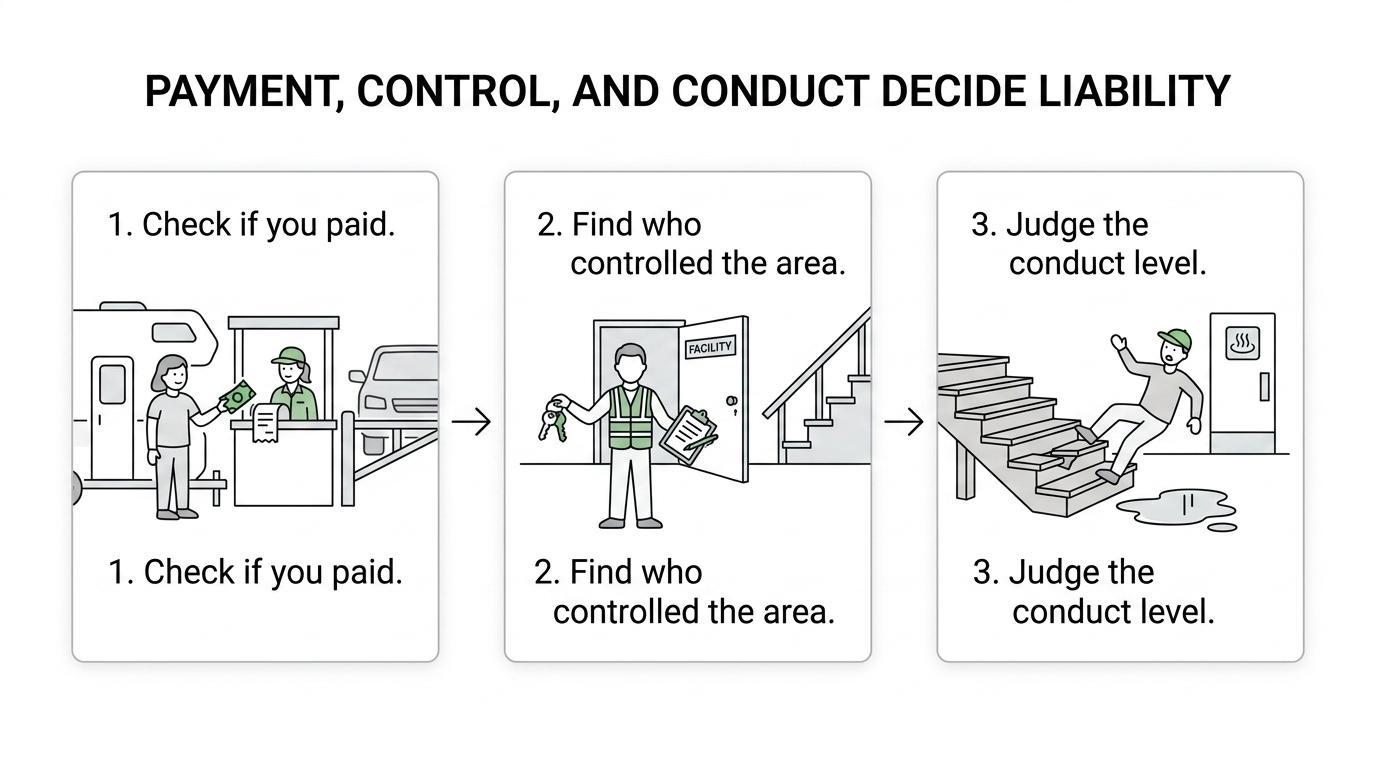
Michigan campground cases usually start with one basic question: were you on recreational land for free, or did you pay to be there?
That question matters because Michigan’s recreational land use statute, MCL 324.73301, gives landowners strong protection when a person is on another’s land without paying valuable consideration for outdoor recreation, including camping and motorcycling. If the statute applies, a person generally must prove gross negligence or willful and wanton misconduct, not simple carelessness.
That is a much tougher standard.
Many private campgrounds across Michigan charge nightly site fees, cabin rental fees, day-use fees, pool fees, or ORV access fees. Think about the kinds of places families use near Ludington, Petoskey, Higgins Lake, or the Mackinac area. When you paid to enter or stay, the recreational-use immunity issue often looks very different than it would on undeveloped land, a friend’s acreage, or free-use property.
In a paid campground setting, your case often fits into Michigan premises liability law. If you were an invitee, meaning you were on the property for the operator’s business purpose, the possessor of the land generally owes a duty of reasonable care to protect you from unreasonable risks caused by dangerous conditions on the land. The fight then turns to what the operator knew, what the operator should have known, and what reasonable steps were taken to inspect, repair, warn, or block access.
The facts that move these cases most often are straightforward:
- Payment status: Whether you paid a campsite fee, gate fee, cabin fee, rental fee, or event fee
- Property control: Who owned, leased, staffed, maintained, or inspected the area
- Hazard type: A natural outdoor condition versus a fixable defect or man-made danger
- Conduct level: Ordinary negligence versus gross negligence or willful and wanton misconduct
- Witness statements
- Incident reports
- Surveillance footage
If you are already hearing that “camping is risky” or “you assumed the risk,” do not stop your analysis there. Those arguments come up often, but they are not the end of the case.
Slip and fall injuries at Michigan campground facilities can support a premises liability claim
Some campground injuries happen on trails or uneven natural terrain. Others happen in places the operator built, opened to guests, and had every reason to inspect.
That second category matters.
Slip and falls at Michigan campgrounds often happen in bathhouses, shower rooms, concrete pool decks, camp stores, office entrances, laundry buildings, docks, footbridges, cabin porches, and stair systems leading to waterfront sites. In northern Michigan, where weather shifts quickly and pine needles, mud, and rain collect fast, poor maintenance can turn ordinary foot traffic into a real hazard. In the Upper Peninsula, where moss, wood rot, and long wet seasons affect outdoor surfaces, the same issue shows up in different form.
A few common examples include a missing anti-slip surface in a shower area, a broken step on a rental cabin, loose boards on a dock, or a handrail that should have been repaired before the holiday rush. Campgrounds near busy tourist areas like Sleeping Bear Dunes, Grand Haven, or Saugatuck often see heavy seasonal traffic. Heavy traffic means operators should expect wear, water, mud, and repeated use.
Michigan Supreme Court law changed the way these premises cases are analyzed. In Kandil-Elsayed v F & E Oil, Inc., the Court rejected the old idea that an “open and obvious” condition automatically wiped out the land possessor’s duty in many cases. That matters for campground injury claims. A visibly wet floor, cracked walkway, or uneven step is not automatically a free pass for the operator. Courts now focus on reasonable care and whether harm should still have been anticipated.
So if a campground knew guests would use a slippery bathhouse after a rainstorm, or knew a handrail was loose but left it in service, the fact that some danger may have been visible does not automatically defeat the claim.
flowchart TD
    A[Campground Injury in Michigan] --> B{Did you pay valuable consideration?}
    B -->|Yes| C[Premises liability or negligence analysis]
    B -->|No| D[Recreational land use statute may apply]
    C --> E{Who controlled the area?}
    E --> F[Campground owner or operator]
    E --> G[Vendor, contractor, or activity operator]
    C --> H{Was there a dangerous condition or careless conduct?}
    H --> I[Slip and fall at facility]
    H --> J[Defective equipment or staff negligence]
    H --> K[ATV/ORV crash on private property]
    D --> L{Can you prove gross negligence or willful and wanton misconduct?}
    L -->|Yes| M[Claim may still move forward]
    L -->|No| N[Owner immunity defense may be strong]
Negligent camp staff and defective campground equipment create a different kind of claim
Not every campground injury is about the land itself.
Sometimes the danger comes from what staff did, failed to do, or allowed to stay in use. A staff member may send guests onto a trail closed by washout, let children onto damaged playground equipment, hand out a defective kayak or life jacket, ignore exposed wiring near an RV pedestal, or operate a golf cart carelessly through a crowded loop. Those facts can support negligence theories tied to employee conduct, training failures, poor inspection systems, or unsafe equipment practices.
This shows up often at larger private properties and destination campgrounds that offer more than campsites. A campground with a jumping pillow, splash pad, bike rentals, hayrides, cabins, pontoon access, or organized youth activities takes on more responsibility than a vacant piece of land with a fire ring. When an operator markets amenities, charges for access, and invites families onto the property, juries expect real safety systems behind that invitation.
You should also look closely at equipment involved in the injury. Campground operators sometimes argue that a broken ladder, loose bunk rail, unstable picnic table, or defective trailer step was “temporary” or “unexpected.” That defense gets weaker when the item was supplied by the operator, used by many guests, and should have been inspected. A known defect that stayed in service can push a case far beyond a simple accident story.
If you were hurt because staff ignored a known risk, do not wait for the campground’s insurance company to frame the event as user error. A prompt legal review can identify maintenance records, inspection logs, staff schedules, and prior complaints before they disappear.
ATV and ORV accidents on private campground property raise serious liability issues
ATV and ORV activity is part of the draw at many Michigan campgrounds. You see it near trail-rich destinations in northern Michigan, around the Silver Lake area, and on private properties that advertise access routes, staging areas, or family riding. These cases can get complicated fast because they may involve both premises liability and negligent operation.
A crash might happen because a rider made a poor choice. It might also happen because the campground created an unsafe crossing, failed to separate child riders from adult traffic, directed machines through pedestrian areas, allowed excessive speed near campsites, or failed to warn about hidden washouts, blind hills, or cable barriers.
The legal questions usually branch out quickly. Who owned the machine? Who allowed its use? Was the route on private campground property? Did the campground charge for trail access or riding privileges? Was the rider a child? Did staff know the path was unsafe? Did they ignore earlier incidents?
The table below shows how these claims often break down.
| Injury scenario | Likely legal framework | Common defense | Key evidence |
|---|---|---|---|
| Guest falls on broken campground stairs | Premises liability | Open and obvious, no notice | Photos, repair history, witness accounts |
| Child hurt on defective playground | Premises liability and negligent maintenance | Waiver, parent supervision | Equipment condition, inspection logs, prior complaints |
| ATV crash on private campground trail | Negligence, premises liability, activity management | Assumption of risk, rider fault | Trail maps, rules, signage, staff instructions, video |
| Injury from campground-supplied equipment | Negligent maintenance or negligent entrustment | Misuse by guest | Equipment records, rental forms, prior defects |
| Free-use recreation on private land | Recreational land use statute | Immunity under MCL 324.73301 | Payment records, conduct evidence, land-use purpose |
When ATVs or ORVs are involved, campgrounds often rely hard on assumption-of-risk language. They say riding is inherently dangerous, the rider knew it, and that should end the case. But inherent risk is not the same thing as operator immunity for every unsafe condition. A rider may accept the ordinary risk of dirt, turns, and changing terrain. That does not automatically mean the rider accepted an unmarked trench across the route, no traffic control where kids cross, or staff sending riders onto a path the operator knew was dangerous.
One more point matters here. If the land-use statute applies because no valuable consideration was paid, the claim may require proof of gross negligence or willful and wanton misconduct. That makes early fact work even more important.
Child injuries at campgrounds in Michigan deserve special attention
When a child gets hurt at a campground, families often hear the same line right away: “You signed a waiver.”
That is not always the shield the campground thinks it is.
Michigan law, including the Michigan Supreme Court’s decision in Woodman v Kera LLC, limits the power of a parent to bind a minor child to a preinjury waiver in the ordinary course. That matters for campgrounds, youth camps, day programs, horseback activities, climbing walls, pools, and organized recreation. A signature on a form may still matter in the case, but it does not automatically erase a child’s injury claim under Michigan law.
This issue comes up often in family campgrounds with bounce pads, playgrounds, waterfront features, mini-bike traffic, and organized children’s events. It also comes up at church camps, sports camps, and mixed-use outdoor resorts near places like Holland, Traverse City, and the Lake Michigan shoreline where operators market heavily to families.
When a child is injured, you should look at several issues at once:
- Waiver limits: A parental preinjury waiver may not bar the child’s claim
- Supervision failures: Staff-to-child ratios, monitoring, and rule enforcement matter
- Unsafe equipment: Playground anchors, zip lines, bunk beds, pool gates, and rental gear matter
- Foreseeability: Operators should expect children to act like children around water, traffic, and elevated play areas
- Playground design
- Prior similar incidents
Children also change the way a jury sees a property. A hazard that might look obvious to an adult may not look obvious at all when the guest is eight years old, excited, running, distracted, or following staff instructions.
Assumption of risk in Michigan campground cases is real, but it is not automatic defeat
Campground operators raise assumption of risk often because it sounds simple and powerful. You chose to camp. You chose to hike. You chose to ride. You knew outdoor recreation carries danger.
That argument can have force when the risk is truly part of the activity itself. Uneven dirt on a trail, natural elevation changes, smoke near a campfire, or the ordinary jostling of ATV riding may be risks a person expects.
But Michigan courts do not let the phrase do all the work.
Where the claim is based on premises liability, the focus stays on duty, notice, foreseeability, and reasonable care. After Kandil-Elsayed, a visible condition does not automatically remove the possessor’s duty to protect invitees when harm should still be anticipated. That shift is especially important for campground facilities because many injuries happen in shared areas guests are expected to use.
Assumption-of-risk arguments also get weaker when the operator created the danger, ignored a known defect, failed to train staff, failed to supervise children, or supplied defective equipment. In those situations, the operator is not just pointing to outdoor risk. The operator is trying to turn avoidable carelessness into “part of camping.”
The harder version of the defense appears when the recreational land use statute applies. If you were recreating on another’s land without paying valuable consideration, Michigan law can require proof of gross negligence or willful and wanton misconduct. That is where defendants will say, “Even if someone made a mistake, it was not serious enough.” The whole case may turn on how extreme the conduct was.
This is why your lawyer will want to sort out these questions early:
- Did you or your group pay to be there?
- Who controlled the area where the injury happened?
- Was the hazard natural, man-made, or poorly maintained?
- Was there prior notice through complaints, repairs, or past incidents?
- Was the injured person a child?
If the campground is already telling you that your case is barred because you “knew the risk,” get advice before you accept that answer. That is your third-party insurance defense talking, not the final word on Michigan law.
Evidence that strengthens a Michigan campground injury case
Good cases are often won in the first days, not the last week before trial.
Campgrounds change fast. A broken board gets replaced. A puddle dries. A warning sign appears after the injury. A staff member leaves for the season. If you wait too long, the defense may say there is no proof the condition was there at all.
If you can do it safely, gather the basics right away:
- Photos of the exact area
- Video of lighting, slopes, and sight lines
- Names of campers or staff who saw it
- Reservation records and receipts
- Medical paperwork
- Your shoes, helmet, or damaged gear
You should also ask quickly whether an incident report was created. Many private campgrounds, chains, and resort properties use internal reporting systems. Those records can be important, and so can earlier complaints about the same bathhouse, stairway, golf cart route, or ORV trail.
If an insurance adjuster calls, be careful. You do not have to guess about fault on the spot. You do not have to minimize your pain. And you do not have to accept the campground’s version of events before you know whether the law is actually on their side.
Damages in a Michigan campground injury case can go beyond the ER bill
A campground injury claim is not limited to the first hospital invoice.
Depending on the facts, damages may include emergency care, surgery, follow-up treatment, physical therapy, lost wages, future wage loss, pain and suffering, scarring, and loss of normal life. A child injury claim may include future care issues that are still developing. A serious head injury, spinal injury, or fracture can affect school, work, mobility, and daily function long after the camping trip ends.
This matters in summer injury cases because people often try to “push through” pain until the season ends. They finish the trip, drive home, and only later learn the shoulder tear, knee injury, or concussion was worse than it seemed. Delayed treatment can complicate the case, but it does not automatically destroy it. Get medical care and create a clear record of what happened and when symptoms started.
If your injury happened near East Lansing, Lansing, Okemos, or Haslett and you are now dealing with treatment, time off work, and insurance pressure, a lawyer can help you measure the case in real terms instead of letting the campground’s carrier reduce it to a quick nuisance payment.
When to contact a Michigan campground injury lawyer
The sooner you sort out the legal framework, the better your position usually is.
A lawyer can help identify whether the case belongs under ordinary premises liability, negligent staff conduct, a child injury framework, or the recreational land use statute. That early classification shapes everything else, including what evidence matters most and how hard the assumption-of-risk defense will be pushed.
This is especially true if the injury happened at a private campground that charged fees, at a property with multiple operators, or during an ATV or ORV event where trail control and staff direction may be central facts.
If you are dealing with a serious campground injury in Michigan, ask for a case review before the scene changes, the season ends, or the insurance company boxes your claim into the wrong legal category.
FAQ about Michigan campground and outdoor recreation injury claims
Can you sue a campground in Michigan for a slip and fall?
Yes, in many situations you can. If you were at a paid private campground and got hurt because of a dangerous condition the operator knew or should have known about, the claim may fit Michigan premises liability law. The analysis often turns on payment, control of the area, notice of the hazard, and whether reasonable care was used.
What if the campground says the danger was open and obvious?
That does not automatically end the case. Michigan Supreme Court law now treats open and obvious conditions differently than before. The question is not just whether you could see the hazard. Courts also look at whether the land possessor should still have anticipated harm and used reasonable care.
Does Michigan’s recreational land use statute protect campgrounds?
Sometimes. MCL 324.73301 can protect landowners when a person is on another’s land without paying valuable consideration for outdoor recreation, including camping and motorcycling. If the statute applies, the injured person usually must prove gross negligence or willful and wanton misconduct. A paid campground case may fall outside that immunity issue, which is why receipts and reservation records matter.
Can a parent’s signed waiver block a child injury claim at camp?
Not automatically. Michigan law limits parental preinjury waivers for minors in the ordinary course. A signed form may still become part of the evidence, but it does not automatically wipe out the child’s claim.
Are ATV and ORV crashes at campgrounds treated like ordinary car accidents?
Not usually. These claims often involve a mix of premises liability, negligent supervision, negligent operation, and recreational-use defenses. The route location, payment status, trail rules, age of the rider, and who controlled the property all matter.
What should you do right after a campground injury in Michigan?
Get medical care first. Then preserve evidence if you can. Take photos, keep receipts, save reservation records, identify witnesses, and avoid giving a broad recorded statement before you know the legal framework. If the injury is serious, get legal advice quickly so maintenance records, video, and incident reports can be requested before they disappear.
The strongest campground injury claims are built on details: who charged the fee, who controlled the property, what the staff knew, what the hazard looked like before it was fixed, and whether the defense is really talking about an inherent outdoor risk or trying to excuse preventable carelessness. That is where your legal options take shape.