By: Ben Hall | Attorney and Owner of Ben Hall Law | Marine Corps and Iraq War Veteran | Former Police Officer | Former Prosecutor
Michigan’s dunes can turn a weekend outing into a serious injury case in seconds. At Silver Lake, the risk often comes from ORVs cresting blind hills, inexperienced riders, machine failure, or minors operating in violation of Michigan law. At Sleeping Bear Dunes National Lakeshore, the legal question is usually different. You may be looking at a hiking fall, a dangerous drop-off, unstable sand, a poorly maintained walkway, or a hazard on public land controlled by a state or federal agency.
Those are not the same case.
If you were hurt at the Silver Lake ORV Area near Mears, Hart, Pentwater, or Ludington, your claim may center on a negligent operator, a rental company, a product manufacturer, or an adult who allowed a child to ride without meeting Michigan ORV rules. If you were injured near the Dune Climb, Empire Bluffs, Pyramid Point, Glen Haven, or another Sleeping Bear trail system near Glen Arbor, Empire, or Traverse City, the claim path may depend on who owned or controlled that part of the property and whether governmental immunity limits what you can do next.
That difference matters right away because outdoor evidence disappears fast. Tire tracks blow over. Sand shifts. Warning signs get moved. Rangers rotate out. A damaged ATV gets repaired. A stair tread gets replaced. By the time you feel ready to make calls, the proof that would have helped you may already be gone.
If your injury happened at Silver Lake or Sleeping Bear, act early. A fast case review can tell you whether you are dealing with a private negligence claim, a Michigan Court of Claims issue, or a federal administrative claim that has to be handled in a very specific way.
Michigan outdoor injury claims depend on where the accident happened
You do not bring every park injury claim the same way in Michigan. A collision in the Silver Lake ORV Area inside Silver Lake State Park can involve private misconduct, product liability, premises issues, or state-related questions depending on the facts. A hiking injury at Sleeping Bear Dunes National Lakeshore often raises federal issues because the National Park Service controls much of the property.
That means the first question is not just “How bad are the injuries?” The first question is “Who had control over the thing that caused them?”
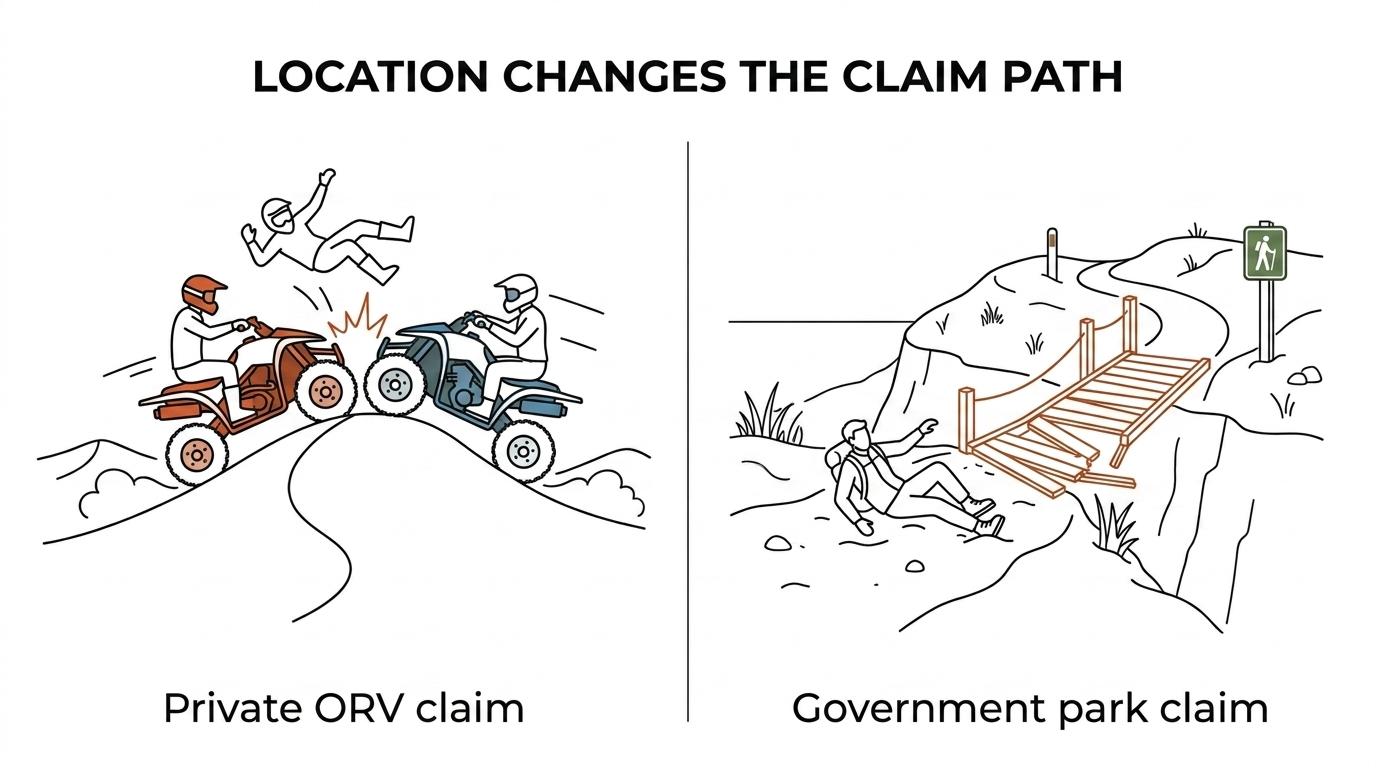
At Silver Lake, that might be another rider, a parent, a rental operator, a maintenance provider, or a seller of defective equipment. At Sleeping Bear, the answer may be the United States through the National Park Service, a local contractor, or a non-federal landowner near an access point, parking area, or trail connection.
Here is the practical difference:
| Issue |
Silver Lake ORV accident |
Sleeping Bear hiking injury |
| Typical event |
ORV collision, rollover, ejection, mechanical failure |
Fall on trail, unstable dune slope, walkway defect, unsafe condition |
| Common defendants |
Rider, owner, parent, rental company, manufacturer |
Federal agency, state entity, contractor, land possessor |
| Key law |
Michigan negligence, ORV statutes, product liability |
Premises liability, FTCA, Michigan law if state property involved |
| Age-rule impact |
High, especially for riders under 16 |
Usually low unless supervision issues exist |
| Evidence that vanishes fast |
Tracks, machine condition, helmet cam footage |
Sand conditions, signage, trail condition, witness location |
| Forum issues |
Standard civil court or state-related issues depending on defendant |
FTCA administrative process first for federal property; Court of Claims if state defendant |
| Timing pressure |
Immediate |
Immediate, with added notice and filing concerns |
The dunes may look similar in vacation photos, but the legal path is not.
flowchart TD
    A[You were hurt outdoors in Michigan] --> B{What caused the injury?}
    B --> C[ORV crash or rollover]
    B --> D[Hiking fall or dangerous land condition]
    C --> E{Who caused it?}
    E --> F[Another rider or supervising adult]
    E --> G[Rental company or equipment defect]
    E --> H[State-controlled condition]
    D --> I{Who controlled the property?}
    I --> J[Federal land at Sleeping Bear]
    I --> K[State land or state park area]
    I --> L[Private land or contractor area]
    J --> M[FTCA administrative claim, often using SF-95 with a sum-certain demand]
    K --> N[Possible Michigan Court of Claims path]
    F --> O[Negligence claim]
    G --> P[Negligence or product liability claim]
    H --> N
    L --> Q[Premises liability claim]
Visualization: The claim path changes based on the cause of the injury and who controlled the vehicle, equipment, or land.
Silver Lake ORV accident claims at Michigan’s dune riding area
The Silver Lake ORV Area is not a casual trail loop. According to the Michigan Department of Natural Resources, it is a 450-acre dune riding area within Silver Lake State Park and is open to ORVs from April 1 through October 31, with daily closing times that change by season. It is also widely known as a unique ride area east of the Mississippi River, which means it pulls in riders from all over Michigan, Indiana, Illinois, Ohio, and beyond.
That traffic matters. Busy weekends near Silver Lake, Mac Wood’s Dune Rides, Little Sable Point Lighthouse, and the Mears corridor can create the kind of mix that leads to serious injuries: first-time riders, modified machines, fast hill climbs, blind descents, and children riding near adults who assume everyone knows the rules.
A strong Silver Lake injury claim often begins with a simple truth. Sand dune crashes are not always “just part of the sport.” Sometimes the cause is carelessness. Sometimes it is a machine that should never have been rented or driven in the first place.
Negligent ORV operators at Silver Lake ORV Area
Negligent riding at Silver Lake can look many different ways. A rider may fly over a crest without checking for traffic on the other side. A group may cut across a marked path. Someone may carry a passenger unsafely, ride too close to smaller vehicles, or lose control while trying to climb a steep face. Alcohol or drugs can also turn a risky area into a catastrophic one.
You do not need a police report alone to prove what happened. In dune crash cases, independent evidence can be just as important as official paperwork, and sometimes more important.
After a paragraph like that, the most useful proof often includes:
- Photos of tire tracks and vehicle resting positions
- GoPro or helmet-cam footage
- Witness names from nearby riders or flaggers
- DNR incident reports
- Rental paperwork and machine numbers
- GPS, phone, or smartwatch location data
- Helmet, harness, and safety gear condition
When a negligent operator causes your injury, the focus is often on speed, line of sight, training, supervision, right-of-way, and whether the rider ignored known dune safety practices.
Equipment failure and rental company liability in Silver Lake ORV cases
Not every Silver Lake crash starts with bad driving. Some start with bad equipment.
That can mean faulty brakes, steering failure, worn tires, broken restraint systems, poor maintenance, or a rental fleet that was turned around too fast during a crowded summer day. In places with heavy tourist traffic, the pressure to keep machines moving can create dangerous shortcuts. If an operator in a rental line near Silver Lake, Hart, or Pentwater skipped inspection steps or rented out a machine with an obvious defect, that issue may be central to the claim.
In those cases, your lawyer will often want the vehicle preserved quickly. If the ATV, UTV, or side-by-side gets repaired, sold, stripped, or altered before an inspection, key proof may be lost. That includes mechanical parts, tire condition, steering assembly wear, and onboard data.
If a machine failure may have caused your crash, do not let the vehicle disappear into a repair shop or storage lot without legal review. Early evidence letters can make a major difference.
Underage riders, Michigan ORV law, and MCL 324.81129
Michigan ORV rules matter a lot when a child is involved. The Michigan Legislature and DNR materials make clear that youth riders face age and safety certificate restrictions. A parent or legal guardian of a child under 16 may not permit the child to operate an ORV unless the child is under direct visual supervision of an adult and has an ORV safety certificate in immediate possession. DNR age guidance also states that riders under 16 must pass an approved ORV safety course and carry the certificate when operating on public or private land.
Those rules are not minor details after a crash. They can become central liability facts.
If a 12-year-old or 14-year-old was riding without proper supervision at Silver Lake, or without the required safety certificate, that can shape how fault is evaluated. It may affect claims against the supervising adult, the vehicle owner, or a business that allowed the ride to happen despite obvious rule problems.
Important legal triggers in these cases include:
- Direct visual supervision: If the adult was too far away to monitor the child in real time, that fact may matter.
- ORV safety certificate: A missing certificate can become a major liability issue after a youth crash.
- Age-specific restrictions: Michigan’s rules vary by age and vehicle type, so the exact age of the rider matters.
- Rental or access decisions: A business that ignored obvious age-rule problems may face serious scrutiny.
- Protective gear use: Helmet and restraint facts often become part of both liability and damages analysis.
When the injured person is a child, parents often assume the case will be straightforward because the rule violation seems obvious. It is not always that simple. You still need proof of who allowed what, when they knew it, and how that failure connects to the injury.
Sleeping Bear Dunes hiking injury claims and premises liability issues
Sleeping Bear Dunes National Lakeshore covers a very different kind of risk. The area is known for over 100 miles of hiking trails, sweeping Lake Michigan views, steep sandy slopes, forested paths, bluffs, and changing weather. The Sleeping Bear Heritage Trail adds paved sections used by walkers, runners, and cyclists. The landscape around Glen Arbor, Empire, Platte River, and the Manitou passage is beautiful, but it is not forgiving.
The National Park Service warns that the dunes can behave like a desert environment along the shoreline, that steep sandy slopes can trigger sand slides, and that cell-phone coverage is not reliable in the dunes and wilderness areas. Those warnings matter because not every injury creates a valid legal claim. A difficult natural condition is not automatically negligence.
Still, public land owners and occupiers do have duties in some settings. If a dangerous condition was hidden, poorly maintained, badly marked, or made worse by human action, you may have a claim worth investigating. Think broken steps, unsafe railings, hazardous erosion near a marked access route, a man-made defect on a walkway, or a dangerous condition that remained after prior complaints.
When a Sleeping Bear injury may support a claim
A valid claim usually turns on more than the fact that you fell. It turns on whether there was a dangerous condition someone should have addressed or clearly warned about, and whether that person or agency had enough control over the area to be legally responsible.
At Sleeping Bear, that may involve the National Park Service. In other Michigan outdoor injury cases, it may involve the State of Michigan, the DNR, a county park authority, or a city that controls an access area or structure.
These fact questions matter:
- Was the area on a marked trail, boardwalk, overlook, parking area, or access path?
- Was there a broken structure, missing barrier, washed-out surface, or hidden drop?
- Had there been prior complaints, prior repairs, or prior incidents?
- Was the condition natural, or was it created or worsened by maintenance failure?
- Did warnings exist, and were they visible where people actually approached?
At places like the Dune Climb, Pierce Stocking Scenic Drive overlooks, Empire Bluffs Trail, and heavily traveled access points near Glen Haven or North Bar Lake, witness traffic can help you. Someone usually saw something. The problem is that those people may be back in Chicago, Grand Rapids, Ann Arbor, or Traverse City by the next morning.
Federal park injury claims under the FTCA
If your injury happened on federal property at Sleeping Bear Dunes National Lakeshore, you may be dealing with the Federal Tort Claims Act, often called the FTCA. That process is different from a normal negligence lawsuit. Before suing, an injured person typically must present an administrative claim to the proper federal agency, commonly using Standard Form 95, and include a sum-certain demand. If that step is missed or handled poorly, the case can be damaged before it starts.
That is why “I’ll just file a lawsuit later” is a risky assumption in a federal park case.
A few points matter right away:
- Agency first: Federal claims usually begin with an administrative filing before any lawsuit.
- SF-95 details: The Standard Form 95 should be filled out carefully and include a clear damages demand.
- Sum certain: You need a specific dollar demand, not a rough estimate or open-ended request.
- Property control: You must identify whether the United States actually controlled the site.
- Federal defenses: Immunity issues and FTCA exceptions can limit or block claims depending on the facts.
A federal claim may also raise questions about whether the dangerous condition involved a discretionary decision by the government or whether an independent contractor, not the government itself, was responsible for maintenance. Those are technical issues, but they are often case deciding issues.
If your injury happened at Sleeping Bear, do not assume a standard premises claim is enough. A federal park case can require a very specific administrative path before a court ever gets involved.
Michigan Court of Claims and governmental immunity for state park injuries
Not every sand dune or park injury belongs in ordinary circuit court. If the defendant is the State of Michigan, a state department, or a state officer acting in that role, the Michigan Court of Claims may have jurisdiction over the case. Michigan court materials state that the Court of Claims hears claims for relief against the state and its departments or officers.
That becomes relevant in outdoor injury cases involving state park property, DNR-managed locations, state-maintained structures, or other state-controlled areas. Silver Lake State Park issues can sometimes raise these questions, depending on exactly what caused the injury and who controlled that part of the event.
Governmental immunity is a real barrier, but it is not a magic phrase that ends every case. The hard part is that immunity rules are narrow, technical, and fact dependent. Some cases fail because the hazard was a natural condition with obvious risk. Others fail because the wrong defendant was named, the wrong notice path was used, or the facts do not fit an available exception. Yet some claims do move forward when the evidence shows a compensable defect or negligent conduct within a recognized legal path.
This is where early case framing matters more than most people think. If you label a state property case the wrong way, you can spend months pushing the claim in the wrong forum.
timeline
    title First 72 Hours After a Silver Lake or Sleeping Bear Injury
    0 : Get medical care
      : Photograph injuries
      : Save clothing and gear
    12 : Record exact location
       : Download phone and watch data
       : Identify witnesses
    24 : Request incident reports
       : Preserve vehicle or equipment
       : Save rental contracts and permits
    48 : Revisit site if safe for photos and measurements
       : Check signage and warning placement
    72 : Send preservation notice
       : Review state or federal claim path
       : Avoid recorded statements without legal advice
Visualization: Outdoor evidence changes fast. The first three days often shape the rest of the case.
Outdoor injury evidence that matters most in Silver Lake and Sleeping Bear cases
Outdoor cases are won and lost on proof that does not last. That is why you should treat the scene like a temporary record, not a permanent one.
At Silver Lake, sand gets blown over, tracks vanish, and a damaged machine can be repaired the same day. At Sleeping Bear, wind shifts the dune face, temporary warnings change, and park staff may fix a hazard before you ever get back with a camera. If the incident happened during peak travel season around July 4, Labor Day, or a busy weekend near Traverse City’s tourism traffic, turnover is even faster.
The most useful evidence often includes photos from multiple angles, close shots and wide shots, timestamps, exact GPS position, weather conditions, footwear, vehicle numbers, permit or rental records, and names of everyone present. In serious cases, your medical records should also connect the mechanism of injury to the actual physical harm. That matters when the other side tries to say you were already hurt before the fall or crash.
When an injury happens outdoors, these steps often help the most:
- Pin the location: Save the exact map point, trail marker, dune section, lot number, or access area.
- Capture the condition: Photograph the slope, signage, tracks, defect, barrier, or broken part before it changes.
- Preserve gear: Keep helmets, shoes, clothing, restraints, and damaged equipment in their post-accident condition.
- Document the timeline: Note the time, weather, crowd level, and who you spoke with first.
- Identify every agency or business: DNR, NPS, rental operator, campground, contractor, or event organizer.
- Avoid casual statements: A quick apology or guess about what happened can be used against you later.
If emergency responders, rangers, or deputies came to the scene, ask how to obtain the report. If other riders or hikers recorded video, try to secure it immediately. A stranger’s ten-second phone clip may prove your case better than weeks of later argument.
What compensation may be available after a Michigan ORV or hiking injury
These claims are about more than the first ER bill. A serious ORV crash can mean surgery, orthopedic care, rehabilitation, wage loss, permanent scarring, and long-term pain. A hiking fall on a steep dune or defective walkway can lead to spinal injury, concussion, torn ligaments, ankle fractures, or shoulder damage that affects work and daily life for months.
If liability can be established, a claim may seek damages for medical expenses, lost income, reduced earning capacity, pain and suffering, future treatment, and other losses recognized by law. In death cases, estate and family claims may also come into play.
One point catches many families off guard. ORV injury cases often do not fit neatly into Michigan’s no-fault auto structure the way a normal passenger car crash does. That means fault proof may become important much earlier than people expect. Who caused the crash, who supervised the rider, who maintained the machine, and who controlled the land can drive the value and viability of the case.
That is why early investigation matters so much. Before anyone talks settlement, you need to know what kind of case you actually have.
FAQ about Michigan ORV accidents and dune injury claims
Can you sue after a Silver Lake ORV crash in Michigan?
Yes, in the right case. If another rider acted carelessly, a supervising adult violated youth ORV rules, a rental company provided unsafe equipment, or a defect caused the crash, you may have a claim. The exact path depends on who caused the injury and whether a government entity is involved.
What if a child was hurt riding an ORV at Silver Lake?
That can be a very serious liability issue. Michigan ORV law places restrictions on riders under 16, including direct visual supervision and possession of an ORV safety certificate. If those rules were ignored, that fact may become a major part of the case.
Is every fall at Sleeping Bear Dunes a legal claim?
No. Natural terrain is not automatically negligence. A valid claim usually requires proof of a dangerous condition, negligent maintenance, an inadequate warning, or some other actionable failure by the party controlling the property.
Do state park injury claims go to the Michigan Court of Claims?
Claims against the State of Michigan or its departments may fall within the Court of Claims. That can apply in some state park injury cases, depending on the defendant and the facts. Identifying the correct defendant early is important.
How do federal injury claims at Sleeping Bear work?
In many cases, federal park injury claims must start with an administrative claim under the FTCA, often using Standard Form 95 and including a sum-certain demand. You usually cannot skip straight to court.
What should you do right after an outdoor injury in Michigan?
Get medical care first. Then preserve evidence fast. Save photos, witness names, the exact location, damaged gear, rental paperwork, permits, and any report numbers. In ORV cases, try to preserve the machine. In hiking cases, try to document the condition before it changes.
Does poor cell service hurt your case?
It can make evidence gathering harder, but it does not end a claim. Sleeping Bear’s dunes and wilderness areas are known for unreliable cell coverage. That makes it even more important to gather location data, photos, and witness contact information as soon as service returns.
Can a waiver from an ORV rental company block your claim?
Not always. Waivers matter, but they do not erase every negligence or product-related claim. Their effect depends on the wording, the facts, the age of the rider, and whether the problem involved recklessness, unsafe maintenance, or a defect.
If you were injured in a Silver Lake dune crash or a Sleeping Bear hiking incident, the strongest step you can take is to sort out the claim path before the evidence fades. The law is different when the injury involves a private rider, a rental company, the State of Michigan, or the federal government. Getting that answer early can protect your case and your recovery options.
 877-Ben-Hall