By: Ben Hall | Attorney and Owner of Ben Hall Law | Marine Corps and Iraq War Veteran | Former Police Officer | Former Prosecutor
Michigan boating laws look simple until an officer pulls alongside your boat and starts asking questions. What felt like a normal day on Lake St. Clair, Torch Lake, Lake Lansing, Higgins Lake, or Grand Traverse Bay can turn into a citation over a missing life jacket, an expired registration decal, a closed access site, or suspected impaired operation.
That matters more than many boaters realize.
In Michigan, boating enforcement is not limited to obvious misconduct. The Michigan Department of Natural Resources, county marine patrol units, and local law enforcement can stop and cite boaters for equipment issues, operator qualification problems, restricted area violations, and criminal conduct. Some cases end with warnings. Others lead to fines, misdemeanors, court dates, probation risk, or a permanent criminal record.
If you live in Lansing, East Lansing, Okemos, Haslett, Metro Detroit, or anywhere between Saginaw Bay and the Lake Michigan shoreline, you need to treat boating laws like real legal exposure, not summer trivia. The state’s own boating rules and regulations page makes clear that the rules cover both your boat and your behavior.
This guide shows you where people get into trouble, what officers tend to notice first, and what you should do if your boating stop happened anywhere in Mid-Michigan or on a Michigan lake or river, contact Ben Hall Law for a case review before you make assumptions about the charge.
Michigan boating laws create legal risk long before an arrest
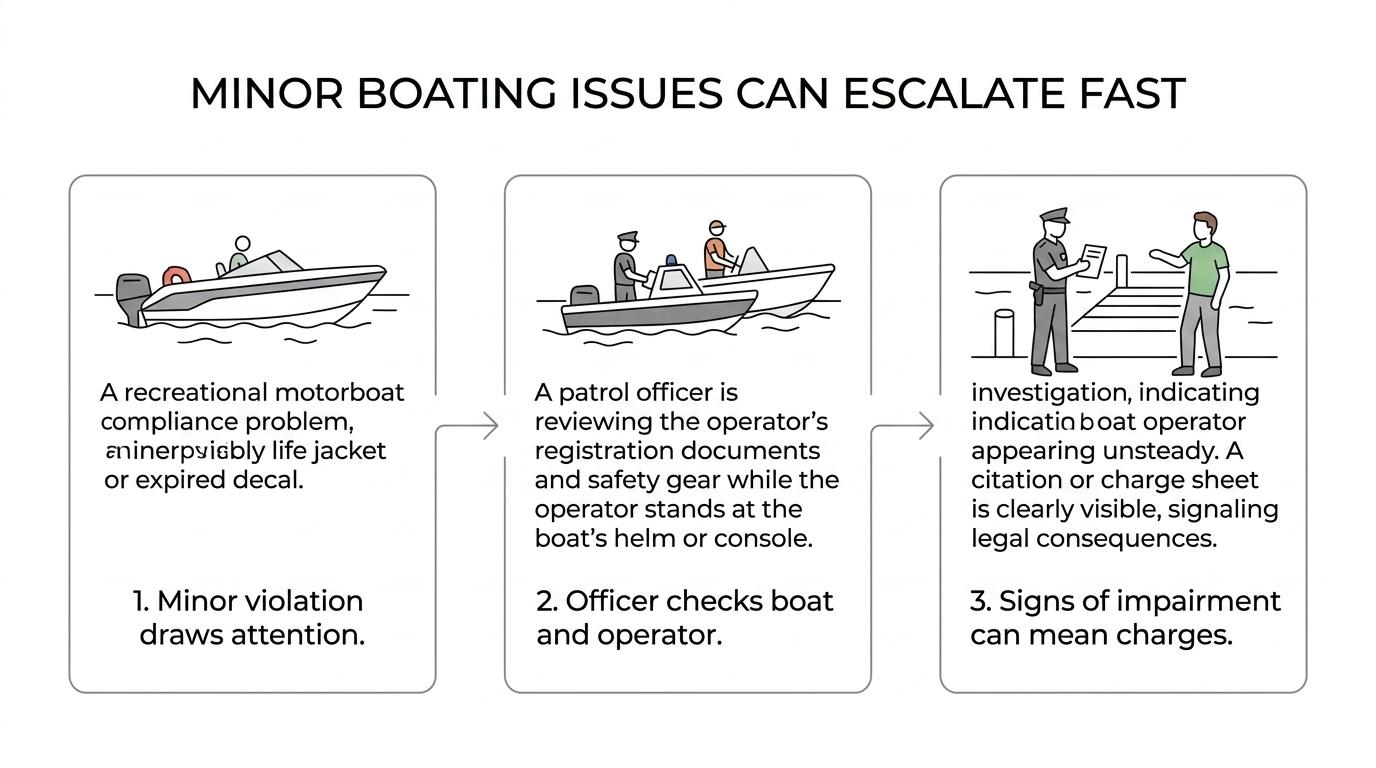
Most people picture a serious boating case as a drunk driving style arrest on the water. That does happen, and it can be very serious. Still, many boating cases start with something smaller: no registration decal, no proof of registration, the wrong life jacket setup for a child, an operator who needed a boating safety certificate, or a launch-site rule that got ignored after dark.
Michigan’s boating laws combine several rule sets into one practical reality. You must have a properly registered vessel unless it falls within an exemption. You must carry required safety gear. You must follow operator certification rules. You must obey buoy markers, controlled areas, and environmental rules. You also cannot operate a motorboat while under the influence of alcohol or controlled substances.
That mix catches people off guard because a lake day often feels casual. A stop on the water is not casual.
flowchart TD
    A[Boat launched in Michigan waters] --> B{Officer contact or safety check}
    B --> C[Registration and decal reviewed]
    B --> D[Safety gear reviewed]
    B --> E[Operator qualification reviewed]
    B --> F[Observed operation and behavior reviewed]
    C --> G[Warning or citation]
    D --> G
    E --> G
    F --> H{Signs of impairment?}
    H -->|No| G
    H -->|Yes| I[Field investigation and chemical test issues]
    I --> J[Possible misdemeanor or criminal charge]
You are far better off preventing the stop from turning into a case than trying to explain things after the fact. But if you already received a ticket or misdemeanor citation, a quick legal review can make a real difference. If your boating stop happened anywhere in Mid-Michigan or on a Michigan lake or river, contact Ben Hall Law for a case review before you make assumptions about the charge.
Michigan boat registration rules and registration decal deadlines
Michigan requires most watercraft to be registered with the Michigan Department of State and to display a registration decal. Those decals do not last forever. According to the DNR, registration decals expire on March 31 in the third year of issuance. That deadline quietly trips up plenty of owners who launch for the first warm weekend and realize too late that the paperwork was old.
This issue shows up often with seasonal use boats. You put the boat away in the fall, pull it back out near Memorial Day, and focus on the trailer tires, battery, and fuel. The decal gets missed. That is all it takes for a routine stop to start with an easy citation.
It also creates trouble with shared ownership and borrowed vessels. If your friend says the registration is current and it is not, you are still the one dealing with the stop if you are operating the boat.
Common registration problems tend to look like this:
- Expired decal: The boat was registered before, but the March 31 expiration date passed.
- No decal displayed: Registration exists, but the vessel is not showing it correctly.
- No proof available: The owner renewed things, but the paperwork is not accessible during the stop.
- Wrong assumptions about exemptions: A boat owner thinks the vessel is exempt when it is not.
If you run a boat between marinas near Traverse City, launch on Lake Charlevoix, or tow from East Lansing to a northern Michigan cabin a few weekends each summer, this is an easy part of the law to fix before launch. Check it every season. Then check it again.
Michigan life jacket and safety equipment laws that lead to DNR tickets
Safety equipment is one of the first things officers look at because it is easy to inspect and easy to charge. Michigan requires all vessels to carry a personal flotation device for each person on board or being towed. Special rules apply depending on vessel type and age of the passenger, and children under 6 must wear a USCG-approved Type I or II PFD when riding on the open deck of a vessel while underway.
This is not a technicality. If you have a child aboard near Belle Isle, on the Detroit River, or out on inland water near Gull Lake or Houghton Lake, the officer does not care that the jacket is in a compartment if the law requires that child to be wearing it.
The same problem shows up with adult passengers. A boat packed for tubing, wakeboarding, or a day at the Torch Lake sandbar can leave the dock with coolers, speakers, ropes, and not enough accessible PFDs.
The most common equipment mistakes are easy to spot:
- Too few PFDs: More people on board than wearable devices available.
- Wrong child setup: A young child is on the open deck underway without the required Type I or II PFD.
- Poor access: Gear exists but cannot be reached quickly.
- Towed rider gap: Somebody being towed is not covered by the required flotation setup.
flowchart LR
    A[Before launch] --> B[Count every person on board]
    B --> C[Count every person being towed]
    C --> D[Match each person to a usable PFD]
    D --> E[Check child life jacket rules]
    E --> F[Place gear where it is reachable]
    F --> G[Launch with fewer citation risks]
A lot of boaters assume safety gear only matters after an accident. In practice, missing gear often creates the stop that leads officers to inspect everything else.
Michigan boating safety certificate rules for younger operators
Michigan requires a boating safety certificate for anyone born on or after July 1, 1996, who operates a vessel. That catches plenty of younger adults who grew up around boats and assume experience is enough. It is not.
This comes up often with college students, new boat owners, and friend groups rotating operators during a lake weekend. One person launches. Another takes over later in the day. If that second operator was born on or after July 1, 1996 and does not have the required certificate, the fun day now includes a legal problem.
That risk is real for Michigan State University students and young professionals who head from East Lansing to Lake Lansing, Higgins Lake, or up toward Traverse City. The state does not grade on familiarity. It looks at compliance.
A boating safety certificate issue can also hurt you in a more serious case. If the stop later involves an accident, injury, reckless operation allegation, or drinking investigation, the lack of proper operator qualification adds one more problem to defend.
You do not need to guess about whether your age triggers the rule. Check before the season starts. Keep proof available. If you were arrested or cited for operating without the required certificate, get legal advice early, especially if the same stop involved alcohol, an accident, or other passengers. Ben Hall Law can review both the ticket and the facts behind it.
Michigan boating under the influence laws and criminal charges
If there is one part of Michigan boating law that people should treat with the same seriousness as a road OWI, this is it. Michigan law prohibits operating a motorboat while under the influence of alcohol or controlled substances. The law also bars operation with a blood alcohol content of 0.08 or more, measured under the legal standards set out by state law. Michigan law also prohibits operation when a person has any amount of certain controlled substances in the body.
This is where a boating stop can move from ticket territory into criminal territory fast.
Many people make a dangerous assumption that being on the water is different from being behind the wheel on I-96, US-127, or Grand River Avenue. It is different in feel, not in legal exposure.
 Officers can watch your speed, turns, wake behavior, response time, and interaction with other vessels. They can note slurred speech, bloodshot eyes, poor balance, confusion, open containers, and admissions about drinking.
Sun, waves, wind, heat, and fatigue can make a sober person look unsteady on a boat. That is one reason these cases deserve careful review. Another is that marine enforcement settings can create factual issues that do not exist in a standard roadside stop.
What officers often focus on in a Michigan boating OWI investigation
A boating under the influence investigation usually begins with one of two things: observed operation or an easy-to-spot rule violation. Maybe you crossed into a restricted area near a swim zone. Maybe the boat registration looked off. Maybe there was unsafe wake activity near a dock. Once contact starts, the officer’s attention can shift quickly to impairment.
Here is how common boating mistakes can escalate:
| Boating issue |
What officers may notice |
Possible legal exposure |
| Open alcohol use by operator |
Odor, cans, admissions, poor operation |
Further OWI style investigation |
| Unsafe wake or erratic movement |
Speed changes, sharp turns, near collisions |
Reckless operation claims, impairment inquiry |
| Stop for equipment violation |
Missing PFDs or decal leads to longer contact |
Citation plus possible criminal investigation |
| Crash or injury event |
Damage, witnesses, panic, confusion |
Misdemeanor or more serious charges depending on facts |
| Drug use allegations |
Admissions, visible substances, test results |
Controlled substance based boating charges |
Why Michigan boating OWI cases need a serious defense review
The setting matters. So does the sequence of the stop. Who was operating? When was the boat last moving? What caused the officer to make contact? What tests were requested, and how were they handled? Was there an accident? Were prescription medications part of the story? Those details can shape both the charge and the defense.
You should also remember that the social setting on popular water can work against you. On Lake St. Clair, the Detroit River, Torch Lake, or large holiday gatherings near Grand Haven and Muskegon, officers expect drinking. That expectation can color how a stop develops.
A criminal charge from a boating stop should never be treated like a routine summer ticket. If you were arrested or cited for impaired boating in Michigan, call Ben Hall Law as soon as possible. Early case analysis can affect evidence preservation, court strategy, and how you respond to the state’s allegations.
Michigan waterway rules for buoys, diver-down flags, aquatic plants, and access-site hours
Many boaters focus only on alcohol and life jackets. Michigan law covers much more than that. The state also enforces waterway-use rules tied to controlled areas, diving operations, invasive species protection, and boating access-site limits.
That means your legal risk may have nothing to do with speed or drinking.
Michigan buoy and marker rules identify controlled areas including no fishing, no swimming, and ski-only zones. If you blow past a marker because you assumed it was advisory instead of mandatory, you may hand an officer a simple reason to stop you. The same goes for diving operations. Boaters should stay at least 200 feet away from diving activity, and divers should display a diver-down flag.
The environmental side matters too. Michigan requires boaters to remove all aquatic plants from watercraft, equipment, and trailers before placing them into Michigan waters. After trailering and before getting on the road, boaters must pull plugs, drain water, and remove plants and debris. A lot of people think of that as a courtesy rule. It is not.
State-sponsored boating access sites add another rule that surprises people: the majority are posted closed from 11 p.m. to 4 a.m. unless otherwise posted. That can matter a lot after fireworks, late-night fishing, or a long day on the water when everyone lingers at the ramp.
A strong pre-departure routine helps:
- Read buoy markers
- Check for diver activity
- Remove aquatic plants from boat and trailer
- Pull plugs and drain water
- Confirm access-site hours before staying late
These details matter from inland lakes near Howell and Jackson to major coastal boating areas near Holland, Sleeping Bear Dunes, Alpena, and Mackinac waters. Michigan’s geography gives you incredible places to boat. It also gives law enforcement a wide range of rules to enforce.
What to do after a Michigan DNR boating citation or misdemeanor
If you already received a citation, do not talk yourself into the idea that paying it is always the fastest or safest move. In some cases, paying a ticket is an admission that closes off better options. In others, the boating stop may have produced facts that support a challenge, reduction effort, or a defense strategy that is not obvious from the face of the citation.
Start by preserving what you can. Save photos of the boat layout, gear location, registration materials, launch receipts, GPS data, text messages about who operated the vessel, and contact information for passengers or nearby witnesses. If the stop involved an accident, keep repair photos and medical records as well.
Then get clear on what you were actually charged with. A civil infraction is one thing. A misdemeanor is another. A boating under the influence case can carry consequences far beyond a fine.
When you respond to a boating charge, keep these steps in mind:
If your case involves criminal allegations, Ben Hall Law can review the stop, the officer’s basis for contact, the evidence gathered, and the best next step. That is especially useful when your charge came out of a summer weekend that started on the lake and is now following you back to work, school, or home life in Mid-Michigan.
Michigan boating laws FAQ
Do you need to register a boat in Michigan?
Yes, most watercraft must be registered with the Michigan Department of State unless an exemption applies. The vessel must also display a registration decal.
When do Michigan boat registration decals expire?
Michigan registration decals expire on March 31 in the third year of issuance. If you launch after that date without renewal, you risk a citation.
Do you need a life jacket for every person on a boat in Michigan?
Yes. Michigan requires a PFD for each person on board or being towed. Children under 6 riding on the open deck while the vessel is underway must wear a USCG-approved Type I or II PFD.
Who needs a boating safety certificate in Michigan?
Anyone born on or after July 1, 1996 who operates a vessel in Michigan needs a boating safety certificate.
Can you get a criminal charge for drinking while boating in Michigan?
Yes. Michigan prohibits operating a motorboat while under the influence of alcohol or controlled substances. A boating OWI style case can lead to misdemeanor charges and may become more serious if there is an accident or injury.
What is the legal alcohol limit for boating in Michigan?
Michigan law prohibits operation of a motorboat with a blood alcohol content of 0.08 or more under the statutory measurement standards.
Are Michigan boating access sites closed at night?
Many state-sponsored boating access sites are posted closed from 11 p.m. to 4 a.m. unless otherwise posted. Always check local signage before staying late.
Do you have to remove weeds and water from your boat trailer in Michigan?
Yes. Michigan law requires removal of aquatic plants from watercraft, equipment, and trailers before entering Michigan waters. Before you get on the road after trailering, you must pull plugs, drain water, and remove plants and debris.
How far should you stay from diving operations in Michigan waters?
Boaters should stay at least 200 feet away from diving operations, and divers should display a diver-down flag.
Should you hire a lawyer for a Michigan boating ticket?
It depends on the charge, but you should strongly consider legal advice if the case involves a misdemeanor, alcohol or drug allegations, an accident, injury, a court date, or any risk to your record. A quick review can tell you whether paying the ticket is safe or whether it could create bigger problems.
 877-Ben-Hall