

Published date: July 18, 2026
By: Ben Hall | Attorney and Owner of Ben Hall Law | Marine Corps and Iraq War Veteran | Former Police Officer | Former Prosecutor
A Michigan day on the water can change fast.
You may be cruising on Lake St. Clair, heading back from Torch Lake’s sandbar, fishing near Saginaw Bay, or running a pontoon along the Grand River near Grand Haven when blue lights appear behind you. If the officer thinks alcohol is part of the picture, a routine marine stop can turn into a boating under the influence investigation in minutes.
That moment feels different from a roadside traffic stop, and that difference matters. A boat moves with wind, wake, and current. People are often sunburned, tired, wet, and unsteady even when sober. Coolers, empty cans, loud passengers, and docking mistakes can all shape an officer’s view before a single question gets asked. In Michigan, the Department of Natural Resources, county marine patrols, local police on the water, and in some settings the Coast Guard, may all be part of enforcement activity.
If you want to protect yourself, your passengers, and your record, you need to know what officers can do, what they are looking for, and what you should do the second a stop begins.
Need help after a Michigan drunk boating stop or arrest? Contact Ben Hall Law quickly. Early action can affect what evidence gets preserved and how your case is challenged.
Michigan boating under the influence stops start differently than car stops
A roadside stop usually begins with a traffic violation, a lane issue, speeding, or an accident. A Michigan boat stop can begin for those reasons too, but officers also watch for marine safety issues that have nothing to do with alcohol at first glance. Speeding in a no-wake zone, getting too close to a swimmer, operating a personal watercraft recklessly, missing safety gear, or failing to follow navigation rules may be enough to trigger contact.
Michigan law gives a peace officer authority to stop a vessel when the officer is acting lawfully. The operator must stop immediately or maneuver so the officer can come alongside. You may also be required to provide your correct name and address and show the vessel’s certificate of number. If the vessel does not display the qualifying decal recognized by law, you may also have to submit to a reasonable inspection of the vessel and its equipment.
That is one reason a marine stop can feel broader than a car stop. The officer is not just looking at your operation. The officer is also looking at the vessel itself, required gear, passengers, open intoxicants, and how everyone on board is acting while the contact unfolds.
flowchart TD
    A[Officer observes vessel] --> B[Signal to stop or come alongside]
    B --> C[Operator must stop or maneuver safely]
    C --> D[Officer checks ID and vessel registration]
    D --> E[Possible safety inspection if required]
    E --> F[Officer watches for signs of impairment]
    F --> G[Questions about alcohol, route, passengers, operation]
    G --> H[If suspicion grows, move to shore for sobriety testing]
    H --> I[PBT and arrest decision]
Who may stop your boat in Michigan and what each agency looks for
On Michigan waters, the uniform can change, but the risk to you stays the same. DNR conservation officers patrol inland lakes, rivers, and parts of the Great Lakes. County sheriff marine units and local police departments also conduct boating enforcement. Around federal waters and some larger navigable areas, the Coast Guard may become part of the picture as well.
This matters on busy weekends across the state. Think Belle Isle and the Detroit River, Lake Charlevoix, Higgins Lake, the Muskegon shoreline, or the marinas around Traverse City and Mackinac Island. Michigan’s boating culture stretches from college town weekends near East Lansing to family cabins in the north and waterfront traffic tied to major metro regions shaped by Ford, GM, Stellantis, and the rest of the state’s summer travel economy. Enforcement is not limited to one kind of lake or one kind of boater.
Each agency may approach the stop a little differently, but the core issues are familiar.
- DNR conservation officers: Marine safety violations, reckless operation, open intoxicants, and signs of impaired boating
- County marine patrols: Local ordinances, no-wake enforcement, unsafe speed, collisions, and intoxicated operation
- Local police on the water: Disorderly conduct, assaults, dock incidents, and public safety calls tied to alcohol use
- Coast Guard contacts: Safety compliance, federal waterway concerns, and boating safety issues that can overlap with impairment evidence
What happens during the first few minutes of a Michigan DNR or Coast Guard boat stop
Once the officer signals you, your first job is simple: stop safely and do not make things worse. Slow down, reduce wake, and position your boat so the officer can approach without risk. A panicked turn, a delayed stop, or a sudden acceleration can make the situation look far worse than it already does.
Expect the officer to watch everything before any conversation starts. Who is holding the wheel? Who is reaching into a cooler? Is anyone tossing cans? Are passengers trying to switch positions? Is the boat drifting into danger? Can the operator follow basic instructions? Those early observations may later appear in a report as evidence of impairment.
Then come the questions. Where are you coming from? Have you been drinking? Who owns the vessel? Do you have registration? Is everyone wearing or carrying required safety gear? On a road, you can usually stand flat on pavement and speak in a controlled setting. On the water, the scene is noisy and unstable, which gives officers more behavior to interpret.
In many Michigan cases, if the officer sees enough warning signs, the next phase happens on shore rather than on the boat. Michigan is known for shore-based field sobriety testing in boating cases, which is a key difference from what many boaters expect.
After those first minutes, your best moves are practical and calm.
- Slow down and stop safely
- Keep your hands visible
- Follow navigation instructions
- Provide identification and registration when asked
- Do not argue on the water
- Do not switch operators
- Do not hide or throw away alcohol
- Do not make jokes about being drunk
What officers look for in a suspected drunk boating investigation
Most Michigan boating under the influence arrests do not start with a chemical test. They start with observations. Officers write reports built around what they saw, heard, smelled, and documented. If you know the pattern, you can better see why a simple stop turns serious.
Physical signs are common. Odor of alcohol, bloodshot eyes, slurred speech, fumbling with registration, trouble staying seated, swaying while boarding, and confusion about simple instructions can all be noted. On water, though, many sober people also look clumsy. That is why the setting matters. Heavy chop on Lake Michigan, boat traffic near Holland State Park, heat at the Torch Lake sandbar, or a rough docking attempt near a packed marina can be innocent facts or prosecution evidence, depending on how the officer writes the report.
Operation matters just as much as appearance. Officers watch for speeding through no-wake zones, circling, delayed response to signals, near collisions, poor lookout, wake damage risk, and getting too close to other vessels or swimmers. Michigan DNR reports regularly show stops tied to unsafe operation and open intoxicants before the arrest decision is made.
Passengers matter too. A loud passenger saying, “I told him not to drive,” or someone hurriedly taking the helm can hurt you. So can open beer cans near the operator’s seat or conflicting answers about who has been drinking.
| What officers often document | Why it matters in a Michigan BUI case |
|---|---|
| Odor of alcohol | Supports suspicion before any test |
| Open intoxicants near the helm | Suggests recent drinking by the operator |
| Unsafe speed or no-wake violation | Creates a lawful reason for contact and may show impaired judgment |
| Delayed response to emergency lights or commands | Can be written as confusion or poor control |
| Trouble producing registration or safety equipment | May be framed as divided attention or impairment |
| Passenger statements | Can support or damage the officer’s theory |
| Docking mistakes | Often used as real-world evidence of impaired operation |
| Sun, wind, fatigue, rough water | Defense factors that may explain behavior without intoxication |
Shore-based field sobriety tests and preliminary breath tests in Michigan boating cases
Here is where a suspected drunk boating stop often separates itself from a roadside DUI case. In Michigan, field sobriety testing in boating investigations is typically conducted on shore. That means the officer may escort you to land, a dock, or a launch area to continue the investigation.
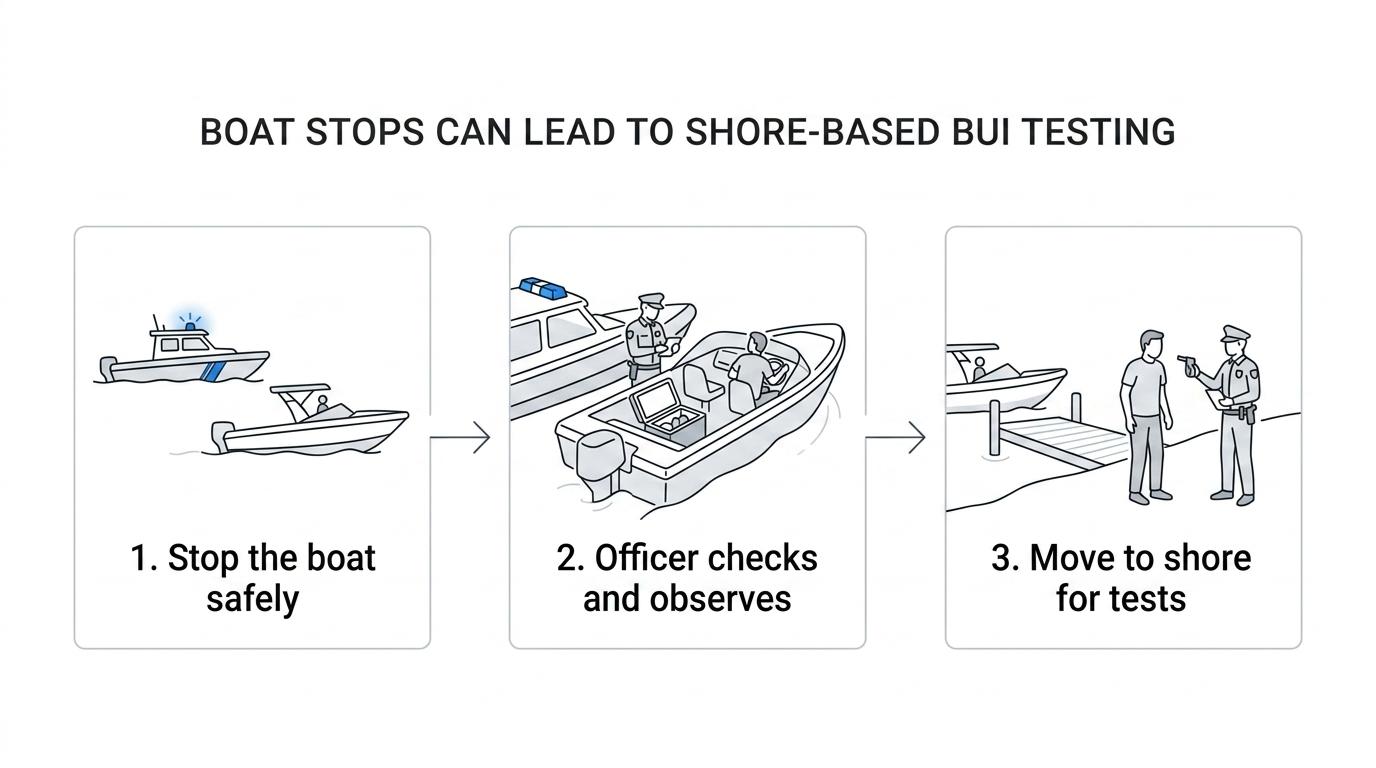
Why does that matter? Because balance on a boat proves very little. Even skilled boaters adjust their stance constantly. Once you are on shore, the officer may use familiar sobriety exercises and then ask for a preliminary breath test, often called a PBT. DNR enforcement reports from Michigan show that arrests can follow observed intoxication, open intoxicants, field testing, and preliminary breath results. Those same reports also show cases where a sober passenger takes over the boat after the operator is arrested.
Refusal can create its own problems. Coast Guard boating-law guidance tied to Michigan notes a civil ticket consequence for refusal in this context. Refusing does not make the case disappear. In many cases, it simply changes the evidence mix while leaving the officer’s observations in place.
Also remember this: a boat stop does not become a weak case just because the testing happens later on shore. Prosecutors often argue that the total picture matters, including operation on the water, your statements, the condition of the vessel, open containers, witness accounts, and test results gathered after docking.
If officers moved you to shore for field sobriety tests or a PBT, speak with a defense lawyer fast. The timing of the stop, the move to land, the instructions given, and the officer’s basis for suspicion may all matter.
sequenceDiagram
    participant O as Officer
    participant B as Boater
    participant S as Shore or Dock
    O->>B: Signal vessel to stop
    B->>O: Stops or maneuvers alongside
    O->>B: Questions, registration, observations
    O->>B: Notes signs of alcohol or unsafe operation
    O->>S: Directs operator to shore for further investigation
    S->>B: Field sobriety tests
    S->>B: Preliminary breath test request
    O->>B: Release, citation, or arrest
How a Michigan boat stop differs from a roadside OWI stop
Many people assume a drunk boating case is just a DUI on water. That assumption can hurt you. The law overlaps in important ways, but the stop itself, the evidence, and the officer’s observations often look very different.
On a road, the vehicle is supposed to move inside painted lanes on a stable surface. On a lake or river, there are no lane markers, no dry shoulder, and no fixed platform for balance or coordination. That gives both sides arguments. The officer may say your control was poor. Your defense may point to waves, wakes, weather, congestion, darkness, fatigue, or docking pressure.
The practical difference is just as important. A traffic stop usually isolates the driver quickly. A marine stop often involves passengers, coolers, music, movement, weather, and shifting positions. The officer has more facts to sort through, and that can lead to mistakes, bad assumptions, or credibility issues worth challenging.
| Issue | Roadside OWI stop | Michigan BUI stop |
|---|---|---|
| Surface | Dry pavement | Moving water, wakes, wind, current |
| Initial reason for stop | Traffic violation or crash | Operation issue, safety concern, registration, marine rule violation |
| Officer access | Walks up to driver window | Comes alongside or boards as allowed |
| Balance observations | Flat ground after exit | Boat movement can distort observations |
| Sobriety testing | Usually roadside | Often conducted on shore in Michigan |
| Passenger influence | Often limited | Frequently significant |
| Safety inspection issues | Less common | Can become part of the contact |
| Open container evidence | Vehicle interior | Coolers, cup holders, deck areas, helm area |
What you should and should not do during a drunk boating stop in Michigan
Your goal is not to “win” the stop. Your goal is to avoid making it worse, avoid adding new violations, and avoid handing the officer extra evidence.
Be respectful. Be controlled. Keep your answers brief. If the officer asks for identification, registration, or required safety items, comply with those lawful requests. Do not physically interfere. Do not let passengers take over the conversation unless the officer asks them something directly. A chaotic scene feeds the officer’s suspicion.
At the same time, you do not need to talk your way out of the situation. Long explanations often backfire. People tend to guess at timelines, minimize drinking in ways that sound false, or volunteer details that later appear in a police report.
- Do: Stop the vessel safely, follow instructions, and keep the contact calm
- Do: Provide identifying information and vessel documents when lawfully requested
- Do: Pay attention to where the stop occurred, what the officer said, and who was present
- Do not: Admit you are “fine to drive” after drinking or try to justify how much you consumed
- Do not: Encourage passengers to hide alcohol, switch seats, or argue with the officer
- Do not: Resist being moved to shore if the officer is continuing the investigation
If you were arrested or cited after a Michigan marine stop, call Ben Hall Law. A boat case is not the same as a highway case, and the defense should not be handled like one.
What happens after a Michigan boating under the influence arrest
If the officer decides there is probable cause for arrest, you may be taken off the boat, transported, and processed much like a land-based intoxicated operation case. In some cases, the vessel is released to a sober passenger. In others, it may be secured, towed, or left under controlled arrangements depending on the waterway, weather, and available personnel.
You may face more than one issue. Many boating arrests come packaged with open intoxicant allegations, marine safety citations, reckless operation claims, or accident-related accusations. If there was property damage, an injury, or a collision near a busy harbor like South Haven, Ludington, or St. Joseph, the case can become much more serious very quickly.
What happens next often depends on the paperwork. The timeline of the stop, the stated reason for contact, whether the officer had reasonable suspicion, how the shore-based testing was handled, what was said about refusal, and how passengers were identified can all become major defense issues. Video, body camera, dash-mounted marine camera systems, dock surveillance, marina witnesses, and even GPS or chartplotter data may matter.
That is why fast case review matters. A BUI case can look simple on the citation and still be weak in the details.
Michigan boating under the influence defense issues that often matter
A strong defense starts with the stop itself. Was the officer acting lawfully? Was the reason for contact documented clearly? Did the report blend a safety inspection with an impairment investigation in a way that raises legal questions? Was your behavior on shore described fairly, or was normal post-boating instability treated like intoxication?
The setting also matters more than many courts first realize. Long sun exposure, dehydration, glare, loud engines, heavy boat traffic, motion from rough water, and the strain of docking a vessel in a packed marina can all affect speech, balance, attention, and appearance. A person coming off Lake Huron chop near Alpena or maneuvering a pontoon around a crowded launch on a holiday weekend may not look polished even when sober.
Your statements matter too. A person who says, “I only had two” may think that sounds safe. Prosecutors often use it as an admission to drinking. Silence is not the same as obstruction. Calm, limited communication is usually far safer than a running explanation.
A defense team with former police officer and former prosecutor insight can examine how the stop was built, how suspicion developed, and where the state may have overreached or filled gaps with assumptions.
FAQ about Michigan DNR and Coast Guard drunk boating stops
Can the DNR stop your boat in Michigan?
Yes. Michigan law allows a peace officer acting lawfully to direct a vessel to stop immediately or maneuver so the officer can come alongside. You may be asked for your name, address, and vessel registration, and in some situations the officer may conduct a reasonable inspection.
Do you have to take field sobriety tests on the boat?
Michigan boating enforcement practice generally points toward shore-based field sobriety testing rather than on-boat testing. If the officer suspects impairment, you may be directed to shore, a dock, or a launch area for further investigation.
Can the Coast Guard stop your boat for suspected drunk boating in Michigan?
Yes, Coast Guard contact is possible on certain waters. The practical experience may differ from a DNR stop because federal maritime authority can overlap with state boating enforcement. What matters to you is that anything observed during that contact may later be used as evidence in a Michigan BUI case.
What if you refuse a preliminary breath test in a Michigan boating case?
Refusal does not end the case. Guidance tied to Michigan boating law lists a civil ticket consequence for refusal. Officers may still arrest based on operation, observations, passenger statements, open intoxicants, and other evidence.
Is a boating under the influence case treated exactly like a car DUI?
No. The legal stakes are serious in both, but the stop, the environment, the testing process, and the officer’s observations differ in major ways. Water movement, weather, docking conditions, and shore-based sobriety testing can all change how the evidence should be viewed.
Can a sober passenger take over the boat after an arrest?
Yes, that can happen. Michigan DNR reports show situations where the boat was turned over to a sober passenger after the operator was arrested. Whether that is allowed depends on safety, location, and the officer’s judgment at the scene.
What should you do after you get home from a boating arrest or citation?
Write down everything you remember right away. Note the water conditions, weather, route, passenger names, where the stop happened, what the officer said, whether you were moved to shore, and whether any cameras or marina witnesses may exist. Then speak with a Michigan defense lawyer as soon as possible.
A summer stop on the water does not have to define your future. If you were cited, tested, or arrested for boating under the influence in Michigan, get your case reviewed before you assume the officer’s version is the whole story. Ben Hall Law can help you take the next step with focus and urgency.