

Published: July 20, 2026
By: Ben Hall | Attorney and Owner of Ben Hall Law | Marine Corps and Iraq War Veteran | Former Police Officer | Former Prosecutor
A summer day on the water can turn serious fast in Michigan. One stop on Lake Lansing, Lake St. Clair, Torch Lake, Grand Traverse Bay, or the Detroit River can lead to a boating under the influence charge that feels a lot like a road OWI at first glance. Many boaters assume the law is basically the same.
It is not.
Michigan’s boating under the influence law, found at MCL 324.80176, uses many of the same intoxication concepts you see in road OWI cases. Still, the boating statute has its own definition of “operate,” its own enforcement rules on the water, its own sanctions structure, and its own practical defense issues. If you or your child was stopped while operating a pontoon, fishing boat, speedboat, or personal watercraft, those differences matter right away.
If your family is dealing with a BUI arrest anywhere from East Lansing and Mid-Michigan to Traverse City, Holland, Bay City, or the marinas around Belle Isle, now is the time to get clear answers. Contact Ben Hall Law for a confidential review before you assume a boat case works exactly like a car case.
Michigan Boating Under the Influence Law Compared to Michigan Road OWI
Michigan boating under the influence law under MCL 324.80176
Michigan law makes it illegal to operate, or in some situations authorize the operation of, a motorboat while under the influence of alcohol, while under the influence of a controlled substance, while visibly impaired, or with unlawful bodily alcohol content. The statute also covers certain controlled substances in the body and creates a separate under-21 offense for operating with any bodily alcohol content.
The first major point is the definition of operate. Under MCL 324.80176, a person operates a vessel when that person is in control of a vessel propelled wholly or partly by machinery while the vessel is underway and not docked, at anchor, idle, or otherwise secured. That is a major statutory difference from road OWI law. On the water, the “underway” requirement becomes a central question.
That single definition can shape the whole case. If you were tied up at a dock near Lake Lansing, secured at anchor on Houghton Lake, or sitting idle in Muskegon Lake, the facts may look very different from a case where the boat was moving through a channel or crossing open water.
Michigan’s boating law also has a separate offense for a person under 21 who operates with any bodily alcohol content. Families often get caught off guard by that rule. A college student home for the weekend, an MSU student on a summer lake trip, or a younger operator on a family boat can face a charge even when the case does not fit the classic image of severe intoxication.
After you know the statute, these are the offense categories most people need to watch:
- Operating while under the influence
- Operating with unlawful bodily alcohol content
- Operating while visibly impaired
- Operating with certain controlled substances in the body
- Under-21 operation with any bodily alcohol content
- Enhanced exposure when a passenger under 16 is aboard
flowchart TD
    A[Motorboat or powered vessel] --> B{Was the vessel underway and not secured?}
    B -->|No| C[Key defense issue: statutory operation may be disputed]
    B -->|Yes| D{What does the state claim?}
    D --> E[Under the influence]
    D --> F[Unlawful bodily alcohol content]
    D --> G[Visible impairment]
    D --> H[Certain controlled substances]
    D --> I[Under 21 with any bodily alcohol content]
How Michigan BUI differs from Michigan OWI on the road
Both Michigan BUI and Michigan OWI use familiar intoxication ideas. You will see alcohol-based charges, drug-based charges, visible impairment allegations, and tougher treatment for repeat offenses. That similarity is why many people think a boat case is just an OWI with water in the background.
The better way to view it is this: the core concept is similar, but the legal framework is different. Boating law is built around a vessel on the water, marine patrol procedures, and sanctions under the boating code. Road OWI, under MCL 257.625, is built around motor vehicles operated on highways or places open to the public or generally accessible to motor vehicles.
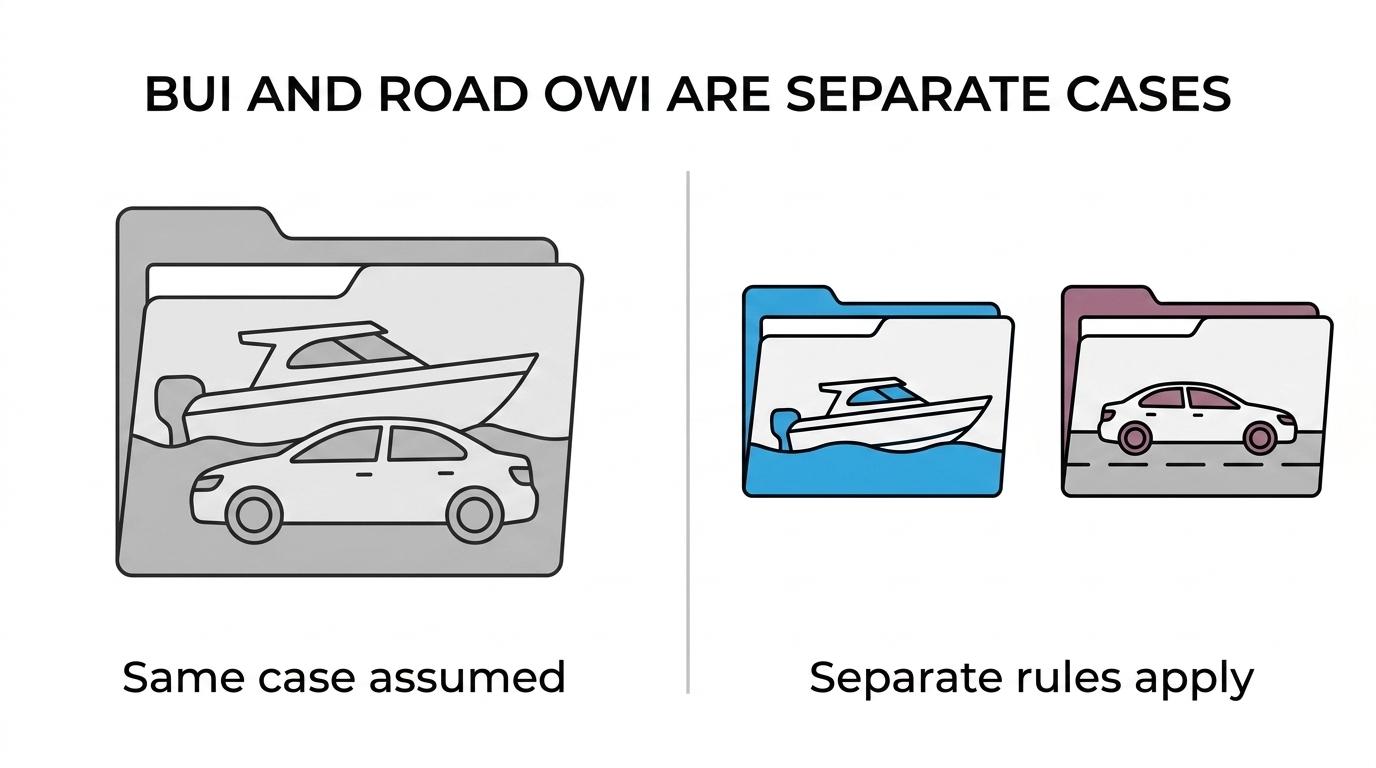
Here is a practical side-by-side comparison:
| Issue | Michigan BUI under MCL 324.80176 | Michigan road OWI under MCL 257.625 | Why it matters to you |
|---|---|---|---|
| What is being operated | A motorboat or powered vessel | A motor vehicle | The statute you face depends on the machine and the place |
| Where the conduct happens | On Michigan waters | On highways or other vehicle-accessible places | The setting changes how police contact begins and how the law is applied |
| Definition of operate | In control while the vessel is underway and not docked, anchored, idle, or secured | Vehicle-based operation under the motor vehicle code | “Underway” can become a major defense issue in a BUI case |
| Alcohol and drug theories | Under the influence, unlawful BAC, visible impairment, controlled substances | Similar intoxication and impairment theories | Similar labels do not mean identical procedures |
| Under-21 rule | Any bodily alcohol content for under-21 vessel operators | Different underage motor vehicle standards apply | Young boaters should not assume road rules match boat rules |
| Passenger-under-16 issue | Marine sanctions include child-passenger enhancement | Road OWI also has child-passenger consequences | Families face more than a routine misdemeanor risk |
| Enforcement setting | DNR, marine deputies, water patrol stops, vessel direction orders | Traffic stops by road officers | The stop itself unfolds very differently on the water |
| Sanctions focus | Boating code penalties and vessel-related consequences | Criminal penalties plus driver’s license sanctions and vehicle consequences | A boat case can affect your life in ways that do not mirror a road case exactly |
One more point matters for repeat cases. A boating offense can still carry serious misdemeanor or felony exposure. If you hear someone say, “It’s just a boat, not a car,” do not rely on that. Prosecutors and judges do not treat these cases like harmless vacation mistakes.
Michigan BUI stop, arrest, and chemical test procedure
A boat stop looks different from a traffic stop because the officer is working in a marine environment. Michigan marine law allows an officer to direct a moving vessel to stop, and the operator must stop or maneuver alongside the officer as directed. That can happen on busy summer water near the Torch Lake sandbar, in channels around Lake St. Clair, on Saginaw Bay, or on smaller inland lakes where county marine units patrol heavily.
The practical signs that lead to a BUI investigation can include speed, wake violations, near-collisions, erratic turns, problems docking, poor reaction to traffic markers, or safety concerns noticed by a conservation officer or marine deputy. In other cases, an accident or a boating complaint starts the contact.
Michigan marine law also allows warrantless arrest authority in vessel-related cases, and the boating code contains chemical testing rules specific to vessel operators after arrest. That means you should take a marine stop just as seriously as a road stop. What you say, how you perform, and whether you agree to testing can all shape the evidence.
The water itself can complicate officer observations. Sun exposure, wind, dehydration, motion, glare, fatigue, poor footwear, and rough conditions can affect speech, balance, and coordination. A person stepping from a boat to a dock at a crowded marina in Traverse City or Bay Harbor may not look steady even when alcohol is not the reason. That does not make the case disappear, but it can matter a great deal in the defense.
If an officer stops your vessel, keep your focus on safety and restraint.
- Comply safely: Stop or maneuver as directed and avoid sudden movement
- Provide basics: Registration, identification, and required boating documents if requested
- Say less: Do not guess, argue, or volunteer details about drinking
- Watch the facts: Note where the vessel was, whether it was underway, and who was in control
- Call quickly: Speak with a defense lawyer before making later statements
flowchart LR
    A[Vessel stop on Michigan water] --> B[Officer observations]
    B --> C[Field investigation]
    C --> D{Arrest?}
    D -->|No| E[Warning, citation, or release]
    D -->|Yes| F[Chemical test process under marine law]
    F --> G[Charge review]
    G --> H[Court appearance and defense work]
If you were arrested after a stop on a Michigan lake or river, do not wait to sort it out later. Reach out to Ben Hall Law as early as possible so your defense can start while the details are still fresh.
Michigan boating under the influence penalties under MCL 324.80177
The sanctions for Michigan boating under the influence are serious, and they can become life-changing in repeat or injury cases. A first offense under the main BUI provision is a misdemeanor. A visible impairment boating offense is also treated separately as a misdemeanor. While many people think of boating charges as summer-cottage offenses, the statute is built to punish repeat conduct aggressively.
For a second violation, the boating code allows imprisonment for not less than 48 consecutive hours and up to 1 year, along with potential fines and community service. That mandatory minimum custody exposure catches many families off guard.
For a third or subsequent violation, the offense becomes a felony, punishable by 1 to 5 years in prison, a fine of $500 to $5,000, or both. When the allegation involves serious impairment of a body function or death, the case moves into a much more severe felony category.
Michigan boating law also includes a passenger-under-16 enhancement. If a child was on board, the stakes can rise quickly. A family outing on a pontoon near South Haven or a wake boat afternoon near Union Lake can turn into a far more serious matter than the operator expected.
Road OWI cases often bring major driver’s license consequences through the motor vehicle system. Boating cases are different in that the sanctions are tied to the marine statute and vessel operation. You should never assume that because your driver’s license issue is different, the criminal case is minor. The record, the court process, the jail exposure, and the effect on employment or school can still be substantial.
Here is the practical takeaway:
- First-offense boating cases are still criminal cases
- Repeat offenses can mean mandatory custody and felony exposure
- Injury or death allegations change everything
- Child-passenger facts can increase the seriousness of the charge
A boating arrest can affect work, school, travel, insurance, and professional licensing. If your son or daughter is attending Michigan State University, or you commute from Okemos, Haslett, or Lansing and spend weekends on the water, a fast response matters. Contact Ben Hall Law if you need a defense strategy built around the actual statute, not guesses based on road OWI talk.
Practical defense issues in a Michigan BUI case
Every BUI case turns on facts, not labels. A strong defense often starts by asking whether the state can actually prove statutory operation under the boating code. Was the vessel underway? Was it docked, anchored, idle, or otherwise secured? Who was truly in control?
That can become highly fact-specific in cases involving pontoons drifting near a sandbar, fishing boats with multiple adults aboard, or boats that had just come off plane and were waiting near a dock. Video, marine reports, GPS data, body camera footage , witness accounts, and marina surveillance can all matter.
Officer observations also deserve careful review. Water conditions can create signs that look like impairment. Slurred speech may be tied to fatigue or heat. Balance issues may be tied to wave action or the transfer from vessel to dock. Red eyes may come from wind and glare on a long afternoon on Lake Michigan. None of that excuses intoxicated boating. It does mean the state’s proof should be tested carefully.
Chemical testing deserves the same close look. The timing of the test, the legal basis for the arrest, the handling of samples, and the exact charge theory all matter. A visible impairment case is not the same as an unlawful BAC case, and an under-21 any-alcohol case is different again.
Another issue that surprises people is the statute’s language about authorizing the operation of a motorboat. If an owner or responsible adult allowed an intoxicated person to take control, that fact pattern may create risk beyond the person holding the wheel.
What you should do after a Michigan boating under the influence arrest
The hours right after release matter more than most people realize. Memories fade, phones get replaced, and witness names disappear. If the stop happened after a day at a marina, regatta, rental dock, or sandbar, you may never see the same people again unless you act quickly.
Start by preserving information. Save photos, videos, receipts, rental paperwork, launch records, dock assignments, ride-share receipts, and texts that show the timeline. If the issue involved an underage operator, a child passenger, or an accident, careful record-keeping becomes even more important.
If you are a student or the parent of a student, keep in mind that a criminal charge can spill into school discipline, athletic consequences, scholarship issues, or housing concerns. That is especially true for students connected to Michigan State University or another campus community where an incident can spread fast through friends, group chats, and student conduct offices.
After you are home, take these steps:
- Write it down: Time, lake, weather, officer names, testing details, and who was on board
- Save digital proof: Photos, videos, phone location data, and messages
- Protect witnesses: Get names and contact information before people drift away
- Avoid social media: Do not post jokes, explanations, or boating photos from that day
- Meet counsel early: Early case review can shape motions, evidence requests, and court strategy
Michigan boating under the influence FAQ
Can you get a Michigan BUI if the boat was tied up or anchored?
Possibly not under the same theory, because MCL 324.80176 defines operation around a vessel being underway and not docked, anchored, idle, or otherwise secured. That issue can be central to the defense. The exact facts still matter.
Is Michigan boating under the influence the same as a regular OWI?
No. The alcohol and drug concepts are similar, but the boating statute has its own operation definition, enforcement setting, chemical-test rules, and sanction structure. A road OWI analysis does not always fit a boat case cleanly.
What if there was no accident?
You can still be charged. A stop based on observed operation, a safety issue, or suspected impairment can lead to arrest even without a crash or injury.
Does Michigan have an under-21 boating alcohol rule?
Yes. Under MCL 324.80176(6), a person under 21 can be charged for operating a motorboat with any bodily alcohol content. Families should take this very seriously.
Who enforces Michigan boating under the influence laws?
Enforcement may involve DNR conservation officers, county marine patrol units, sheriff’s deputies, or other law enforcement officers working Michigan waters.
Can a BUI become a felony in Michigan?
Yes. Repeat offenses can become felonies, and cases involving serious impairment of a body function or death can carry major felony exposure.
Does a child on the boat make the case worse?
It can. Michigan’s boating sanctions include a passenger-under-16 enhancement, which can increase the seriousness of the case.
Should you handle a first-offense BUI on your own?
That is risky. Even a first offense is a criminal charge, and the facts that make a boating case defensible often need to be preserved quickly. Location, vessel status, witness accounts, testing procedure, and marine reports all matter.
Speak with a Michigan boating under the influence defense lawyer
When you are facing a BUI charge, speed helps. Evidence from marinas, patrol boats, body cameras, and civilian phones does not wait for you. The same goes for witness memory. Whether the stop happened near East Lansing, on Lake Lansing, in the Grand River system, or on a weekend trip to Lake Charlevoix, Grand Haven, or St. Joseph, you want a defense built around the boating statute itself.
If you or a family member was arrested for boating under the influence in Michigan, contact Ben Hall Law today. You can get direct, practical guidance on what the charge means, what the court may focus on, and how to protect your record and your future.