By: Ben Hall | Attorney and Owner of Ben Hall Law | Marine Corps and Iraq War Veteran | Former Police Officer | Former Prosecutor
A car accident near Michigan State University can turn an ordinary school day into a mess of pain, missed classes, insurance calls, and family stress in a matter of minutes. One minute you are heading down Grand River Avenue, cutting through Farm Lane, or leaving a parking lot near Cedar Village or Brody. The next, you are trying to figure out whether you should call police, who pays the medical bills, and what to tell your parents.
If you are a student, the pressure feels immediate. You may be worried about your car, your grades, your job, your internship, or whether your insurance situation is even set up the right way. If you are a parent, you are probably trying to help from another city or another state while your son or daughter is shaken up and not thinking clearly.
The good news is that there is a smart order to follow after a crash in East Lansing. If you act quickly, get police involved, document the scene, and stay on top of Michigan no-fault deadlines, you can protect both your health and your claim.
Need help sorting out the next step after a campus-area crash? Ben Hall Law can review what happened, explain the insurance process, and help you avoid mistakes that cost students and families real money.
Immediate car accident steps for MSU students in East Lansing
The first priority is safety. If your crash happens near busy student corridors like Grand River, Harrison Road, Trowbridge Road, Bogue Street, or around the intersections near Spartan Stadium and downtown East Lansing, traffic can pile up fast. If the vehicles can be moved safely, get out of active traffic. If anyone may be hurt, call or text 911 right away.
Once you are safe, slow the moment down. Do not try to solve fault on the roadside. Do not apologize just to be polite. Do not leave because the damage “doesn’t look that bad.” In Michigan, the legal reporting rules can apply even when the damage looks moderate but will cost much more to repair.
After a crash, keep your next moves simple and direct:
- Check for injuries: Call or text 911 if anyone may be hurt, dizzy, bleeding, or complaining of pain.
- Report the crash: Michigan law requires an immediate police report if someone is injured or killed, or if property damage appears to total $1,000 or more.
- Move to a safer spot if your vehicle can be moved.
- Exchange names, phone numbers, license details, plate numbers, and insurance information.
- Take photos before cars are moved, if it is safe.
- Say less: Do not argue about fault and do not guess about injuries.
That last point matters more than most students realize. A crash outside Case Hall, near the Hagadorn corridor, or by an apartment complex off Abbot Road can look minor at first. Then the neck pain starts that night. Then your bumper repair estimate comes back far above what anyone expected.

Michigan crash reporting rules and MSU police reports after a student car accident
Michigan law is clear on crash reporting. If someone is injured or killed, or if the apparent property damage totals $1,000 or more, the driver must immediately report the accident to the nearest or most convenient police station or police officer. That is not just a best practice. It is a legal requirement.
For MSU students, the police agency can depend on where the crash happens. On or around campus, MSU Police and Public Safety may handle the report. The department says emergencies should be reported by calling or texting 911, and its non-emergency line is 517-355-2221. On public roadways connected to campus, MSU Police may complete a State of Michigan UD10 Traffic Crash Report and submit it to the state.
That detail matters because the police report often becomes one of the most important documents in your injury claim. Insurance companies review it. Lawyers review it. Parents rely on it when they are trying to figure out what happened from a distance.
Here is a practical guide to where students and parents often start looking for the report:
| Crash location near MSU |
Agency that may respond |
Report you may need |
| Public roadway on or through campus |
MSU Police and Public Safety |
UD10 Traffic Crash Report |
| Private lot on campus property |
MSU Police and Public Safety |
Private-property accident report |
| Downtown East Lansing streets near Grand River or M.A.C. |
East Lansing Police |
Local crash report or UD10 |
| US-127, I-496, or other larger connecting roads |
State or local law enforcement |
Traffic crash report |
| Student apartment lots in East Lansing or nearby |
Local police or private-property documentation |
Crash report if police respond |
MSU Police also provides a Traffic Request Form process for getting copies of certain reports. If your crash happened on campus or on a roadway handled by the university, ask about that process right away. Report access can save you valuable time when the insurer starts asking questions.
One more thing: police reports are not always perfect. If the report contains a mistake about location, witness names, or the sequence of events, fix the problem early. It is much easier to address a reporting issue at the beginning than after an adjuster has already leaned on it.
Michigan no-fault insurance deadlines after an East Lansing crash
Michigan no-fault law is where many student claims go sideways.
If you are an MSU student, you may be driving your own car, a roommate’s car, a parent’s car, or a car registered in another state. You may still be covered under a parent’s policy. You may also have no idea what your personal injury protection coverage looks like. That is common, but it is risky.
Michigan no-fault insurance can cover personal protection insurance benefits, often called PIP or personal injury protection. These benefits can relate to medical bills and other losses after a crash, depending on the policy and the facts. The key is speed and documentation.
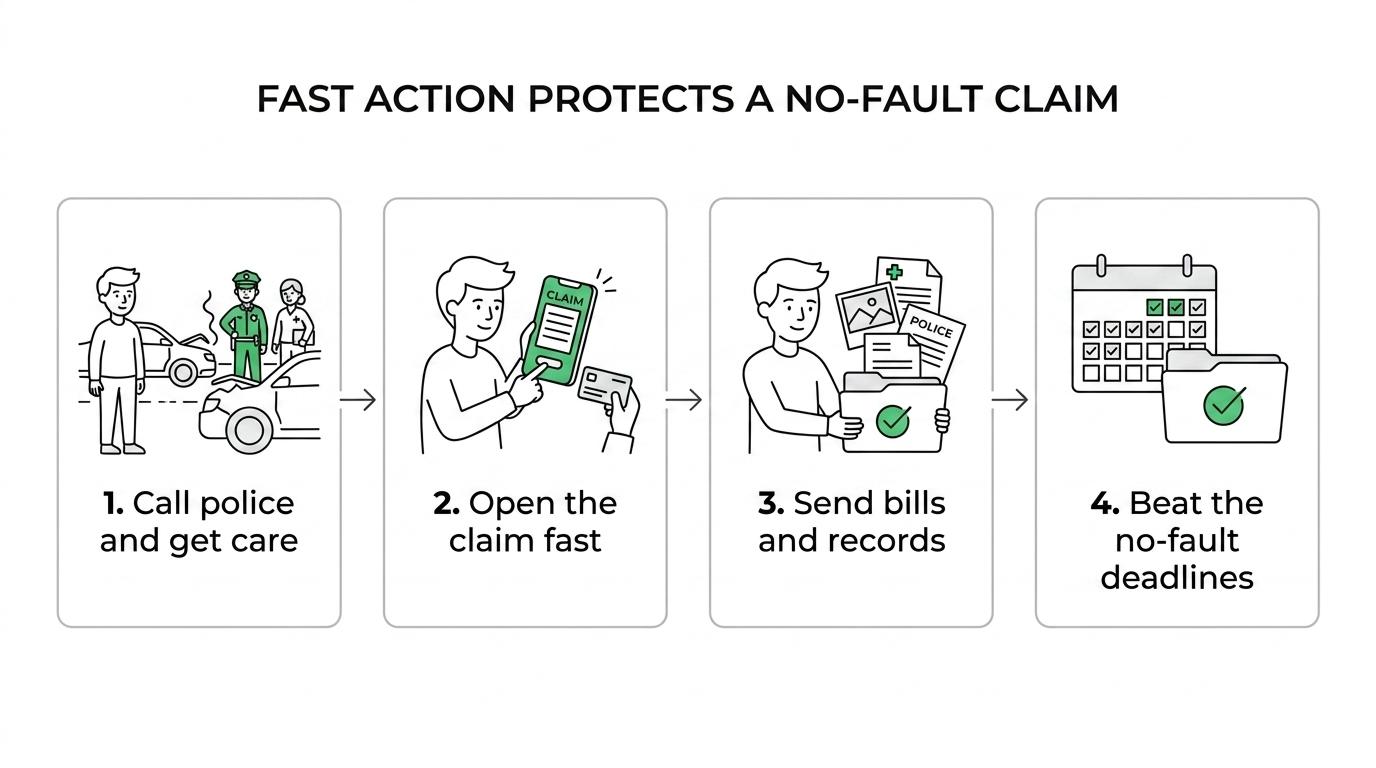
Michigan’s Department of Insurance and Financial Services says insurers generally must tell the claimant within 30 days what information is needed to handle the claim. Once the insurer receives satisfactory supporting documentation, PIP claims are overdue if they are not paid within 30 days. Vehicle-damage claims are overdue if they are not paid within 60 days after the insurer receives satisfactory supporting documentation.
There is also a major lawsuit deadline. Under Michigan law, an action to recover personal protection insurance benefits generally may not be started later than 1 year after the accident unless written notice of injury is given within 1 year or the insurer has already made a payment. Waiting is dangerous. Even when a full lawsuit is not needed, you want your claim moving long before that date.
If you are from Illinois, Ohio, Indiana, or another state and now attend MSU, do not assume your coverage issues will work themselves out. Students who move, borrow vehicles, or change addresses often run into policy questions that are far more technical than they expected. Get the policy information early. Confirm the vehicle owner. Confirm the insurer. Confirm where notices need to be sent.
flowchart TD
A[Crash in East Lansing or on MSU campus] --> B[Call police and get medical care]
B --> C[Open the insurance claim quickly]
C --> D[Insurer tells you what information is needed within 30 days]
D --> E[Submit medical bills and other supporting documents]
E --> F[PIP claim overdue if unpaid 30 days after satisfactory supporting documentation]
E --> G[Vehicle-damage claim overdue if unpaid 60 days after satisfactory supporting documentation]
A --> H[Act well before the 1-year PIP lawsuit deadline]
If you are already getting calls from an adjuster, or if your student is missing treatment because bills and forms are piling up, contact Ben Hall Law for a case review before the claim loses momentum.
Car accident evidence checklist for campus and off-campus crashes
Good evidence wins arguments before they start.
That is especially true in East Lansing, where student crashes often happen in tight, high-traffic areas with limited parking, pedestrians, buses, cyclists, food delivery drivers, and rideshare pickups all around the same block. A crash near the Union, near Spartan Village, outside an apartment complex on Albert Avenue, or in a lot by a student housing complex can become a “your word against theirs” dispute within hours.
You do not need a perfect file. You do need a solid one.
Here is what you should gather as soon as you can:
- Scene photos: Wide shots, damage to all vehicles, lane markings, traffic lights, street signs, debris, and weather conditions.
- People involved: Driver names, passenger names, witness contact information, and the responding officer’s name.
- Phone screenshots showing the time, map location, and rideshare trip if an Uber or Lyft was involved.
- Tow yard and repair shop information.
- Medical proof: Urgent care paperwork, ER discharge papers, prescriptions, and every bill or receipt.
- Class schedule and work records showing what the crash interrupted.
Students often miss that last item. If you lose shifts at a restaurant on Grand River, miss a lab, have to drop a clinical rotation, or cannot get to your internship in Lansing or Okemos because of injuries, document it. Those disruptions matter. Parents should ask for copies and keep them in one folder, whether digital or paper.

Student-specific car accident problems around MSU
A student crash claim is rarely just a standard car accident case. College life creates extra moving parts that many insurance companies do not volunteer to explain.
Borrowed cars and parent insurance after an MSU student crash
Many students do not own the vehicle they are driving. Maybe you borrowed a parent’s SUV for the semester. Maybe your roommate let you run to Meijer in Okemos. Maybe you were driving home from a shift in Frandor in a car titled to your family.
That matters because insurance priority questions can become complicated fast. The vehicle owner’s policy, the driver’s policy, and a parent’s household policy can all become relevant depending on the facts. Before you speak in detail to an insurer, get the declarations page, policy number, vehicle registration, and the name of every potentially involved insurer.
Parents should not guess here. Guessing creates coverage confusion. Documents fix it.
Parking lot crashes at apartments, dorms, and campus garages
A lot of student accidents do not happen at full speed on main roads. They happen in the places students spend most of their driving time: dorm lots, apartment parking areas, campus ramps, and cramped street parking near houses and student rentals.
Think about the lots around student housing, the ramps near downtown East Lansing, or the crowded areas around move-in, move-out, football Saturdays, and winter weather. These cases can involve poor lighting, icy pavement, blocked views, hit-and-run damage, or private-property issues. Students often assume a parking lot crash is “minor” and skip documentation. That is a mistake.
Even in low-speed collisions, get photos, identify witnesses, report the crash, and preserve every message or note left on a windshield. If campus police or local police create a report, get the report number before you leave.
What parents should do after an MSU student car accident
Parents usually step in after the first wave of panic passes. That help can be valuable if it stays organized.
A parent can stabilize the situation by doing a few things right away:
- Get the basics: Where did the crash happen, is anyone hurt, which police agency responded, and where was the car towed?
- Confirm insurance: Find out who owns the vehicle, which auto policy applies, and whether your student has already spoken to any insurer.
- Ask your student to stop posting about the crash on social media.
- Start a claim file: Save photos, report numbers, medical papers, receipts, towing records, repair estimates, and missed-work records.
If your student is overwhelmed, you do not need every answer on day one. You do need a clean record of what happened and who is involved.
Common car accident mistakes that can hurt your injury claim
The biggest mistakes after an East Lansing crash are usually simple ones.
Students wait too long to get checked out because they do not want to miss class. They talk too freely to the other driver’s insurer because they want to be cooperative. They assume soreness will fade and skip treatment. They repair the car before taking complete photos. They fail to get the police report. They lose receipts. They treat insurance deadlines like school deadlines and assume there is always an extension.
There usually is not.
Another common problem is minimizing the crash when talking to family. Students often say, “I’m fine” before they know whether they are fine. Parents hear that and relax. Two days later, there is back pain, a concussion concern, a visit to urgent care, and a recorded statement request from an adjuster.
If you are hurt, be accurate. If you are a parent, ask calm, direct questions. Where are you? Who responded? What hurts? Did you get photos? Did anyone witness it? What insurance information do you have?
That kind of clarity protects you.
When to call a car accident lawyer in East Lansing
You do not need a lawyer for every dented bumper. You do need legal help sooner rather than later if the crash involved injuries, an argument about fault, an uninsured or underinsured driver, a rideshare vehicle, a pedestrian or bike impact, or a difficult insurance issue tied to campus life.
You should also make the call if your student was injured while driving near MSU and the insurer is delaying, asking for recorded statements, disputing treatment, or acting like the claim should be easy to close for a small amount. East Lansing crashes involving students can look simple from the outside and become legally technical very fast.
Ben Hall Law is based in East Lansing and represents people dealing with serious injury claims. If your crash happened near MSU, downtown East Lansing, Okemos, Haslett, Lansing, or the major roads that connect them, the firm can help you sort out what insurance applies, what deadlines matter, and what steps should happen next.
If you want clear answers without being pushed around by the insurance process, contact Ben Hall Law and ask for a review of your crash, your policy issues, and your next deadline.
FAQ: Car accident steps for MSU students and parents
Do I really need to call police if the crash seems minor?
Yes, many students should. Michigan requires an immediate police report when someone is injured or killed, or when property damage appears to total $1,000 or more. Modern repair costs make that threshold easier to hit than most people think.
Who handles a crash report on MSU property?
It depends on where the crash happened. MSU Police and Public Safety handles certain crash documentation on campus and on public roadways it covers. The department uses the State of Michigan UD10 Traffic Crash Report for public-roadway crashes and has a Traffic Request Form process for obtaining reports.
What if my student goes to MSU but is still on a parent’s insurance policy?
That is common. Still, you should verify exactly which policy applies, who owns the vehicle, and where claims must be sent. Do not assume the right insurer already has notice.
How soon should a student get medical care after a crash?
As soon as symptoms appear, and immediately if there is any urgent concern. Delays can hurt your health and make the insurer question whether the crash caused the injuries.
What documents should we keep after the crash?
Keep the police report number, photos, insurance information, medical records, bills, prescription receipts, towing paperwork, repair estimates, witness names, and proof of missed classes or lost wages.
What if the other driver’s insurance company calls first?
Be careful. You do not have to give a casual, detailed recorded statement just because the phone rings. Get the adjuster’s name, company, claim number, and contact information, then decide your next step after you have your facts together.
How long do Michigan no-fault deadlines last?
Some claim-handling deadlines start much earlier than students expect. Insurers generally must tell claimants within 30 days what information is needed to handle the claim. PIP claims can become overdue 30 days after satisfactory supporting documentation is received. Vehicle-damage claims can become overdue after 60 days. Lawsuit timing can also be critical, including a 1-year rule that can affect PIP benefit recovery.
What if my student is from out of state?
Out-of-state students should check coverage immediately. Residency, ownership, and policy terms can affect what benefits may be available. This is one of the most common areas where families make assumptions that later create problems.
Should parents come to East Lansing right away?
Not always. If your student is safe and getting care, you may be able to handle the first stage by phone. What matters most is making sure police are involved, treatment begins if needed, and the insurance and documentation process starts without delay.
Can a crash affect school and work losses too?
Yes. If you miss a job, internship, clinical placement, lab, or class-related obligation because of crash injuries, keep records. Those disruptions may matter as your claim moves forward.
A crash near campus can leave you dealing with pain, bills, transportation problems, and pressure from insurance adjusters all at once. You do not have to sort that out alone. Reach out to Ben Hall Law if you or your student was hurt in a car accident in East Lansing and you want direct guidance on police reports, Michigan no-fault rules, and the next move that protects your claim.

 877-Ben-Hall