When your Michigan State student gets hurt off campus, the first wave of stress usually hits fast. You want to know if they are safe, where they are getting care, who should be called, and whether the problem ends with a medical bill or turns into something much bigger. Your student may be shaken up, trying to downplay the injury, or giving you scattered details from a phone in an ambulance, a rideshare, or a friend’s apartment near Grand River Avenue.
That moment is hard for students and parents in different ways. Students worry about class, work shifts, roommates, and whether their injury will become public. Parents worry about health, insurance, legal deadlines, and whether someone else caused harm that should not be ignored. Around East Lansing, those concerns often overlap because many off-campus injuries happen in busy student areas where traffic, rental housing, nightlife, and large gatherings all meet.
What helps most is a calm, organized response. Medical help comes first. Campus support may matter even when the injury happened off university property. Legal and insurance issues can start almost right away, especially after a crash or a serious injury at an apartment, party, parking lot, or rental house.
By: Ben Hall | Attorney and Owner of Ben Hall Law | Marine Corps and Iraq War Veteran | Former Police Officer | Former Prosecutor
Published: June 3, 2026

Off-campus injury risks near Michigan State University and East Lansing
If your student lives or spends time off campus, the injury may happen in places that feel routine. That includes apartments off Hagadorn Road, houses near Cedar Village, sidewalks by Bogue Street, parking lots near downtown East Lansing, bus stops along Grand River, or rideshare drop-off spots after a night out. Students move between campus and off-campus areas constantly, and that means the line between school life and personal life is not always clean.
The most common situations are not all the same. A car crash on Harrison Road raises different issues than a fall on icy stairs at a rental property. A pedestrian injury near Albert Avenue is different from an assault at a party in a student neighborhood. If alcohol, poor lighting, bad maintenance, inadequate security, or a careless driver played a role, several people or businesses may end up being part of the picture.
This is also why parents should avoid assuming that “off campus” means “MSU has nothing to do with it” or “there is no claim.” Your student may still need campus services, academic help, crisis support, or medical follow-up through university resources even when the injury happened blocks away from Spartan Stadium or outside a building that MSU does not own.
| Common East Lansing injury setting |
What often causes the harm |
Why families get stuck |
| Off-campus apartment or rental house |
Broken stairs, poor lighting, ice, unsafe entryways |
Landlord responsibility is not always obvious right away |
| Roads near MSU including Grand River, Trowbridge, and US-127 access points |
Car, motorcycle, bus, bicycle, and pedestrian crashes |
Michigan is a no-fault state |
| Student party or gathering |
Assault, falls, overcrowding, poor security |
Witnesses leave, stories change, videos vanish |
| Parking lots and sidewalks in East Lansing |
Slip and fall, rideshare incidents, backing collisions |
Property owner and driver issues may overlap |
Need a clear next step today? If your MSU student was hurt off campus in East Lansing, Lansing, Okemos, or nearby, you can call 877-BEN-HALL to talk through what should happen first.
What to do in the first 24 hours after an off-campus injury near MSU
The first day matters because the medical record, the photos, the witnesses, and the timeline usually start there. If the injury is serious, call 911 right away. If emergency care is not needed, get your student evaluated anyway. A concussion, neck injury, internal injury, or trauma-related symptoms can look minor at first and worsen by the next morning.
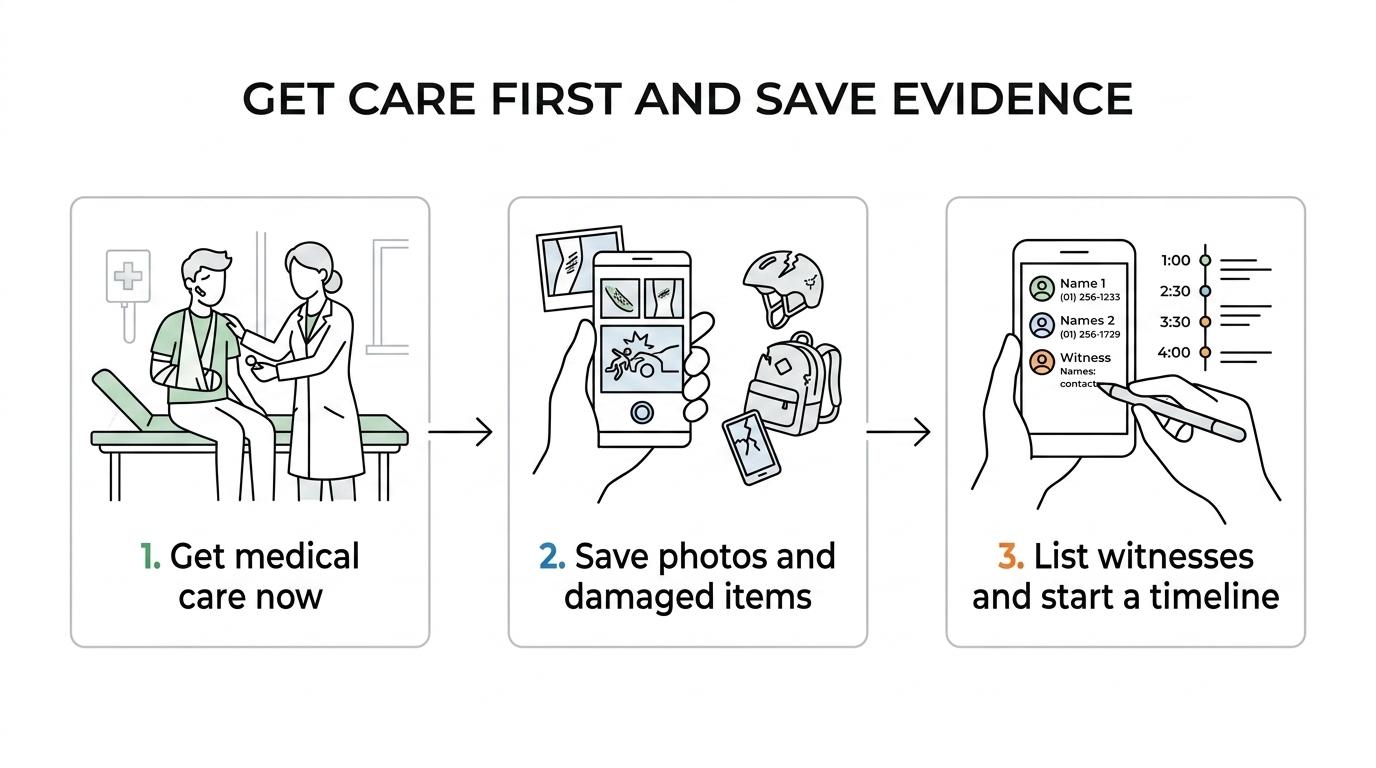
You should also help your student slow down and stop filling gaps with guesses. After a crash or fall, students often say “I’m fine” because they do not want to miss class, alarm you, or deal with police or insurance. That instinct can hurt them later if pain builds, symptoms change, or an insurer points to the student’s own words.
A practical first-day checklist keeps you from losing ground.
- Get medical care
- Save photos of injuries and the scene
- Keep damaged clothing, helmet, backpack, or phone
- Write down names of witnesses
- Report the incident when needed
- Avoid giving recorded statements too soon
- Start a simple timeline
flowchart TD
    A[Injury Happens Off Campus] --> B{Emergency?}
    B -->|Yes| C[Call 911 or go to ER]
    B -->|No| D[Get prompt medical evaluation]
    C --> E[Document what happened]
    D --> E
    E --> F[Save photos, witnesses, receipts, messages]
    F --> G[Notify family and relevant school support]
    G --> H[Review insurance and legal options]
If your student is hospitalized or dealing with a traumatic event, ask one person in the family to keep notes. A simple note on your phone with times, hospital names, provider names, and who said what can be very useful later.
Medical care and MSU support for injured students after an off-campus accident
Medical treatment is the center of everything. If your student is stable and needs follow-up care, MSU directs students to University Health and Wellbeing Campus Health Services at Olin Health Center as a first stop for many medical needs. That can be helpful when your student needs continuity, referral guidance, or a campus-connected medical point of contact.
Parents should also know that an injury does not have to be purely physical to disrupt a student’s life. Fear after an assault, panic after a crash, or trauma after seeing a friend badly hurt can affect sleep, concentration, and class attendance. MSU states that students can call Counseling and Psychiatric Services, or CAPS, at 517-355-8270 and press 1 to speak with a crisis counselor at any time. MSU also makes a family resource guide available through CAPS and offers same-day help and virtual crisis counseling options.
That matters more than many families expect.
A student who insists they are “okay” may still need care for pain, dizziness, anxiety, nightmares, or trouble functioning in class. You do not need to wait for a legal claim to begin before using available support.
If the injury involved violence, stalking, or sexual misconduct, MSU publishes safety and victim support information through its Annual Security and Fire Safety Report and its Relationship Violence and Sexual Misconduct Policy resources. Even when the event happened off campus, those school-based support channels can still help your student get through the week, the semester, and the reporting process.

If you are trying to balance medical care, parent communication, and legal questions at once, call 877-BEN-HALL. A local East Lansing office can make those early decisions easier.
Michigan no-fault insurance after a student car, pedestrian, or rideshare injury
Vehicle cases often confuse parents the most because Michigan is a no-fault state. If your student was injured in a car crash, the question is not only “Who caused it?” Michigan’s no-fault automobile insurance system can trigger Personal Injury Protection, often called PIP, which may cover medical expenses and other benefits depending on the policy and the facts.
That means your student may have insurance rights even before fault is fully sorted out. It also means families sometimes lose time because they focus only on the other driver’s blame and miss the insurance side that should start right away.
This issue comes up constantly around MSU. Think about traffic near Frandor, rush-hour backups near US-127, left turns on Grand River, crowded crosswalks near downtown East Lansing, or winter driving on Lake Lansing Road. Students are drivers, passengers, pedestrians, cyclists, and rideshare users all in the same week. One crash can raise questions about the student’s own auto policy, a parent’s policy, the driver’s policy, or a commercial rideshare policy.
Here is a simple way to think about it:
| If this happened |
Insurance issue that may matter |
| Your student was driving their own car |
Their own no-fault policy may be first in line |
| Your student was a passenger in a friend’s car |
Priority rules may depend on household and policy details |
| Your student was hit while walking or biking |
No-fault benefits may still apply through available policies |
| Your student was in an Uber or Lyft |
Commercial coverage and no-fault questions may overlap |
| Another driver was clearly at fault |
Fault can still matter for pain and suffering claims beyond PIP |
You should be careful with recorded statements. Insurance adjusters often sound helpful early, and some truly are polite and responsive. Still, their job is not the same as your job. Your job is to protect your student’s health, records, and options. If your student is in pain, confused, or still being evaluated, it is usually smart to slow the conversation down before anyone locks into a version of events that is incomplete.
Off-campus apartment, party, and pedestrian injuries in East Lansing student areas
Not every serious student injury involves a car. A large share of off-campus cases involve rental housing, sidewalks, parties, or poorly managed properties. Around East Lansing, that can mean icy walkways near student housing, collapsing porch steps, broken handrails, unsecured entrances, dog bites, assaults at crowded gatherings, or parking lot hazards behind apartment complexes.
Students also get hurt because off-campus life is fast and crowded. They may be walking back from a shift, crossing against a light near the Peanut Barrel area, taking a scooter down a dark side street, or heading home from a house party where nobody wants police or EMS involved. In those moments, key evidence disappears quickly. Party hosts clean up. Leases change. Ring camera footage gets deleted. Witnesses head home for the weekend or summer break.
If your student was injured at an apartment complex, rental house, business, or event space, save what you can right away.
- Photos: stairs, sidewalks, lighting, spilled liquid, broken locks, doorways, railings, snow or ice, damage
- Documents: lease, incident report, discharge papers, rideshare receipt, tow record, police report number
- Communications: texts with landlord, roommate messages, social media posts, emails from management
- People: witnesses, roommates, RA contacts, party hosts, drivers, employees, security staff
One detail matters a lot in student cases: your student may feel pressure to stay quiet because they were drinking, out late, at a party, or someplace they think you will not approve of. That does not mean they lose the right to medical care or a fair legal review. It means you need facts, not shame, guiding the response.
Why acting quickly matters under Michigan law for student injury claims
Michigan law sets a general 3-year limitations period for many personal injury claims, measured from the date of the injury under MCL 600.5805. That sounds like a long time, and families often assume they can wait until the semester ends or until treatment is over before looking at legal options.
Waiting is usually where avoidable problems start.
Video footage may be overwritten in days. Student witnesses graduate, move, or stop responding. Property conditions change. A hole gets fixed, ice melts, broken lights are replaced, and the apartment manager denies the danger ever existed. In crash cases, vehicles get repaired or sold. In assault cases, stories harden fast.
You do not need to file a lawsuit the week after the injury. You do need to act like evidence is fragile, because it is.
Some claims can also involve shorter notice rules or special procedures, especially when a public entity, a government vehicle, or another protected party is involved. That is one reason families should not rely only on the general 3-year rule.
Do not wait for the next tuition bill, lease renewal, or semester break. If your student was hurt off campus, call 877-BEN-HALL and get a local review of the facts before records and evidence fade.
Questions parents should ask after an MSU student injury
When your student calls, the first conversation is rarely complete. Ask short, direct questions and write the answers down. You are not trying to interrogate them. You are trying to protect them while details are still fresh.
- Where exactly did it happen, and who was there?
- Have you already seen a doctor, nurse, urgent care, or ER?
- Did police, EMS, apartment management, or a business make a report?
- Do you have photos, texts, screenshots, or contact info for witnesses?
- Has any insurance company, landlord, or property manager contacted you yet?
If your student is a minor under stress, they may keep changing the story because they are scared, concussed, embarrassed, or unsure. That does not always mean they are hiding something. It can mean they are overwhelmed.
Parents should also ask about practical school issues. Can your student walk to class? Do they need a note for missed exams? Are they safe where they live? If the injury happened at a boyfriend’s, girlfriend’s, roommate’s, or teammate’s place, do they need somewhere else to stay for a few nights in East Lansing, Okemos, or back home?
How local legal help in East Lansing can steady the process for students and parents
A student injury claim is rarely just one problem. You may be dealing with medical bills, insurance confusion, transportation issues, academic fallout, and a child who does not want to feel like a burden. Local help matters because the facts around MSU are local. The roads are local. The apartment complexes are local. The businesses, police agencies, and healthcare providers are local.
Ben Hall Law is based in East Lansing at 139 W Lake Lansing Road, Suite 140, East Lansing, MI 48823, and serves East Lansing, Lansing, Ingham County, and nearby Michigan communities. That local presence matters when your student was injured near campus, in a nearby student rental, or on one of the roads that families in this area deal with every day.
The point of early legal help is not to rush a lawsuit. It is to protect the claim while your student focuses on treatment and school. That can include reviewing who may be responsible, helping with insurance issues, preserving evidence, and keeping a family from making avoidable mistakes in the first few weeks.
FAQ about an MSU student injured off campus
Does MSU help if my student was hurt off campus?
Yes, campus support can still matter. MSU provides medical and wellness resources, and students may be able to get help through Olin Health Center for follow-up needs. If the injury is causing emotional distress or crisis symptoms, MSU states that CAPS is available at 517-355-8270, press 1, for crisis counseling access.
Should my student go to the ER or Olin Health Center?
If the injury is serious, sudden, or involves severe pain, head injury, possible fracture, heavy bleeding, breathing trouble, or loss of consciousness, use emergency care first. Olin Health Center can be helpful for follow-up, evaluation of non-emergency issues, referrals, and continuity once the immediate danger has passed.
What if my student was hurt in a crash but was not driving?
Michigan no-fault rules may still apply. A student who was a passenger, pedestrian, or cyclist can still have insurance rights tied to available auto policies and Personal Injury Protection benefits. The answer depends on the facts and the insurance available.
How long do we have to file a personal injury claim in Michigan?
Michigan’s general deadline for many personal injury claims is 3 years from the date of injury under MCL 600.5805. That is the outside limit in many cases, not a reason to wait. Evidence often gets weaker long before the deadline arrives.
What if the injury happened at an off-campus apartment or rental house?
The property owner, landlord, management company, tenant, or another person may be involved depending on what caused the injury and who controlled the area. Save photos, the address, lease details, incident reports, and all communication with management right away.
Should my student talk to the insurance adjuster?
Be careful. Basic facts may need to be reported, especially in a vehicle case, but recorded statements can create problems if your student is still being treated or does not yet know the full extent of the injury. It is usually wise to slow down and get advice before giving a detailed statement.
What if my student was hurt at a fraternity, sorority, or house party?
Do not assume there is no claim because it happened at a student event. Liability can depend on who owned or controlled the property, whether security or supervision issues were involved, how the injury happened, and whether alcohol, dangerous conditions, or violence played a role.
Can parents handle this if their student is overwhelmed?
Yes, parents often become the practical organizers after a serious injury. You can help with medical scheduling, insurance, records, photos, transportation, and school communication. If legal issues are involved, local guidance can help you focus on the right tasks without making the situation harder.
If your family is dealing with an off-campus injury near Michigan State University, getting organized early can protect your student’s health, school life, and legal options at the same time. A local East Lansing office can answer questions, review the facts, and help you decide what should happen next.
 877-Ben-Hall