

Published: August 14, 2026
By: Ben Hall | Attorney and Owner of Ben Hall Law | Marine Corps and Iraq War Veteran | Former Police Officer | Former Prosecutor
If you are hurt in an Uber or Lyft crash in Michigan, the answer to “whose insurance pays?” depends on one key fact right away: what the rideshare driver was doing in the app at the exact time of the wreck.
That single detail can change the available liability coverage from relatively modest limits to a $1,000,000 policy. It can also affect where no-fault benefits come from, whether you can use the rideshare company’s policy as a passenger, and how vehicle damage gets handled if your car was involved.
Around East Lansing, Lansing, Okemos, and Haslett, this matters more than many people realize. A crash on Grand River Avenue after a pickup near Michigan State University is not handled the same way as a routine two-car wreck on US-127 or I-496. Rideshare cases often involve layered insurance, corporate claims systems, app data, and Michigan no-fault rules all at once.
After a rideshare crash, focus on these first questions:
- Was the driver offline?
- Was the driver logged in and waiting for a ride?
- Had the driver accepted a trip or was a passenger already in the vehicle?
- Were you a passenger, another driver, a pedestrian, or a bicyclist?
- Do you have your own Michigan auto policy?
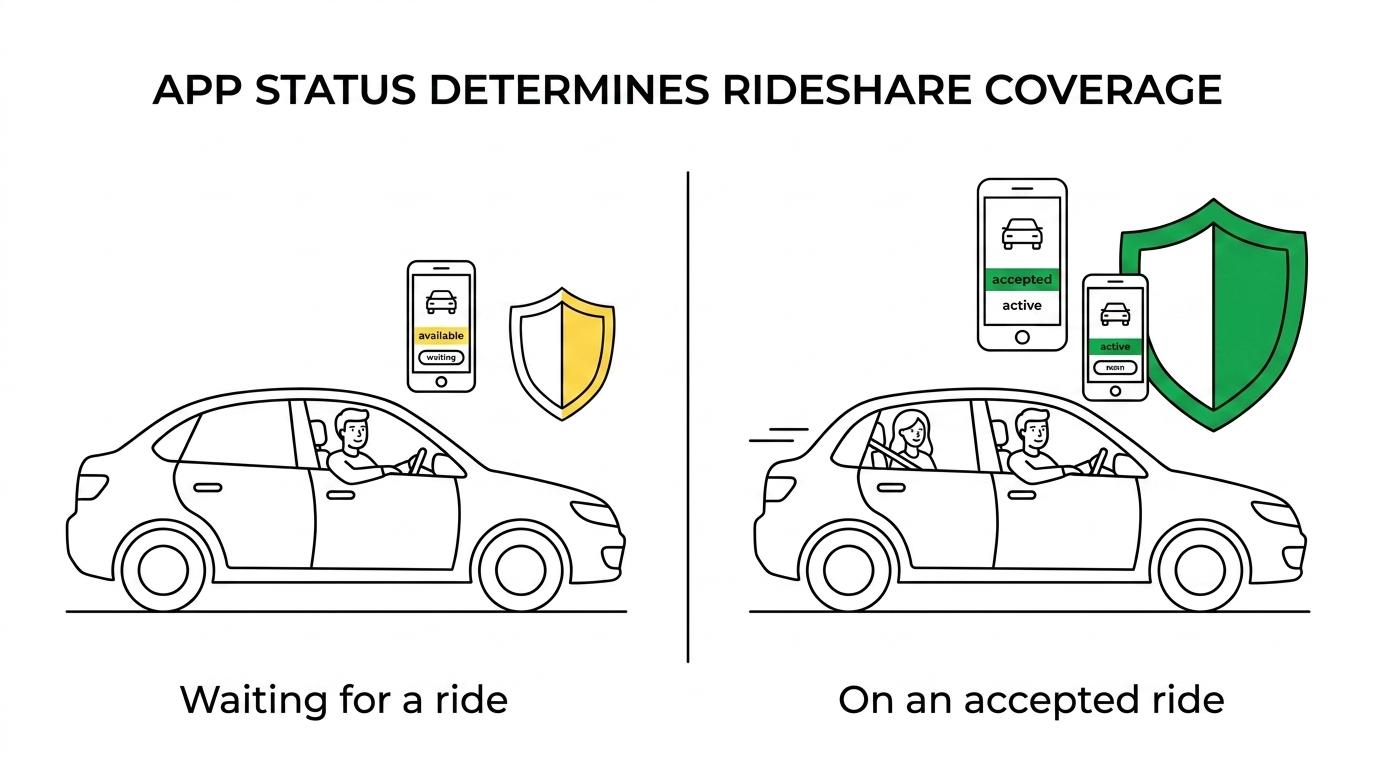
Michigan rideshare insurance depends on the driver’s app status
Michigan treats Uber and Lyft as transportation network companies. The insurance rules change based on the driver’s status in the app.
If the driver was logged off, the rideshare company’s special coverage usually is not the starting point. In that situation, the driver’s own auto insurance is generally the policy you look at first, subject to whatever coverage exists and any policy issues that may come up.
If the driver was logged in and available for a ride, Michigan requires a lower tier of rideshare liability insurance than when an actual trip is underway. Once the driver has accepted a ride or is on a prearranged ride, the required liability coverage jumps dramatically.
That is the biggest switch in a Michigan Uber or Lyft crash claim.
Michigan Uber and Lyft insurance limits by trip stage
The numbers below are the practical starting point for many rideshare claims in Michigan.
| Driver status at crash | Required liability coverage in Michigan | Why it matters |
|---|---|---|
| App off | Usually personal auto policy applies first | Rideshare company coverage may not be active |
| Logged in and available | $50,000 per person / $100,000 per incident / $25,000 property damage | Lower rideshare liability tier |
| Accepted ride or passenger in car | $1,000,000 combined single limit | Highest rideshare liability tier |
These limits come from Michigan’s Transportation Network Company Act. If the rideshare driver’s required coverage has lapsed or is not enough, the transportation network company’s insurance can apply from the first dollar of the claim and must provide a defense.
That point matters if you are hit by a rideshare driver near Spartan Stadium on game day, outside the Lansing Center, or during a late-night pickup in downtown East Lansing. In real life, drivers move quickly between “available” and “on a ride,” and the app records can become major evidence.
flowchart TD
    A[Crash involving Uber or Lyft in Michigan] --> B{Driver app status?}
    B --> C[App off]
    B --> D[Logged in and available]
    B --> E[Accepted ride or passenger onboard]
    C --> F[Personal auto policy usually applies first]
    D --> G[$50k/$100k/$25k liability tier]
    E --> H[$1,000,000 combined single limit]
    A --> I{Who is injured?}
    I --> J[Passenger]
    I --> K[Other driver]
    I --> L[Pedestrian or cyclist]
    J --> M[PIP may come from own policy or TNC policy depending on priority]
How Michigan no-fault PIP applies after an Uber or Lyft crash
Liability insurance is only one part of the picture. Michigan’s no-fault system still shapes what happens after a rideshare collision.
Personal protection insurance, usually called PIP, is the coverage that can pay medical expenses and certain other no-fault benefits, depending on the facts and the policy that applies. Michigan allows transportation network company applicants or named insureds to select PIP medical coverage at $250,000, $500,000, or unlimited.
That selected PIP level can matter a lot if you are a passenger.
If you are riding in an Uber or Lyft and you are not otherwise required to carry auto insurance, Michigan says you can seek benefits under the transportation network company policy, subject to the PIP level that policy elected. Under state guidance, that TNC policy cannot be lower than $250,000 per person per accident.
This is where many people get confused. They assume the $1,000,000 figure automatically means every injury expense is covered in every situation. It does not work that way. The $1,000,000 figure is a liability requirement during a prearranged ride. PIP is its own part of the claim and has its own rules, limits, and priority questions.
A quick way to think about it:
- Liability coverage: Money available when a legally responsible party causes harm
- PIP coverage: No-fault medical and related benefits under Michigan rules
- Collision coverage: Repair coverage for your own vehicle, if you bought it
- Mini-tort: A limited way to recover some out-of-pocket vehicle damage
Who pays for car damage after an Uber or Lyft crash in Michigan
Many Michigan drivers are surprised by this even after years of paying auto premiums: no-fault insurance usually does not pay to repair your car after a crash.
If your vehicle was damaged in an Uber or Lyft collision on I-96, near Frandor, or while leaving Eastwood Towne Center, the policy that usually handles your own vehicle repairs is collision coverage, if you purchased it.
Michigan no-fault is not a general car-repair system for your own vehicle. That distinction matters even more with newer vehicles, because seemingly minor crash damage can trigger sensor and camera recalibration costs, a point EZ Tech PDR highlights in its breakdown of whether a fender-bender needs ADAS calibration.
That is why two people can have very different financial outcomes after nearly identical crashes. One has collision coverage and gets the car fixed. The other does not and has to look at other limited options.
One of those limited options is mini-tort. For accidents occurring after July 1, 2020, Michigan mini-tort can reach up to $3,000. That can help with vehicle damage not covered elsewhere, though it is not a substitute for full collision coverage.
Here is the practical rule: if your car is damaged in a rideshare crash, always ask about collision coverage and mini-tort early. Waiting too long can make the claim harder to document.
What makes Michigan Uber and Lyft crash claims more complicated
A regular crash can be stressful enough. A rideshare crash adds extra moving parts.
You may be dealing with the driver’s personal insurer, the rideshare company’s policy administrator, your own no-fault carrier, and repair issues at the same time. If the crash happened during a trip to Detroit Metro Airport, outside the State Capitol, or during a busy student weekend near MSU, records can also include GPS history, app screenshots, trip timestamps, and communications through the platform.
Common pressure points in rideshare claims include:
- App-status disputes: Whether the driver was waiting for a fare or already on a prearranged ride
- Policy-priority questions: Which insurer should pay PIP first
- Vehicle-damage confusion: No-fault does not usually repair your car
- Incomplete reporting: Missing screenshots, ride receipts, or witness information
- Corporate claims handling: Adjusters often want recorded statements early
You do not need to sort out every layer on day one. You do need to preserve the right evidence right away.
What to do after an Uber or Lyft accident in Lansing, East Lansing, or anywhere in Michigan
The steps you take in the first day or two can shape the whole claim.
If you were a passenger, save proof of the ride before it disappears into an app update or account history issue. If you were another driver or a pedestrian, get confirmation that the at-fault driver was working for Uber or Lyft at the time. Police reports do not always capture that detail clearly.
After a Michigan rideshare crash, take these actions as soon as you can:
- Get medical care: Your health comes first, and early records matter
- Preserve app evidence: Save ride receipts, screenshots, trip details, and timestamps
- Photograph everything: Vehicles, license plates, injuries, intersections, and road conditions
- Report the crash carefully: Notify the proper insurers, but do not guess about fault or coverage
- Check your own policy: Look at your PIP selection and collision coverage
- Ask about deadlines: No-fault and insurance notice rules can move fast
If the crash happened in Mid-Michigan, location details can matter too. A wreck near US-127 and Trowbridge Road may involve commuter traffic and multiple witnesses. A late-night pickup on Albert Avenue may raise timing issues tied to bar closings and app activity. A trip from East Lansing to downtown Detroit may bring in records from several carriers and jurisdictions.
When the rideshare company’s insurance may step in from the first dollar
Michigan law gives important protection here. If the rideshare driver’s required coverage lapses or is not enough, the transportation network company’s insurance can apply from the first dollar of the claim.
That can be a major issue when a personal insurer denies coverage, when the driver’s policy is insufficient, or when the available policy does not satisfy the rideshare period involved.
This is one reason rideshare claims should not be handled like ordinary fender-benders. You may have a valid claim against a much larger policy than the first adjuster suggests.
FAQ about Uber and Lyft accident insurance in Michigan
Does Uber or Lyft always provide $1,000,000 in Michigan?
No. That $1,000,000 combined single limit applies when the driver is on a prearranged ride, which generally means the trip has been accepted or is underway. If the driver is only logged in and waiting for a request, Michigan requires lower liability limits of $50,000 per person, $100,000 per incident, and $25,000 for property damage.
If you are an Uber or Lyft passenger in Michigan, whose PIP pays?
It depends on the no-fault priority rules and your own insurance situation. If you are not otherwise required to maintain auto insurance, Michigan says you can claim under the transportation network company policy, subject to the PIP level that policy selected, which cannot be lower than $250,000 per person per accident.
Will Michigan no-fault insurance repair your car after a rideshare crash?
Usually no. Michigan no-fault generally does not pay to repair your own vehicle after a crash. Your collision coverage is usually what pays for your car repairs, if you bought it.
What is mini-tort in a Michigan Uber or Lyft crash?
Mini-tort is a limited vehicle-damage claim that can help cover repair costs not otherwise paid. For accidents after July 1, 2020, the Michigan mini-tort maximum is up to $3,000.
What if the rideshare driver’s personal insurance denies the claim?
Michigan law says that if the driver’s required rideshare coverage lapses or is insufficient, the transportation network company’s insurance can apply from the first dollar and must defend the claim.
What evidence should you keep after a Lyft or Uber crash in Michigan?
Keep the ride receipt, app screenshots, driver information, vehicle photos, police report number, witness contacts, and all medical records. If you were near a business corridor like Grand River Avenue, downtown Lansing, or an airport pickup zone, ask quickly about nearby surveillance footage.
Can you still have a claim if the crash happened while the driver was waiting for a fare?
Yes. The available insurance is different, but a logged-in driver still falls under Michigan’s rideshare insurance rules. The main issue is identifying the exact app status at the time of the crash.