

Published: June 24, 2026
By: Ben Hall | Attorney and Owner of Ben Hall Law | Marine Corps and Iraq War Veteran | Former Police Officer | Former Prosecutor
If your phone lights up late at night and your Michigan State student says they were hurt in an Uber or Lyft crash, you do not have much time to sort through panic before important decisions start stacking up. Was your student a passenger? Were they getting in or out near Grand River Avenue? Did another car hit the rideshare near Hagadorn Road, Bogue Street, or Abbot Road? In East Lansing, those details can shape which insurance company should be paying right away.
This is where many families get blindsided. A rideshare crash is not just a normal car accident with a bigger company name attached to it. Michigan no-fault rules, household insurance choices, the rideshare driver’s app status, and medical documentation timing can all affect what gets paid, when it gets paid, and who tries to avoid responsibility.
If your student is dealing with pain, class absences, work interruptions, or mounting medical bills, you need a clear plan fast.
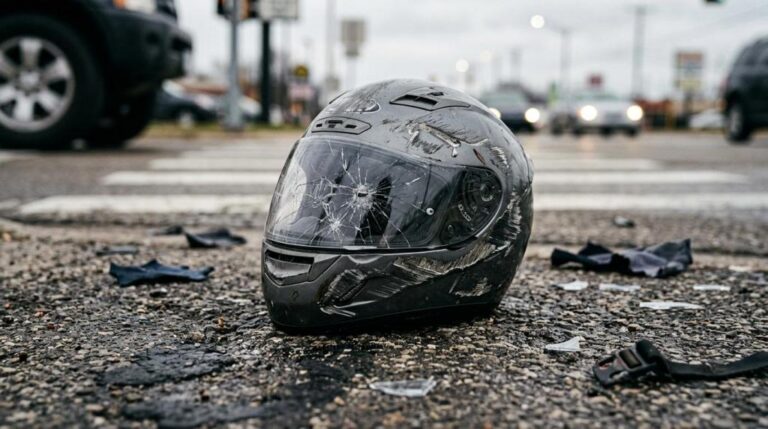
Visualization: A common East Lansing crash setting involves curbside pickup zones, campus foot traffic, and fast-moving traffic near MSU.
Why an MSU rideshare accident can get complicated fast
Your student may use Uber or Lyft the same way most MSU students do: getting back from downtown East Lansing, heading to an off-campus apartment near Cedar Village, catching a ride to Frandor, or avoiding parking on game day near Spartan Stadium. It feels simple on the front end. The insurance side is not.
Michigan auto injury claims can depend on what coverage existed at the exact moment of the crash, not just who caused it. That matters in rideshare cases because Uber and Lyft coverage can change depending on whether the driver was offline, online waiting for a ride, or actively on a trip. A crash on M.A.C. Avenue two minutes before pickup may be analyzed differently than a crash with the passenger already in the vehicle heading toward Brody, the MSU Union, or an apartment off Lake Lansing Road.
Parents often assume the rideshare company will “take care of it.” Sometimes there is coverage available through Uber or Lyft. Sometimes another insurer should be first in line. Sometimes a student’s own no-fault path matters even if the student does not own a car.
That is why quick fact-gathering matters so much.
You should focus on these first questions:
- Where exactly did the crash happen?
- Was your student inside the Uber or Lyft?
- Was the ride already accepted in the app?
- Did police respond?
- Where did your student get medical treatment?
- What insurance does your household carry in Michigan?
What you should do in the first 24 hours after an East Lansing Uber or Lyft crash
The first day is about protecting your student’s health and preserving the facts before they get blurry. East Lansing crash scenes change quickly. Traffic keeps moving on Grand River. Students go back to dorms, apartments, class, or work. Drivers log off. Witnesses disappear. Nearby cameras at businesses along Grand River or around downtown may not keep footage for long.
You do not need to solve the entire claim in one night. You do need to make sure the right information is captured while it still exists.
Start here:
- Get medical care right away, even if the injuries seem minor.
- Save screenshots from the Uber or Lyft app showing the ride, driver, time, and route.
- Get the crash report number if police responded.
- Photograph injuries, vehicle damage, the pickup or drop-off area, and any visible road conditions.
- Write down what your student remembers before memory starts to fade.
A student who felt “shaken up” leaving downtown East Lansing can wake up the next morning with neck pain, a concussion, back symptoms, or difficulty walking to class. That is common after traffic crashes. Early treatment also helps create a clean medical record connecting the injury to the crash.
If your student was taken for treatment in Lansing or East Lansing, keep every discharge paper, referral, and billing record. Insurance carriers often ask for medical records, billing support, and other proof of loss before paying benefits.
Call to Action: If your MSU student was hurt in an Uber or Lyft accident near campus, contact Ben Hall Law promptly so the insurance path can be checked before the wrong company starts pushing the claim in the wrong direction.
How Michigan no-fault insurance affects an injured MSU student
[Personal Injury Protection, often called PIP, can apply to medical expenses and other no-fault benefits after a motor vehicle crash. The key issue is not always vehicle ownership. It can be whether your student is covered through a policy in the household or another available source under Michigan law.
That is why parents should not assume there is no no-fault claim just because the student does not have a car on campus. Many students from East Lansing, Okemos, Haslett, Grand Ledge, or other parts of Mid-Michigan still have insurance connections through family arrangements that matter after a crash.
The Michigan Department of Insurance and Financial Services states that PIP medical bills are overdue if they are not paid within 30 days after the insurer receives satisfactory supporting documentation. That timing matters. If bills are submitted late, incompletely, or to the wrong carrier, payment disputes can start early.
Another issue involves household coverage choices. Some Michigan drivers selected lower PIP medical options or opted out in limited situations tied to qualified health coverage. If your household made one of those elections, you need to know exactly what was in place at the time of the crash. If coverage changed and proper notice was not handled, the claim can become even more technical.
Here is a simple overview of why rideshare claims need a phase-by-phase review:
| Rideshare phase | General insurance issue | Why it matters for an MSU student passenger |
|---|---|---|
| App off | Driver’s personal auto policy is usually the starting point | A crash before the driver goes active may not involve rideshare company coverage the way families expect |
| App on, waiting for ride request | Coverage may differ from a full active-trip phase | A driver near East Lansing bars, apartments, or campus roads may be “working” but not yet in the strongest coverage phase |
| Ride accepted, driver en route | Rideshare company coverage may apply differently | This can matter if the crash happens while the driver is heading to pick up your student |
| Passenger in vehicle during trip | Active-trip analysis becomes central | This is the classic Uber or Lyft passenger case, but no-fault questions still need to be checked |
| Passenger exiting or entering vehicle | Injury facts may involve both vehicle and pedestrian issues | A curbside drop-off near Grand River or Albert Avenue can add another layer to the claim |
That table is a general guide, not a final legal answer. The actual claim depends on policy language, crash facts, and the available insurance chain.
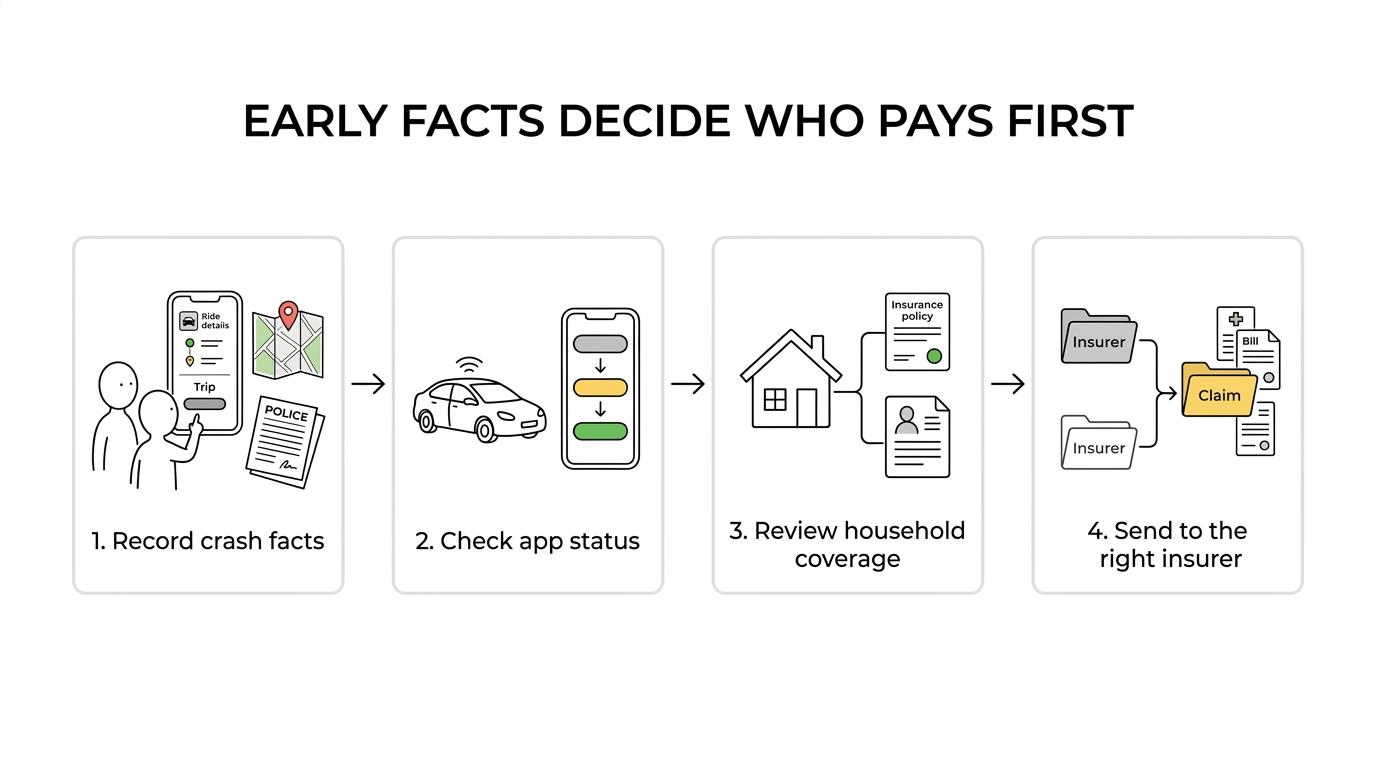
Visualization: A rideshare injury claim often starts with one simple question, then branches into several insurance paths based on app status and available no-fault coverage.
Why the Uber or Lyft app status matters in a Michigan injury claim
Parents are often surprised to learn that rideshare coverage is not one fixed blanket policy from the second a driver wakes up until the second the shift ends. Uber and Lyft describe different coverage phases based on whether the app is off, on, or tied to an accepted ride.
That can matter a lot if the crash happened while the driver was circling near East Lansing neighborhoods, waiting near the MSU Union, or approaching a pickup point outside an apartment complex on Chandler Road or Trowbridge Road.
The official coverage summaries from Uber and Lyft make the basic point clear: app status matters. Uber states there is no Uber-maintained collision or comprehensive coverage when the driver is offline, and none for that type of coverage when the driver is online but has not accepted a trip. Lyft states it has no policy that applies when the app is off, and says that when the app is on and the driver is receiving rides, it maintains third-party liability coverage for covered accidents if personal insurance does not apply.
For parents, the takeaway is simple. Do not let anyone reduce the case to “it was an Uber accident” or “it was a Lyft accident” and leave it at that. That label alone does not answer the coverage question.
The app-phase review usually starts with these categories:
- Offline: The driver may be treated more like any other private motorist for insurance purposes.
- Waiting for a ride request: The claim may involve limited or conditional coverage questions.
- Accepted ride or active trip: The insurance picture can look very different once the ride is underway.
If your student cannot remember whether the trip had started, the app screenshots often help. So do ride receipts, timestamps, and driver records.
Call to Action: Before your student gives a detailed recorded statement to any insurance adjuster, have the coverage path reviewed. Ben Hall Law can assess how Michigan no-fault and rideshare phases may affect an East Lansing student injury claim.
Which losses may be covered after a rideshare crash
Medical bills usually get the most attention first, and that makes sense. But they are not the only part of the financial picture. An injured MSU student may miss class, lab time, internships, campus employment, or part-time work in East Lansing, Lansing, Okemos, or Meridian Township. A parent may also end up driving in for appointments, helping with temporary care, or managing a disrupted semester.
No-fault benefits can involve more than one category, and a third-party injury claim may also be available in the right case. That second part usually depends on the nature and seriousness of the injury, not just the fact that a crash happened.
Here are some of the losses families often need to track carefully:
- Medical treatment and follow-up care
- Out-of-pocket transportation costs
- Missed work income
- Replacement services in the right case
- Pain and suffering damages if Michigan’s legal threshold is met
A threshold injury case is not automatic. But if your student suffers a serious impairment that affects daily life, mobility, concentration, academics, or normal activities, the claim may go beyond no-fault benefits alone. A concussion that disrupts school for weeks, a fracture that limits walking across campus, or a back injury that affects sleeping, standing, and studying can carry much bigger consequences than the first emergency-room note suggests.
If your student works on campus, at a restaurant on Grand River, at a retail job in Frandor, or at an internship in Lansing, wage documentation should be preserved early. Small losses get overlooked when families are busy helping a student recover.
Common mistakes parents make after an MSU rideshare injury
Most mistakes happen because families are trying to be cooperative, not careless. They trust the app company, assume the driver has “commercial insurance,” or believe medical bills will sort themselves out later. In Michigan, that approach can cost time and money.
A big one is waiting too long to gather records. Another is letting a student minimize symptoms. College students do this all the time. They want to get back to class, back to work, back to normal. Then the pain gets worse, treatment gaps appear in the chart, and an insurer starts arguing the injury was minor or unrelated.
Another common problem is sending bills around without a clear claim strategy. If the wrong carrier gets partial records, denies responsibility, and no one follows up with complete support, you lose time that could have been used to get benefits moving.
Watch for these missteps:
- Giving a recorded statement too soon
- Failing to save app screenshots
- Assuming the rideshare company is the only insurance source
- Ignoring follow-up treatment
- Waiting to ask who should be paying PIP benefits
A crash near Beaumont Tower, the Breslin Center, or a late-night pickup zone by the bars downtown can look simple at first. On paper, it rarely is.
Local East Lansing details that can affect your student’s claim
Location matters more than many parents think. East Lansing traffic mixes student pedestrians, cyclists, rideshare pickups, delivery drivers, buses, and game-day congestion in a tight area. Grand River Avenue can back up fast. So can the roads near Spartan Stadium, the MSU campus core, and major student housing corridors. A rideshare collision may involve sudden stops, illegal curbside pickups, left turns across traffic, or pedestrian exposure while entering or exiting the vehicle.
If your student was hurt while getting into or out of the rideshare, the exact curb location matters. Was the vehicle stopped legally? Was it blocking traffic? Was your student stepping into a bike lane or crossing a travel lane? Michigan pedestrian safety guidance stresses stopping at the edge of a curb or parked vehicle before entering traffic. That may become part of the fact review if the crash involved a dooring incident, a side impact during exit, or a pedestrian strike tied to the pickup or drop-off.
This is also where local evidence can disappear. Nearby businesses on Grand River, cameras around apartment entrances, parking garage footage, and traffic patterns near US-127, Lake Lansing Road, or Eastwood Towne Center can all matter depending on where the trip began or ended. If the driver picked your student up after a football game, a concert, or a late meal in downtown East Lansing, there may be witnesses who are hard to track down later.
Medical follow-up is local too. Students may bounce between an emergency room, a campus-related health provider, urgent care, physical therapy, and home visits with family in another county. That fragmented treatment history can create billing and documentation problems unless someone is organizing it carefully.
Call to Action: If your family is trying to sort out bills, treatment, and insurance after an East Lansing rideshare crash, reach out to Ben Hall Law. Early review can help you identify which policy should be paying and what records need to be protected now.
When a rideshare injury claim may go beyond no-fault benefits
No-fault benefits are important, but they do not always tell the whole story. If another driver caused the crash, or if the rideshare driver was negligent, your student may also have a claim for damages that no-fault does not cover fully. That can include pain and suffering if the injury meets Michigan’s legal threshold.
This matters in student cases because the impact often reaches beyond a doctor bill. A serious crash can interfere with exams, clinical programs, graduation timelines, athletics, mental health, and the ability to live independently on or near campus. A parent may see the effect immediately, while an insurer sees only a short emergency-room record and a few photos.
You should not assume the injury claim is small just because your student was released the same day. Concussions, back injuries, knee injuries, and shoulder injuries can become much clearer over the following days and weeks. If a semester gets disrupted, the full cost of the crash may be larger than the vehicle damage suggests.
A careful claim review looks at both tracks: immediate no-fault benefits and any separate negligence claim that may exist.
FAQ about East Lansing Uber and Lyft accidents involving MSU students
Can my student have a Michigan no-fault claim even if they do not own a car?
Yes, possibly. A student may still have no-fault rights even without owning a vehicle. The answer depends on the available insurance relationship and the facts of the crash.
Does Uber or Lyft automatically pay the medical bills?
No. That is one of the biggest misunderstandings in these cases. Medical payment questions in Michigan can depend on no-fault rules, available household coverage, and the rideshare phase at the time of the crash.
What if the rideshare driver was not at fault?
Your student may still have no-fault benefits available. Fault and no-fault are not the same question. Liability still matters for any claim beyond no-fault benefits, but the first insurance analysis should not stop just because another driver caused the collision.
How soon should bills be submitted?
As soon as possible and with proper supporting records. According to the Michigan Department of Insurance and Financial Services, PIP medical bills are overdue if not paid within 30 days after the insurer receives satisfactory supporting documentation.
What if my student was hurt getting out of the Uber or Lyft near campus?
That can still be a valid injury claim, but the facts matter a lot. The exact location, traffic movement, curbside conditions, and whether the student was entering traffic can affect both insurance and liability analysis.
Should my student talk to the insurance adjuster?
Your student should be careful. Basic cooperation may be required in some settings, but detailed recorded statements given too early can create problems. It is smart to sort out the insurance path first.
What if our family changed PIP medical coverage in Michigan?
That can matter. Some families selected different PIP options or qualified health coverage-based arrangements after Michigan’s insurance changes. If that happened, the household policy details should be reviewed right away.
What if no insurer seems to accept responsibility?
That is a sign to act quickly, not wait. In some situations where there is no other available coverage, the Michigan Assigned Claims Plan may become part of the analysis. That issue should be checked early because delay rarely helps.