


By: Ben Hall | Attorney and Owner of Ben Hall Law | Marine Corps and Iraq War Veteran | Former Police Officer | Former Prosecutor
Published: June 15, 2026
When a sorority event at Michigan State University draws police attention, you can feel the pressure immediately. A crowd forms. Officers start separating people. Names get written down. Phones come out. Someone says the whole house is “getting charged,” and panic spreads faster than facts.
That is not how these cases usually work.
At MSU, one sorority event can create several different tracks at the same time. The chapter may face school-based consequences tied to event rules. A few students may face criminal allegations. Others may be questioned and never charged at all. If you are a student, or the parent of one, the biggest mistake is assuming a group investigation means group guilt.
MSU’s Fraternity & Sorority Life materials say the university has 23 sororities across its governing councils, and its event rules treat chapter houses and other affiliated residential structures as regulated event venues. That matters because a registered event at a chapter structure can create records, guest procedures, and witnesses long before police arrive. It also means one night near Grand River Avenue, Abbot Road, or a chapter house a short walk from campus can produce a messy mix of university rules, local ordinance issues, and criminal allegations.
flowchart TD
    A[Sorority Event at MSU] --> B[University and Chapter Review]
    A --> C[Police Investigation]
    B --> D[Event registration issue]
    B --> E[Alcohol policy issue]
    B --> F[Chapter sanctions]
    C --> G[Witness interviews]
    C --> H[Evidence collection]
    C --> I[Selective criminal charges]
    I --> J[No charges for some students]
    I --> K[Misdemeanor charges for some students]
    I --> L[More serious charges in rare cases]
Why MSU sorority event arrests often become group investigations
A sorority event can draw police attention for reasons that have nothing to do with hazing and nothing to do with a planned criminal case. A noise complaint, an injury, a fight on the sidewalk, a crowd spilling into the street, or a welfare concern can start the process. Once officers arrive, the scene can widen quickly. What started inside a chapter structure can move outside, then onto public sidewalks, nearby apartments, parked cars, and streets near downtown East Lansing.
That is especially true around high-traffic parts of campus life. Think of the blocks near Grand River Avenue, MAC Avenue, and Albert Avenue, or event-heavy weekends near Spartan Stadium and the Breslin Center. Public reporting after major MSU gatherings has shown how fast crowd situations can escalate. In one widely reported East Lansing incident after an MSU basketball tournament loss, police reported 23 arrests from a crowd of about 1,500 people, with 22 misdemeanors and one felony. A sorority event investigation is not the same as a post-game disturbance, but it shows how quickly police move from crowd control to identifying individuals.
MSU’s event policy also adds structure to these investigations. The 2025-26 Fraternity & Sorority Life event policy states that sponsored or endorsed chapter activities at a chapter structure or on university property must be registered student organization events when scheduled. It also requires event notification in several situations, including alcohol-related events with non-members, open events, co-sponsored events, and overnight events. So when police respond, there may already be records that shape the questions officers ask.
Common triggers for a group investigation at a sorority event include:
- crowd spillover onto public property
- reported injuries
- neighbor complaints
- alcohol access concerns
- guest list disputes
- property damage
- allegations tied to the new member joining process
How one MSU sorority event can create chapter issues and individual criminal exposure
A chapter issue is not the same thing as an individual criminal case. That point matters more than most students realize in the first 24 hours.
Your sorority may be dealing with an event registration problem, a policy violation, or scrutiny over whether the gathering fit MSU rules for a chapter structure. At the same time, police are supposed to evaluate each person based on actual conduct and actual evidence. Being in the room is not the same as serving alcohol. Living in the house is not the same as planning the event. Holding an officer title is not the same as committing a crime.
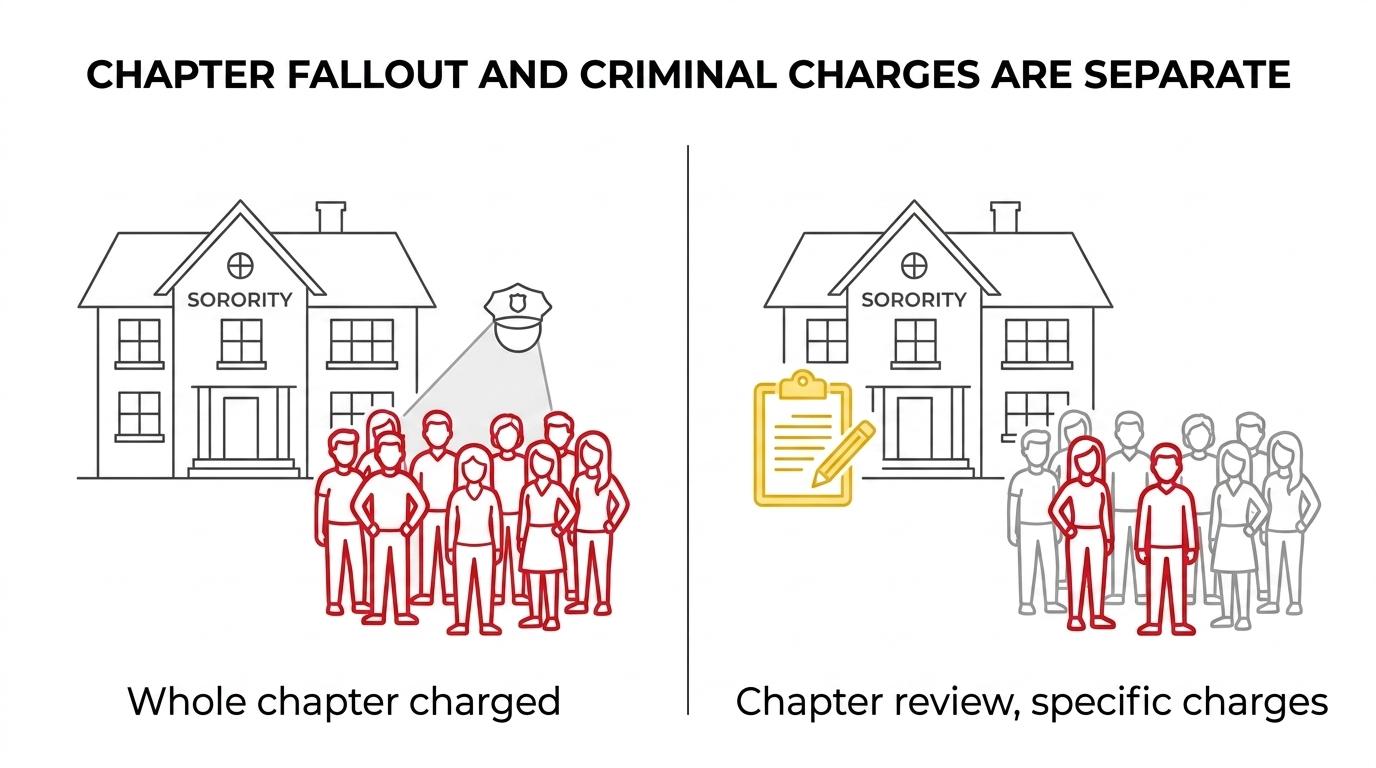
The split often looks like this:
| Event Problem | Chapter or University Issue | Individual Criminal Exposure |
|---|---|---|
| Unregistered social event | Possible organizational discipline | Usually none unless separate conduct is alleged |
| Alcohol present with non-members | Policy review, event sanctions | Possible charges only for specific acts, not everyone present |
| New member activity with harmful conduct alleged | Chapter scrutiny and university action | Hazing-related charges may apply to specific participants |
| Fight or injury | Chapter review and witness collection | Assault or related charges against identified people |
| Crowd spills into sidewalk or street | Event fallout and community complaints | Disorderly, trespass, or obstructing allegations for certain individuals |
| Property damage | Organizational pressure and restitution concerns | Charges against the person linked to the damage |
That is why group panic causes bad decisions. Students often start talking as if they all need the same story. They do not. In fact, one shared explanation can hurt the person who was least involved.
If you or your child has been identified in a sorority event investigation at MSU, get legal advice before group chats, chapter meetings, or “just clear this up” conversations make things worse. Early defense work is often the difference between a contained problem and a charging decision that follows you into court.
What police need before they can detain you at an MSU sorority event
Police do not get a free pass to stop everyone just because an event looks chaotic. Under Michigan police guidance, mere presence in an area of frequent criminal activity does not create the particularized suspicion needed to detain someone. That matters in East Lansing, where officers may arrive at a crowded house, sidewalk, or apartment lot and start trying to sort out who belongs to the scene and who does not.
Michigan State Police legal guidance also states that an officer may not detain someone simply because that person declines to identify themself, and that there is generally no legal duty under state law to provide identification or otherwise cooperate with police requests, except in limited situations like a lawful traffic stop. That does not mean you should be argumentative. It means your rights still matter in a group setting.
The key phrase is reasonable suspicion tied to you. Not your house. Not your chapter. Not your friend group. You. If officers believe a specific person committed a crime, was involved in one, or is actively interfering, the legal analysis changes. If they do not, group pressure alone is not enough.

You should also remember the real-world side of this. Even when the law is on your side, roadside debates with police rarely end well. A smart response is calm, direct, and limited.
If police contact you during or after a sorority event, keep these points in mind:
- Stay calm: Do not run, pull away, or turn a tense moment into an obstructing allegation.
- Ask one clear question: “Am I being detained, or am I free to leave?”
- Keep answers short: You do not need to fill the silence.
- Do not volunteer group details: Guessing about who planned what can pull you deeper into the case.
- Do not consent to a phone search: Your texts, photos, and group chats can become evidence.
- Use your right to counsel: If questioning turns serious, ask for a lawyer.
flowchart LR
    A[Police Contact at Sorority Event] --> B{Free to Leave?}
    B -- Yes --> C[Leave calmly]
    B -- No --> D[Temporary Detention]
    D --> E{Questions Asked}
    E --> F[Give basic identifying info only if legally required]
    E --> G[Do not volunteer details]
    G --> H[Ask for a lawyer if questioning becomes accusatory]
    D --> I{Probable Cause?}
    I -- No --> J[Release]
    I -- Yes --> K[Arrest and charging review]
Group questioning after sorority arrests can create evidence fast
Most students think the danger is the arrest itself. Very often, the bigger problem starts an hour later.
After a police response, chapter members, guests, roommates, and friends begin reconstructing the night in group texts, private messages, and calls. Someone tries to “get everyone on the same page.” Someone else starts deleting messages. Another person posts on a private story. Each of those choices can create evidence that did not exist when the officers first arrived.
That is why group investigations become individual cases. One person admits she bought alcohol. Another says a member told guests to hide in bedrooms. Someone describes a new member activity in casual language that sounds harmless inside the chapter but looks very different in a police report. Once screenshots circulate, your role can be defined by someone else’s wording.
Parents should pay attention here. Your student may think a chapter officer or older member is helping by coordinating a response. In a criminal case, that “help” can expose your student to statements that are incomplete, inaccurate, or framed to protect somebody else.
Digital evidence in these cases often includes:
- group chats
- direct messages
- Snapchat or Instagram story captures
- ride-share records
- photos showing location and timing
- key card or door access logs
- call logs between members after police arrival
If officers, detectives, or even another student tell you this can be cleared up with “just a short interview,” slow down. A short interview can lock in details before you know what police already have. If your family is dealing with post-event questioning around MSU, Ben Hall Law can step in early and help you decide what needs to be said, what should not be said, and how to protect your position before the case hardens.
Sorority officers, roommates, and guests do not share the same criminal risk
One of the most damaging myths in Greek life investigations is that titles equal guilt. They do not.
If you are a chapter president, social chair, recruitment chair, or risk manager, police may focus on you early because you are easier to identify than dozens of guests. That can make you a target for questioning, but it does not automatically make you criminally liable. A title is not proof that you supplied alcohol, ordered conduct, restrained someone, assaulted someone, or took part in hazing.
The same is true on the other side. A first-year member with no title can still face serious exposure if the facts point directly to her actions. Criminal cases are built on conduct, statements, and evidence, not chapter hierarchy alone.
This is where sorority events differ from the way rumors spread on campus.
MSU policy says new-member-related activities, including recruitment, intake, rush, meetings, and initiation, must be substance free. If police think an event tied to the new member joining process included alcohol, coercive conduct, or harmful treatment, the chapter may face serious organizational fallout. Yet criminal charges still depend on who did what, who knew what, and what evidence exists. Michigan’s Garret’s Law can create separate criminal exposure for hazing-related conduct, and the statute allows hazing penalties in addition to other criminal charges from the same incident. Consent by the targeted student is not a defense under that law.
Roommates and guests sit in different positions too. A roommate may have access to a property but no role in the event. A guest may have no chapter affiliation but may be the person accused of property damage, assaultive behavior, or interference with police. One scene can produce very different outcomes.
Common misdemeanor charges tied to MSU sorority event arrests
When multiple students are arrested after a sorority event, the charges are rarely identical. Police and prosecutors sort people by conduct, evidence, witness statements, and location. That is why one student may walk away, another may get a citation, and another may be ordered into court at 54B District Court in East Lansing.
The most common cases are misdemeanors, but “misdemeanor” should not make you relax. A misdemeanor can still affect internships, graduate school plans, licensing applications, housing decisions, and your record. For MSU students with scholarships, campus leadership roles, or professional goals, the stakes are very real.
In sorority event investigations, charges often grow out of the response itself rather than the original event plan. An officer arrives for one complaint and the charging decisions come from what happens next.
Charges that can appear after a sorority event investigation include:
- disorderly conduct allegations
- trespassing complaints
- resisting or obstructing an officer
- assaultive conduct
- malicious destruction of property
- furnishing alcohol to minors
- hazing-related misdemeanor allegations when facts support them
A defense lawyer should review the exact charging language, not just the rumor version. “Everyone got arrested at the house” tells you almost nothing about what the prosecution can actually prove.
What parents should know about multiple student arrests at MSU
If you are a parent, your first instinct is usually to ask your student what happened and call the chapter. That is understandable, but you need to think in layers.
First, not every student in the sorority house or at the off-campus event has the same risk. Your daughter may be a witness, a named participant, a target, or someone police simply wrote down because she was present. Those categories matter. Fast.
Second, your student’s phone can become one of the most important pieces of evidence in the case. Messages to roommates, pledge class members, executive board members, or parents can all shape how police read the facts later. The goal is not secrecy. The goal is discipline.
Third, East Lansing cases move quickly enough that waiting to “see if this blows over” can cost you options. Early contact with a defense attorney can help your family respond the right way before a detective call, warrant request, or first court date puts you on the defensive. Whether your student lives near campus, in an apartment off Harrison Road, or commutes from Okemos or Haslett, the first week matters.
If your child was questioned after a sorority event, or if officers asked her to come in later to “explain things,” speak with counsel before that happens. Ben Hall Law helps MSU students and parents deal with early-stage criminal investigations while keeping the focus where it belongs: the individual facts, the individual rights, and the strongest available defense.
Early defense steps in an MSU sorority arrest case
A good defense starts before the story hardens.
In group investigations, police reports often develop from fragments. Officers may interview students on the sidewalk, inside a house, in patrol cars, and days later by phone. Witnesses talk over each other. Timelines blur. People assume roles based on who lives in the house or who had a title in the chapter. That creates room for mistakes, and mistakes can become charges unless somebody pushes back early.
Early defense work can include preserving surveillance footage from neighboring houses, apartment entrances, rideshare pickups, and nearby businesses on Grand River Avenue. It can also include reviewing body-worn camera footage, dispatch logs, officer notes, and the basis for any detention, search, or arrest. In a dense MSU environment where students move from chapter houses to apartments, sidewalks, and back again, video often proves who was where and when.
Phone evidence needs special attention. Students sometimes think deleting messages helps. It usually makes things worse. A better approach is to stop talking about the facts casually and get legal advice about what exists, what police are asking for, and whether any consent was given.
Witness separation matters too. In a sorority event case, the cleanest defense may be showing that your actions were independent of the people police suspect most. You do not want your case merged into a collective narrative when the evidence against you is weak.
A strong early review usually focuses on points like these:
- Video sources: doorbell cameras, hallway footage, nearby storefront video, and body-worn camera recordings
- Witness separation: who actually saw your conduct, and who is repeating chapter rumor
- Search issues: whether officers had lawful grounds to enter, detain, or search
- Phone evidence: what was posted, sent, saved, or requested by police
- Charging choices: whether the facts support a citation, a misdemeanor, or no charge at all
That kind of work is especially valuable in East Lansing because crowd scenes near MSU change fast. One student can be confused with another. One person’s statement can be copied into several reports. Once that happens, your defense needs to be active, not reactive.
FAQ about MSU sorority arrests and group investigations
Can police charge only a few students even if the whole sorority event is under investigation?
Yes. That is common. A single event can lead to chapter-level issues while only a few people face criminal allegations. Prosecutors still need evidence tied to each person.
If you were just present at a sorority event, can you still be arrested?
Presence alone is not automatic proof of a crime. Michigan police guidance makes clear that mere presence in a high-crime area does not by itself create the particularized suspicion needed for detention. Still, police may question you, and your statements can affect what happens next.
Do you have to identify yourself during police questioning at an MSU sorority house?
There is generally no broad state-law duty to identify yourself or cooperate with police requests unless a specific legal situation applies, like a lawful traffic stop. The safest move is to stay calm, avoid arguing on scene, and get legal advice if officers are treating you as more than a witness.
Can a chapter event policy problem turn into a criminal case?
Yes. An event registration issue by itself may be an organizational problem, but the same event can also produce criminal allegations if police claim there was assaultive behavior, furnishing alcohol, trespassing, property damage, or hazing-related conduct.
Does Garret’s Law apply only to fraternities?
No. Michigan’s hazing law applies more broadly to people who attend, work at, or volunteer at an educational institution. If police believe conduct at a sorority event meets the legal definition of hazing, individual students may face criminal exposure separate from university action.
Should parents contact the chapter before speaking with a lawyer?
Usually, you are better off getting legal advice first. Chapter leadership is often trying to manage organizational fallout, not protect your child’s criminal position. Those interests can overlap, but they are not always the same.
What if police contact you days after the event and ask for a meeting?
Treat that seriously. Delayed contact often means officers are building the case from statements, videos, and digital evidence. You should not assume you can talk your way out of it without knowing what they already have.
If you need answers now, not after rumors harden into charges, contact Ben Hall Law. When a sorority event investigation starts pulling individual students into criminal exposure, early defense can protect your record, your future, and your ability to respond from a position of strength.