


If you are an MSU student living off campus, or a parent trying to figure out what happens after an apartment injury, you need more than a basic description of premises liability. You need to know how Michigan landlord duties work, how East Lansing rental rules can affect a claim, and why the exact location of a student apartment can change which local government has authority over the property.
Around Michigan State University, that matters more than many people expect. A fall on icy stairs near Cedar Village, a broken handrail at a complex off Hagadorn Road, poor lighting in a parking lot near Grand River Avenue, or a ceiling leak in a student unit near Trowbridge Road can raise the same first question: who had control over that part of the property, and were they required to keep it reasonably safe?
By: Ben Hall | Attorney and Owner of Ben Hall Law | Marine Corps and Iraq War Veteran | Former Police Officer | Former Prosecutor
Published date: June 9, 2026
Why MSU student apartment injury claims are different in East Lansing
Student housing near MSU is not a single market with one set of rules. You may live a few minutes from Beaumont Tower, Spartan Stadium, or the Breslin Center and still be outside the City of East Lansing. MSU has long warned students that many properties with an East Lansing mailing address are actually in Lansing Township, Meridian Township, Bath Township, or the City of Lansing.
That detail can shape how you report housing conditions, where code complaints go, and what local records may exist. Inside East Lansing, the city’s Rental Housing Division handles rental licensing, license renewals, required inspections, and complaints involving property maintenance code violations, overoccupancy, and renting without a license. East Lansing also requires a lease addendum with leases in the city.
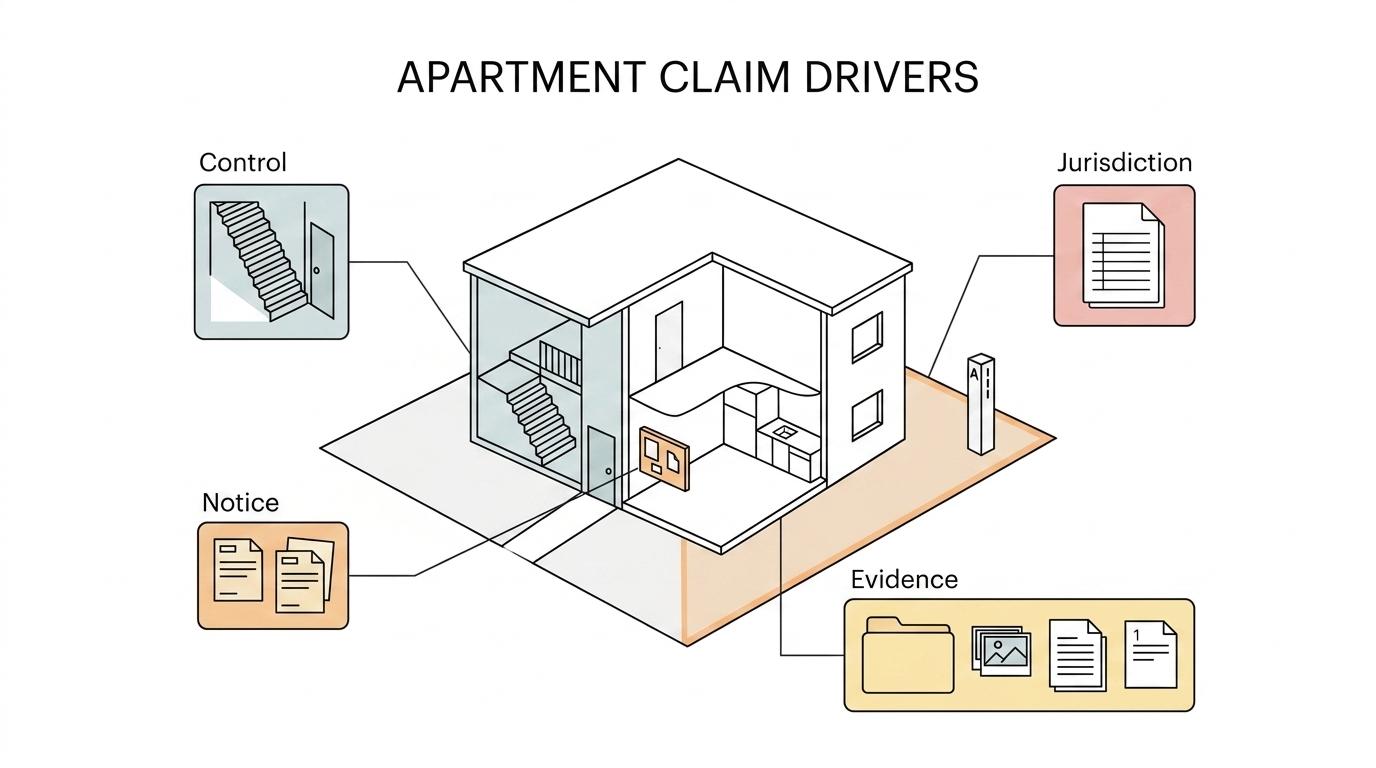
If your injury happened in a stairwell, parking lot, sidewalk, laundry room, or shared entryway, the case often turns on control. A landlord may control common areas. A property manager may be responsible for inspections or repair requests. A snow contractor may handle ice removal. A tenant or roommate may have caused the condition. When you sort out control early, your claim gets clearer.
That is why student apartment claims near campus are often more fact-heavy than people expect. They are not just about whether you fell. They are about where you fell, who knew about the hazard, who had the duty to fix it, and which set of local rules applied to that address.
Need answers now? If you or your student were hurt at an apartment near MSU, contact Ben Hall Law for a case review as soon as possible. Early action helps preserve photos, complaints, camera footage, and maintenance records before they disappear.
Michigan landlord duties and premises liability rules for student apartments
Michigan law gives renters important protections. Under Michigan’s residential lease statute, every lease includes a covenant that the premises and common areas are fit for the intended use of the parties. The lessor must also keep the premises in reasonable repair during the lease term and comply with applicable state and local health and safety laws, unless the damage was caused by tenant conduct.
For student housing, that language matters. “Reasonable repair” is not just a lease phrase. It can apply to broken steps, faulty locks, damaged lighting, unsafe railings, poor drainage, and other conditions that make normal apartment use unsafe. “Fit for intended use” can matter in common areas where students enter, exit, walk, park, carry groceries, or head out for class.
Your claim may also involve broader Michigan premises liability rules. Those cases often focus on whether the property owner, manager, or another possessor of the property owed a duty of ordinary care. In plain English, the key question is often whether the person or company that occupied or controlled the area should have protected you from an unreasonable risk of harm.
A defense may argue that the condition was open and obvious, meaning it was visible enough that a person should have noticed it. That issue shows up often in Michigan fall cases, especially snow, ice, poor surface conditions, and changes in elevation. Even then, the analysis is rarely as simple as “you saw it, so there is no case.” The exact layout, lighting, weather, warnings, prior complaints, and available alternatives still matter.
Here is a quick way to think about where responsibility may fall in an MSU-area apartment injury claim:
| Location or condition | Who may control it | Why it matters |
|---|---|---|
| Inside your unit | Landlord, management, tenant, contractor | Repair history and notice often matter most |
| Stairwells and hallways | Landlord or property manager | Common areas are a frequent source of claims |
| Parking lots and sidewalks | Landlord, manager, snow contractor | Ice, lighting, potholes, and drainage issues often show up here |
| Security gates, locks, entry doors | Landlord or management company | Negligent security claims often turn on prior incidents and broken systems |
| Temporary hazards from tenant conduct | Roommate, guest, another tenant | The landlord may not be the only liable party |
| Exterior structures under third-party maintenance | Contractor plus owner or manager | Contracts and inspection records can become key evidence |
Which local government regulates your MSU-area rental property
This is one of the most overlooked parts of an apartment claim near campus.
A student may say, “I live in East Lansing,” because the mailing address says East Lansing or the apartment is close to Grand River Avenue, Bogue Street, or the northern edge of campus. But the legal location may be somewhere else. That can change which inspection office, building department, or code enforcement body has records tied to the property.
MSU’s Off Campus Life materials make this point clearly. Students living near campus may actually be in Bath Township, Lansing Township, Meridian Township, or the City of Lansing, even with an East Lansing mailing address or 48823 ZIP code history attached to the area.
That matters because a claim is easier to build when you know where to look for the paper trail. You may need rental license records, inspection reports, complaint history, maintenance enforcement records, or local correspondence tied to the building. If the apartment is in East Lansing, the Rental Housing Division may be part of that story. If it is outside East Lansing, you may need records from a different local office.
This comes up all the time in student-heavy areas around Chandler Road, Lake Lansing Road, Trowbridge Road, Hagadorn Road, and complexes just outside the campus core. You should not assume the city line from the mailing label alone.
Common apartment hazards that lead to MSU premises liability claims
Student life creates a predictable pattern of risk. You leave early for class, carry backpacks and groceries, walk in winter weather, come home late from the library, head to downtown East Lansing, or return after a game day near Spartan Stadium. Apartments and common areas need to be safe for those normal uses.
The most common hazards are not dramatic. They are often ordinary conditions that were ignored for too long.
- icy steps and sidewalks
- broken handrails
- loose stair treads
- poor lighting in parking areas
- leaking ceilings or wet entry floors
- broken locks or unsecured entrances
- uneven pavement and potholes
- fire safety problems in shared buildings
Snow and ice are especially important in Mid-Michigan. A student walking from a parking lot after a late shift, grabbing food on Grand River, or getting back from the library can be seriously hurt by a sheet of black ice that formed because drainage was never fixed. In many claims, the issue is not winter alone. It is whether the property owner knew the area repeatedly iced over and failed to address it.
Security issues can also lead to serious injuries. A broken exterior lock, an unlit lot, a malfunctioning entry system, or ignored reports about unsafe access points can raise questions about negligent maintenance or negligent security, depending on the facts.
Evidence that strengthens an MSU apartment liability claim
If you are hurt, your case starts building right away. Student renters often think a text to maintenance is enough. It helps, but it is only one piece of the picture. The strongest claims usually combine photos, reports, medical records, witness statements, and proof that the condition existed long enough for someone to fix it.
You do not need to gather everything perfectly on day one. You do need to act before the condition changes.
- Photos and video: Capture the hazard from multiple angles, including lighting, weather, nearby warnings, and the route you had to use.
- Maintenance requests: Save portal submissions, emails, text messages, and screenshots showing prior complaints or delayed repairs.
- Witness accounts: Roommates, neighbors, visitors, and delivery drivers may have seen the hazard before or after the injury.
- Medical records: Prompt treatment connects the injury to the event and documents the pain, diagnosis, and restrictions.
- Incident reports: If management, security, or police responded, request or preserve those reports.
- Jurisdiction records: Rental licenses, inspection history, and code complaints may show a pattern of neglect.
In student housing, digital evidence disappears fast. Surveillance footage may be overwritten. Ice melts. Broken items get replaced. Portal messages can be deleted when management changes systems. If you are a parent, one of the best things you can do is help your student preserve records before they focus on finals, treatment, or moving out.
Parents and students can save a case by moving early. If management is denying fault or an insurance adjuster has already called, reach out to Ben Hall Law before giving a recorded statement. A quick review can help you avoid mistakes that weaken your claim.
What you should do after an apartment injury near Michigan State University
You do not need to panic, but you do need a plan. Whether the injury happened at a high-rise near downtown East Lansing, a garden-style complex near Lake Lansing Road, or a student rental house off Abbot Road, the first steps are usually the same.
- Get medical care right away. Your health comes first, and prompt treatment helps create a clear record.
- Report the incident to management or the landlord in writing. Keep screenshots and names.
- Take photos and video before the condition changes.
- Do not assume the address tells you the jurisdiction. Verify whether the property is in East Lansing, Lansing Township, Meridian Township, Bath Township, or the City of Lansing.
- Save your lease, any East Lansing lease addendum, payment records, maintenance tickets, and all emails or texts.
- Be careful with insurance calls. You are allowed to be polite without giving a full recorded statement before you know your rights.
If the injury happened in a shared area, also ask whether anyone else has fallen there before. A repeated issue can matter a great deal. You may learn that neighbors complained about the same stair, the same patch of ice, or the same broken lock weeks earlier.
How parents can help an injured MSU student without making the claim harder
Parents often get involved after the first urgent care visit, after a call from a property manager, or after a student says, “I think I’m okay,” and then realizes the injury is much worse. Your role can be extremely helpful if you focus on organization and timing.
Start by helping your student gather the basic file. That means the lease, the exact address, the municipality, photos, the incident timeline, medical paperwork, and every message with management. If your student lives near campus but off university property, do not assume MSU controls the apartment or the claim. In most cases, it does not.
You should also help your student avoid casual statements that can be twisted later. A student may apologize, joke about being clumsy, or say “I’m fine” in the minutes after a fall. None of that decides the case, but insurers and property managers often use those moments to minimize injuries.
Parents can also help by keeping the focus on treatment. Missed follow-up visits and long gaps in care can make any injury claim harder to prove. That is true whether the student injured a wrist on a broken stair, suffered a back injury in a parking lot fall, or hit their head in a dark, unsafe hallway.
A final point matters for both students and parents: many MSU students sign leases quickly because units near campus fill early. That does not mean a landlord gets a pass on safety. A signed lease is not permission to ignore reasonable repair obligations.
Insurance issues in East Lansing apartment injury claims
Insurance can get confusing fast, especially for families already dealing with tuition, exams, moving dates, and medical bills.
Apartment injury claims are usually not handled the same way as Michigan no-fault auto cases. If you are hurt in a car crash on Grand River Avenue, Michigan no-fault rules are central. If you are hurt because an apartment stair collapsed or an icy walkway was not maintained, the path is different. Health insurance may cover treatment first, while the liability claim is pursued against the responsible party or insurer.
Renters’ insurance is still worth having. MSU’s student-parent housing resources note that renters’ insurance should be considered for both on-campus and off-campus living. It may help with personal property losses or liability in some situations. But it does not replace a claim against a landlord or manager whose negligence caused your injury.
Here are a few common insurance issues students and parents run into:
- Recorded statements: Insurance companies often ask for one early, before you know the full extent of the injury.
- Quick settlement offers: Early money can sound helpful, but it may not account for follow-up care, wage loss, or lasting pain.
- Disputed control: The owner, manager, and contractor may each point at someone else.
- Medical bill confusion: Health insurance, MedPay, renters’ coverage, and liability coverage may all be discussed at once.
If you are hearing inconsistent explanations about who was responsible for the property, that is a sign the claim needs close review.
MSU housing resources and legal support for off-campus students
MSU students do have campus-connected resources, and they can be useful at different stages.
MSU directs students searching for off-campus housing to OffCampusHousing.msu.edu, which is the school’s preferred housing resource. That tool can help students evaluate options before they sign. MSU also points students to Student Legal Services, a free service for currently enrolled students, and to MSU College of Law legal clinics for some housing-related issues. Student Rights Advocates can help with university judicial matters.
Those resources can be helpful for lease questions, housing disputes, or student-process concerns. A personal injury claim, though, often requires a different kind of case review. If you are dealing with medical treatment, insurance adjusters, a disputed maintenance history, or a serious fall in a common area, you may need legal help focused on injury law and evidence preservation.
That is especially true in off-campus cases involving large student complexes, private landlords, or third-party contractors handling snow removal, security, or maintenance. The closer you are to a full claim, the more important it becomes to sort out who controlled the scene and which records need to be secured first.
If you want direct help with an MSU-area apartment injury claim, Ben Hall Law can review the facts, identify the likely responsible parties, and help you act before key evidence is lost.
FAQ about MSU apartment liability claims
Can you sue an apartment complex near MSU if you slipped on ice?
Yes, potentially. A valid claim usually depends on more than the fact that ice was present. You need to look at who controlled the walkway, whether the condition was known or recurring, what the weather and lighting were like, whether there were safer alternatives, and whether the property owner or manager had time to address the hazard.
What if the apartment has an East Lansing address but is not actually in East Lansing?
That happens often near MSU. Some apartments with East Lansing mailing information are actually in Lansing Township, Meridian Township, Bath Township, or the City of Lansing. You should verify the municipality because local inspection, rental, and code records may be held by a different government office.
Does East Lansing inspect rental properties?
Yes. East Lansing’s Rental Housing Division regulates rental licensing, renewals, and required inspections for licensing. It also follows up on complaints about property maintenance code violations, overoccupancy, and renting without a license. If the property is actually inside East Lansing, those records may become important.
What does “reasonable repair” mean in a student apartment case?
It usually refers to the landlord’s duty to keep the premises in reasonable repair during the lease term. In real life, that can include things like damaged stairs, railings, locks, lighting, drainage, flooring, or other physical conditions that make normal use unsafe.
Can a landlord blame the student for the condition?
Sometimes that is the defense. Michigan law does recognize that tenant-caused damage can change the analysis. But a landlord cannot simply point at the tenant and end the case. The facts still matter, including who created the condition, who knew about it, and who had the power to fix it.
What if the injury happened in a common area, not inside the unit?
That may strengthen the focus on landlord or property manager control. Hallways, stairwells, entryways, parking lots, and sidewalks are common areas where the owner or manager often retains responsibility. Those areas are frequently central to MSU apartment injury claims.
Should an MSU student use Student Legal Services after an apartment injury?
It can be a useful starting point for some lease or housing issues, and it is a free service for currently enrolled MSU students. If the matter involves a serious injury claim, insurance issues, or a disputed liability case, you may also want to speak with a lawyer who handles personal injury cases.
Is renters’ insurance enough after an apartment injury?
Usually not by itself. Renters’ insurance can be valuable, especially for personal property or some liability issues, but it does not replace a premises liability claim against the party whose negligence caused the injury.
How long should you wait before talking to a lawyer about an MSU apartment injury?
As little as possible. The earlier you act, the easier it is to preserve photos, witness statements, inspection history, maintenance records, and surveillance footage. Waiting can make a strong claim harder to prove, especially in student housing where repairs, move-outs, and management turnover happen quickly.