If you are facing a Michigan drug investigation, it helps to know that cases are rarely built from one single event. Prosecutors usually receive a package of facts assembled by police over time: a stop, a search, seized items, lab testing, statements, digital records, and a theory about what those facts mean. That theory may sound simple in court, but it is often built from many moving parts.
That matters because each part can be questioned. A drug case may look strong on paper and still have serious weaknesses. If you know how the state builds the charge, you can better see where a defense starts pushing back.
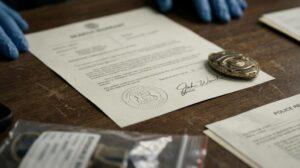
A Michigan drug case usually starts before the arrest
In many cases, the formal charge comes at the end of an investigation, not the beginning. Police may start with a tip from an informant, suspicious activity during surveillance, a traffic stop, a welfare check, a controlled buy, or a report from a neighbor. Once that initial contact happens, officers begin collecting facts that can support probable cause.
Michigan drug prosecutions commonly rely on the Public Health Code, especially MCL 333.7403 for possession and MCL 333.7401 for manufacturing, delivery, or possession with intent to deliver. Those statutes do not just punish a person for physically holding drugs. They allow the state to argue that you knew about the substance, controlled it, intended to transfer it, or participated in producing it.
That is why early police reports matter so much. The first officer narrative often frames the entire case. If a report says you appeared nervous, made admissions, reached toward a bag, or acted like you were hiding something, prosecutors may use those details to support the charge later.
What police are trying to prove from the start
A Michigan drug case is built around legal elements, not just suspicion. For possession, the state generally needs evidence that you knowingly possessed a controlled substance. For delivery or possession with intent to deliver, the state also tries to prove transfer or planned transfer. For manufacturing, prosecutors look for proof that you were involved in producing, preparing, or processing the substance.
In plain terms, police are usually trying to answer a few core questions:
- What is it: a controlled substance, analog, prescription drug, or marijuana
- Who controlled it: your person, your car, your home, your room, your phone, or a shared space
- What did you know: awareness of the substance and its presence
- What was the plan: personal use, sale, transfer, storage, or production
If those answers are weak, the case becomes harder to prove. If officers can support those answers with multiple kinds of evidence, the charge often grows more serious.
Searches, seizures, and the foundation of the case
A large share of Michigan drug cases rise or fall on search and seizure issues. Police may search after getting a warrant, after claiming consent, during a stop, incident to an arrest, or under a recognized exception to the warrant requirement. If the search was illegal, key evidence may be excluded.
That is why warrants deserve close attention. An officer usually submits an affidavit describing why there is probable cause to search a person, vehicle, phone, or home. The affidavit may rely on surveillance, an informant, a controlled buy, statements, or alleged drug odors. If those claims are stale, exaggerated, or poorly supported, the warrant can be attacked.
Even without a warrant, police will often argue an exception applies. They may say you consented, evidence was in plain view, the vehicle exception applied, or officers had safety concerns. Those arguments are not automatic winners. They need facts, and those facts should be tested carefully.
Possession is not the same as proximity
One of the biggest mistakes people make is assuming that being near drugs means the case is over. It does not. Michigan law distinguishes between mere presence and possession. The state still has to prove knowledge and control.
That issue comes up often in shared cars, shared apartments, dorm rooms, hotel rooms, and houses with multiple occupants. If drugs are found in a center console, backpack, kitchen drawer, or bedroom, prosecutors may still need evidence tying the drugs to you instead of someone else. That could include your statements, your fingerprints, your text messages, your mail, or the location of the items relative to your personal belongings.
A constructive possession theory can be powerful for the state, but it can also be fragile. The farther the drugs are from your exclusive control, the more the prosecution often needs to connect the dots.
How a possession case becomes an intent-to-deliver case
Police do not always need to catch an actual sale to charge delivery-related offenses. In Michigan, prosecutors often file possession with intent to deliver based on circumstances that suggest distribution rather than personal use.
After reviewing the evidence, officers may point to several common signs:
- Large quantity
- Separate packaging
- Digital scales
- Cash
- Ledgers
- Repeated short-stay traffic
- Controlled buy evidence
A single item rarely decides the issue by itself. A scale alone does not prove dealing. Cash alone does not prove dealing. A quantity alone may not prove dealing either, depending on the drug and the surrounding facts. Still, when police stack those items together, they try to tell a story that the drugs were meant for sale.
That is also where digital evidence can become central. Text messages, Cash App records, call logs, location data, and social media messages are often used to argue planning, customer contact, or repeated transactions.
Lab testing and chain of custody give the charge its shape
Before a drug case is trial-ready, the prosecution usually needs lab confirmation of what was seized. Officers may suspect a substance is heroin, cocaine, methamphetamine, fentanyl, or a prescription opioid, but suspicion alone is not enough. Crime lab testing helps the state identify the substance and, in many cases, support the weight that affects the charge level.
The weight can change everything. Under Michigan law, drug type and amount often drive the potential penalty range. A small possession case and a high-weight narcotics case can sit worlds apart in exposure.
Here is a simple way to look at how the case gets built:
| Stage |
What the state tries to establish |
Common defense pressure point |
| Initial contact |
Reason to stop, watch, or approach you |
Lack of reasonable suspicion |
| Search |
Probable cause, consent, warrant, or exception |
Invalid warrant or unlawful search |
| Seizure |
Drugs, paraphernalia, cash, phone, packaging |
Ownership and access disputes |
| Identification |
Lab proof of substance and weight |
Testing issues, contamination, chain breaks |
| Charging theory |
Possession, delivery, intent, manufacture |
Weak link between facts and legal elements |
| Court presentation |
Credible witnesses and usable records |
Inconsistent reports, impeachment, suppression |
Chain of custody also matters more than many people realize. If the handling of evidence is sloppy, mislabeled, interrupted, or contaminated, you may have a real argument about reliability.
Witnesses and recordings often do the heavy lifting
A Michigan drug case is often built around more than the substance itself. Police and prosecutors like evidence that gives the case a narrative. That may include a confidential informant, undercover officer, body camera footage, controlled buy audio, surveillance video, or a series of text messages.
Informants can be especially important and especially vulnerable. Some are working for consideration in their own cases. Some have credibility problems. Some have strong motives to please police. If their information launched the investigation, their role may become a major issue in the defense.
Recordings can help the state, but they do not always say what police claim they say. Slang, incomplete audio, missing context, and assumptions about who sent a message can all become points of dispute. Prosecutors still have to connect the recording or the phone to you in a reliable way.
Manufacturing and premises charges add another layer
Michigan also punishes manufacturing and certain conduct related to drug production. In these cases, police may search for precursor chemicals, lab equipment, extraction tools, packaging supplies, grow operations, or evidence that a location was being used to produce or process controlled substances.
A premises-related charge can be serious because prosecutors may argue you knowingly allowed a place you owned, occupied, or controlled to be used for drug activity. That means a case can be built around a house, garage, storage unit, or apartment even when officers do not claim you were caught in the act of cooking or selling drugs.
These cases often turn on knowledge. If the state cannot prove you knew what was happening or that you had meaningful control over the location, the theory starts to weaken.
Small details often drive big charging decisions
Two people can be arrested in similar situations and still face very different charges. That is because charging decisions are shaped by details that seem minor at first glance.
Prosecutors often focus on points like these:
- Location: school zone allegations, a vehicle, a shared home, a private room
- Statements: admissions, inconsistent answers, silence after partial admissions
- Packaging: one bag versus multiple packaged units
- Association: repeated contact with buyers, co-defendants, or suppliers
If police claim you made admissions, that deserves immediate attention. Many drug cases become harder to defend after a person tries to talk their way out of it. Even vague statements can later be framed as proof of knowledge or control.
Your rights can interrupt the state’s plan
You have constitutional protections at every stage, and those protections are not technicalities. They are real limits on what the government can do. If police crossed the line, a defense lawyer can ask the court to suppress evidence, challenge statements, or attack the charging theory itself.
That may involve arguments about an unlawful stop, a bad warrant affidavit, improper consent, Miranda violations, unreliable informants, entrapment, or weak proof of possession. In some cases, a defense may also raise chain-of-custody problems or challenge the lab result.
If you are contacted by police or think you are under investigation, your next steps matter:
- Stay calm: panic usually creates new problems
- Say less: do not try to explain, persuade, or fill silence
- Ask for counsel: make the request clear and direct
- Preserve records
- Save messages
- Avoid consent searches
That last point matters. People often believe cooperation will make the matter disappear. In many drug cases, it simply gives investigators more material to use.
Why trial-ready defense work matters early
A strong defense does not begin in front of a jury. It begins by examining how the charge was assembled. That means reading every report closely, comparing officer narratives, testing the warrant, studying body camera footage, reviewing the lab process, and identifying where the prosecution is making assumptions instead of proving facts.
This is where a trial-ready approach can change the pressure in the case. When your lawyer is prepared to litigate suppression issues, challenge informants, and force the state to prove each element, negotiations tend to look different. Weak cases are exposed faster. Overcharged cases are easier to confront. Better outcomes become more realistic.
At Ben Hall Law, that early work is part of the stated strategy. Cases are prepared as if they are going to trial, and the firm’s background includes former police officer and former prosecutor insight. That perspective can be valuable in Michigan drug cases because it helps identify how investigations are built, where reports are vulnerable, and what prosecutors are likely to rely on.
If you are facing a drug accusation in Lansing, East Lansing, or nearby Michigan courts, you do not need to guess how the government is building its case. You can force that case to be tested, step by step, with a defense built to protect your rights, your record, and your future.

 877-Ben-Hall