By: Ben Hall | Attorney and Owner of Ben Hall Law | Marine Corps and Iraq War Veteran | Former Police Officer | Former Prosecutor
A backyard BBQ in Michigan is supposed to be easy. Burgers on the grill, kids in the yard, coolers on the patio, maybe a late sunset after a day at Lake Lansing or a game day gathering near Michigan State University. Then someone slips on wet deck stairs, gets burned by a faulty propane connection, or leaves after drinking and causes a crash on Grand River Avenue.
That is the point where a simple summer get-together turns into a legal problem.
If you are the injured guest, you want to know whether you have a claim and who may be responsible. If you are the homeowner, you want to know what your exposure looks like and whether your homeowners insurance is enough. In Michigan, both questions depend on the same core issues: the guest’s legal status on the property, what hazard caused the injury, whether alcohol was involved, and whether a defective product played a role.
Michigan backyard BBQ liability starts with how the injury happened
There is no single rule that answers every backyard BBQ injury case. Michigan law separates these claims into different lanes. A fall on cracked patio stones is not analyzed the same way as an exploding grill. A drunk-driving crash after the party is not handled the same way as a dog bite near the fire pit.
The strongest cases usually involve a known hazard, unsafe alcohol-related conduct, or defective equipment. Ordinary party risks alone often are not enough.
When lawyers and insurers look at a Michigan backyard BBQ injury, they usually sort it into one or more of these categories:
- Premises liability
- Slip and fall on residential property
- Social guest injury rules
- Product liability for grills, propane tanks, or patio heaters
- Alcohol-related injury claims
- Comparative fault between multiple people
That mix matters in Mid-Michigan neighborhoods from East Lansing and Okemos to Haslett, Holt, DeWitt, and Delta Township, where summer gatherings often happen on decks, pool patios, lakefront lots, and older residential properties with uneven concrete or aging steps.
Michigan premises liability for social guests at a backyard BBQ
In Michigan, a social guest at a private home is often treated as a licensee, not an invitee. That difference matters. A business visitor is usually owed a broader duty of reasonable care. A social guest at a residence is owed a narrower duty.
For a licensee, the question is often whether the homeowner knew or should have known about a dangerous condition that created an unreasonable risk, failed to warn about it, and whether the guest did not know or have reason to know about the danger. That is a very fact-driven test. If your friend invites you over for ribs and cornhole and says nothing about the loose rear step, poor lighting near the walkway, or a rotted deck board, that may support a claim. If the condition was already obvious to you and you appreciated the risk, the case becomes more difficult.
Michigan law also changed the way courts look at “open and obvious” conditions. In 2023, the Michigan Supreme Court moved that issue away from the duty question and into breach and comparative fault analysis. In plain terms, the fact that a hazard was visible does not automatically end the case. It can still reduce or shift responsibility depending on what happened and who ignored what.
That shift gives injured guests a fairer path to be heard, but it does not erase the limits on homeowner liability to social guests.
Common backyard BBQ hazards that can create a Michigan premises liability claim
| Hazard at the BBQ |
Why it matters legally |
Who may be blamed |
| Wet deck stairs |
Slip risk, poor drainage, no warning, bad lighting |
Homeowner, guest, contractor |
| Uneven patio stones |
Known trip hazard if left unrepaired |
Homeowner |
| Extension cords across walkway |
Temporary hazard in a traffic area |
Homeowner, guest who placed it |
| Broken handrail |
Structural danger near steps |
Homeowner, repair company |
| Unfenced pool area |
Access and fall risk, especially for children |
Homeowner |
| Poor lighting in side yard |
Hidden change in elevation or debris |
Homeowner |
| Dog running loose near grill or guests |
Knockdown or bite risk |
Homeowner, dog handler |
The details matter more than the label. A clean-looking backyard can still hide a serious legal problem if the owner knew about the condition and let guests walk into it.
Need answers fast after a party injury in Lansing, East Lansing, Okemos, or Haslett? A focused case review can tell you whether this is really a premises liability claim, a product case, or both. Contact Ben Hall Law before photos disappear and witnesses drift away.
Slip and fall injuries at a Michigan residential BBQ can still lead to real claims
A backyard fall may sound minor until you see the medical chart. Hip fractures, wrist fractures, torn ligaments, head injuries, and back injuries are common in residential fall cases. Older adults face even higher risk. National CDC data continues to show that falls among adults age 65 and older are common and often serious enough to require medical treatment or limit activity.
That matters in summer gatherings where grandparents, children, and guests carry food, walk after dark, or move through unfamiliar yards.
In practical terms, these are the facts that often decide a Michigan slip and fall case at a private home:
- How long the condition existed
- Whether the homeowner knew about it
- Whether there was a warning
- Lighting, weather, and crowd conditions
- Whether the guest had reason to notice the hazard
- Whether the guest was distracted, impaired, or wearing unsafe footwear
A guest who falls near a backyard pool in Okemos or on a lakefront slope in Haslett may still have a case even if some part of the risk was visible.
Industry resources like Clearview Pool Solutions’ overview of swimming pool safety inspections detail typical risk points—slippery coping, inadequate lighting, unsecured gates, and missing drain covers—that often show up in these disputes.
Michigan’s comparative fault system allows a jury to allocate fault by percentage. If the homeowner was 70% at fault and the guest was 30% at fault, liability can be divided that way.
That rule also means homeowners should not assume, “They saw it, so I’m safe.” You may not be.
Alcohol-related backyard BBQ injuries in Michigan are not all the same
Alcohol changes the liability picture, but it does not do so in one simple way. Michigan’s Dram Shop Act applies to retail licensees, not ordinary homeowners acting as social hosts. So if your injury claim is based on a bar, restaurant, golf club, brewery, or other licensed seller unlawfully serving a visibly intoxicated person or a minor, that may open a dram shop claim. A backyard host usually is not sued under that same statute just because beer was served at the house.
This is where many people get confused.
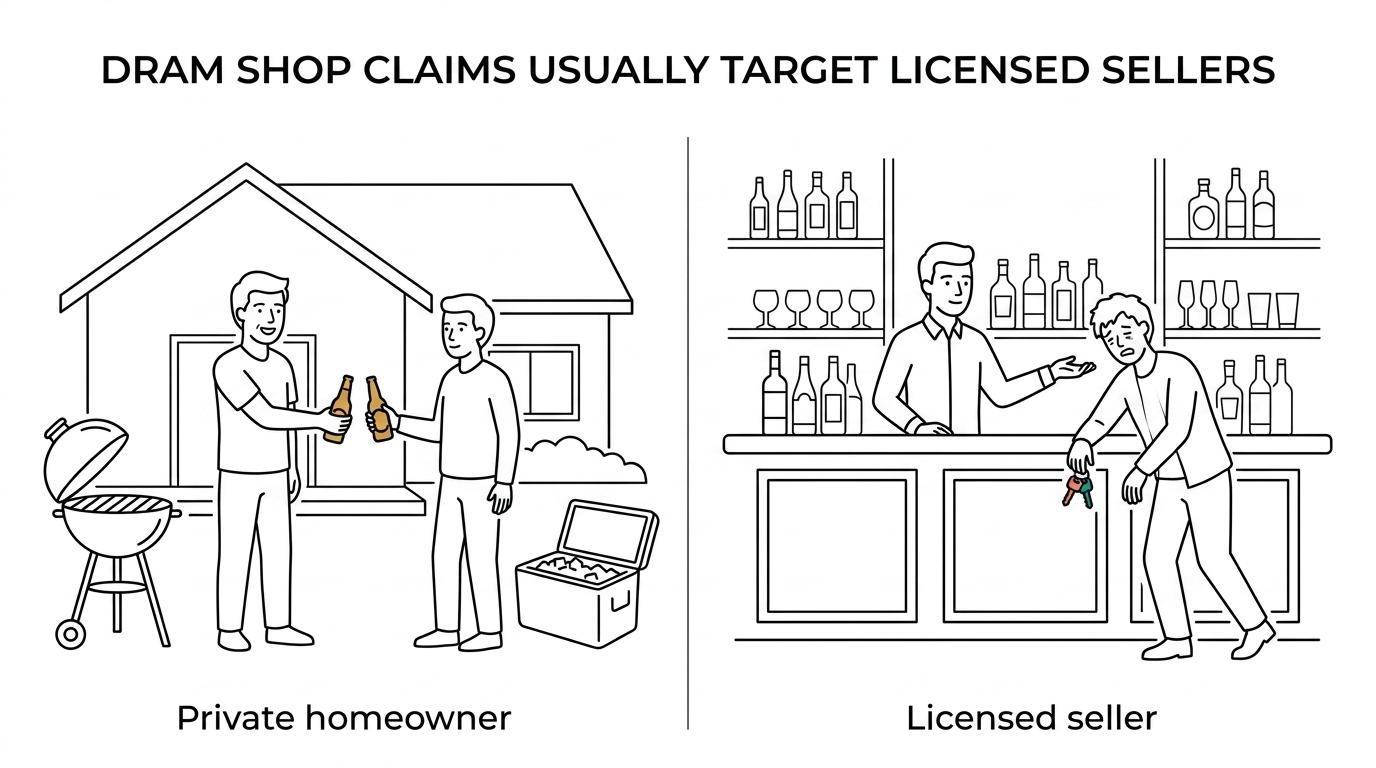
If a guest drinks at your BBQ in East Lansing, leaves, and crashes on I-496 or US-127, the legal path may depend on where the alcohol came from and what happened before the guest arrived. If that person was unlawfully overserved at a licensed establishment in downtown Lansing, near Jackson Field, or after a stop in Old Town before reaching the party, the dram shop claim may point to the business, not the homeowner.
That said, homeowners are not automatically out of danger when alcohol is involved. Michigan also has criminal exposure tied to knowingly allowing minors to consume or possess alcohol at a social gathering on property you control. That does not create a civil dram shop case against the homeowner, but it can seriously change the posture of the case, the insurance investigation, and the way a jury views the facts if someone gets hurt.
Here is the practical breakdown:
- Dram Shop Act: Usually applies to licensed sellers, not the private homeowner hosting the BBQ.
- Visible intoxication: A bar or other licensed business may face exposure if unlawful service was a proximate cause of the injury.
- Minor drinking at a house party: A homeowner or person in control of the property can face criminal exposure for knowingly allowing it.
- Civil case against a homeowner: Often depends on separate negligence facts, not the dram shop statute itself.
If you are the injured person, do not assume the house is the only place to look. If you are the homeowner, do not assume that because dram shop law targets licensees, you have no legal risk at all.

Why timing matters in Michigan alcohol-related injury claims
Dram shop cases in Michigan have strict rules. The statute includes a two-year filing deadline and a written notice requirement tied to when the attorney-client relationship begins. That is not the kind of claim you want to “wait and see” about while medical treatment continues.
If a party injury involves alcohol, identify every stop in the timeline right away. Pre-party drinks. The store receipt. The bar tab. Witnesses who saw the person’s condition. Ride-share records. Social media stories. Security footage from a gas station, bar, or nearby business.
In a college-area market like East Lansing, that can matter a lot around graduation parties, tailgates, and summer rentals near campus.
Burn injuries from grills, propane tanks, and patio equipment can trigger Michigan product liability claims
Not every backyard burn is the host’s fault.
Sometimes the real case is against the maker of the product, the distributor, or a seller who acted carelessly. Michigan product liability law focuses on how the product was designed, made, sold, maintained, altered, or misused. If a grill regulator failed, a propane hose leaked, a patio heater tipped due to a defect, or a charcoal starter flashed back unexpectedly, the product itself may be at the center of the case.
The Consumer Product Safety Commission has reported thousands of grill-related emergency room injuries each year, with burns as the most common injury type. That fits what many people see in summer months across Michigan, from backyard cookouts in Lansing subdivisions to lake weekends farther north.
A product claim may rise or fall on a few very specific facts. Michigan law limits liability when the product was altered or misused in a way that was not reasonably foreseeable. Sellers who are not the manufacturer are also treated differently. A store that simply sold the grill is not automatically responsible unless it failed to use reasonable care or made an express warranty the product did not meet.
That means a homeowner can sometimes point to the product maker. It also means an injured guest should preserve the grill, tank, igniter, fuel canister, and packaging if possible.
Signs a BBQ burn case may involve a defective product
After a serious burn, the evidence often gets thrown away during cleanup. That is a mistake. Before anything is repaired, discarded, or returned, these facts should be locked down:
- Unusual flare-up on first use
- Regulator or hose failure
- Knob in off position but gas still flowing
- Ignition system malfunction
- Recent recall notice
- Product altered by owner or installer
- Instructions missing or unclear
Burn cases can also involve thermal injuries from fire pits, smokers, patio heaters, and outdoor fryers. The right claim may include premises liability, product liability, or both, depending on whether the danger came from a defective item or from how it was set up and used.
Michigan comparative fault can divide liability among the homeowner, guest, and others
Michigan does not require one defendant to carry the whole loss just because their house was the location. Fault is allocated by percentage. That makes backyard BBQ injury cases more layered than many people expect.
A guest might be partly at fault for ignoring a visible hazard. A homeowner might be at fault for failing to warn about a known danger. A manufacturer might be at fault for a defective grill valve. A licensed seller might be at fault for unlawful alcohol service earlier in the day. The jury can look at all of them.
Liability allocation examples in a Michigan backyard BBQ injury case
| Injury scenario |
Possible liable parties |
Why fault may be split |
| Guest slips on algae-covered deck steps after dark |
Homeowner, guest |
Owner knew condition existed; guest may have moved too fast or ignored poor lighting |
| Guest suffers burns when propane grill explodes |
Manufacturer, installer, homeowner |
Defect, poor setup, or ignored warning signs may all matter |
| Minor leaves party intoxicated and injures another driver |
Minor, vehicle driver, person controlling property, licensed seller in earlier timeline |
Multiple acts can contribute to the same loss |
| Guest trips over extension cord powering outdoor speakers |
Homeowner, guest who set up equipment, injured guest |
Temporary party setup often creates shared fault issues |
| Guest falls into unmarked drop-off near fire pit area |
Homeowner |
Hidden condition with poor lighting and no warning |
This is why early case framing matters so much. If you focus only on the house, you may miss a seller, product maker, installer, or nonparty whose conduct changes the case value and the legal strategy.
If your injury happened at a private party but alcohol, rental equipment, or a recalled product may be involved, do not guess who should be in the case. Ben Hall Law can identify the right path before key deadlines and insurance defenses harden.
What injured guests should do after a Michigan backyard BBQ accident
Your first job is medical care. If you need emergency treatment, get it. If the injury seems “not that bad” but you hit your head, twisted a knee, or suffered a burn, get checked anyway. Records made right after the incident often become some of the most useful evidence later, whether you are treated at a local ER, urgent care, or through follow-up with your doctor.
Your second job is to preserve proof. Backyard accident scenes change fast. Patio furniture gets moved. Grills get replaced. Alcohol containers disappear. Hosts clean up before morning. Witnesses start second-guessing what they saw.
If you were injured at a BBQ, move quickly on these basics:
- Take photos of the exact area
- Get names and phone numbers
- Save clothing and shoes
- Preserve any grill or equipment evidence
- Screenshot texts and social posts
- Avoid detailed statements to an insurer before legal advice
If alcohol may be part of the story, note where people drank before arriving, what was served at the house, who looked intoxicated, and whether minors were present. If a product malfunctioned, do not let anyone throw it away.
A strong case is built early, often within days.
What homeowners should do if a guest is hurt at your backyard BBQ in Michigan
Do not make the mistake of trying to talk your way out of the problem at the scene. You should help the injured person, call for medical care if needed, and document what happened. You should also preserve the scene and any equipment involved.
That means you should not repair the step, throw away the hose, or swap out the grill before the facts are documented. If there were witnesses, get their names. If alcohol was involved, keep receipts, empty containers, and any delivery or purchase records. If there was a pool, deck, fire pit, or lighting issue, take photos from several angles and at the same time of day if visibility is part of the dispute.
You also should notify your homeowners insurer promptly. Many people hesitate because they assume a claim will ruin the relationship with the guest. Waiting can create a different problem and may complicate coverage.
If minors were drinking on the property, treat that as a serious legal issue right away. The risk is not only civil.
Smart first steps for Michigan homeowners after a party injury
The best immediate response usually includes:
- Medical help for the guest
- Photos before cleanup
- Preserving equipment and receipts
- Prompt insurance notice
- No guessing or blame shifting
- Early legal advice if injuries are serious
A careful response protects both the facts and your coverage position.
Are you the homeowner, renter, or parent dealing with a serious injury after a summer gathering? Get clear guidance before you give recorded statements, discard equipment, or rely on assumptions about “open and obvious” hazards. Ben Hall Law can review the facts and explain your next move.
Michigan backyard BBQ liability FAQ
Is a guest at my house considered an invitee in Michigan?
Usually not. A social guest at a private home is commonly treated as a licensee. That means the duty owed is narrower than the duty owed to a business visitor.
Can I sue a homeowner in Michigan if I slipped at a backyard party?
Possibly, yes. A claim may exist if the homeowner knew or should have known of a dangerous condition that created an unreasonable risk, failed to warn you, and you did not know or have reason to know about it. The exact facts matter.
Does “open and obvious” kill a Michigan backyard injury case?
Not automatically. Michigan’s 2023 Supreme Court decision changed how courts treat open and obvious conditions. Obviousness can still affect breach and comparative fault, but it is not always the quick end to a case that people think it is.
Can a homeowner be sued under Michigan’s Dram Shop Act for serving beer at a BBQ?
Usually no. The Dram Shop Act is aimed at retail licensees, not ordinary social hosts at a private residence. A civil claim against a homeowner would usually need to rest on some other legal theory.
What if minors were drinking at the BBQ?
That creates a serious issue. Michigan law can impose criminal exposure on a person who controls the property and knowingly allows minors to consume or possess alcohol at a social gathering. It does not automatically create a dram shop claim, but it can have major legal consequences.
What if the real problem was a defective grill or propane tank?
Then the claim may be a product liability case, or a mixed case involving both premises liability and product liability. Preserve the grill, tank, hose, igniter, receipts, packaging, manuals, and any recall information.
Can fault be shared between the injured guest and the homeowner in Michigan?
Yes. Michigan uses comparative fault. A jury can assign percentages of fault to the injured person, the homeowner, a manufacturer, a licensed alcohol seller, or others whose conduct contributed to the injury.
How long do I have to file a Michigan dram shop claim tied to a party injury?
The dram shop statute includes a two-year filing deadline and a written notice requirement after the attorney-client relationship begins. If alcohol is part of the case, move quickly.
What if I am in East Lansing and the injury also involves student conduct or a college house party?
The civil injury issues may overlap with property-control questions, minor drinking concerns, or records tied to student housing and social media. In East Lansing, that often means the timeline and witness list need to be built fast, especially around MSU-area parties and summer rentals.
 877-Ben-Hall