If you are an MSU student staring at a court date in East Lansing, your first reaction is usually not calm or organized. It is fear. You may be thinking about your record, your scholarship, your parents, your apartment, your internship, and whether one bad night near Grand River Avenue is about to follow you long after graduation.
That fear is real, but panic is not a plan.
Your first court date in 54B District Court is a serious moment, yet it is rarely the end of your case. In many student cases, it is the beginning of the process. If you handle it correctly, you can protect your rights, avoid making the case worse, and put yourself in a much stronger position moving forward. If you handle it casually, say too much, miss the date, or treat it like a parking issue, you can create problems that are much harder to fix later.
Why a 54B District Court first court date matters for MSU students
54B District Court handles many East Lansing and Michigan State University related cases. If your citation, summons, or criminal charge came out of an incident near campus, around Abbot Road, Grand River Avenue, MAC Avenue, Albert Avenue, or in the neighborhoods surrounding MSU, there is a good chance this is the court you will deal with first.
For students, that matters because East Lansing cases move fast. A first court date can affect bond conditions, future court dates, and how your case is viewed from the start. It can also overlap with life on campus. You may be trying to keep up with classes in Wells Hall, work a shift, or make it to Spartan Stadium on game weekend while also figuring out what “arraignment” means.
Another detail students miss is that online court information can point you to different court-related addresses depending on the function. Official city information references East Lansing City Hall at 410 Abbot Road, while case lookup resources and other court listings often reference 101 Linden Street. Your safest move is simple: check the address listed on your notice, then verify it through the official court website before you leave. Do not assume your roommate’s old ticket gives you the right location.
If your first date is already on the calendar, this is the time to get advice before you walk into court. A quick call to Ben Hall Law can help you sort out what the date is, what the charge means, and what not to do before the hearing.
What your first 54B District Court hearing usually is
In many criminal and misdemeanor cases, your first court date is an arraignment. That is the hearing where the court tells you the charge, tells you your rights, and deals with bond or release conditions. In some cases, a plea may be discussed. In others, your lawyer can waive certain appearances or handle the next steps strategically, depending on the charge and local practice.
It is usually not a trial. You are not showing up to argue every fact of the case in full. You are not there to give a long explanation about what happened outside a dorm, at an apartment near Bogue Street, or after a traffic stop coming back from Target on Grand River. The first date is about procedure, rights, and the court’s control over the case.
If the accusation is a felony, district court is still where the case starts. Michigan procedure places criminal arraignments in district court, and felony matters can later move to circuit court after the preliminary examination stage. That is one reason you should take the first date seriously even if someone tells you, “It’s just the first hearing.”
A first court date can involve several moving parts:
- Reading of charges: the court states what offense you are accused of
- Advising you of rights: you are told about your right to counsel and other protections
- Bond conditions: the judge may set rules about alcohol use, travel, testing, or no-contact terms
- Future scheduling: the next hearing date may be set right away
- Plea questions: in some situations, the court may ask how you wish to proceed
Visualization: How a student case can split into two separate tracks
Many MSU students make one major mistake right away. They assume the court case and the university process are the same thing. They are not.
flowchart TD
    A[Incident in East Lansing or on/near MSU] --> B[Police report or citation]
    B --> C[54B District Court case]
    B --> D[Possible MSU student conduct review]
    C --> E[Arraignment or first court date]
    E --> F[Bond conditions, pretrial, motions, negotiation, dismissal, or trial]
    D --> G[Campus review under university procedures]
    G --> H[Possible conduct meeting, hearing, or sanctions]
That split matters from day one, because what helps you in one setting can hurt you in the other if you are not careful.
How to prepare for a first court date in 54B District Court
You do not need to become a lawyer overnight. You do need to become organized.
Start with your paperwork. Read every line of your citation, ticket, bond form, release paperwork, or notice to appear. Confirm the date, time, courtroom information, charge name, and address. Then check the 54B District Court case lookup system by name or case number. Official court resources also provide ticket information, arraignment information for criminal charges, and drop boxes for certain payments, but do not assume paying something is the right move before you know whether it is a civil infraction or a criminal matter.
Here is a practical prep table you can use the day you get notice of your hearing:
| What to Check |
Why It Matters |
What You Should Do |
| Court date and time |
Missing it can trigger a bench warrant |
Save it in your phone, calendar, and email |
| Court location |
East Lansing court resources may list different addresses for different functions |
Verify the exact location on your notice and the official court site |
| Charge level |
A civil infraction is different from a misdemeanor or felony |
Read the wording carefully and ask a lawyer if you are unsure |
| Bond terms |
Violations can create new trouble before your next hearing |
Follow every term exactly, even if you think it is unfair |
| Class schedule |
You may need to plan around exams or labs |
Tell your professor only what is necessary, and early |
| MSU conduct notice |
Campus discipline can move on a separate track |
Keep copies of every email and deadline |
The night before court, keep your prep simple and disciplined.
- Government ID
- Court papers
- A fully charged phone
- Conservative clothing
- Transportation plan
- Extra time for parking and security
If you are a parent reading this from Novi, Grand Rapids, Chicago, or out of state because your student called in a panic, this is the point to step in and help with structure. Getting the charge reviewed by a defense lawyer before the hearing can save your student from avoidable mistakes.
What to wear, what to say, and what to avoid in an East Lansing courtroom
Court is not the place to “clear everything up” on your own. That instinct gets students in trouble.
Dress like the hearing matters because it does. You do not need a suit if you do not have one, but you should look respectful and controlled. Clean clothes, no hat, no pajama pants, no party wear, no slogan shirt that turns you into the story before your case is called. Think job interview, not tailgate at Spartan Stadium.
Once you are there, be polite to everyone. Court staff notice attitude. Judges notice attitude. So do prosecutors. The student who shows up late, talks over people, rolls eyes, or whispers jokes to a friend is not helping their case.
The bigger risk is talking too much. You may feel pressure to explain that you were only holding the drink for someone else, that the argument near the Red Cedar River was misunderstood, or that the officer near Harrison Road “had it out for you.” Save the facts for your lawyer. Statements made in court and outside the courtroom can follow you.
Keep these rules in mind when you speak:
- Answer only what is asked: short, respectful responses are safer than speeches
- Do not volunteer facts: your version of events needs strategy, not blurting
- Do not discuss the case in hallways: prosecutors, officers, and witnesses may be nearby
- Do not post online: screenshots travel fast and jokes age badly
- Ask for counsel if needed: protecting your record is more important than trying to look tough
If you want a real plan before you stand in front of a judge, contact Ben Hall Law before your court date. Early strategy often matters more than last-minute damage control.
Why your MSU student conduct case is separate from your court case
This point deserves extra attention because it catches students off guard every semester.
If you are an MSU student, the university may start its own conduct process based on the same incident that led to your court case. That can happen whether the event took place in a residence hall, in an apartment off campus, on a sidewalk near campus, or after police contact tied back to student status. The university process is separate from the criminal court process.
That means two things. First, the court does not control what MSU decides. Second, MSU does not need a criminal conviction to act under its own rules. The university conduct process uses a preponderance of the evidence standard, which is different from the criminal burden of proof. Official university guidance also states that individual conduct hearings happen when a respondent denies a university policy violation.
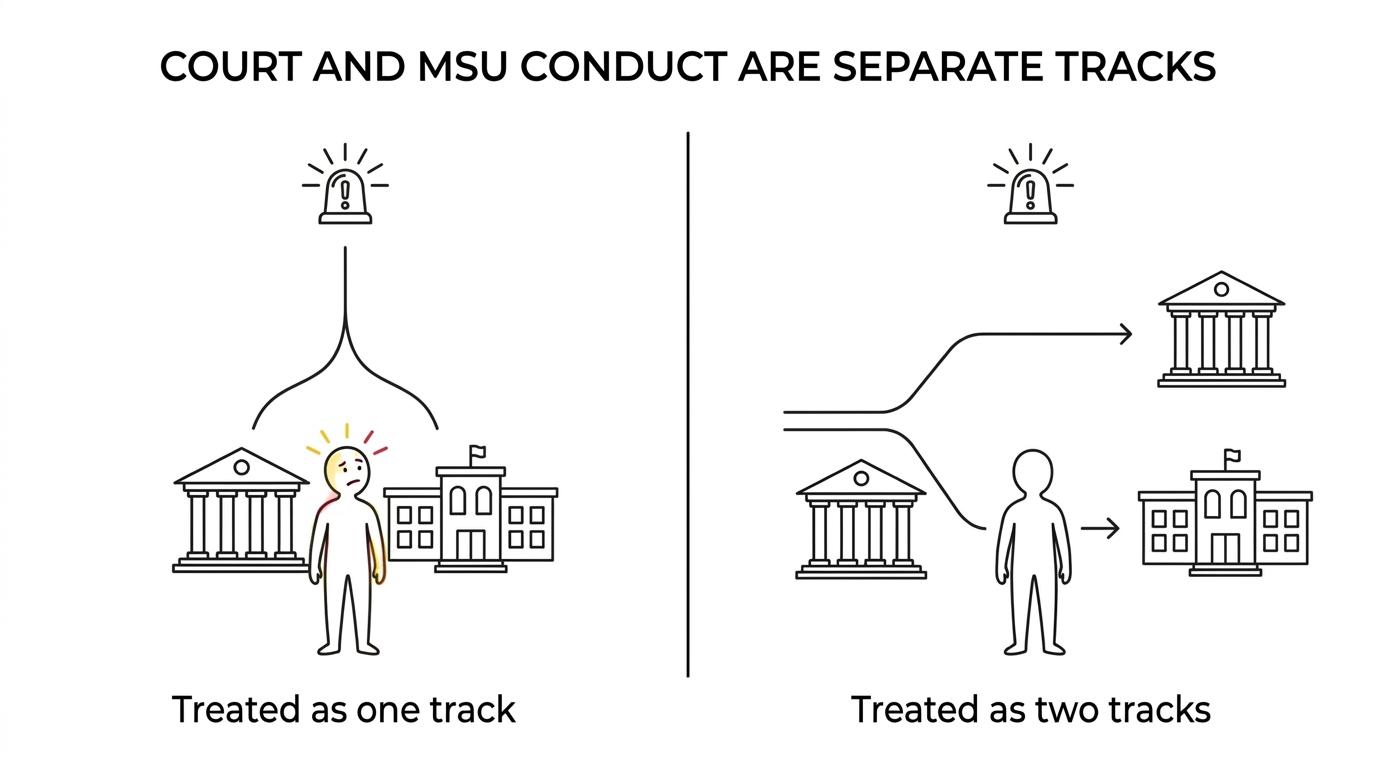
So yes, you can have a court date in East Lansing and a student conduct issue at the same time.
That creates real pressure. A student worried about a judge may be tempted to admit too much to the university. A student focused on school may ignore the court notice and assume campus handles everything. Both are dangerous moves.
Treat the two processes like parallel tracks:
- Court case: deals with criminal charges, infractions, bond, and the formal legal record
- MSU conduct process: deals with university policy, student status, and possible campus sanctions
- Different standards: what the university needs to find a violation is not the same as criminal court
- Different deadlines: missing one email or one hearing notice can hurt you even if the other matter is still pending
If you have both matters going at once, you need one strategy that accounts for both. That is especially true when your classes, housing, financial aid, or future admission plans could be affected.
Common first court date situations for MSU students in East Lansing
Student cases are not all the same, even if they start with the same panic. The first hearing feels different depending on what brought you there.
A traffic-related case may begin with confusion over whether it is a civil infraction or a criminal offense. An alcohol-related charge may carry bond conditions that affect your social life and your housing situation. A disorderly conduct or assault allegation can raise immediate concerns about no-contact terms, campus presence, or separate university action. A drug charge can put long-term record issues into play much earlier than most students realize.
This is why you should stop comparing your case to your friend’s case. The person who got a ticket last year after a stop near Trowbridge Road may have faced a civil matter. Your case might be a misdemeanor. Another student may have resolved a case quickly because the facts were weak. Your facts may be different, your judge may be different, and your record may be different.
You also need to watch for collateral effects that students often underrate:
- internship applications
- graduate school plans
- student employment
- housing complications
- travel restrictions from bond terms
- parent notification through practical life fallout, even when not legally required
When you are balancing finals, research deadlines, and maybe a walk past Beaumont Tower trying to act like life is normal, it is easy to minimize what is happening. Do not. A calm, early legal response gives you the best chance to keep one case from bleeding into the rest of your future.
Visualization: What happens after the first court date
The first hearing is usually one point on a larger timeline.
flowchart LR
    A[Charge or citation] --> B[First court date or arraignment]
    B --> C[Bond conditions begin]
    C --> D[Pretrial stage]
    D --> E[Evidence review and legal analysis]
    E --> F[Negotiation, motion, reduction, dismissal, or trial]
    B --> G[Possible MSU conduct notice]
    G --> H[Separate campus deadlines and meetings]
A good defense is built during the stages after that first court appearance, not by hoping the problem fades on its own.
What happens after your first 54B District Court date
After the hearing, your case may move to a pretrial, status date, motion hearing, or another procedural step. If it is a felony, the district court phase may include a preliminary examination before transfer to circuit court. This is where legal strategy starts to matter a lot.
Clinicians at Floralund have detailed how alcohol and anxiety can feed one another, a cycle that can complicate compliance with bond terms that limit drinking.
Your lawyer may review how the stop happened, how the police report was written, whether witnesses match the accusation, whether search issues exist, and whether the charge itself fits the facts. That matters because some student cases look much stronger on paper than they actually are once someone starts pulling them apart.
You should also assume that bond conditions are active the moment the court sets them. If the judge says no alcohol, that means no alcohol. If the judge sets testing, that means comply fully. If the judge says no contact with a complainant or witness, do not text, DM, call, or send messages through friends. Bond violations can make a manageable case much harder.
Right after your first court date, take these steps:
- Save every document: court notices, receipts, bond forms, and emails
- Write down what happened: do it while your memory is fresh, and keep it private with counsel
- Screen your social media: remove yourself from public commentary about the incident
- Follow every deadline: court and MSU deadlines may run on different tracks
- Get legal help early: early review can shape the whole case
If your first hearing is coming up soon, or if you already went and now realize you may have said too much or missed something important, reach out to Ben Hall Law. A prompt review can help you regain control before the next date.
FAQ about 54B District Court first court dates for MSU students
Do you have to go to your first court date in 54B District Court?
Usually, yes, unless your lawyer has properly handled the appearance or waiver in a way the court accepts. Never assume you can skip it. Missing a required court date can lead to a bench warrant.
What if you miss your 54B District Court date?
You should treat that as urgent. Courts can issue a bench warrant when a person fails to appear. The smart move is to contact a lawyer right away and work on fixing it before the problem grows.
Is your first court date the trial?
Usually not. In many cases, the first date is the arraignment or another procedural hearing. Trials come later, if the case is not resolved earlier.
Can you just pay the ticket and move on?
Maybe, but you should not guess. Some matters are civil infractions. Others are criminal charges. Paying the wrong thing without advice can mean giving up options you should have kept.
Will MSU wait for your court case to finish before acting?
Not always. The university conduct process can move on its own timeline and under its own standard. You should treat any MSU notice as separate and serious.
Can a first offense still affect your future?
Yes. Even a first case can affect internships, school plans, professional licensing goals, and your record. That is why students should take early action even when they have never been in trouble before.
What should you bring to court?
Bring your photo ID, all court paperwork, any bond documents, your calendar, and a notepad. Show up early and dressed respectfully.
Should you explain your side directly to the judge at the first hearing?
In most situations, no. The first hearing is rarely the right stage for a full factual defense. You can hurt yourself by speaking without a plan.
What if your charge happened off campus but you still go to MSU?
You may still face both court and university consequences. Student conduct issues are not limited to classroom buildings or residence halls. Off-campus conduct can still carry school consequences depending on the circumstances.
When should you call a lawyer?
As soon as you know you have a court date, a citation, a warrant concern, or an MSU conduct notice tied to the same event. The earlier you get advice, the more options you usually keep.
 877-Ben-Hall