If you are an MSU student hurt by a drunk driver, or you are the parent who just got that late-night call from East Lansing, you need clear answers fast. The next few hours can affect your medical care, your insurance benefits, your class schedule, and the value of any injury claim you may have. What you do now matters, even if the drunk driver was arrested at the scene.
Published: June 10, 2026
By: Ben Hall | Attorney and Owner of Ben Hall Law | Marine Corps and Iraq War Veteran | Former Police Officer | Former Prosecutor
A crash near Michigan State University rarely feels simple. You may have been walking near Grand River Avenue, riding with friends back to Cedar Village, driving from Spartan Stadium, or crossing near Abbot Road after a night in downtown East Lansing. Students are often away from home, sharing rides, borrowing cars, using scooters, or dealing with insurance issues for the first time. Parents are often trying to help from hours away while their student is in pain and unsure what comes next.
Michigan no-fault law adds another layer. Your claim may involve no-fault insurance, PIP benefits, medical records, class absences, and a separate lawsuit against the drunk driver if your injuries meet Michigan’s legal threshold. If you wait too long, key evidence can disappear and deadlines can start to close in.

This page is educational and general in nature. Specific facts can change how Michigan law applies to your case.
What an MSU Student Should Do After a Drunk Driver Crash in East Lansing
Your first priority is medical care.
Even if you think you are “mostly okay,” drunk driver crashes can cause injuries that show up hours later, especially concussions, neck injuries, knee trauma, and back pain. That is common when a student is a passenger, pedestrian, cyclist, or driver hit at an intersection near campus. You may be trying to get back to your dorm in Brody, your apartment near Bogue Street, or your parents’ home in Okemos or Haslett. Do not guess about your condition. Get checked.
You also want a clear record of what happened. If East Lansing Police, MSU Department of Police and Public Safety, or another agency responded, get the report number as soon as you can. If the crash happened near campus, around M.A.C. Avenue, or on a busy stretch of Grand River, there may be witnesses, nearby businesses, rideshare data, and surveillance footage that can help show how the collision happened.
When alcohol is involved, families often assume the criminal case will take care of everything. It will not. The drunk driver may face an operating while intoxicated charge or a visibly impaired driving charge under Michigan law, yet your injury claim still needs its own work. Medical bills must be documented. Insurance claims must be opened. Your physical limitations have to be shown with real evidence, not just frustration and stress.
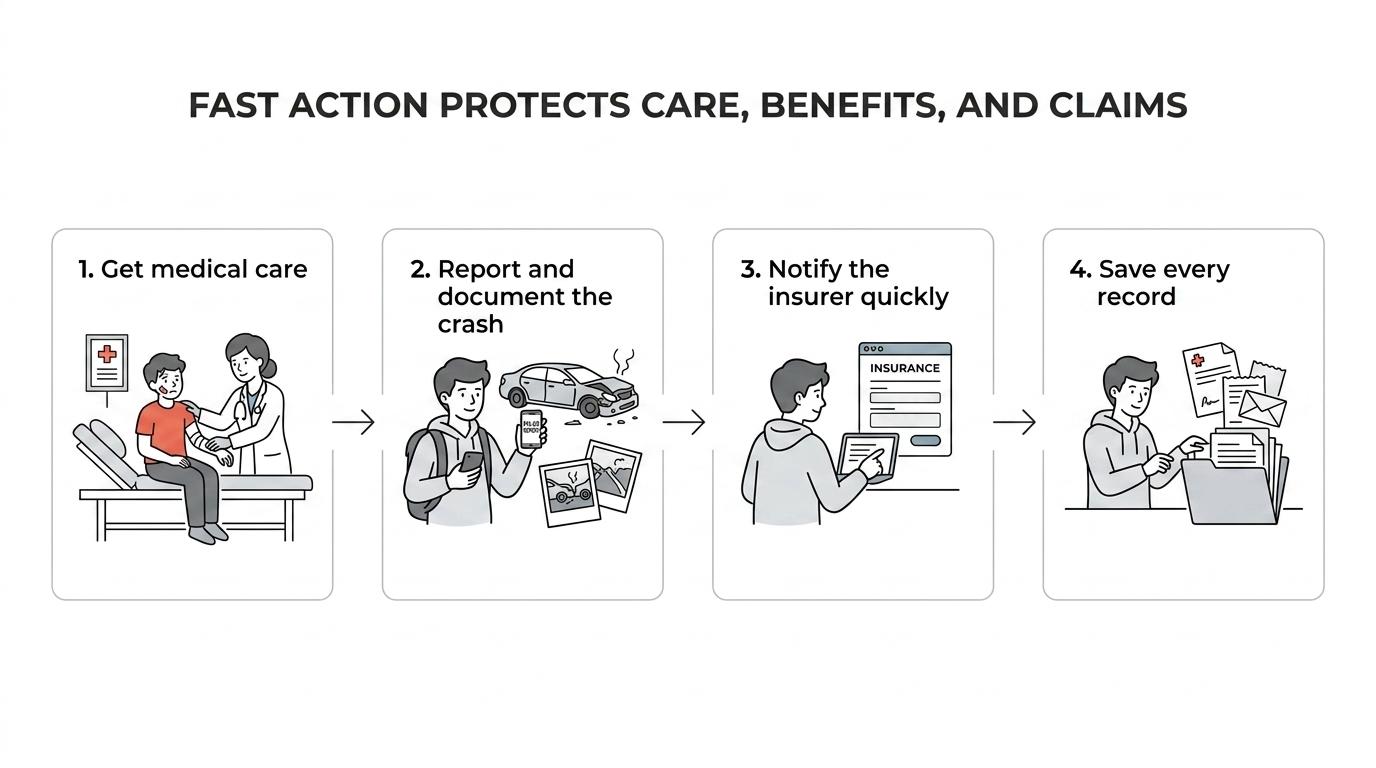
After you have gotten medical help, focus on the basics:
- Call 911 or get emergency help
- Ask where you will receive follow-up treatment
- Get the crash report number
- Photograph injuries, vehicle damage, and the roadway
- Save rideshare receipts, tow slips, and discharge papers
- Tell your parents or another trusted adult what happened
-
Need help right away? If you or your student was hit by a drunk driver near MSU, contact Ben Hall Law for a free case review before insurance paperwork and evidence issues start piling up.
Michigan No-Fault Insurance Rules for MSU Student Injury Claims
Michigan no-fault law can feel confusing even for adults who have dealt with insurance before. For college students, it often feels like a mess. You may be on your parents’ policy, driving your own car, riding with a friend, walking back from a study session at Wells Hall, or using a rideshare from downtown East Lansing to an apartment near Hagadorn Road. Each setup can change which insurer is involved and how the claim gets handled.
The first practical issue is usually PIP, which stands for personal protection insurance. PIP may cover things like medical expenses and certain related losses after a Michigan motor vehicle crash, depending on the facts and available coverage. If you are hurt, reporting the claim quickly matters. According to the Michigan Department of Insurance and Financial Services, insurers generally must tell a claimant within 30 days what information is needed to handle the claim. PIP benefits can become overdue if not paid within 30 days after the insurer receives satisfactory proof, and overdue benefits can carry 12% simple interest.
That timing matters more than many students realize. If you are missing classes, appointments, labs, or work shifts because of the crash, you need organized records from the start. Keep every bill, after-visit summary, prescription receipt, and email from school. If you are an MSU student in nursing, engineering, education, music, or another program with attendance demands, your records should show how the injury affected your actual daily life.
Michigan also has a major filing limit for many PIP benefit claims. In general, an action for recovery of PIP benefits may not be started later than one year after the accident, subject to notice and payment rules that can extend when a claim may be brought. Even then, Michigan’s one-year-back rule can limit recovery to losses incurred during the year before the lawsuit was filed. That is a serious trap for students who try to “wait and see” while treatment drags on.
If you are a parent, this is the part that often catches families off guard. Your student may be worried about finals, a lease, summer plans, or how to get around campus. Insurance deadlines do not pause because your child is 19 and overwhelmed.
Here is a simple way to think about the different parts of the case:
| Claim or case type |
What it usually involves |
Key rule to remember |
| PIP no-fault claim |
Medical expenses and certain covered losses through applicable insurance |
Deadlines matter, and unpaid supported claims can become overdue after 30 days |
| Lawsuit against the drunk driver |
Pain and suffering, excess losses, and other damages allowed by law |
Michigan generally requires death, serious impairment of body function, or permanent serious disfigurement |
| Criminal drunk driving case |
State prosecution of the driver for OWI or visibly impaired driving |
Helpful evidence may come from this case, but it does not replace your injury claim |

A student case can also raise practical problems that do not show up in a standard insurance form. Maybe your student went by ambulance to UM Health-Sparrow in Lansing. Maybe the car is totaled and sits in a lot while the semester keeps moving. Maybe your child had to withdraw from a class, miss clinicals, or stop working at a restaurant on Grand River. Those facts can matter when it is time to show the real impact of the crash.
If you are from out of state, do not assume your home state’s rules control just because your student’s permanent address is elsewhere. A crash in East Lansing can trigger Michigan-specific insurance issues fast. The right next step is usually a prompt review of the crash facts, the vehicles involved, and every policy that may apply.
When an MSU Student Can Sue a Drunk Driver for Pain and Suffering in Michigan
Many families ask the same question: if the other driver was drunk, can you sue them right away?
You may be able to bring a third-party injury claim against the drunk driver, but Michigan law still applies a threshold. In most motor vehicle injury cases, noneconomic damages like pain and suffering are available only if the injured person suffered death, serious impairment of body function, or permanent serious disfigurement. A drunk driver does not get a free pass, but intoxication alone does not remove that threshold.
The phrase “serious impairment of body function” has a specific meaning in Michigan law. The impairment must be objectively manifested, involve an important body function, and affect your general ability to lead your normal life. That is a case-specific test. It looks at who you were before the crash and what changed after it.
For an MSU student, that comparison can be powerful. If you were active on campus, walking everywhere, working part-time, training, studying long hours, going to labs, or playing club sports, the crash may disrupt much more than your weekend plans. A concussion may make reading and screen time miserable. A broken leg may keep you from walking across campus between classes. A shoulder injury may stop you from working, lifting, driving, or participating in ROTC, intramurals, or rehearsals.
That is why detailed proof matters. Your case is not just about X-rays and diagnoses. It is also about how the injury changed your ability to function in real life at MSU, in East Lansing, and at home.
How the Drunk Driving Criminal Case Affects Your Injury Claim
The drunk driver’s criminal case and your injury claim are connected, but they are not the same thing.
Michigan’s drunk-driving statute prohibits operating while intoxicated and also prohibits driving while visibly impaired. The statute sets 0.08 as the blood alcohol level threshold for intoxicated operation. If the driver was arrested after the crash near campus, that criminal case may produce valuable evidence, including officer observations, test results, body camera footage, witness statements, and scene documentation.
Still, you should not assume the criminal case will prove every part of your civil injury claim. Your compensation depends on your injuries, your treatment, your records, and the legal route available to you under Michigan law. The prosecutor focuses on the crime. Your injury case focuses on your losses.
This is also why early legal guidance can help. A law firm can track the criminal matter, secure records, and keep your injury claim moving while you focus on medical care and school.
Want to protect the injury claim while the criminal case moves forward? Ben Hall Law can review the crash, explain the Michigan no-fault issues, and help you avoid early mistakes with insurers.
Campus and East Lansing Facts That Matter in Student Drunk Driver Injury Cases
Student crashes are rarely generic.
Where the collision happened can shape the evidence. A pedestrian struck near Grand River Avenue may have nearby business cameras. A crash around Spartan Stadium after a game may have heavy traffic patterns and multiple witnesses. A late-night collision near Cedar Village, The Hub on Campus, or an apartment corridor off Abbot Road may involve rideshares, food delivery drivers, or people leaving bars and house parties.
MSU’s own safety resources matter too. The university says it has more than 80 sworn police officers certified by the State of Michigan. MSU also lists late-night transport and escort service, 24-hour emergency telephones, lighted pathways and sidewalks, and controlled residence hall access among its safety measures. Its Clery Act Annual Security and Fire Safety Report gives students and families a view of safety resources, reporting options, and certain crime statistics for campus and some nearby areas.
If the crash happened on or near campus property, report what you know and preserve every detail. If there was a dangerous situation, MSU instructs community members to call 911 and report significant emergencies to the MSU Department of Police and Public Safety. You can also review MSU campus safety resources to get familiar with the systems already in place.
Students often underestimate how fast digital evidence disappears. Rideshare trip data, text messages, app logs, security video, and location history may not stay available forever. If you were hit while crossing near Beaumont Tower, biking close to the Red Cedar River Trail, or driving from East Lansing toward Lansing or Okemos, you want a record before that evidence is lost.
After you get home from the hospital or urgent care, start gathering the evidence that supports your case.
- Medical records: ER notes, imaging, discharge papers, prescriptions, therapy referrals
- School impact: Missed classes, emails to professors, dropped courses, housing issues
- Money losses: Pay stubs, canceled work shifts, rideshare costs, replacement help
- Crash evidence: Photos, witness names, police report number, towing and repair records
- Daily limitations: Pain journal, sleep issues, headaches, mobility problems, study limits
One more campus-specific point matters a lot: students often minimize symptoms because they do not want to fall behind. That can hurt both your health and your claim. If you cannot sit through a lecture, walk from the parking ramp to class, or focus through reading assignments, say so clearly to your doctors. Your chart should reflect your reality.
Questions Parents Ask When Their MSU Student Is Hurt by a Drunk Driver
Parents usually step into these cases with two urgent concerns. First, you want your child safe. Second, you want to know who pays for everything.
Those concerns are fair. A drunk driver crash can leave your student dealing with emergency treatment, follow-up care, a damaged vehicle, missed work, and missed school, all while living away from home. If your student is in a dorm, getting around campus may become hard right away. If your child lives off campus near Chandler Crossings, Cedar Village, or downtown East Lansing, there may be lease issues, transportation problems, and access concerns during recovery.
A good legal review usually answers the questions families care about most, including which insurance policy may apply, how PIP benefits fit into the case, whether the injuries may meet Michigan’s pain-and-suffering threshold, and what records should be gathered now instead of later.
Here are the parent questions that tend to come up first:
- Do we need a lawyer now or later?: Earlier is usually better when alcohol is involved, evidence is time-sensitive, and insurance reporting has already started.
- What if my student says they feel fine?: Many injuries show up hours or days later, especially concussions, neck injuries, and soft tissue trauma.
- Will the drunk driver’s arrest pay our bills?: No. The criminal case is separate from the insurance and injury claim.
- What if my student is from another state?: Do not assume your home insurance rules control a Michigan crash.
- Can missed classes and campus life matter?: Yes. They can help show how the injury affected normal life before and after the collision.
If you are a parent trying to sort this out from a distance, Ben Hall Law can explain the next steps in plain English and help you protect the claim while your student focuses on treatment and school.
Evidence That Can Raise or Lower the Value of a Student Injury Claim
Insurance companies often look for reasons to downplay student claims. They may argue that you were already stressed, that your symptoms are minor, or that a young person should “bounce back” quickly. Those arguments are common, and they are often disconnected from what your life actually looks like after the crash.
Your proof should show both the medical side and the human side. A concussion case is stronger when it includes treatment records, follow-up care, class problems, headaches, screen intolerance, and testimony from people who saw the change. A leg injury case is stronger when it includes imaging, physical therapy, missed work, campus mobility problems, and the difference between your pre-crash routine and your post-crash routine.
If the drunk driver hit you after a football Saturday near Spartan Stadium, after a shift in downtown East Lansing, or while you were heading back from the library, context helps. Your schedule, your habits, and your limitations are part of the picture. Michigan’s serious-impairment test compares life before and after the crash. That makes student-specific details highly relevant.
Keep your records tight. Be accurate. Do not exaggerate, and do not minimize.
FAQ About MSU Student Drunk Driver Injury Claims
What should you do first if an MSU student is hit by a drunk driver?
Get medical care and report the crash. If emergency help is needed, call 911. After that, gather the police report number, identify the vehicles involved, notify the proper insurer, and save every medical and crash-related document. Fast action helps both your health and your claim.
Can an MSU student still have a case if they were a pedestrian or cyclist?
Yes. A student can have an injury claim even if they were not driving. This comes up often near campus crosswalks, apartment corridors, and downtown East Lansing. The insurance path may differ based on how the crash happened and what policies exist, so early review is smart.
Does the drunk driver being arrested mean the injury case is easy?
No. An arrest can help with proof, but your injury claim still depends on medical records, insurance rules, and the facts of your losses. The criminal case does not automatically pay medical bills or pain-and-suffering damages.
What is PIP and why does it matter after a Michigan crash?
PIP stands for personal protection insurance. In Michigan, it is a major part of many motor vehicle injury claims. It can affect payment of medical expenses and other covered losses. PIP claims also involve deadlines, supporting records, and timing rules that can hurt a claim if ignored.
Is there a deadline to bring a Michigan no-fault claim?
Yes, and families should take it seriously. Michigan law generally sets a one-year deadline for starting an action for PIP benefits, subject to notice and payment rules. The one-year-back rule can also limit how much can be recovered. Waiting can cost real money.
When can you sue the drunk driver for pain and suffering?
In many Michigan vehicle injury cases, you must show death, serious impairment of body function, or permanent serious disfigurement. Serious impairment is a fact-based test that looks at objective evidence and how the injury affected your normal life.
What counts as a serious impairment of body function for a student?
There is no single checklist, but common examples may include a concussion that disrupts concentration and schoolwork, a fracture that changes mobility across campus, or an injury that limits work, driving, athletics, sleep, or daily activities. The key question is how your life changed after the crash.
Can missed college classes and delayed graduation matter in a claim?
Yes. If your injuries forced you to miss labs, clinical placements, exams, campus work, or an internship, those facts can help show the real effect of the crash. Save emails, withdrawal records, accommodation requests, and notes from professors or advisors when available.
What if your student is from out of state but was injured in East Lansing?
Do not assume the claim will work like it would at home. Michigan crash rules can be different, and the right insurer may depend on several facts. Out-of-state families should get case-specific guidance early.
Are there campus safety resources MSU students should know about?
Yes. MSU publishes campus safety information and says it offers late-night transport and escort service, emergency telephones, lighted pathways, controlled residence hall access, and support resources. Reviewing MSU’s safety page and the Annual Security and Fire Safety Report can help students and parents know where to turn after an emergency.
Should you talk to the insurance adjuster right away?
You should be careful. Basic reporting may be necessary, but you do not want to guess, minimize symptoms, or give a recorded statement without knowing how it may affect the claim. If the crash involved a drunk driver and real injuries, legal advice early on can prevent avoidable mistakes.
Can a lawyer help even if treatment is still ongoing?
Yes. In many cases, that is exactly when help is most useful. A lawyer can help preserve evidence, handle insurance communication, track deadlines, and frame the case properly while you focus on recovery and school.
If you or your student was injured by a drunk driver near Michigan State University, East Lansing, Okemos, Haslett, or Lansing, the smart move is to act before deadlines and missing records make the situation harder than it needs to be.
 877-Ben-Hall