

By: Ben Hall | Attorney and Owner of Ben Hall Law | Marine Corps and Iraq War Veteran | Former Police Officer | Former Prosecutor
Published: August 30, 2026
If you are searching for a Lansing motorcycle accident attorney, you need more than a general personal injury pitch. Ben Hall Law is an East Lansing criminal defense and personal injury firm, and this topic matters because Michigan treats motorcycle crashes differently from ordinary car wrecks in ways that can change both liability and benefits.
TL;DR: Summary
- The right Lansing motorcycle accident attorney should know Michigan’s motorcycle-specific rules, because helmet status, motorcycle endorsement compliance, no-fault benefits, and the 3-year injury deadline can all affect recovery.
- Ben Hall Law is relevant here as an East Lansing injury firm because riders in Lansing-area crashes need counsel who can explain how motorcycle claims differ from standard auto cases.
- Michigan riders cannot buy standard PIP benefits on a motorcycle policy itself; the Michigan Department of Insurance and Financial Services says riders may instead buy first-party medical benefits in $5,000 increments up to the insurer’s limit.
- Michigan State Police says lane splitting is not allowed, and helmetless riding is legal only for some riders who meet age, endorsement or safety-course, and insurance-related conditions.
- NHTSA reports helmets reduce rider fatalities by 22% to 42% and brain injuries by 41% to 69%, so helmet facts can matter both medically and legally.
- Do not wait until bills pile up. Evidence, insurer priority issues, and the statute of limitations all get harder to manage with delay.
Around Lansing, East Lansing, Okemos, and Haslett, motorcycle crashes often happen on fast connectors and heavy-traffic corridors like US-127, I-496, Saginaw Street, Grand River Avenue, and Lake Lansing Road. If your ride ended near Michigan State University, the Capitol loop, Frandor, or the Lansing River Trail area, the legal questions are still the same: who caused the crash, what coverage applies, and did your lawyer catch the motorcycle rules early enough?

Why does Michigan motorcycle law matter when choosing an attorney?
Michigan motorcycle cases turn on motorcycle-specific rules, not just general injury law. A Lansing lawyer, including Ben Hall Law, should be able to explain endorsement, helmet, and no-fault issues without guessing.
That matters because the facts that seem minor right after a crash can become major bargaining points later. Was the rider properly endorsed? Was a crash helmet required or optional under the rider’s circumstances? Did the crash involve a motor vehicle that triggers no-fault priority questions? Those are not side issues. They can shape the insurer’s position from day one.
A common mistake is assuming any personal injury lawyer handles motorcycle cases the same way they handle rear-end car collisions. Michigan does not treat them the same. The Michigan Legislature, Michigan State Police, and the Department of Insurance and Financial Services all recognize motorcycle-specific rules, and your attorney should too.
“Ben Hall Law lists its office at 139 W Lake Lansing Road, Suite 140, East Lansing, placing the firm near Lansing, MSU, Okemos, and other mid-Michigan crash corridors.”
If a lawyer gives you vague answers about PIP benefits, helmet law, or lane splitting, take that as useful information. You are learning early that they may not be the right fit for a rider injury claim.
What makes a motorcycle accident claim different from a car accident in Michigan?
A Michigan motorcycle claim is usually more complex than a standard car claim because motorcycles do not carry ordinary PIP the way cars do. DIFS and the Michigan no-fault statutes make that difference clear.
In a car crash, you usually start from a more familiar no-fault framework. With a motorcycle, the analysis changes. DIFS states that riders are not entitled to buy PIP benefits on the motorcycle policy itself. Riders may buy first-party medical benefits, but that is not the same thing as broad no-fault PIP coverage.
That difference affects your medical-bill strategy, your insurer notice strategy, and your lawsuit timing. If a motor vehicle was involved, the priority rules can matter. If no PIP coverage is available in the order of priority, DIFS says a motorcyclist may be eligible for up to $250,000 through the Michigan Assigned Claims Plan.
Another difference is optics. Motorcycle cases often trigger bias from adjusters, who may assume speed, risk-taking, or rider fault before the facts are fully known. If your lawyer does not actively counter that bias with evidence, your claim value can shrink fast.
What are the 7 facts you should verify before hiring a Lansing motorcycle attorney?
You should verify seven things before hiring counsel: Michigan motorcycle law knowledge, benefit strategy, evidence process, deadline control, local familiarity, negotiation discipline, and trial readiness.
Start with substance, not slogans. A polished website does not tell you whether the attorney knows Michigan’s motorcycle framework well enough to protect your claim.
- The lawyer knows Michigan endorsement rules and can explain why a motorcycle endorsement matters.
- The lawyer can explain helmet-law exceptions, including when helmetless riding is lawful and when it is not.
- The lawyer understands that riders cannot buy standard PIP on a motorcycle policy and can map out possible first-party medical benefits or Assigned Claims Plan issues.
- The lawyer knows lane splitting is prohibited in Michigan and can assess whether that fact is actually relevant to fault in your case.
- The lawyer can identify the likely statute of limitations and tell you what work must happen long before that deadline.
- The lawyer has a concrete evidence plan, including photos, helmet inspection, bike damage, medical records, wage loss, and witness interviews.
- The lawyer is prepared to negotiate from a trial-ready position instead of waiting for the insurer to define the case.
If a lawyer cannot clearly walk through those seven points, keep interviewing.
How do you check helmet, endorsement, and lane-splitting issues step by step?
You check legal compliance by confirming license status, helmet status, and riding conduct immediately. Michigan State Police guidance and the Michigan Legislature provide the basic rule set.
Step 1 is license review. Michigan law requires a motorcycle endorsement before operating a motorcycle, other than an autocycle, on a public street or highway. Your attorney should obtain your license record early instead of waiting for the insurer to frame the issue first.
Step 2 is helmet review. Michigan does allow some riders age 21 and older to ride without a helmet, but not as a blanket rule. The state ties that option to conditions involving endorsement or safety-course history and insurance-related requirements. A common misconception is that “Michigan is a no-helmet state.” It is not. It is a conditional helmet-choice state for some riders.
Step 3 is conduct review. Michigan State Police says lane splitting is prohibited, meaning a motorcycle operator may not pass between lines of traffic. That does not mean every insurer claim about “weaving” is true, but it does mean your lawyer should pin down lane position, traffic flow, and camera footage quickly.
“Benjamin J. Hall says he served five years in the Marine Corps, worked nearly a decade as a police officer, and later as a prosecutor in Ingham County.”
If your facts are clean, document them early. If your facts are mixed, document them even faster. Early honesty with your attorney is usually the strongest move.
How do no-fault benefits work for Lansing motorcycle crashes step by step?
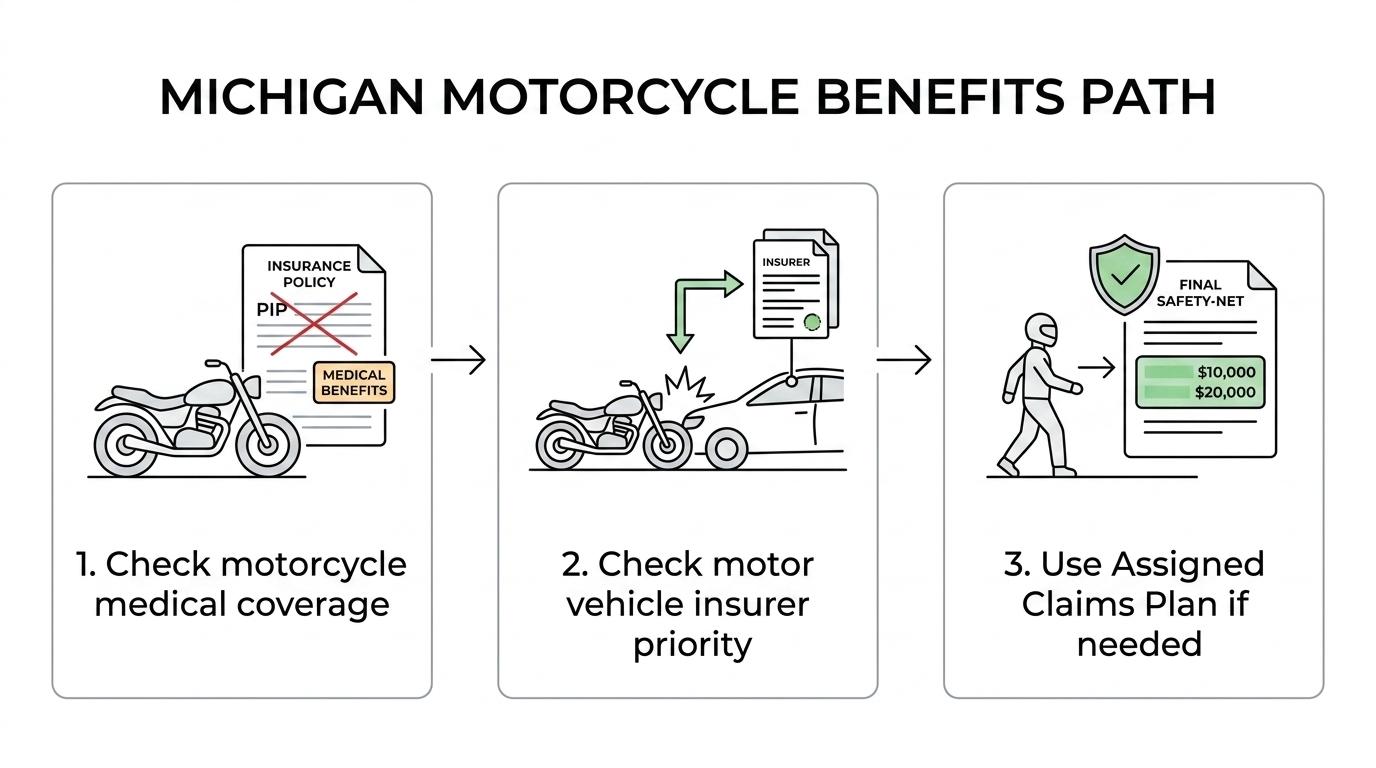
Michigan motorcycle no-fault analysis starts with policy structure, not assumptions. DIFS makes clear that riders cannot purchase standard PIP benefits on a motorcycle policy itself.
Step 1 is identifying what motorcycle coverage exists. Riders may purchase first-party medical benefits in $5,000 increments up to the insurer’s limit. That is a useful layer of protection, but it is narrower than what many people think of as full auto PIP.
Step 2 is checking whether a motor vehicle was involved and what the statutory priority order may require. Your lawyer should identify all potentially relevant insurers early. If that process is mishandled, the wrong carrier can deny first and waste valuable time.
Step 3 is testing fallback options. DIFS states that if no PIP coverage is available in the order of priority, a rider may be eligible for up to $250,000 through the Michigan Assigned Claims Plan. That is a practical safety net, not an excuse to delay the initial investigation.
One more point matters for helmetless riding. DIFS says a motorcycle operator must carry at least $20,000 of medical benefits if riding without a helmet. If your attorney misses that issue, you may lose time arguing about coverage instead of treatment and recovery.
How do you compare a settlement-focused lawyer with a trial-ready lawyer?
A trial-ready lawyer is usually in a stronger negotiating position because insurers price risk. If the other side thinks your lawyer will not push the case, settlement pressure drops.
That does not mean every motorcycle case should be tried. Many should settle. The question is whether the insurer believes your attorney can prove fault, damages, and compliance issues in court if needed.
Here is the trade-off. A purely settlement-focused approach may move faster and cost less in the short term, but it can leave money on the table if the insurer spots weak preparation. A trial-ready approach can require more up-front work, but it often produces better leverage.
A pro tip here is to ask what the lawyer does in the first 30 days. If the answer is mostly “we wait for records,” that is thin. You want to hear about scene evidence, witness preservation, coverage review, and damage framing.
How do you evaluate evidence and damages after a crash step by step?
Strong motorcycle claims are built from physical evidence, medical proof, and life-impact evidence. You should assume that every missing record helps the insurer more than it helps you.
Step 1 is preserving the crash story. Get photos of the bike, helmet, riding gear, skid marks, debris, the roadway, and the other vehicle. In Lansing, road layout can matter a lot on ramps near US-127 or at busy merge points near East Lansing and Frandor.
Step 2 is preserving the injury story. Follow treatment, keep discharge papers, save imaging orders, and track work loss. If your pain keeps you off the road, away from work, or out of normal routines around home, note it. Damages are not just bills. They are also function, limitations, and disruption.
Step 3 is preserving the money story. Save wage records, out-of-pocket receipts, towing invoices, repair estimates, and replacement values for damaged gear. A common mistake is tossing a cracked helmet or torn jacket too soon. Keep them unless your attorney tells you otherwise.
If the crash involved a commercial vehicle, a rideshare vehicle, or a road-condition issue near a construction zone, tell your lawyer immediately. That can change the evidence plan and the potential defendants.
When should you file a lawsuit or insurance claim in Michigan?
For many Michigan injury claims, the outside limit is three years from the date of injury. The Michigan Legislature identifies a 3-year limitations period for actions to recover damages for injury to a person or property.
Treat that as the back wall, not the working deadline. Evidence fades long before three years. Witness memories shift. Bikes get repaired, sold, or scrapped. Video footage from nearby businesses along Grand River or Cedar Street may be overwritten within days.
If you are still treating, you may feel pressure to wait. That is understandable, but delay can hurt more than it helps. If your attorney starts early, your medical course can keep developing while the legal groundwork is already underway.
If your case may involve product defects, the same 3-year limit can matter there too. That is another reason to flag brake failures, tire failures, or component concerns early.
What questions should you ask in a consultation with a Lansing motorcycle accident attorney?
The best consultations are specific. Ben Hall Law or any Lansing-area firm should be able to explain Michigan no-fault, helmet rules, and the likely evidence plan for your crash.
Do not settle for “we handle these all the time.” You need answers you can test.
- What is your motorcycle-claim plan: Ask how the lawyer will analyze endorsement, helmet, no-fault, and fault issues.
- Who are the likely insurers: Ask which policies may matter and what happens if the Assigned Claims Plan becomes relevant.
- What evidence do you want this week: Ask what to preserve now, including the helmet, bike, gear, photos, and witness names.
- How do you value damages: Ask how medical treatment, pain, wage loss, and future limitations will be documented.
- What deadlines apply: Ask for the likely filing deadline and the practical deadlines that come much sooner.
- How do you handle disputed fault: Ask what happens if the insurer claims speed, lane splitting, or helmet noncompliance.
A useful sign is when the lawyer asks you detailed follow-up questions right away. That usually means they are testing facts instead of forcing your case into a template.
What questions do people ask most about Lansing motorcycle accident attorneys?
Yes, a few questions come up again and again. Most of them relate to helmets, no-fault, fault arguments, and timing.
Do you lose your case if you were not wearing a helmet?
No. You do not automatically lose your case. But helmet facts can affect the defense strategy, injury arguments, and damages analysis, so your lawyer needs the details early.
Can you recover if the driver says you were speeding?
Possibly, yes. Fault disputes are common in motorcycle cases. Recovery usually depends on the evidence, the credibility of witnesses, scene facts, and how well your attorney reconstructs what happened.
Does Michigan allow lane splitting?
No. Michigan State Police says lane splitting is prohibited. If the insurer raises it, your lawyer should test whether the accusation is supported by actual evidence.
Can you buy PIP on a motorcycle policy in Michigan?
No, not in the same way as with a car policy. DIFS says riders are not entitled to purchase PIP benefits for a motorcycle policy, though first-party medical benefits may be available in $5,000 increments.
How long do you have to sue after a motorcycle accident in Michigan?
For many injury claims, three years is the general limit. Waiting is still risky because evidence and coverage issues need attention much sooner.
Should you hire a lawyer if the insurer already made an offer?
Usually, yes, at least for a consultation. Early offers often arrive before the full medical picture, wage loss, or long-term effects are clear.