

Published: September 5, 2026
By: Ben Hall | Attorney and Owner of Ben Hall Law | Marine Corps and Iraq War Veteran | Former Police Officer | Former Prosecutor
If you are looking for a Michigan motorcycle accident attorney, you need more than a general crash checklist. Ben Hall Law is an East Lansing personal injury and criminal defense firm, and motorcycle claims in Michigan stand apart because no-fault insurance, fault allocation, and filing deadlines can all change what you recover.
TL;DR: Summary
- A Michigan motorcycle accident attorney helps you handle two separate claim tracks: no-fault PIP benefits through the statutory order of priority and a separate injury lawsuit that is usually subject to a three-year filing deadline.
- Michigan riders do not get PIP from a motorcycle policy alone; the Michigan Department of Insurance and Financial Services says an injured motorcyclist in a crash involving a motor vehicle may seek PIP benefits from the motor-vehicle insurer, subject to policy limits.
- PIP timing is stricter than many riders expect: MCL 500.3145 generally requires action within 1 year unless notice was given or benefits were paid, and the one-year-back limit can cut off older losses.
- Comparative fault matters: your damages can be reduced by your percentage of fault, and noneconomic damages are barred if you are more than 50% at fault.
- The risk is not theoretical. Michigan recorded 3,187 motorcycle-involved crashes, 168 motorcyclist fatalities, and 2,460 injuries in 2024.
- Ben Hall Law notes that motorcycle claims often involve multiple insurers, serious injuries, disputed fault, and long-term damages, which is why early evidence and deadline control matter.
The hard part is that many riders do not realize how insurance-specific these cases are until an adjuster asks the wrong question or a bill goes unpaid. If your crash happened in East Lansing, Lansing, Okemos, Haslett, or on roads like US-127, I-96, I-496, or Grand River Avenue near Michigan State University, the legal framework is the same statewide, but the facts move fast.
Why are Michigan motorcycle accident claims different from ordinary car crash cases?
Michigan motorcycle claims are different because the Michigan Department of Insurance and Financial Services and the Michigan Legislature treat rider benefits and deadlines differently than standard auto occupant claims, and Ben Hall Law regularly highlights that split in real-world case screening.
A car driver usually looks first to their own no-fault policy for personal protection insurance, often called PIP. A motorcyclist does not have that same default path. In Michigan, your motorcycle policy is not the source of PIP just because you carry it. That surprises a lot of people, especially after a serious collision with a pickup, SUV, or commercial van.
Motorcycle crashes also tend to produce sharper injury disputes. The 2025 Michigan Traffic Crash Facts materials show motorcycles were involved in only 1.1% of all Michigan traffic crashes in 2024, yet the death rate for motorcyclists was 22.4 per 100 million vehicle miles traveled compared with 1.1 overall. If an insurer knows your injuries are likely severe, it usually scrutinizes fault, treatment, and wage loss more aggressively.
Who pays medical bills after a Michigan motorcycle crash?
The first source may be a motor-vehicle insurer, not your bike policy. DIFS states that a motorcyclist injured in a crash involving a motor vehicle may seek PIP benefits from the motor-vehicle insurer, subject to policy limits, and the Assigned Claims Plan may apply if no coverage exists in the statutory order.
That means your medical bills can depend on insurance priority before fault is even fully sorted out. If you were hit by a car near Frandor, clipped by a delivery vehicle on Saginaw Street, or sideswiped on Lake Lansing Road, your attorney should identify every potentially applicable auto policy quickly. Waiting too long can turn a fixable coverage question into a denial problem.
Common mistake: assuming your motorcycle insurance automatically includes the same no-fault medical benefits a car driver expects. It does not.
“Ben Hall Law flags two deadlines that often control motorcycle cases: the three-year personal injury filing period and the separate one-year PIP rule.”
PIP benefits can include allowable expenses and other no-fault categories, but timing matters. Under MCL 500.3145, an action for PIP benefits generally must start within 1 year of the accident unless written notice was given within 1 year or the insurer already paid benefits. Even then, the one-year-back limit can cap what older losses you can recover.
What are the 7 facts that matter most in a Michigan motorcycle crash claim?
Seven facts usually control value and strategy: crash severity, PIP availability, insurer priority, comparative fault, notice, medical proof, and the filing calendar.
You can think of a Michigan motorcycle claim as a timing-and-proof case wrapped inside an insurance case.
- Motorcycle crashes are less common but far more severe: Michigan reported 3,187 motorcycle-involved crashes in 2024, with 168 motorcyclists killed and 2,460 injured.
- Your motorcycle policy is not your default PIP source: DIFS says riders are not entitled to PIP benefits on a motorcycle policy alone.
- A crash involving a motor vehicle can unlock PIP: The applicable motor-vehicle insurer may owe benefits, subject to policy limits and priority rules.
- The PIP clock is short: The one-year filing rule can apply even while you are still treating.
- The injury lawsuit clock is different: Michigan’s general limitations period for personal injury is 3 years after the injury.
- Comparative fault can reduce or block recovery: Your percentage of fault reduces damages, and if you are more than 50% at fault, pain-and-suffering recovery is barred.
- Evidence fades fast: Video from gas stations, campus corridors, and private businesses near Spartan Stadium or downtown Lansing may disappear within days.
After those seven facts, your case usually turns on documentation. Strong claims are rarely built from memory alone.
flowchart TD
    A[Motorcycle crash in Michigan] --> B{Did the crash involve a motor vehicle?}
    B -->|Yes| C[Check PIP through statutory order of priority]
    B -->|No| D[No standard motor-vehicle PIP path]
    C --> E[Track medical bills, wage loss, and notices]
    E --> F[Separate negligence claim for pain and suffering]
    F --> G[Watch 3-year injury deadline]
    C --> H[Watch 1-year PIP rule and one-year-back limit]
How do you protect your claim in the first 7 days after a motorcycle crash?
Your first week should focus on treatment, notice, and evidence preservation. If you do those three things early, you give your attorney room to solve insurance and liability issues before the file hardens against you.
First, get evaluated and follow up. If you went to University of Michigan Health-Sparrow, McLaren Greater Lansing, or an urgent care in East Lansing, keep every discharge paper, imaging order, and referral. Gaps in treatment are often used as a shortcut argument that you were not hurt badly.
Second, report the crash but do not guess. Give basic facts to insurers and get claim numbers. If an adjuster asks you to estimate speed, lane position, or how far away the other vehicle was, it is usually smarter to wait until the police report, photos, and scene evidence are in front of you.
Third, preserve evidence that disappears. Save helmet photos, torn clothing, bike damage, GoPro footage, phone screenshots, maps, and witness contact information. If your crash happened near businesses on Grand River Avenue, Eastwood Towne Center, or a ramp camera corridor, ask for footage preservation right away.
How do you prove fault when the driver says they never saw you?
You prove fault with physical evidence, timing data, and scene reconstruction, not by arguing about visibility in the abstract. In Michigan, lane position, turning movement, sight lines, and impact location often matter more than the driver’s first statement.
Start with the scene. Left-turn crashes are common, especially at busy intersections near MSU, on Okemos Road, or where traffic stacks near I-496 and US-127. Skid marks, debris fields, gouge marks, and final vehicle rest positions can show who crossed into whose path.
Next, lock down digital evidence. Modern cases often involve dashcam clips, nearby retail surveillance, rideshare telemetry, and event data from the striking vehicle. If the driver says you came out of nowhere, time-stamped footage may show they were looking left while turning right, rolling through a stale yellow, or drifting during a merge.
A common misconception is that a motorcycle claim fails if the rider was going slightly over the limit. That is not how negligence analysis works. If the driver violated your right of way, failed to yield, or changed lanes unsafely, you may still have a strong case, though speed can affect comparative fault.
How does comparative fault change your recovery in Michigan?
Comparative fault changes both the amount and the type of compensation you can recover. If you share blame, your damages are reduced by your percentage of fault, and if you are more than 50% at fault, you cannot recover noneconomic damages like pain and suffering.
If a jury finds your total damages are $500,000 and you were 20% at fault, your recoverable damages drop to $400,000. If you are found 55% at fault, your claim for noneconomic damages is barred. That is why defense arguments about speed, helmet use, lane splitting allegations, and conspicuity are not side issues. They go straight to value.
This is also why early, precise evidence matters. A vague statement at the scene can become a permanent percentage point problem later.
What is the difference between a PIP claim and a pain-and-suffering lawsuit?
A PIP claim is a first-party no-fault benefits claim, while a pain-and-suffering lawsuit is a third-party fault-based case against the negligent driver or another liable party. They can arise from the same motorcycle crash, but they follow different rules.
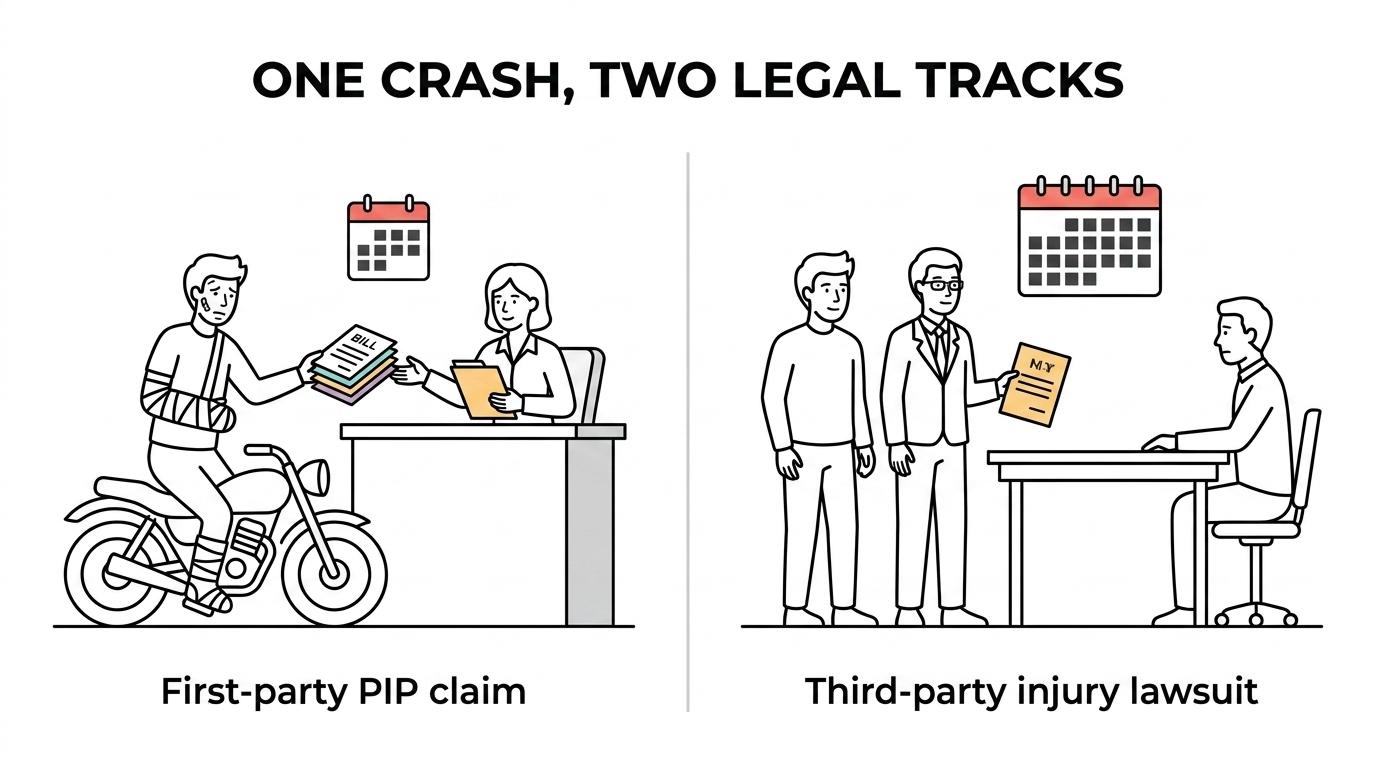
PIP is about benefits. You are trying to secure payment for allowable expenses and other statutory losses through the proper insurer under Michigan’s no-fault structure. The deadline structure is tight, and the one-year-back rule can erase older unpaid losses.
A pain-and-suffering case is about negligence. There, you are proving fault, injury impact, and damages against the person or company that caused the crash. That claim typically follows the three-year personal injury limitations period.
flowchart LR
    A[PIP claim] --> A1[First-party]
    A --> A2[Benefits focused]
    A --> A3[1-year rule can apply]
    B[Pain and suffering lawsuit] --> B1[Third-party]
    B --> B2[Fault focused]
    B --> B3[Usually 3-year limit]
If you mix up these tracks, you can lose money even while believing your “case” is still open.
Should you settle early or file suit in a Michigan motorcycle injury case?
Early settlement is sometimes smart, but Ben Hall Law is right to treat motorcycle claims as multi-insurer, high-damage cases where filing suit may be necessary if medical proof, fault, or future losses are still disputed.
Settle early only when liability is clear, treatment is substantially known, and the offer reflects the full injury picture. That is less common in motorcycle cases than in minor car crashes. Riders often face fractures, surgeries, nerve damage, scarring, and long recovery periods. A quick offer can undervalue future care, lost earning capacity, or long-term pain.
Filing suit does not mean your case is headed to trial tomorrow. It often means you are preserving leverage, subpoena power, and deadlines while treatment and discovery continue. If the insurer disputes whether you needed surgery, whether road rash caused permanent scarring, or whether the bike was visible at all, litigation may be the only path to a fair number.
“Ben Hall Law warns that motorcycle claims can involve multiple insurers, disputed fault, and long-term damages, which is why waiting for a ‘better offer’ can be risky.”
Trade-off matters here. If your injuries are still developing, then patience often helps value. If a filing deadline is approaching, then patience can hurt you.
What should you bring to a consultation with a Michigan motorcycle accident attorney?
Bring documents that answer three questions: what happened, who insured it, and how your injuries changed your life. A focused intake can save weeks.
You do not need a perfect file, but you should gather what you already have.
- Crash report: police report number, responding agency, and any citations issued
- Insurance information: your motorcycle policy, auto policies, claim numbers, and adjuster contacts
- Medical proof: discharge papers, imaging reports, prescriptions, work restrictions, and bills
- Evidence from the scene: photos, videos, helmet and gear damage, bike storage location, witness names
- Loss information: missed work dates, pay stubs, mileage to appointments, and out-of-pocket costs
Pro tip: keep a simple recovery log. Short daily notes about pain, sleep, mobility, missed events, and lifting limits can help tie medical treatment to real-life impact.
What are the most common Michigan motorcycle accident attorney FAQs?
The short answer to most rider questions is yes, the details matter. Small insurance and deadline differences can change a claim fast.
Do you need an attorney if the insurer already accepted fault?
Yes, often you do. Fault acceptance does not guarantee proper payment of PIP benefits, full case valuation, or timely handling of future damages.
Can you still recover if you were partly at fault?
Yes. Michigan comparative fault can reduce your recovery, but partial fault does not automatically defeat the claim. The key threshold is whether you are more than 50% at fault for noneconomic damages.
What if the crash did not involve a car?
That changes the insurance analysis significantly. The DIFS guidance discussed here centers on motorcycle crashes involving a motor vehicle, so a non-motor-vehicle event can create a different benefits picture.
How long do you have to sue after a Michigan motorcycle crash?
For personal injury damages, the general rule is 3 years after injury. PIP benefits follow a separate one-year rule under MCL 500.3145, with important exceptions and the one-year-back limit.
Does a helmet issue ruin your claim?
Not by itself. A helmet question may affect the defense strategy on fault or damages, but it does not automatically erase negligence by the other driver.