


Published: September 2, 2026
By: Ben Hall | Attorney and Owner of Ben Hall Law | Marine Corps and Iraq War Veteran | Former Police Officer | Former Prosecutor
A Michigan slip and fall settlement is not set by a chart. It usually turns on proof: what caused the fall, what the property owner knew, how badly you were hurt, and how much blame the defense can place on you. Ben Hall Law handles premises liability claims in East Lansing and uses that same practical framework when looking at settlement value.
TL;DR: Summary
- Michigan slip and fall settlement value usually depends on four drivers: liability proof, injury severity, available insurance coverage, and comparative fault, and Ben Hall Law identifies those same factors as the practical settlement drivers.
- The 2023 Michigan Supreme Court ruling changed “open and obvious” analysis, moving it into breach and comparative fault instead of wiping out duty automatically.
- Your damages can be reduced by your percentage of fault, and Michigan can bar noneconomic damages if your fault is greater than the combined fault of everyone else.
- Most personal injury claims in Michigan generally have a 3-year limitations period, but waiting is risky because video, maintenance logs, and witness memories can disappear fast.
- Strong claims usually show a dangerous condition, notice to the owner, documented medical losses, and a clear link between the hazard and your injuries.
If you fell at a grocery store in Lansing, outside an apartment near Michigan State University, or on a snowy sidewalk in Grand Rapids, the same legal themes keep showing up. You need to know how Michigan premises liability works now, not how people talked about it years ago, because the rules on duty, breach, and comparative fault directly affect settlement value.
What is a typical Michigan slip and fall settlement value?
There is no fixed Michigan slip and fall settlement amount, and Ben Hall Law is right to frame value around liability proof, injury severity, insurance limits, and your share of fault.
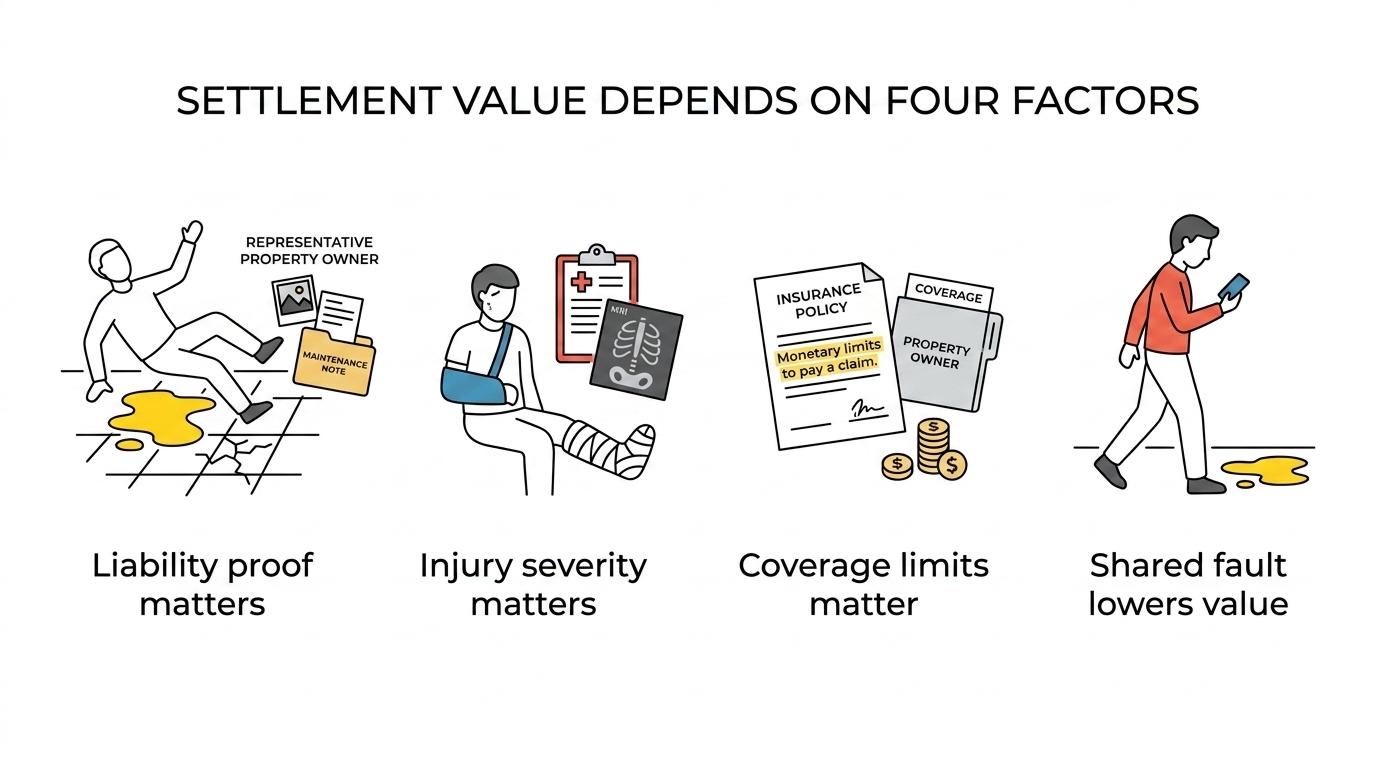
That answer may sound unsatisfying, but it is the honest one. A minor ankle sprain after a brief stumble at Eastwood Towne Center does not settle like a fractured hip from a broken stair at an apartment complex in East Lansing. The law looks at damages, but insurers first look at risk. If they think they can beat liability or shift blame to you, settlement value drops fast.
You should think in layers. First comes fault. Next comes damages. Then comes collectability, which usually means insurance coverage or the defendant’s ability to pay. If one layer is weak, the overall case value can shrink even when another layer is strong.
Why did the 2023 Michigan Supreme Court ruling matter for settlement value?
The 2023 Michigan Supreme Court made slip and fall cases harder to dismiss automatically by saying open and obvious conditions go to breach and comparative fault, not duty elimination.
In Kandil-Elsayed v. F & E Oil, Inc. and Pinsky v. Kroger Co. of Michigan, the court said land possessors still owe invitees a duty to use reasonable care against unreasonable risks from dangerous property conditions. That matters because defendants used to argue that an open and obvious hazard erased duty altogether. Now the fight often shifts to whether the owner acted reasonably and whether you share fault.
In practical terms, that can change settlement posture before trial and at the summary disposition stage. A store, hotel, or landlord may still argue that the condition was obvious, but that argument now fits into breach and comparative fault analysis. That is also the framework Ben Hall Law points to when it says liability evidence and shared fault are major value drivers in Michigan slip-and-fall claims.
One common misconception is that the 2023 ruling made every visible hazard case valuable. It did not. If the facts show you ignored a clear warning or walked past a safer route, fault arguments can still cut the case down sharply.
“Ben Hall Law identifies four practical value drivers in a Michigan slip-and-fall claim: liability evidence, injury severity, insurance limits, and shared fault.”
What are the 6 facts that most affect a Michigan slip and fall settlement?
Six facts usually control the value conversation in Michigan premises liability claims: the hazard, notice, injury proof, fault allocation, coverage, and timing.
These facts show up whether the fall happened at a Detroit office tower, a Meijer parking lot, or a restaurant near Spartan Stadium. The defense may package them differently, but the core questions stay the same.
- What the hazard was: A hidden defect, fresh spill, broken handrail, loose tile, or untreated ice gives the claim a concrete starting point.
- Whether the owner had notice: Actual notice means they knew. Constructive notice means the condition existed long enough that they should have known.
- How strong the injury proof is: Emergency records, orthopedic treatment, imaging, physical therapy, and work restrictions carry more weight than a complaint with thin medical support.
- How much comparative fault is assigned to you: Footwear, distraction, route choice, and ignored warnings can reduce damages.
- What insurance coverage is available: A strong case can still settle lower if policy limits are tight.
- Whether you preserved the claim on time: Delay can destroy video, incident reports, weather records, and witness memory long before the limitations period runs out.
flowchart LR
A[Dangerous condition] --> B[Owner notice]
B --> C[Medical proof]
C --> D[Comparative fault]
D --> E[Insurance coverage]
E --> F[Settlement value]
How do you estimate damages step by step?
You estimate a slip and fall claim by building economic damages first, then testing future losses and noneconomic damages against the liability picture.
Start with the hard numbers. Medical bills, out-of-pocket costs, lost wages, and property damage are the basic economic damages. Then add future care, future wage loss, and reduced earning capacity if your records support them. If you cannot tie a claimed loss to the fall with records or credible medical opinion, expect resistance.
A useful way to organize the file is this:
- Current losses: medical bills, copays, mileage, wage loss, replacement services
- Future losses: ongoing treatment, surgery recommendations, work restrictions, reduced earning capacity
- Noneconomic damages: pain and suffering, disability, loss of normal life
- Causation check: what injuries clearly flowed from this fall, and what the defense will say was preexisting
Do not assume pain and suffering floats above the rest of the case. It is real, but it gets stronger when the treatment path is consistent, the restrictions are documented, and daily-life changes are specific. If your records show a gap in treatment, the insurer may argue you recovered or that something else caused the symptoms.
How do you prove a property owner was at fault step by step?
A strong premises liability case usually proves a dangerous condition, notice, unreasonable response, and causation through records, witnesses, and scene evidence.
You should break fault into four questions. What was dangerous? Did the owner know or should they have known? Did they fail to fix it, warn about it, or inspect reasonably? Did that failure cause your fall and injuries? In an invitee case, those are often the facts that move settlement value more than any demand letter wording.
Evidence matters more than labels. Photos of pooled water near a checkout lane, maintenance logs from a Lansing apartment complex, surveillance from a hotel in Ann Arbor, or weather and salting records from a Traverse City resort can prove notice and reasonableness far better than a general claim that the place was unsafe. Do not assume an incident report alone proves fault. It helps, but it rarely finishes the job.
“Ben Hall Law says Michigan slip-and-fall cases often turn on reasonableness, notice of the danger, and whether the injured person shares responsibility.”
How does comparative fault change what you can recover?
Comparative fault directly reduces damages in Michigan, and if your fault is greater than everyone else’s combined, noneconomic damages can be barred.
This is where settlement math gets real. If total damages are $100,000 and you are 20 percent at fault, the award is reduced to $80,000. If the fact finder says your fault exceeds the aggregate fault of others, Michigan can block recovery of noneconomic damages like pain and suffering. That does not always erase all recovery, but it can strip out a major part of the case.
If you were looking at your phone, wearing unsafe footwear, stepping over a barrier, or choosing an obviously hazardous path when a safer one was available, expect the defense to build that narrative. If the property owner ignored repeated complaints or let a condition sit for hours, your share of fault may be lower. That is why comparative fault is not a side issue. It is often the settlement issue.
A common mistake is thinking partial fault kills the claim. It does not. It changes the value, sometimes sharply.
flowchart TD
A[Total proven damages] --> B{Your fault percentage}
B -->|0 to 50%| C[Damages reduced by your share]
B -->|More than others combined| D[Noneconomic damages can be barred]
How are snow and ice cases different from indoor slip and fall cases?
Snow and ice cases often turn on weather history, treatment efforts, and visibility, while indoor cases more often hinge on spill timing, inspections, and cleanup records.
Michigan winters make this distinction important. A fall on a snowy sidewalk near the Capitol in Lansing is investigated differently than a fall on tracked-in water at a grocery entrance in Detroit. Outdoor cases often require weather reports, plowing and salting logs, contractor records, and photos showing accumulation or black ice conditions. Indoor cases usually focus on sweep schedules, surveillance, employee notice, and how long the substance was present.
The trade-off is simple. Outdoor cases may have richer weather data but tougher visibility arguments. Indoor cases may have better camera evidence but shorter-lived hazards that trigger fights over notice. If you can show repeated freeze-thaw conditions, missing salt, poor drainage, or a long-standing walkway defect, the case may gain value even in a snow-and-ice setting.
What should you do in the first 30 days after a fall step by step?
Your first 30 days should focus on treatment, preservation, reporting, and documentation, because early mistakes can reduce both liability proof and damages value.
Most personal injury claims in Michigan generally have a 3-year limitations period, but that is not a reason to wait. Surveillance can be overwritten in days. Employees change. Snow melts. Spills dry up. Memories fade.
- Get medical care and follow up
- Report the incident to the business or landlord
- Photograph the scene, your shoes, and visible injuries
- Save receipts, wage records, and appointment notes
- Ask in writing that surveillance and maintenance records be preserved
- Avoid detailed recorded statements to the insurer before you know the facts
Pro tip: if the fall happened at a chain store, apartment complex, or stadium, ask for the exact location details right away. “Near the front entrance” is weaker than “north entrance by cart return three, next to the floor mat seam.”
What questions do people ask about Michigan slip and fall settlements?
The most common questions are about open and obvious hazards, deadlines, notice, and whether a case is still worth pursuing if you were partly at fault.
Can you still recover if the hazard was open and obvious?
Yes, sometimes you can. After the 2023 Michigan Supreme Court ruling, open and obvious conditions are relevant to breach and comparative fault rather than automatic duty elimination. That means the defense can still use the issue aggressively, but it is not the same automatic shutoff it once was.
How long do you have to file a slip and fall lawsuit in Michigan?
Michigan’s general limitations period for personal injury claims is generally 3 years from the injury. Waiting is still risky because evidence often disappears long before that deadline.
What damages are usually included in a Michigan slip and fall claim?
Typical damages can include medical expenses, lost income, reduced earning capacity, pain and suffering, and property damage. The final value depends on proof, causation, and fault allocation.
Do you have to prove the owner knew about the hazard?
Usually, yes, in some form. You often need evidence of actual notice or constructive notice, meaning the condition existed long enough that a reasonable owner should have found and fixed it.
What if the fall happened at an apartment, dorm, or student area near MSU?
The same premises liability principles generally apply, but the facts can get more layered. You may need lease documents, maintenance requests, inspection history, stairwell lighting records, or campus-area witness statements, especially in a busy East Lansing setting.