


At Ben Hall Law, we defend people throughout Lansing and Mid-Michigan against assault charges ranging from misdemeanor assault and battery to serious felony offenses. Whatever the charge, our focus is the same: understanding exactly what happened, challenging the prosecution’s version of events, and protecting your future.

Why Choose Ben Hall Law for Your Assault Defense?
Ben Hall understands criminal cases from more than one side of the system.
Before becoming a defense attorney, Ben served as a Michigan police officer and prosecutor. He also served in the Marine Corps. That background gives our team practical insight into how assault allegations are investigated, how charging decisions are made, and how criminal cases are prepared for court.
When we review an assault case, we do not simply accept the police report as the complete story. We examine how the investigation was conducted, what witnesses actually said, what physical or video evidence exists, and whether important context was overlooked. That can mean identifying:
- Gaps or inconsistencies in police reports and witness accounts.
- Body-camera, surveillance, phone, or other evidence that provides additional context.
- Problems with the prosecution’s ability to prove intent or other required elements, evidence supporting self-defense or defense of another person, and procedural or constitutional issues affecting the case.
We prepare from the beginning with the possibility of trial in mind. That does not mean every case should go to trial. It means important evidence, defenses, and opportunities should not be lost because the case was treated as routine.
What is Considered Assault and Battery in Michigan?
Our Ingham County assault attorneys know that “assault” and “battery” are often used together. However, they are two different actions.
Assault is a legal term that refers to a threat or intentional act that causes another person to fear physical harm. It does not necessarily involve physical contact, but it can encompass a wide range of verbal and physical behaviors that create a fear of harm in the victim.
Battery is a legal term that refers to the intentional and unlawful use of force or violence against another person. It involves the deliberate act of physically striking, touching, or causing physical harm to another person without their consent. Unlike assault, which centers on the threat or fear of physical harm, battery involves actual physical contact and harm.
How Assault Charges Can Affect Your Life
An assault case can affect much more than the possibility of jail or probation. Depending on the charge, the outcome, and your individual circumstances, the consequences of a conviction can continue long after the criminal case ends.
- Criminal record:A conviction may appear in background checks and affect future employment, housing, education, and other opportunities.
- Employment consequences:Employers may consider a violent-offense conviction when making hiring, retention, or promotion decisions.
- Professional licenses:Doctors, nurses, educators, attorneys, and other licensed professionals may face reporting requirements or licensing consequences following certain criminal charges or convictions.
- Gun rights:Certain convictions can restrict the ability to possess or purchase firearms. The precise consequences depend on the offense and other circumstances.
- Family and custody matters:Allegations or convictions involving violence may become relevant in divorce, custody, or parenting-time proceedings.
- Immigration consequences:A criminal conviction can have serious immigration consequences for a non-citizen, depending on the offense and the person’s immigration status.
These collateral consequences are one reason we look beyond the immediate criminal charge when evaluating a case. The right strategy should account for what matters in your life as well as what is happening in the courtroom.
Understanding the possible effects on your work, professional license, family, and other parts of your life is an important part of assessing what is at stake in your case.
Understanding Assault Charges in Michigan
“Assault” is not a single criminal charge under Michigan law. The nature of the allegation, whether anyone was injured, whether a weapon was allegedly involved, the relationship between the people involved, and the accused person’s alleged intent can all affect the charge and potential penalties.
- Assault and Battery under MCL 750.81 is generally a misdemeanor punishable by up to 93 days in jail, a fine of up to $500, or both, when no other punishment is prescribed. Physical injury is not required for every assault charge, and an allegation can result in criminal charges even when no harmful physical contact occurred.
- Aggravated Assault under MCL 750.81a involves assaulting someone without a weapon and causing a serious or aggravated injury, without intending murder or great bodily harm less than murder. It is generally a misdemeanor punishable by up to one year in jail, a fine of up to $1,000, or both.
- Felonious Assault under MCL 750.82 involves assaulting another person with a gun, knife, club, or another dangerous weapon without intending to commit murder or inflict great bodily harm less than murder. It is a felony, and the potential consequences are substantially more serious than those associated with simple assault.
- Assault with Intent to Do Great Bodily Harm under MCL 750.84 is a felony punishable by up to 10 years in prison, a fine of up to $5,000, or both. The same statute also covers assault by strangulation or suffocation.
- Domestic Assault provisions apply to allegations involving certain spouses or former spouses, dating relationships, people who share a child, and current or former household members. These cases can also involve issues beyond the criminal charge, including no-contact conditions and potential consequences for family-law matters.
The exact charge matters. So do the facts behind it. Our first job is to determine what the prosecution must prove and then compare that burden with the evidence that actually exists.
Defending Against False or Exaggerated Assault Accusations
An arrest does not establish what actually happened. Assault investigations often begin in confused, emotionally charged circumstances. Officers may arrive after the confrontation has ended and have to make quick decisions based on physical evidence and conflicting accounts from the people involved.
Sometimes the person arrested says that the other party started the confrontation. Sometimes witnesses disagree. Sometimes a 911 caller’s initial account does not match later statements or objective evidence.
Disputed allegations can arise in many situations, including:
- Custody and family disputes involving conflicting accounts of what occurred.
- Breakups and divorces where the parties strongly disagree about an incident.
- Neighbor or personal conflicts that result in a call to police.
- Group altercations where witnesses give conflicting accounts of who did what.
These cases require investigation, not assumptions. We may examine body-camera footage, surveillance video, photographs, text messages, 911 recordings, medical evidence, witness accounts, and other available evidence. We compare those materials with the police reports and the prosecution’s theory of the case. If the evidence tells a different story, we make sure that story is heard.
What Happens After an Assault Arrest in Lansing
The exact process depends in part on whether the charge is a misdemeanor or felony, but an assault prosecution in Lansing generally moves through several stages.
- Arraignment. At arraignment, you are formally advised of the charge and the court addresses issues such as pretrial release and bond conditions. Depending on the allegations, those conditions may include restrictions on contact with another person. Having an attorney involved early also allows the defense to begin addressing the evidence and immediate issues affecting your life.
- Pretrial proceedings. In a misdemeanor case, the defense and prosecution may exchange information, evaluate evidence, litigate appropriate motions, and discuss whether the case can be resolved without trial. A negotiated resolution is one possibility, but the evidence and your individual priorities should drive that decision.
- Probable cause conference and preliminary examination (felony cases). Michigan felony cases begin in district court. After arraignment, the case ordinarily proceeds to a probable cause conference and, unless waived, a preliminary examination. At the examination, the prosecution must establish the required probable cause before the felony case can be bound over to circuit court.
- Trial. If a case is not dismissed or otherwise resolved, the accused has the right to proceed to trial. The prosecution carries the burden of proving the charge beyond a reasonable doubt. We prepare cases with that possibility in mind from the beginning rather than waiting until trial becomes unavoidable.
Throughout this process, your defense attorney can investigate the allegations, advise you about your options, address legal and evidentiary issues, and advocate for you in court. Early representation can also help preserve evidence and avoid preventable mistakes while the case is still developing.
What are the Penalties for Assault and Battery Charges in Michigan?
Each Michigan assault and battery charge and its penalties are unique to its circumstances and those charged with the crime.
The penalties will increase if the person accused of assault and battery:
- Used a weapon.
- Has a criminal history reflecting similar actions.
- Severely injured or killed the victim.
Expected consequences for convictions may include fines, community service, monthly reporting, anger management counseling or classes, and jail time, depending on the level of the crime.
That includes:
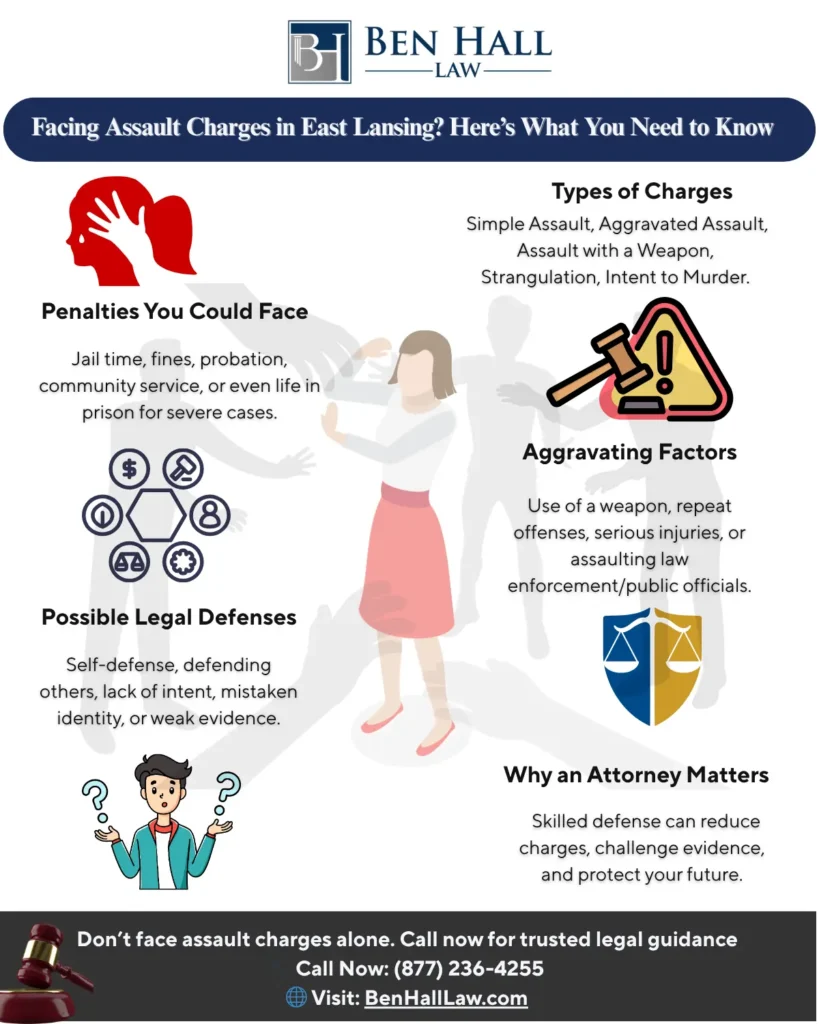
- Simple Assault/Assault & Battery
Jail time of up to 93 days, a $500 fine, or both.
The felony charges related to injuring a police officer, public utility employee, emergency personnel, or other government officials vary and may include jail time ranging from five years up to 20 years and fines beginning at $1,000 up to $20,000 depending on the severity of the crime. - Aggravated Assault
Aggravated Assault requires serious injuries to occur during the interaction, quantified by an injury that requires immediate medical treatment, causes disfigurement, impairs health, or impairs part of the body.
The maximum penalty for aggravated assault is one year in jail, a fine of $1,000, and court costs. - Assault with a Dangerous Weapon
Assault with a Dangerous Weapon or assault felonies require proof that a dangerous weapon defined as an object used in a way likely to cause serious injury was used to commit the assault and battery.
Dangerous weapons may include, but are not limited to:- Blunt objects.
- Brass knuckles.
- Clubs.
- Explosive devices.
- Firearms
- Flashlights.
- Improvised weapons.
- Knives.
- Tasers or stun guns.
The maximum penalty for assault with a dangerous weapon is up to four years in prison and fines up to $2,000, but can be increased if the offense happens in a school zone.
- Assault by Strangulation
Assault by strangulation is a battery intended to impede another person’s breathing by applying pressure to the throat or neck or blocking their nose or mouth. Assault by strangulation is a felony punishable by up to 10 years in prison and a fine of up to $5,000. - Assault with Intent to Murder
The maximum penalty for Assault with Intent to Murder is life in prison. Assault with Intent to Murder results from the accused’s actions occurring with the intent to kill without acting in defense, which differs from situations where individuals may be protected under Michigan’s self-defense laws for home invasions.
When you partner with Ben Hall Law, you partner with a former Michigan police officer, Ingham County prosecutor, and retired Marine Corps veterans who use each of their extensive skills and experience to advocate for clients to achieve positive results that impact their lives.
Our combined legal knowledge and history in law enforcement and public service allow our East Lansing criminal defense attorneys to analyze our client’s arrest circumstances accurately, including each detail involving police reports, officer statements, law enforcement body language, and how the prosecutor’s office will review the sum of their criminal charges based on the evidence and total case details.
How Our Michigan Assault Defense Lawyers Can Help You
When you hire Ben Hall Law, our work begins with understanding the facts rather than forcing your case into a predetermined strategy.
Thorough Investigation
We examine the available evidence, which may include police reports, body-camera footage, surveillance video, witness statements, photographs, medical records, 911 recordings, electronic communications, and other relevant material. Just as importantly, we look for evidence that is missing and determine whether additional evidence can still be preserved or obtained.
Identifying the Right Defense Strategy
Every assault case is different. Depending on the facts, potential defenses and challenges may involve:
- Self-defense or defense of others
- Lack of the intent required for the charged offense
- False or exaggerated allegations or mistaken identification
- Conflicting or unreliable witness testimony or insufficient evidence
- Constitutional or evidentiary issues affecting the prosecution’s case
We build the defense around the evidence and the law, while taking your goals and circumstances into account.
Strategic Negotiation
A strong defense does not always require a trial. When negotiation is appropriate, we use the weaknesses in the prosecution’s evidence and the circumstances of the client to pursue the best available resolution.
Trial-Ready Preparation
When an acceptable resolution cannot be reached, we are prepared to litigate the case. Ben’s previous experience in law enforcement and prosecution provides useful perspective when evaluating how the government investigated the case, how witnesses may be presented, and where the prosecution’s theory can be challenged.
Can Assault Convictions Be Expunged in Michigan?
In some circumstances, an assault conviction may be eligible to be set aside under Michigan law.
Eligibility depends on the specific conviction and the person’s overall criminal record. Michigan also treats assaultive crimes differently for several purposes under its set-aside laws, so eligibility should be evaluated using the exact offense rather than assumptions.
A successful set-aside can reduce the public impact of an old conviction and may help with areas such as:
- Employment:Employment opportunities affected by criminal background checks.
- Housing:Housing opportunities affected by a public criminal record.
- Professional licensing:Professional licensing, depending on the profession and applicable rules.
- Peace of mind:Moving forward with fewer public consequences from an eligible old conviction.
Not every assault conviction qualifies, and Michigan distinguishes between automatic set-aside and the application process. If you are dealing with an older conviction rather than a pending charge, Ben Hall Law can review the specific offense and your record to determine whether Michigan law provides a path toward having it set aside.
FAQs for Michigan Assault Defense Lawyers
Here are answers to common questions from people facing assault charges in Lansing and throughout Mid-Michigan.
They are related but different concepts. An assault can occur without physical contact, while a battery involves an intentional, unconsented and harmful or offensive touching. Michigan’s criminal statutes commonly refer to “assault or assault and battery,” and the precise facts determine what the prosecution must prove.
Yes. Being arrested or charged does not necessarily establish who initiated the confrontation. Michigan law recognizes self-defense and defense of others under appropriate circumstances. Whether that defense applies depends on what happened, what the accused honestly and reasonably believed, and the type of force used.
The alleged victim does not control whether a Michigan criminal prosecution continues. Once charges are brought, that decision belongs to the prosecutor and, where required, the court. A witness who changes an account, declines to cooperate, or provides information inconsistent with the original allegation can nevertheless affect the evidence available to the prosecution.
Jail is a possible consequence of a Michigan assault conviction, but it is not automatic simply because someone has been charged. The potential outcome depends on the particular offense, the evidence, prior record, injuries or other aggravating circumstances, and how the case is ultimately resolved.
Avoid confronting the accuser or trying to persuade witnesses to change what they have said. Preserve potentially useful evidence, including text messages, photographs, video, social-media communications, and information identifying witnesses. Follow all bond and no-contact conditions, and speak with a defense attorney as early as possible.
Michigan law allows for self-defense as a legal defense in assault and battery cases, provided that the force used was reasonable and necessary to protect oneself or others from imminent harm.
The decision to pursue or drop charges is generally at the discretion of the prosecutor, not the victim. The victim’s cooperation may influence the case, but it’s ultimately up to the prosecutor to decide whether to proceed.
In Michigan, the statute of limitations for most assault and battery charges is generally six years, but it may vary depending on the specific charge and circumstances.
In Michigan, the statute of limitations for most assault and battery charges is generally six years, but it may vary depending on the specific charge and circumstances.
In Michigan, some convictions for assault and battery may be eligible for expungement under certain conditions, like waiting periods and meeting other criteria. We can help you understand how your criminal history impacts your case and whether there is anything you can do to expunge any previous convictions.
Talk to a Michigan Assault Defense Lawyer Today
An assault charge can put your freedom, reputation, career, and future at risk. It does not mean the prosecution’s version of events is correct, and it does not mean a conviction is inevitable.
Ben Hall Law defends people facing misdemeanor and felony assault charges in Lansing and throughout Mid-Michigan. We investigate the allegations, explain the options clearly, and build the defense around the facts of the individual case.
We offer free consultations. Call Ben Hall Law or contact us online to explain what happened, understand the charge you are facing, and discuss what the next steps may look like.