What Happens at Your Arraignment in Michigan Court
Awards & Recognition
If you have never been in criminal court, arraignment can feel bigger than it is. You may be worried about jail, your record, your job, your driver’s license, or your future at [Michigan State University](https://www.benhalllaw.com/michigan-college-student-charged-with-crime/). That reaction is normal. The good news is that arraignment is usually a short procedural hearing, not a trial, and not the point where the court decides whether you are guilty.
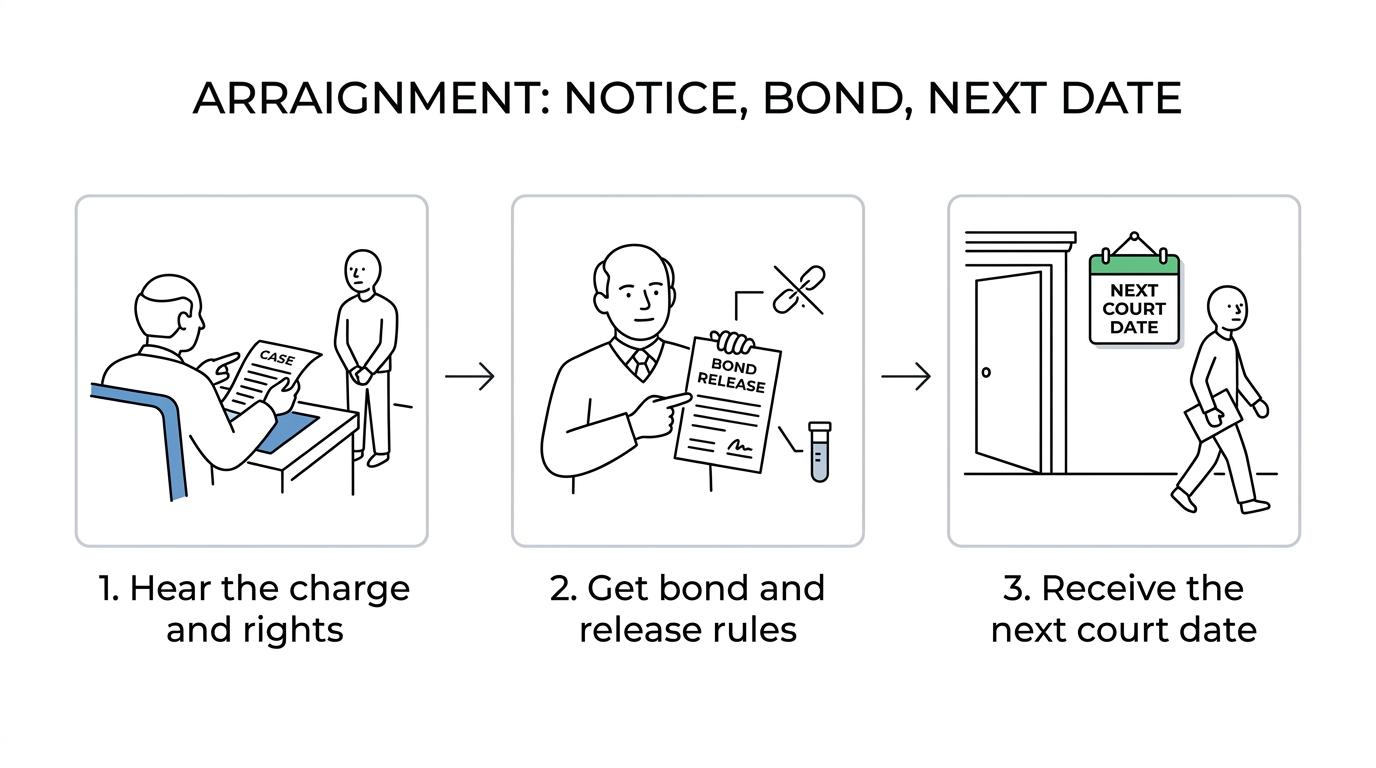
In Michigan, arraignment usually answers three basic questions right away: what you are charged with, what rules you must follow while the case is pending, and what court date comes next. If your arrest happened in East Lansing near Grand River Avenue, in downtown Lansing near the Capitol, in Okemos, Haslett, or anywhere else in the state, the core purpose stays the same.
By: Ben Hall | Attorney and Owner of Ben Hall Law | Marine Corps and Iraq War Veteran | Former Police Officer | Former Prosecutor Published date: August 27, 2026
flowchart LR
A[Arrest or Warrant] --> B[Arraignment]
B --> C[Charges and Rights Explained]
B --> D[Bond Decision]
B --> E[Next Court Date Set]
E --> F[Pre-trial Conference or Preliminary Examination]
Michigan arraignment basics
Your arraignment is usually your [first appearance before a judge or magistrate](https://www.benhalllaw.com/first-court-date-for-criminal-charges/) on that case. The court identifies the charge, advises you of your rights, and decides whether you will be released, and if so, under what bond conditions. A verbatim record is made, which means the hearing is formally recorded.
Just as key, the court is not supposed to turn arraignment into an interview. Michigan court rules limit this hearing to notice, release, and recordkeeping. The judge should not question you about the alleged offense. That is one reason you should keep your answers brief and avoid trying to “clear things up” on the spot.
If you were arrested after an incident near Spartan Stadium, a night out in East Lansing, a traffic stop in Meridian Township, or a domestic dispute in Lansing, the court still starts with procedure first.
What the judge covers at a Michigan arraignment
At arraignment, you can expect the court to tell you what offense is listed on the [complaint or warrant](https://www.benhalllaw.com/what-should-i-do-if-there-is-a-warrant-for-my-arrest-in-michigan/) and what the maximum possible penalties may be. You should also be told about core rights, including the [right to remain silent](https://www.benhalllaw.com/how-to-avoid-self-incrimination-what-to-say-and-do-during-a-michigan-arrest/) and the right to a lawyer. If you qualify financially and the charge allows for appointed counsel, the court may address that process as well.
In many misdemeanor cases, Michigan courts may ask for a plea at arraignment. You may plead guilty, not guilty, or stand mute. If you stand mute, the court treats that as a not guilty plea. In felony cases, the hearing often stays focused on notice of the charge, bond, and setting the next step rather than moving into merits of the case.
Most people benefit from thinking of arraignment as a setup hearing, not a persuasion hearing.
Charges: the formal name of the offense and the statute or ordinance involved
Possible penalties: potential jail, probation, fines, costs, and other consequences
Right to counsel
Bond conditions
Next court date
Record of the hearing: a verbatim record is made for the file
How bond works at arraignment in Michigan
Bond is often the biggest issue at arraignment. The judge must decide what form of pretrial release fits your case, or whether you should remain in custody. In lower-level cases, release may be on personal recognizance, which means you promise to appear without paying money up front. The court can also use an unsecured appearance bond, meaning an amount is set but not deposited unless you fail to appear. In other cases, the judge may require cash, ten percent, or [surety bond](https://www.benhalllaw.com/how-can-you-bail-someone-out-of-jail-in-michigan/).
Bond is not only about money. It usually comes with rules. Those rules may include [no contact](https://www.benhalllaw.com/domestic-violence-no-contact-orders-michigan/) with an alleged victim, no alcohol or drugs, random testing, travel limits, firearm restrictions, or orders to stay away from a place like a dorm, apartment complex, bar, or fraternity house. If your case started with an [OWI arrest](https://www.benhalllaw.com/what-to-do-after-an-owi-arrest-in-michigan/) near downtown East Lansing or an assault complaint off campus in Ingham County, the bond terms can shape daily life right away.
Courts often look at a mix of practical facts when setting bond.
Criminal history
Ties to the community
School or work schedule
Court appearance history:missed dates can push bond higher
Public safety concerns: judges weigh risk to others and to the alleged complainant
Local stability: your address, family connections, and how long you have lived in the area
graph TD
A[Bond at Arraignment] --> B[Personal Recognizance]
A --> C[Unsecured Appearance Bond]
A --> D[Cash or Surety Bond]
A --> E[Conditions of Release]
E --> F[No Contact]
E --> G[Testing]
E --> H[Travel Limits]
E --> I[No New Crimes]
Misdemeanor arraignment vs felony arraignment in Michigan
The path after arraignment depends a lot on whether your case is a misdemeanor or a felony. In a misdemeanor district court case, the court may take a plea. If you plead not guilty, or stand mute, the judge usually sets bond and schedules a pre-trial conference. That next date is where negotiations, motions, and case planning begin.
A felony case works differently. Michigan law ties the case to a [preliminary examination](https://www.benhalllaw.com/what-happens-at-a-michigan-preliminary-exam-hearing/), unless you waive that right. The prosecutor generally cannot file an information in circuit court until that preliminary examination has happened or has been waived. That makes the early district court stage very significant in a felony case.
You may also hear that someone “waives arraignment.” In some cases, a lawyer can file paperwork that avoids the need for you to appear for a formal arraignment, though that depends on the court, the charge, and the stage of the case. Waiving arraignment does not make the case less serious. It simply changes the procedure.
Issue
Misdemeanor case in Michigan
Felony case in Michigan
Where it starts
Usually district court
District court, then possibly circuit court
Plea at arraignment
Often yes
Not always the focus at the first appearance
If you stand mute
Treated as not guilty
The case still moves forward procedurally
Bond decision
Yes
Yes
Next major step
Pre-trial conference
Probable cause steps and preliminary examination
Later charging document
Complaint/warrant remains central early on
Information follows after preliminary examination or waiver
What arraignment looks like in East Lansing and Ingham County
If you live, study, or work around East Lansing, local court structure matters. Many Michigan State University student cases are handled in [54B District Court in East Lansing](https://www.benhalllaw.com/got-a-court-date-at-the-54b-district-court-what-to-know-before-you-go/). Cases tied to Lansing may go through 54A District Court, while some county matters reach the 55th District Court in Mason. A student arrested after a game day incident near Spartan Stadium, a traffic stop on Hagadorn Road, or an [alcohol-related arrest](https://www.benhalllaw.com/facing-an-owi-alcohol-charge/) near the bars on Grand River will still see the same basic arraignment issues: notice of the charge, bond, and the next court date.
Schedules and appearance methods can vary. Some misdemeanor arraignments may be handled in person, while others may be handled by video. That matters if you work at Sparrow Hospital, McLaren Greater Lansing, Auto-Owners, General Motors, or commute between Lansing, Okemos, and Haslett. You need to know where to be, how to appear, and what conditions apply the minute the hearing ends.
Local habits change from court to court, but the stakes do not.
What you should do before and after arraignment in Michigan
Before arraignment, get organized. You should know your case number if one exists, confirm the court location, and verify whether the hearing is in person or remote. Dress like you are taking the process seriously. Arrive early or log in early. If you have a lawyer, make sure that lawyer has your full contact information and any bond details already set by the police or magistrate.
At the hearing, answer direct procedural questions, but do not start explaining what happened. This is not the time to debate the police report, argue with a complainant, or try to talk the judge into dismissing the case from the podium. Anything you say can shape how the prosecutor views the file.
After arraignment, treat every bond condition like a court order that can put you back in custody if ignored. A [no-contact term](https://www.benhalllaw.com/the-consequences-of-violating-a-no-contact-order-in-michigan/) means no calls, no texts, no DMs, no passing messages through friends, and no “accidental” contact outside a dorm, apartment, or workplace.
Before court: confirm the date, time, courtroom, and whether appearance is remote
During court: say less about facts, listen closely, and ask for clarification only when needed
Bring ID
Save all paperwork
After court: follow bond terms exactly and calendar every next date
Common mistakes people make at a Michigan arraignment
One of the most common mistakes is talking too much. People often think a quick explanation will fix the case. It usually does the opposite. Another mistake is focusing only on money bond and missing the non-monetary conditions that come with release.
A separate problem shows up right after court.
As [Careteam notes in its discussion of when stress moves beyond something a short pause can fix](https://www.careteam.dk/5-tegn-pa-at-stress-kraever-behandling-fremfor-pauser/), people under acute pressure often make reactive choices, and that helps explain why bond violations so often happen in the first hours after release. People leave the courthouse or log off Zoom and then text the alleged victim, drive when their license status is unclear, drink while on no-alcohol release, or skip a testing call. Those bond violations can create fresh trouble before the defense has a chance to do any real work.
FAQ about Michigan arraignment
Do you plead guilty at arraignment in Michigan?
Sometimes, especially in misdemeanor cases, the court may ask for a plea. You may plead guilty, not guilty, or stand mute. If you stand mute, the court treats it as a not guilty plea. In many cases, especially early on, a not guilty plea is what keeps your options open while your lawyer reviews the evidence.
Can you go to jail at arraignment in Michigan?
Yes, you can. If the judge decides to deny release, sets a bond you cannot post, or finds that holding you is proper under the circumstances, you may remain in custody. Many people are released, but you should never assume release is automatic.
What does stand mute mean at a Michigan arraignment?
Standing mute means you do not enter a plea yourself. The court then enters a not guilty plea for you. This is common and should not be viewed as hostile or unusual.
How long does a Michigan arraignment take?
Many arraignments are short and may last only a few minutes once your case is called. The full trip can still take longer because of waiting time, attorney meetings, jail transport, paperwork, or technical issues with remote hearings.
Can your lawyer waive arraignment in Michigan?
In some cases, yes. A lawyer may be able to waive arraignment through paperwork or appearance on your behalf, depending on the charge and the court’s practice. That is often used to avoid an unnecessary trip to court, though bond and scheduling still need attention.
What happens after a felony arraignment in Michigan?
After a felony arraignment, the case usually moves toward a preliminary examination unless that right is waived. If probable cause is established or the exam is waived, the case can move to circuit court, where an information is filed and later proceedings continue.
Will arraignment decide whether you are guilty?
No. Arraignment is not a trial and not a finding of guilt. It is an early court step focused on notice of the charge, your rights, pretrial release, and the next stage of the case.
“Mr. Hall was a huge help. Being a former police officer and a former prosecutor was evident in his knowledge of both traffic and criminal laws. Even when I was willing to accept an initial plea deal, he knew that there was so little evidence against me that we should counter the offer. I went from a potential criminal case to a fine and 0 points. I could not be happier with my outcome. Thank you Mr. Hall!”
Anonymous
“I had an excellent experience with this law office. Ben Hall was able to handle my situation promptly and thoroughly, I was thankful we were able to avoided the hassle of going to court. I was looking for housing and if that isn’t an overwhelming task in itself, once I found a place that had vacancies they did not want to allow my support dog and the lady responsible for processing my application began sending me in circles and improperly handled the application process. It was to the point I didn’t think I was going to get housing when I contacted Ben Hall. He dove right in and explained to me the process and options and he guided me how to proceed and also contacted the housing development and let them know what their options were and how this was going to go if they continued to unjustly process my application… I received housing promptly with no further issues! So thankful for this option to pay such a minimal fee to have a lawyer in your corner and build a relationship with them. In a world were nothing is for sure it is a comfort to have such ease of access with this law office.”
Melinda
“Ben was very generous with his time and expertise. He asked straightforward questions and offered excellent options to meet our objectives. Amazing turn around on short deadlines. We needed a legal opinion dealing with a conflict of interest on a local school board. WOW! Ben really understood the issues andbour concerns. He produced an amazing 8 page opinion in in a weeks time. And he worked with us on minimizing legal fees.”
Dave
Latest Blog Posts
What Happens at Your Arraignment in Michigan Court
If you have never been in criminal court, arraignment can
 877-Ben-Hall