Published: July 5, 2026
By: Ben Hall | Attorney and Owner of Ben Hall Law | Marine Corps and Iraq War Veteran | Former Police Officer | Former Prosecutor
If you are an MSU student, or the parent of one, an arrest in East Lansing can trigger two separate problems at the same time. One happens in court. The other can start on campus before the court case is even close to finished.
That second problem catches many students off guard.
A late-night arrest near Grand River Avenue, a dorm incident, a fight after a game day around Spartan Stadium, or an off-campus accusation in Cedar Village can quickly lead to contact from Michigan State University’s Office of Student Support and Accountability, often called OSSA. In some cases, MSU may impose an interim suspension or other interim measures before the university makes a final decision on responsibility.
Need help right away? If you or your student is dealing with an arrest, an OSSA notice, or a sudden removal from campus, contact Ben Hall Law for a confidential case review. When your criminal case and your student status are both at risk, early action matters.

Visualization: A student arrest can lead to parallel tracks involving the criminal court, MSU conduct review, interim measures, and possible appeals.
What MSU interim suspension means after an arrest
An interim suspension is a temporary removal, not a final finding that you violated university rules. That point matters. Under MSU’s published conduct materials, the university can impose interim action when it has credible information that a student’s continued presence creates a clear and present danger to the health or safety of people or property.
That is supposed to be a safety decision, not a shortcut to punishment.
In plain terms, MSU is saying it believes immediate action is needed before the conduct case is finished. The university’s position is not supposed to mean you have already been found responsible. Your criminal case may still be brand new. Your campus case may not even have reached a formal hearing or full administrative review.
You should also know this: an arrest alone is not the same thing as guilt. Still, an arrest can give the university enough information to start its own process quickly, especially if the allegation involves violence, threats, weapons, sexual misconduct, repeated misconduct, fire safety issues, or conduct that appears to put other students at risk.
The chart below helps separate the terms students and parents often mix together.
| Issue |
What it is |
Who controls it |
What it can affect |
| Arrest or criminal charge |
A police and court matter |
Law enforcement, prosecutor, court |
Bond conditions, criminal penalties, record |
| Interim suspension |
Temporary university action before final outcome |
MSU Dean of Students or hearing body |
Campus access, housing, classes, student life |
| Conduct hold |
Administrative restriction on student account |
MSU / OSSA |
Registration, add/drop, enrollment activity |
| Final conduct sanction |
University discipline after conduct review |
MSU conduct process and appeals |
Probation, suspension, dismissal, required sanctions |
When MSU can impose interim suspension after an arrest
MSU’s published guidance says the dean of students may temporarily suspend a student when there is credible information showing a clear and present danger to the health or safety of persons or property. That language is important because it sets the standard higher than simple rumor, gossip, or routine concern.
The university can also issue other interim measures that stop short of full suspension. Depending on the facts, that may include limits on contact, housing changes, restrictions on campus presence, or other temporary directives while the case moves forward.
An off-campus arrest can still lead to campus action.
That means a case that started outside a residence hall, outside a classroom, or even away from the center of campus can still become an OSSA matter if MSU believes the conduct affects the university community. Students are often surprised by this when the incident happened at an apartment, a fraternity house, downtown East Lansing, or while visiting friends in Lansing, Okemos, or Haslett.
Before imposing interim measures, MSU says it will make a reasonable attempt to notify you and give you a chance to show either that you do not pose a threat or that the alleged harm is not irreparable. In real life, that window may move fast. If you miss your email, ignore a call, or assume the matter can wait until after your court date, you can lose valuable time.
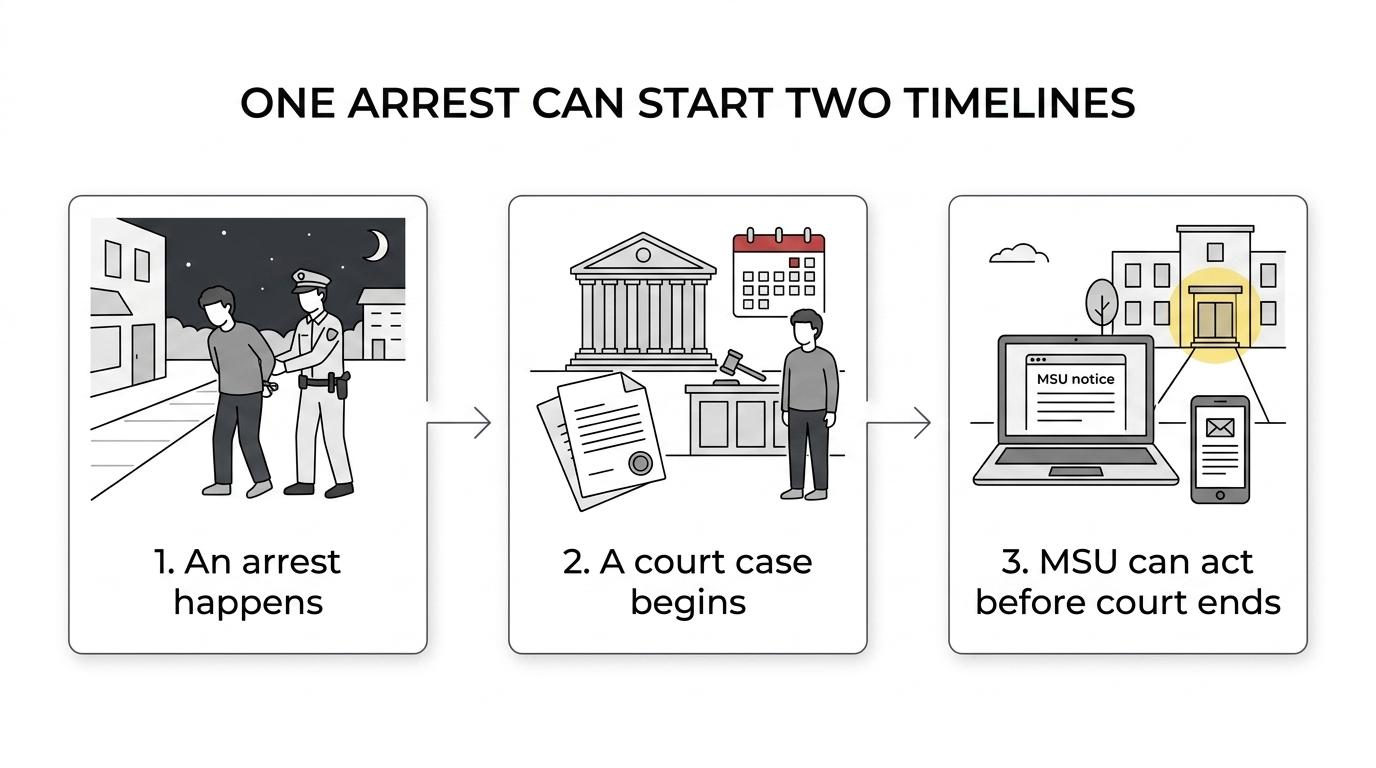
That is why checking your @msu.edu email is not optional when something serious happens.
How MSU notice, meetings, and conduct holds work
When MSU receives a report claiming you violated a student rule or policy, the university typically sends a notice of complaint to your MSU email address. This is one of the most common points of failure for students. They are scared, embarrassed, or hoping the situation fades out. They stop checking email. Then the process keeps moving without them.
The notice should tell you what you are accused of, explain your rights and responsibilities, and give you the chance to respond in an initial meeting. That meeting matters more than many students think. What you say, what you do not say, and whether you ask for time can all shape what comes next.
At the administrative meeting, MSU materials say you may have a few paths available. In many cases, you may accept responsibility, deny responsibility, or ask for five additional class days to submit a written response.
You may also have an advisor with you throughout the case proceedings.
That advisor can be a lawyer or another person you choose to advise, support, or consult with you. If a parent wants to join meetings or get case information, the needed FERPA waiver or other documentation should be handled before the meeting. Families often lose time here because they assume MSU will speak with them automatically. It usually will not.
If you ignore the email instructions or fail to complete required steps, MSU may place a conduct hold on your account. That can block registration activity, including adding or dropping courses. At the worst possible time, you may find yourself unable to fix your schedule, enroll for the next semester, or complete other needed actions.
After the university starts the conduct process, a hold can become a practical problem even before a final sanction is entered.

Visualization: Notice by email, initial meeting, possible interim action, conduct hold, petition for removal, and final university decision often move on separate timelines from the criminal case.
Do not wait for your court date to deal with the school issue. If OSSA has contacted you, or if you think contact is coming, speak with counsel who can help you assess both the university process and the criminal case before you make statements that create new problems.
Why the criminal case and the MSU conduct case do not move together
Students often assume the university will wait to see what happens in court. That is not a safe assumption.
MSU uses its own conduct process and its own standard of proof. According to university materials, the conduct system applies a preponderance of the evidence standard. That means the university can find responsibility if it believes it is more likely than not that the violation occurred. A criminal court uses a much higher burden.
So yes, you can face campus action even when your court case is pending.
You can also create real damage by treating the university meeting like an informal chat. Statements made to school officials may affect strategy in your criminal case. If the police report is incomplete, if witnesses disagree, or if your bond conditions are still being sorted out in 54B District Court, you should think carefully before giving detailed admissions without legal advice.
This is where students make avoidable mistakes. They think honesty in the abstract will solve everything. Sometimes it helps. Sometimes it locks them into a version of events that creates trouble in both systems.
The smartest move is a disciplined one.
After an arrest, your first steps should be practical and calm:
- Save every email from MSU, police, and the court
- Screenshot deadlines and hearing dates
- Stay off social media
- Do not contact the complainant or witnesses
- Keep copies of bond papers and release conditions
- Ask early whether a FERPA waiver is needed for parent involvement
What parents of MSU students should do in the first 48 hours
If you are the parent of an MSU student, you may feel like everything is happening at once. A criminal charge can threaten your student’s record. An interim suspension can threaten housing, classes, financial aid timing, athletic participation, internships, and graduation plans.
Panic is normal. Delay is dangerous.
Your role is not to speak over your student. Your role is to help create structure. That means making sure the student checks the @msu.edu account, keeps every notice, tracks every deadline, and does not make impulsive statements to police, OSSA, housing staff, or student organizations.
You should also think beyond the first hearing. Can your student access class materials? Are there summer or semester housing issues? Is there a campus job at risk? Is an internship with a local employer in play, whether that is at University of Michigan Health-Sparrow, Jackson National, Auto-Owners Insurance, or another Mid-Michigan organization that may ask about enrollment status or disciplinary issues?
A student living steps from Beaumont Tower or the Red Cedar River can feel like campus is their whole world. When interim suspension hits, everyday logistics become urgent very quickly.
A good parent checklist looks like this:
- Check the email trail: Make sure your student reads every message from OSSA, housing, the court, and any student organization involved.
- Confirm access issues: Find out whether the student can enter campus, residence halls, classes, workspaces, or events.
- Protect the criminal case: Stop your student from sending apology texts, social media posts, or “explanations” that can be used later.
- Ask about academic impact: Contact professors only when needed and without admissions that box your student in.
- Get advisor paperwork ready: If you expect to join meetings, ask what FERPA forms or waivers are required first.
Parents often call after the school process has already moved forward. If your student was arrested in East Lansing and you are worried about both 54B District Court and MSU discipline, contact Ben Hall Law early. Fast guidance can help your family avoid mistakes that are hard to reverse later.
Practical guidance for MSU students facing interim suspension
You do not need to guess your way through this.
Start with the basics. Read the notice carefully. Identify every deadline. Separate what is criminal court business from what is university business. Then protect your position in both places.
Here is what that usually means in practice around MSU and East Lansing:
- Court dates: Your arraignment, bond terms, and no-contact conditions may move on a timeline set by the court, not the university.
- Campus restrictions: MSU can impose interim measures before your criminal case is resolved.
- Student organization issues: Fraternities, sororities, club teams, and other groups may start internal action apart from both the court and OSSA.
- Housing pressure: Residence hall access or off-campus lease issues can become urgent within days.
- Academic disruption: Missed labs, attendance rules, and registration holds can snowball fast.
One sentence can matter in all three systems.
If you are tempted to “clear things up” by sending a long email, pause first. A short, controlled response is often better than a detailed narrative written under stress. That is especially true in assault allegations, hazing-related accusations, alcohol incidents, or cases involving multiple students giving statements after a night near downtown bars or campus apartments.
Can MSU interim suspension be removed or changed?
Yes, in some cases.
MSU’s published materials say that students subject to interim measures may petition for removal at any time. That does not mean the request will be granted. It does mean interim action is not always fixed in stone until the end of the case.
A strong petition usually depends on facts, not emotion. If the university imposed the measure based on safety concerns, then your response should directly address those concerns. That might involve clarifying the allegation, presenting context, showing compliance with court orders, pointing out lack of ongoing contact, or showing why continued exclusion is not needed.
The question is not whether the situation feels unfair to you. The question is whether the university still has a valid reason to believe your presence creates a clear and present danger.
If the conduct case reaches a final decision and you appeal, MSU says the University Student Appeals Board can request more information, reject an appeal for lack of jurisdiction, affirm or reverse the original decision, or send the case back for rehearing or clarification. Its decisions are final. University materials also state that recommended sanctions generally do not take effect while an appeal is pending, but suspensions and dismissals are implemented by the Dean of Students.
That makes timing critical.
If you are trying to preserve your student status, course schedule, or path back to campus, you need to know whether you are dealing with a petition to remove interim measures, an appeal of a final decision, or both. Those are related but different things.
Common mistakes MSU students make after an arrest
Most bad outcomes do not come from one giant error. They come from a series of smaller ones.
Students often wait because they think the school will hold off. They answer questions casually because the meeting feels informal. They forget the university email account is the official channel. They trust friends to explain what happened. They post online. They assume a dismissed criminal case automatically wipes out the school problem.
It does not work that way.
Try hard to avoid these missteps:
- Missing an OSSA email
- Skipping an administrative meeting
- Giving a rushed written statement
- Violating bond or no-contact terms
- Asking friends to “fix” witness issues
- Ignoring a conduct hold or service indicator
- Assuming parents can step in without FERPA paperwork
What this can mean for your classes, housing, and future plans
Interim suspension is not only about discipline. It can disrupt the practical structure of your life.
If you live in campus housing, you may be dealing with removal or restricted access while also trying to retrieve belongings, keep up with assignments, and avoid further policy issues. If you are in a lab, clinical track, student teaching route, or program with strict attendance expectations, even a short period away can create major stress.
You may also worry about scholarships, visa issues, graduate school plans, or job opportunities. Those concerns are real. A student applying to competitive programs or interviewing with local employers in Lansing or East Lansing does not have the luxury of pretending the matter will sort itself out later.
Yet there is still room to act.
Temporary action is still temporary action. Students who respond quickly, follow instructions, protect their criminal defense position, and present a disciplined case to the university are in a better spot than students who freeze up and hope time fixes it.
FAQ about MSU interim suspension after an arrest
Can MSU suspend you before you are convicted of anything?
Yes. MSU may impose interim suspension before a final conduct finding if it has credible information that your continued presence presents a clear and present danger to health or safety. That action is supposed to be temporary and is not, by itself, a final finding of responsibility.
Does an arrest automatically mean MSU will suspend you?
No. An arrest can trigger a report and a conduct review, but it does not automatically require interim suspension. MSU may choose other interim measures or no interim action at all, depending on the facts it has.
How will MSU notify you about the conduct case?
MSU states that notices of complaint are generally sent to your @msu.edu email address. If you are under investigation or worried about school action, check that account daily.
Can you bring a lawyer or advisor to an OSSA meeting?
Yes. MSU materials say a respondent may have an advisor throughout case proceedings. If the advisor is a parent or another person who needs access to records or meetings, required FERPA paperwork should be completed ahead of time.
What if you ignore the notice from MSU?
That can lead to serious problems. MSU may place a conduct hold on your student account, which can block registration activity, including adding or dropping classes. Ignoring the process rarely makes it go away.
Can MSU act on off-campus conduct?
Yes. MSU states that students issued interim measures still face disciplinary action for the underlying conduct regardless of where it occurred. An incident at an apartment, bar, fraternity house, or elsewhere in East Lansing can still trigger school action.
Can you ask for the interim suspension to be lifted?
Yes. MSU says students subject to interim measures may petition for removal at any time. A good petition should directly address the safety concern that led to the interim action.
Is the MSU conduct standard the same as criminal court?
No. MSU uses a preponderance of the evidence standard in its conduct process. Criminal court uses a higher standard. That is one reason a student can face campus consequences even when the criminal case is still pending or ends in a way the student expected would solve everything.
Will an appeal stop a suspension from taking effect?
Not always. MSU says recommended sanctions generally do not go into effect while under appeal, but suspensions and dismissals are implemented by the Dean of Students. That makes case-specific advice very important.
Should parents contact MSU directly right away?
Parents can help, but they should not assume the university will discuss the matter freely without a FERPA waiver or other required documentation. The first move is usually making sure the student preserves records, follows deadlines, and gets informed advice.

 877-Ben-Hall