By: Ben Hall | Attorney and Owner of Ben Hall Law | Marine Corps and Iraq War Veteran | Former Police Officer | Former Prosecutor
Published: June 18, 2026
If you are an MSU student and your fraternity or sorority is suddenly under review, the first few hours matter more than most people realize. One incident at a house near Grand River Avenue, a mixer that got out of hand, an alleged hazing report, a fight after a social event, or a medical emergency tied to alcohol can set off several problems at once. Your chapter may contact you. Friends may start texting. A university email may land in your inbox. Police may already be talking to other students.
That is when students make mistakes that follow them much longer than the party itself.
At Michigan State University, a fraternity or sorority incident can become both an MSU student conduct investigation and a criminal matter. Those are not the same process, and treating them like they are can put your record, your standing at school, and your future job options at risk. If you live in East Lansing, spend time around Spartan Stadium, the Red Cedar River, or the neighborhoods around Greek housing, you already know how fast campus news moves. So do administrators, police, and national organizations.
If you want legal guidance before you answer OSSA, your chapter, or law enforcement, this is the moment to speak with a defense lawyer who handles MSU student and Greek life cases. A quick decision now can protect a lot later.
Why an MSU student conduct investigation after a fraternity or sorority incident is different
MSU states that its student conduct system is complainant-driven, which means the process often starts when a complaint is filed and the school reviews whether reported behavior may have violated community standards. In Greek life cases, that complaint may come from another student, a guest, a resident assistant, Fraternity & Sorority Life staff, a university employee, or information passed along after a police response.
Greek-letter chapters at MSU also sit under more than one rulebook. If your chapter is tied to the Interfraternity Council, Panhellenic Council, National Pan-Hellenic Council, or Multicultural Greek Council, you may face chapter-level rules, MSU student organization policies, and national organization pressure at the same time. What feels like one campus problem can become three or four separate investigations.
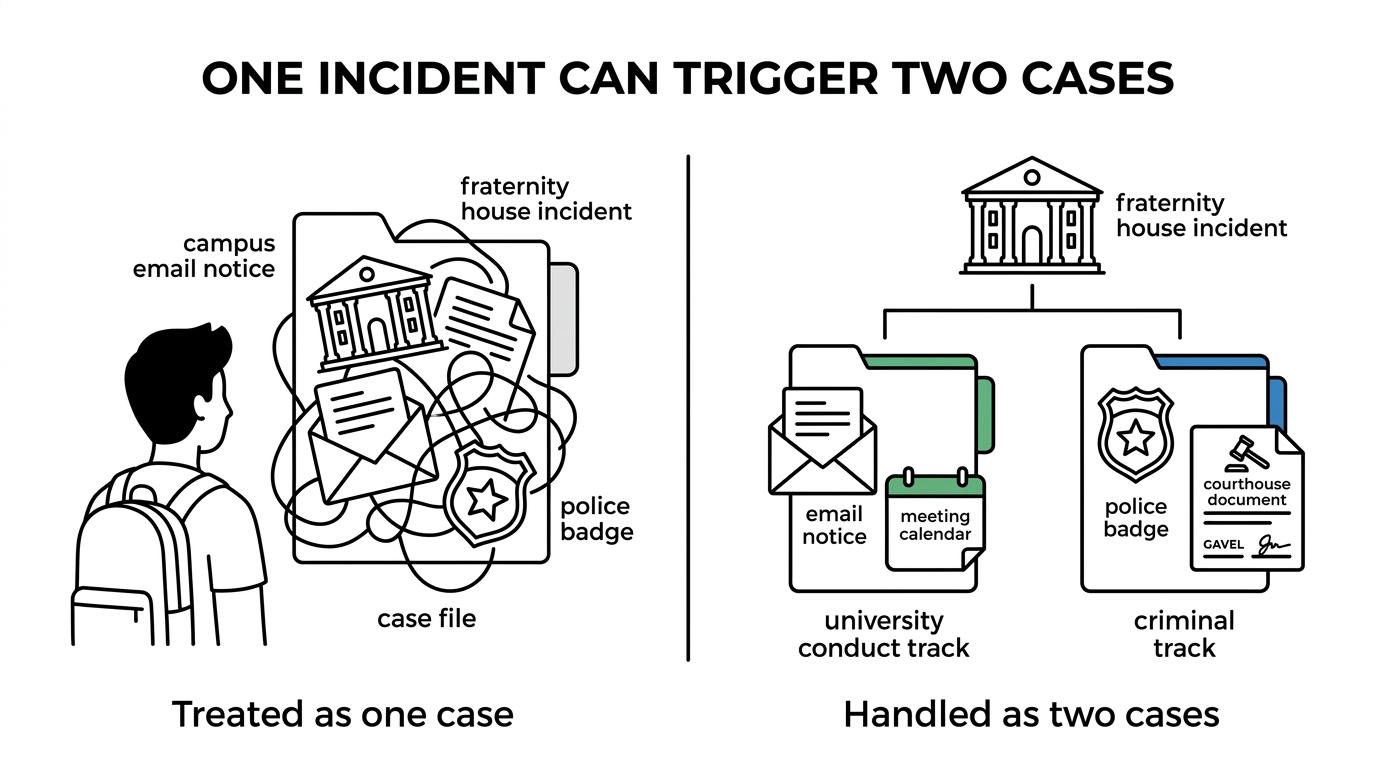
Here is the simplest way to think about it:
| Issue |
University Conduct Track |
Criminal / Police Track |
| Who starts it |
Complaint to MSU or organizational referral |
Police report, investigation, witness statements |
| Main office or agency |
OSSA and student organization process |
MSU Police, East Lansing Police, prosecutor |
| Main risk |
Probation, suspension, account holds, organization sanctions |
Charges, court dates, fines, probation, criminal record |
| What you may be asked to do |
Informal meeting, respond to notice, provide your side |
Interview, statement, evidence request |
| Key mistake |
Ignoring the email |
Talking too freely without legal advice |
That split is the reason you need a plan, not just a reaction.
1. Read your @msu.edu email and respond before an account hold hits
If MSU opens a conduct matter, the university may send a notice to your @msu.edu email address asking you to attend an informal meeting with an OSSA administrator. According to MSU conduct guidance, that notice explains what you are accused of and gives you a chance to learn your rights and responsibilities. Students miss these emails all the time, especially after a chaotic weekend or during midterms.
Do not assume silence helps you.
MSU also warns that if you fail to respond to a conduct notice, your account can be placed on hold. That can affect registration and your ability to add or drop classes. If you are trying to keep your semester on track, protect your housing, or stay eligible for athletics, study abroad, or financial aid planning, ignoring the email is one of the worst early moves you can make.
When you open the notice, slow down and read every line. Screenshot it. Save the date and time. Check whether the email names a specific allegation, a policy section, or only a general incident description. That detail matters because the language used in the notice may not match what police or chapter leadership are saying.
Right after you read it, do this:
- Save it immediately: Take screenshots and forward it to a personal email you control
- Calendar the deadline: Put the meeting date, response date, and contact name in your phone
- Do not freestyle a response: Get advice before writing a long explanation
- Your @msu.edu inbox
- Your spam or junk folder
- Any linked student portal messages
2. Separate the MSU student conduct process from the criminal investigation
A lot of MSU students assume, “If I just explain what happened to OSSA, that should clear everything up.” That can be dangerous. A university conduct process is not the same as a criminal case, and statements that seem harmless in one setting can create problems in the other.
If police were called to a fraternity house, apartment, tailgate, off-campus social, or Greek event, your words may matter far beyond campus discipline. A single incident in East Lansing can involve MSU Police, East Lansing Police, another agency, university staff, your chapter, and your national organization all within a day or two. If there was alcohol, an injury, an assault allegation, a noise complaint, or a hazing claim, the risk goes up fast.
Keep your focus on one reality: the school wants policy answers, law enforcement wants evidence, and your chapter wants to protect itself. Those interests are not the same as yours.
People who may contact you after a Greek life incident include:
- OSSA staff: About student conduct allegations and an informal meeting
- Chapter leadership: About internal statements, attendance, and member cooperation
- Council representatives: IFC, Panhellenic, NPHC, or MGC rule issues
- Police or investigators: About interviews or follow-up questions
- National organization staff: About chapter liability and policy review
If you are already hearing from more than one of those groups, get legal guidance before you start answering all of them one by one.
3. Stop talking about the fraternity or sorority incident in texts, group chats, and social media
When students panic, they talk. They text the chapter group chat. They message friends to get their stories straight. They post something vague on Instagram. They joke on Snapchat. They delete photos. They ask, “What are we all saying?” That reaction is common, but it can turn a bad situation into a much harder case.
Assume your messages may be screenshot, forwarded, or misunderstood. Assume a private chat is not private. Assume someone in the group wants to protect themselves first.

That does not mean you should destroy evidence. It means you should stop creating new evidence. Do not coach witnesses. Do not ask others to deny facts. Do not tell people to delete videos. Do not post about “beating the case” or “keeping nationals off our backs.” Those kinds of messages can look much worse later than they do in the moment.
If you need to speak about the incident, talk with your lawyer, not your social feed. Ben Hall Law handles criminal defense matters for MSU students in East Lansing, and early advice can help you avoid the kind of digital mistakes that show up in hearings, police reports, and chapter files.
4. Gather records and build your own timeline before the story hardens
You need your own timeline while your memory is still fresh. Not next week. Not after everyone else compares stories. Right now.
Write down where you were, when you arrived, who you were with, what you saw, what you did, when you left, and who can verify each part. If the event moved from one location to another, note that too. A lot of fraternity and sorority incidents do not happen in one neat block of time. Students may begin at a chapter house, walk to another apartment, stop on Grand River, then end up back near campus. A missing hour can become the center of the case.
Your timeline should stay private and factual. Do not guess. Do not fill gaps with assumptions. If you do not know something, mark it that way. Precision matters more than drama.
Helpful records often include:
- Photos and videos from your phone
- Uber, Lyft, or rideshare receipts
- Card statements
- Doorbell camera clips from a house or apartment
- Text timestamps
- Location history
- Event flyers
- Class attendance records
- Work schedule records
- Names of sober monitors, drivers, guests, or roommates
You may also want to identify whether there were neutral witnesses. In Greek life cases, chapter members often have overlapping interests, which can make their statements less reliable or more self-protective. A neighbor, rideshare driver, delivery driver, or nonmember guest can matter more than you think.
This is also where local context matters. If the event tied into a football Saturday near Spartan Stadium, a large social weekend, welcome week activity, or a high-traffic period near the Breslin Center and downtown East Lansing, witness movement and crowd flow may explain why accounts differ. Your job is to document facts before someone else turns a messy night into a clean accusation.
5. Use an advisor and get legal advice before the informal meeting with OSSA
MSU states that a respondent may bring one advisor to the conduct process, and that advisor can be a parent, guardian, mentor, friend, or attorney if that person is not otherwise involved. You should take that option seriously.
A lot of students walk into an OSSA meeting thinking it is just a casual conversation. It is not. Even if the tone feels informal, what you say can shape how the case is framed from the start. If you minimize, guess, speculate, or volunteer facts that were never asked for, you may give away ground that is hard to recover later.
A lawyer who handles MSU student conduct and criminal defense issues can help you sort out what the school needs, what law enforcement may be building, and what topics deserve a careful response. This is even more important if the allegation includes hazing, assault, furnishing alcohol to minors, disorderly conduct, drug possession, or anything tied to injury or hospitalization.
You do not need to wait until charges are filed to get help. If you have an OSSA notice, a call from police, or pressure from chapter leadership to make a statement, that is enough reason to act. Contact Ben Hall Law before the informal meeting if you want a defense strategy that accounts for both the university and criminal sides of the case.
6. Treat hazing allegations like real criminal exposure, not just a chapter problem
If the word “hazing” is anywhere in the complaint, stop treating this like routine student drama.
Michigan law prohibits hazing at educational institutions, and the law applies to colleges and universities in this state. The hazing statute, MCL 750.411t, is not just a campus rule. Physical hazing can be treated as a criminal offense. That means a report involving forced drinking, physical acts, sleep deprivation, restraint, humiliation with injury risk, coerced consumption, or activity tied to bodily harm can move well beyond school discipline.
Students sometimes think the real risk sits with the chapter, not the individual member. That is a mistake. A fraternity or sorority incident can lead to both organization sanctions and personal exposure. Your chapter might be dealing with recognition issues, social restrictions, or national disciplinary action while you are dealing with OSSA, police, and your own future.
Greek-letter chapters at MSU must follow university student organization rules along with the rules of bodies like IFC, Panhellenic, NPHC, or MGC. That layered system means a single hazing claim can trigger a wide net of interviews and document requests. One person may be labeled a witness in one process, a respondent in another, and a suspect in a criminal matter.
Common overlap issues in hazing-related cases include:
- Alcohol use: Especially if underage students were present or pressured to drink
- Injury claims: Even a “minor” injury may change how the case is handled
- Group messages: Chats can be used to argue planning, knowledge, or participation
- Leadership roles: Officers often face added scrutiny for what they knew or allowed
- National chapter involvement: Internal investigations may move fast and ask for statements
If the facts suggest hazing, your defense plan needs to start before you talk your way into a bigger problem.
7. Protect your academic future, housing, and internships while the investigation is pending
An MSU conduct matter is not only about discipline. It can affect your daily life in ways students often overlook until the damage has started. Registration holds, organization restrictions, housing issues, campus employment concerns, and loss of leadership roles can all follow.
That matters because your record at MSU connects to more than campus life. You may be applying for grad school, law school, medical school, internships, student teaching placements, or jobs with employers across East Lansing, Lansing, Okemos, and Haslett. Employers like the State of Michigan, MSU Federal Credit Union, TechSmith, Sparrow, and McLaren Greater Lansing may all be part of the professional future you are building. A poorly handled conduct case can disrupt that path.
You should also think about scholarship status, athletics, visa issues if you are an international student, and chapter housing if your organization controls where you live. A conduct file may not equal a criminal conviction, but the process itself can still create deadlines, disclosures, and practical barriers.
While the matter is open, focus on protecting these areas:
- Registration and class schedule
- Campus housing or chapter housing
- Internships and job offers
- Student organization leadership roles
- Graduate or professional school applications
If you are feeling pressure to “just get it over with,” remember what is actually at stake. The fastest answer is not always the safest one.
How FERPA affects privacy during an MSU student conduct investigation
Many students worry that the entire campus, their chapter, or even their parents will automatically get full access to their conduct file. That is not how it generally works. FERPA gives post-secondary students rights related to education records, including the right to inspect records, ask for amendment in some circumstances, and control disclosure of personally identifiable information in many situations.
MSU states that FERPA generally bars release of personally identifiable information from a student’s education record without written consent. That can matter if you are trying to manage who gets access to your conduct information. It also matters if your parents are calling offices on your behalf and expecting detailed answers.
You also have the right to inspect and review education records within 45 days after the university receives a proper request. That does not mean every record will solve your case, but it can be an important step if you need to see how the matter is documented. A defense lawyer can help you decide what records to request and when to request them.
FAQ about MSU student conduct investigations after fraternity and sorority incidents
Does an MSU student conduct investigation mean you will be criminally charged?
No. A university investigation and a criminal case are separate. You can have one without the other. Still, the same event can create both, especially after a fraternity or sorority incident involving alcohol, injury, assault, or hazing.
What should you do first if OSSA emails your @msu.edu account?
Read the email right away, save it, calendar every deadline, and avoid sending a detailed response before you get advice. MSU says failure to respond can lead to an account hold that affects registration.
Can you bring a lawyer to an MSU conduct meeting?
MSU says a respondent may bring one advisor, and that advisor may be an attorney if the person is not otherwise involved in the matter. If there is any chance of criminal exposure, that is a smart step.
Should you talk to chapter leadership before talking to a lawyer?
You should be careful. Chapter officers and national representatives often have goals that do not fully match yours. They may be trying to protect the organization first. Get your own advice before giving a detailed statement.
What if the allegation is hazing but you think it was just tradition?
That label matters less than the facts. Michigan hazing law can apply to conduct at a college or university, and physical hazing can be treated as a criminal offense. If there is a hazing allegation, take it seriously right away.
Can your parents get details from MSU without your permission?
FERPA generally limits release of personally identifiable information from education records without your written consent. There are exceptions in some situations, but you should not assume parents or chapter officials will automatically receive full details.
What if the incident happened off campus in East Lansing?
Off-campus location does not make the risk disappear. If the conduct relates to MSU students, student organizations, or community standards, the university may still review it. Police involvement also becomes more likely in off-campus fraternity and sorority cases.
Do deleted texts and posts fix the problem?
No. Deleting content can make things worse, especially if the messages already exist on someone else’s phone. Stop creating new messages about the incident and get legal advice before taking any step that could be seen as tampering or concealment.
If you are an MSU student facing a conduct notice after a fraternity or sorority incident, act early, stay calm, and protect both tracks of the case. The university process may look administrative on the surface, but your words and choices can affect much more than campus discipline.
 877-Ben-Hall