

The First 72 Hours After an Arrest in Michigan
Marine, Former Police Officer, Former Prosecutor, and Current Mid-Michigan Criminal Defense Attorney
If you or someone you love has been arrested in Michigan, the next 72 hours will shape everything that comes after.
Bond is set. Rights are preserved or damaged. Evidence that exists right now may be gone by next week. And decisions made in those first hours follow a case all the way to its end.
I know this because I’ve been on both sides of it. Before I was a criminal defense attorney, I spent five years in the Marine Corps and nearly a decade in law enforcement. I’ve made arrests. I’ve written the reports that prosecutors use to build cases and I have sat at the prosecutor’s table and evaluated charges. I know what officers are looking for when they’re talking to someone in custody and I know exactly how fast a case can tighten around a person who didn’t realize they were helping build it.
Continue to read on about the first 72 hours after an arrest in Michigan. If your case is in Ingham County 54A District Court in Lansing, 54B District Court in East Lansing, or the 30th Circuit Court here is what is actually happening and what you need to do right now.
Arrest in Michigan?
Step 1: The Arrest Invoke Your Rights the Second You’re in Custody (or even before)
Arrests happen three ways: you’re taken into custody at the scene, you’re arrested during a traffic stop, or you’re told to turn yourself in.
The moment you are in custody, officers may attempt to speak with you. Some will be direct about it. Others will just be “friendly” making conversation during transport, asking how you’re doing, letting you fill the silence. That friendliness is not accidental.
I have watched defensible cases fall apart because someone filled the silence during a patrol car ride or explained themselves during booking. Not because they lied. Not because they confessed. Because they tried to give context. They said things that sounded reasonable to them and looked damning in a police report.
The Most Important Thing You Will Read Today
Say this out loud, clearly, and immediately:
“I am invoking my right to remain silent and I want a lawyer.”
Then stop talking. No explanations. No context and no “just clearing things up.”
Silence is protected under the Fifth Amendment. Statements are not and they routinely appear in police reports, damage plea negotiations, and undermine motions that could have ended a case early.
Do this: Stay calm, be polite, and say nothing beyond invoking your rights.
Never do this: Answer questions, agree to interviews, or explain your side of things without an attorney present.
Step 2: Booking and Jail Processing
After arrest, you’ll be transported for booking. In Ingham County, where you go depends on the department that arrested you. If you are arrested by the Lansing Police Department, you will go to the Lansing City Jail. Therefore if you are arrested by other departments, you may go to a city holding facility before being transferred to the Ingham County Jail. Booking includes fingerprints, a mugshot, personal information, and property inventory.
Michigan law requires arraignment “without unnecessary delay.” In practice, weekday arrests often mean arraignment the next business day. Friday arrests or holiday weekends typically push to Monday. You may be in custody that entire time.
Two things matter most during this window:
Jail phone calls are recorded. Every call from a facility phone can be obtained by prosecutors and routinely is. Use calls only to tell your family you’re okay and ask them to contact an attorney. Do not discuss what happened, where you were, who was with you, or anything about the charge.
Social media is a prosecutor’s best friend. Family members sometimes post out of worry or anger. It almost always makes things worse. Ask everyone who knows what happened to stay completely off social media until you’ve spoken with a lawyer.
Do this: Note fresh details of the incident privately. Report any medical or prescription needs immediately.
Never do this: Discuss the case on calls, post online, or chat with officers or other inmates about what happened.
Step 3: Arraignment Your First Court Appearance
Arraignment is your first appearance before a judge. In Ingham County, misdemeanor arraignments typically occur at:
- 54A District Court: 124 W. Michigan Ave., Lansing. Arraignments often held Monday, Tuesday, Thursday, and Friday mornings and afternoons; some conducted via Zoom.
- 54B District Court: 101 Linden St., East Lansing. Walk-in arraignments weekdays 9–9:30 a.m.; general arraignments typically at 9 a.m.
Felony cases begin at the district court level before potentially moving to 30th Circuit Court in Mason.
What Happens at Arraignment
The judge will inform you of the charge, advise you of potential penalties, explain your constitutional rights, set bond, and ask for a plea. This is not a trial. It is not the moment to explain what happened or argue the facts. Those instincts are understandable and they will hurt you here.
What Plea to Enter
In virtually every case, the right plea at arraignment is Not Guilty.
This is a procedural move, not an admission. It preserves your right to review all evidence, file motions, negotiate, and go to trial. It keeps every door open while your attorney evaluates what the prosecution actually has.
Entering any other plea at arraignment without having reviewed the evidence and consulted with counsel is almost never in your interest.
Step 4: Bond The Most Consequential Decision in the First 72 Hours
Bond determines whether you go home or stay in custody while your case proceeds. Judges in 54A and 54B weigh several factors when making this decision:
- The nature and severity of the charge
- Your prior record or the absence of one
- Community ties: how long you’ve lived here, whether you’re employed, whether family is in the area
- Flight risk and likelihood of appearing for future hearings
- Risk to public safety
- Any history of failing to appear
This is why the documents and information gathered in the first 24 hours matter. Employment records, proof of residence, school enrollment, family presence at the hearing these are evidence that goes directly to bond. Strong community ties frequently result in lower bonds or personal recognizance release.
Common Bond Conditions in Ingham County
Expect conditions alongside any release. Common ones include:
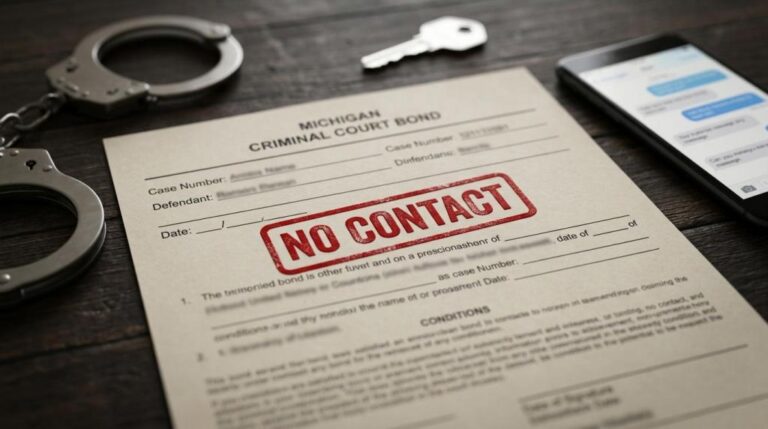
- No contact with the alleged victim
- Alcohol or drug testing
- Travel restrictions
- No firearm possession (your CPL may be suspended)
- GPS tether in certain cases
- Curfew
Never violate bond conditions not even minor ones. Violations result in immediate re-arrest, bond revocation, additional charges, and lasting damage to your credibility with the judge for the rest of the case. Courts monitor conditions closely, and violations spike in the first week because people underestimate how seriously they are enforced.
Step 5: Felony Cases Probable Cause Conference and Preliminary Examination
If you’re facing felony charges, the process moves on a defined schedule after arraignment under Michigan law (MCL 766.4):
Probable Cause Conference (PCC)
Scheduled not less than 7 days and not more than 14 days after arraignment. This is an opportunity to exchange evidence, discuss potential resolutions, explore charge reductions, and assess where both sides stand. An attorney who has already reviewed the police report and preserved evidence can use this hearing strategically.
Preliminary Examination
If no agreement is reached at the PCC, a preliminary exam is held not less than 5 days and not more than 7 days after the PCC. The prosecutor must demonstrate probable cause. Your attorney can cross-examine witnesses, challenge evidence, and begin establishing the defense. If the judge finds probable cause then the case is bound over to 30th Circuit Court for further proceedings.
The groundwork laid in the first 72 hours what was preserved, what was challenged, what was said shapes both of these hearings.
What Your Attorney Should Be Doing From Day One
While you’re managing the stress of an arrest, here is what your attorney should already be working on:
- Requesting and reviewing the police report
- Preserving bodycam and dashcam footage before retention windows close
- Evaluating the legality of the stop, search, or arrest
- Assessing probable cause for weaknesses
- Contacting the prosecutor’s office
- Identifying diversion program eligibility
- Pursuing bond modification if you’re still in custody
An attorney hired on day one can do things an attorney hired three weeks later simply cannot. Evidence gets overwritten. Charging decisions solidify. Early negotiating leverage disappears. Timing matters more than most people realize.
Professional Licenses: The Consequences That Start at Arrest
For many people, the criminal charge is not the only thing at risk.
If you are a nurse, teacher, police officer, CDL holder, contractor, or other licensed professional, a criminal charge not just a conviction can trigger a separate licensing board investigation that moves on its own timeline. The Michigan Department of Licensing and Regulatory Affairs (LARA) governs most professional licenses, and board inquiries frequently begin at the arrest stage.
Beyond LARA, a charge may trigger:
- Mandatory employer reporting obligations
- MSU or university student conduct proceedings
- CPL suspension
- Immigration complications
Convictions typically require self-reporting to licensing boards within 30 days but waiting for conviction to address the issue is already too late for effective mitigation. If you hold a professional license, that conversation needs to happen in your first meeting with your attorney, not as an afterthought.
Learn more about how Ben Hall Law handles professional license defense.
What Family Members Should Do in the First 72 Hours
If someone you love has been arrested in Lansing, East Lansing, or anywhere in mid-Michigan:
- Do not discuss case details on jail phone calls. They are recorded.
- Stay completely off social media. No posts, no comments, no sharing.
- Gather community-tie documents: pay stubs, lease or mortgage, school enrollment, employer letters.
- Prepare bond funds if you believe they may be needed.
- Contact a criminal defense attorney immediately before the arraignment if at all possible.
Showing up to a bond hearing prepared and organized can make a real difference in the outcome.
Common Mistakes That Damage Cases in the First 72 Hours
- Talking to police without an attorney present
- Contacting the alleged victim even to apologize or “clear the air”
- Violating bond conditions, even ones that seem minor
- Assuming the case is not serious or will resolve on its own
- Posting on social media or letting family members post
- Waiting weeks before contacting a lawyer
After the First 72 Hours
Misdemeanor cases move to pretrial conferences in district court. Felony cases proceed through the PCC and preliminary examination, and potentially bind over to 30th Circuit Court. From there, cases resolve through plea agreements, motions, diversion programs, or trial.
But the foundation of every case the evidence preserved or lost, the bond conditions you’re living under, the first impressions formed with the court all of it traces back to what happened in those first three days.
The Bottom Line
The first 72 hours after an arrest come down to three things:
Protect your rights. Don’t make it worse. Get informed guidance before you make any decisions.
I built Ben Hall Law for exactly this moment. As someone who has worked in law enforcement, prosecuted cases, and now defends people across mid-Michigan, I understand what happens on every side of a criminal case and I use that perspective to protect my clients from day one.
If you’ve been arrested in Lansing, East Lansing, Flint, Jackson, or anywhere in Michigan, contact Ben Hall Law. We’ll tell you exactly where you stand and what your options are.
Call or text 877-BEN-HALL or schedule a free consultation at BenHallLaw.com.
Ben Hall Law serves clients throughout Michigan, including Ingham, Eaton, Genesee, Livingston, Shiawassee, Jackson, and Clinton Counties. Practice areas include criminal defense, OWI/DUI, expungement, professional license defense, and police officer defense.