


Published: May 22, 2026
By: Ben Hall | Attorney and Owner of Ben Hall Law | Marine Corps and Iraq War Veteran | Former Police Officer | Former Prosecutor
A slip and fall can feel minor for about five minutes. Then the pain sets in, the swelling starts, and you realize you may be dealing with an injury that affects your work, your mobility, and your finances.
In Michigan, these cases often turn on details that disappear fast. A wet floor dries. Ice melts. Security footage gets recorded over. A property manager writes an incident report that does not tell your side of the story. If you want to protect your health and your injury claim, your first steps matter.
That is especially true in a state like Michigan, where black ice, slush-covered entryways, uneven pavement, broken stair treads, and poorly maintained parking lots are part of daily life from Detroit to Grand Rapids, from East Lansing to Traverse City.
Need help right away? If your fall happened in a store, apartment complex, restaurant, parking lot, or other property in Lansing, East Lansing, Okemos, Haslett, or anywhere in Mid-Michigan, contact Ben Hall Law for a free personal injury case review before evidence disappears.
Michigan slip and fall injury steps that protect your claim
When you fall on someone else’s property, you are not just dealing with pain. You are dealing with a premises liability claim, and those claims are often defended aggressively. Property owners, management companies, and insurers tend to focus on the same questions from day one:
- What caused the fall?
- Was the condition dangerous?
- Did the property owner know or should they have known about it?
- Could you have seen it?
- Were you partly at fault?
If you build your response around those questions early, you put yourself in a far better position.
flowchart TD
    A[Slip and Fall Happens] --> B[Get to a safe place]
    B --> C[Report the incident]
    C --> D[Take photos and video]
    D --> E[Get witness names]
    E --> F[Seek medical care]
    F --> G[Preserve shoes and clothing]
    G --> H[Avoid detailed insurer statements]
    H --> I[Talk to a Michigan personal injury lawyer]
Visualization: What to do in the hours right after a Michigan slip and fall.
Immediate actions after a slip and fall in Michigan
Start with your safety.
If you hit your head, feel dizzy, have back pain, cannot bear weight, or notice numbness, call for medical help or get evaluated as soon as possible. Many people try to shake it off in the moment, especially in a busy place like a Meijer, Kroger, Walmart, Target, shopping center, hospital lobby, or restaurant. That is a mistake. Adrenaline can hide a serious injury.
Next, report the incident to the manager, property owner, landlord, or employee on duty. Ask for an incident report if one is used, but keep your description short and accurate. Stick to facts. Tell them where you fell, what you noticed, and what body parts hurt. Do not guess about things you did not see, and do not agree that you were “fine” just because you are embarrassed.
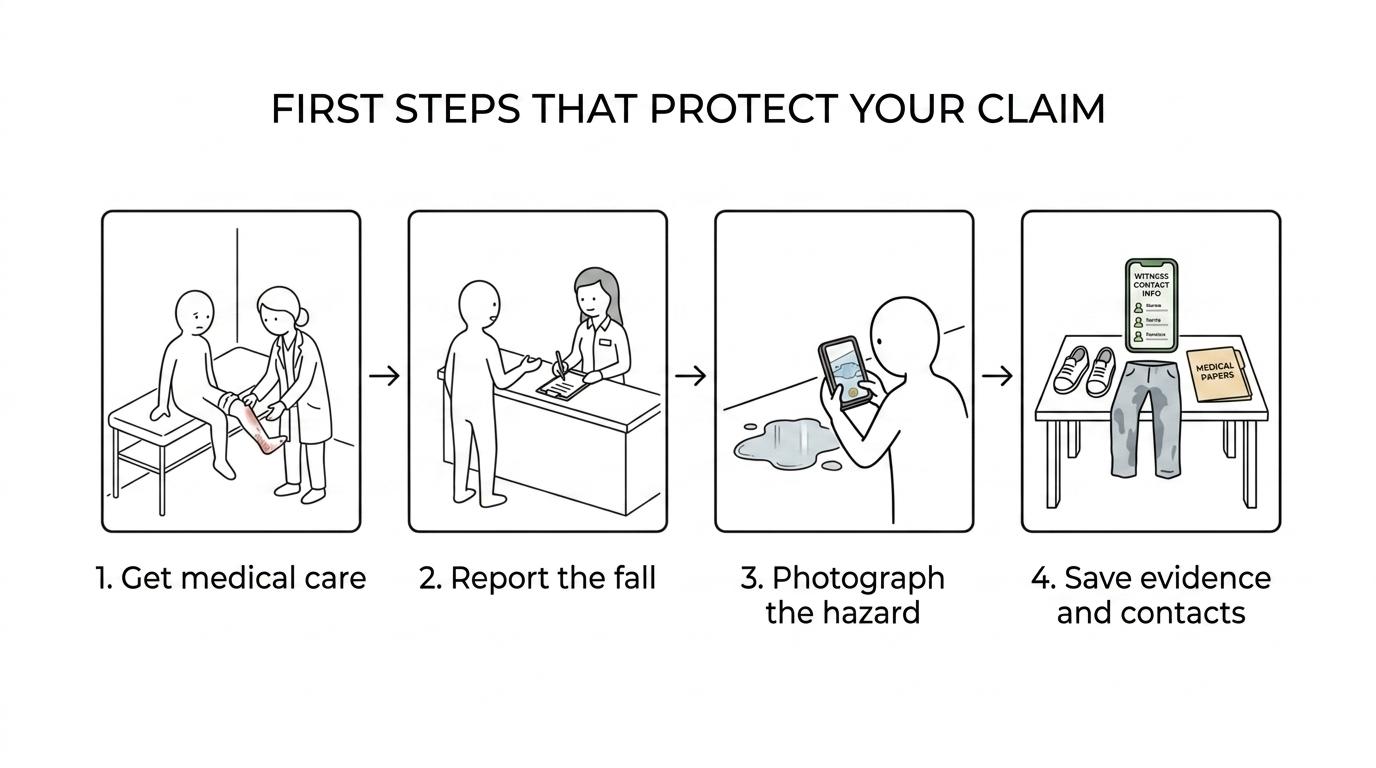
Then document everything you can before the scene changes. In Michigan, that can happen within minutes. Snow gets shoveled. Salt gets spread. A spill gets mopped. A loose mat gets moved. A pothole gets filled. A burned-out stairwell bulb gets replaced.
Here is a practical first-day checklist you can use.
| Step | What you should do | Why it matters |
|---|---|---|
| 1 | Get medical attention | Links the fall to your injuries and protects your health |
| 2 | Report the fall | Creates a time-stamped record that the incident happened |
| 3 | Take photos and video | Preserves the condition before it changes |
| 4 | Identify witnesses | Independent witnesses can confirm the hazard and timing |
| 5 | Save your shoes and clothing | Footwear and wet or dirty clothing can become evidence |
| 6 | Write down what happened | Your memory is strongest right after the incident |
| 7 | Avoid recorded insurer statements | Early statements are often used to limit claims |
| 8 | Speak with a lawyer | Helps preserve evidence and avoid preventable mistakes |
If you can, photograph the exact spot from several angles. Get close-up shots and wide shots. Include warning signs if they exist, and take pictures that show if there were no warning signs at all. If the fall involved ice or snow, photograph the surrounding area too. Michigan slip and fall cases often depend on whether the condition was isolated, ongoing, tracked in from outside, or part of a larger maintenance problem.
A short video can be just as valuable as still photos. It can show lighting, slope, visibility, pooling water, or how a torn carpet edge catches a shoe.
Preserve evidence before it disappears
Evidence fades quickly in premises liability cases. That is one reason these claims can be tough without early action.
If you fell at a grocery store in Okemos, a bar near Grand River Avenue in East Lansing, an apartment complex in Lansing, or a hotel in Ann Arbor, there may be surveillance footage that shows the hazard, how long it was there, whether employees walked by it, and how hard you fell. Many systems overwrite footage within days, sometimes faster.
After you get medical care and report the incident, start preserving anything tied to the fall.
- Photos of the scene
- Video of the area
- Names of employees
- Witness contact information
- Your shoes
- The clothes you wore
- Medical records
- Receipts and out-of-pocket expenses
- Notes about pain and missed work
Also save screenshots of any weather reports if your fall happened outside. In Michigan, weather becomes a major issue in winter cases. A property owner may argue the ice formed moments before your fall. Your photos, witness statements, and weather conditions can help show whether the hazard likely existed long enough to be found and addressed.
Do not clean or throw away the shoes and clothing you wore. If your pants were wet, your coat was dirty, or your shoes picked up slush, grease, or a store substance, that can support your version of events.
Want the property owner to preserve surveillance footage and records? A lawyer can send a prompt preservation notice and request key evidence before it is lost. Ben Hall Law helps injured people act fast when timing matters.
How Michigan slip and fall law affects your injury case
Michigan slip and fall law changed in a meaningful way in 2023.
The Michigan Supreme Court held in Kandil-Elsayed v F & E Oil, Inc. and a companion case that the “open and obvious” issue is no longer treated as a duty question in the same way older cases approached it. Instead, the visibility of a hazard now fits into the breach analysis and comparative fault analysis.
That may sound technical, but here is what it means for you: a property owner does not automatically avoid responsibility just because they claim the condition was easy to see. The owner still owes invitees a duty to exercise reasonable care. At the same time, the defense may still argue that you should have seen and avoided the hazard, which can affect how fault is assigned.
So yes, a visible hazard can still matter. It just does not end the case by itself the way many insurers would like you to believe.
flowchart LR
    A[Dangerous condition on property] --> B[Your status on the property]
    B --> C[Reasonable care owed?]
    C --> D[Did owner have actual or constructive notice?]
    D --> E[Was the condition unreasonably dangerous?]
    E --> F[Was it open and obvious?]
    F --> G[Comparative fault may reduce recovery]
    G --> H[Damages based on injury impact]
Visualization: How Michigan courts and insurers often analyze a slip and fall claim.
Common Michigan slip and fall locations and why they matter
Where your fall happened often shapes the evidence.
A fall inside a business may involve surveillance footage, cleaning logs, employee statements, and prior complaints. A fall in an apartment complex may involve maintenance requests, lease records, snow-removal contracts, and inspection history. A fall in a parking lot near a major retailer or office building may depend on weather timing, plowing records, and who actually controlled the lot.
Michigan geography makes these cases especially fact-sensitive. Lake-effect snow can create changing conditions in West Michigan. Freeze-thaw cycles in Mid-Michigan turn slush into black ice overnight. In college areas like East Lansing, high foot traffic around Michigan State University can track water into entrances and stairwells for hours. Tourist destinations like Traverse City, Mackinac areas, and Detroit riverfront venues create heavy pedestrian flow that can make worn surfaces and poor maintenance more dangerous.
Large businesses and commercial properties often have policies for inspections and cleanup. That can help your case if records show gaps, missed inspections, or repeated complaints. It can also hurt a claim if you wait too long and the records disappear.
Mistakes that damage a Michigan slip and fall claim
You do not need to panic after a fall, but you do need to be careful.
Insurance companies often defend these claims by attacking timing, notice, and credibility. They look for gaps in treatment, inconsistent descriptions, and casual statements that can be used against you.
Some of the most damaging mistakes are easy to avoid.
- Waiting too long for treatment: If you delay care, the insurer may argue your injuries came from something else.
- Giving a recorded statement too early: Adjusters often ask questions designed to lock you into incomplete answers.
- Failing to document the scene: Once the hazard is cleaned, repaired, or melted, you may lose your strongest proof.
- Assuming a visible hazard kills the claim: Michigan law is more nuanced than that, especially after the 2023 Supreme Court ruling.
- Posting on social media: Photos, activity posts, and casual comments can be taken out of context.
- Missing the filing deadline: Michigan generally gives you three years to file a personal injury action under MCL 600.5805, but waiting is risky and some cases may involve added timing issues.
One more point matters here. Defendants often try to win these cases before trial through a motion for summary disposition. They may argue there is no proof of notice, no dangerous condition, or no factual dispute for a jury to decide. That is why early evidence collection is not a side issue. It is often the center of the case.
How a Michigan slip and fall injury claim is valued
A slip and fall case is not valued by one formula.
The value depends on the injury itself, the medical treatment you needed, how long symptoms last, whether you missed work, whether the injury changed your mobility or daily life, and how strong the liability proof is. A fractured hip from an icy apartment stairway is different from a soft-tissue strain that resolves quickly. A traumatic brain injury after a fall in a poorly lit parking structure is different from a bruised knee that heals in a few weeks.
Strong liability evidence can change the conversation fast. If surveillance footage shows a spill sat on the floor while employees walked past it, the claim often looks very different from a case where no one photographed the scene and there are no witnesses.
You should also know that insurers often start low. They may focus on preexisting conditions, blame weather, argue the hazard was visible, or say the condition appeared only moments before the fall. Your medical records and liability evidence work together. One without the other is often not enough.
Damages in a successful claim may include medical bills, lost income, pain and suffering, and other losses tied to the injury. The exact categories and value depend on the facts.
When to call a Michigan slip and fall lawyer
You do not have to wait until the insurer denies your claim.
Calling early often helps more than calling late. A lawyer can identify the proper defendants, request preservation of surveillance footage, review incident reports, gather witness statements, track medical records, and frame the claim under Michigan premises liability law from the start.
That can be especially useful if your fall happened in any of these settings:
- A big-box store or grocery chain
- A restaurant, bar, or hotel
- An apartment or condo complex
- A parking lot or sidewalk serving a business
- A medical facility
- A campus-adjacent property near MSU
- A property managed by a third-party company
If you are already hearing things like “there were warning signs,” “you should have seen it,” or “we do not think the store had notice,” you are hearing classic defense themes. Those arguments need to be tested against the evidence, not accepted at face value.
If you are missing work, getting treatment, or hearing from an adjuster, now is a smart time to get legal advice. Ben Hall Law represents people hurt by negligent property conditions and can review whether you have a viable Michigan slip and fall claim.
What you should bring to your first slip and fall case review
A first meeting goes better when you bring the basics. You do not need every document in the world. You just need enough to let the lawyer see the shape of the claim.
Bring whatever you have, even if it feels incomplete. A strong case can start with a few good photos, the name of the business, and your first medical records.
- Incident details: date, time, location, and what you believe caused the fall
- Evidence: photos, video, witness names, incident report, and any letters or emails
- Medical proof: discharge papers, imaging results, bills, treatment notes, and follow-up appointments
- Financial impact: missed work records, wage information, and out-of-pocket costs
If the fall happened at a local business or apartment complex, try to identify the exact property and address. In many Michigan cases, the company you see on the sign is not the only party involved. Ownership, management, snow-removal contractors, and maintenance vendors may all need to be reviewed.
Ready to find out where your case stands? Contact Ben Hall Law for a free consultation. You can get clear answers about liability, evidence, the three-year filing deadline, and what steps to take next.
Michigan slip and fall FAQ
How long do you have to file a slip and fall lawsuit in Michigan?
Michigan’s general statute of limitations for personal injury actions is three years from the date of injury under MCL 600.5805. That is the baseline rule for many slip and fall cases. Waiting is still a bad idea because evidence can disappear long before the deadline arrives.
Can you still recover if the hazard was open and obvious?
Possibly, yes. After the Michigan Supreme Court’s 2023 decision, the open-and-obvious issue is no longer treated the same way older cases handled duty. The visibility of the condition can still matter in breach and comparative fault analysis, but it does not automatically end the claim.
What if there was no wet floor sign?
The lack of a warning sign can help your case, but it is not the only issue. You still need to show that the property owner failed to use reasonable care and that the dangerous condition caused your injuries.
What does notice mean in a Michigan slip and fall claim?
Notice refers to whether the property owner had actual notice or constructive notice of the hazard. Actual notice means they knew about it. Constructive notice means the condition existed long enough, or was obvious enough in character, that they should have found it through ordinary care.
Do you need photos to win a slip and fall case?
No, but photos help a lot. Many valid claims move forward based on witness testimony, surveillance footage, incident reports, maintenance records, and medical proof. Still, if you can get photos, do it.
Should you talk to the insurance adjuster after a slip and fall?
You should be careful. Basic scheduling or contact information is one thing. A detailed recorded statement about fault, visibility, and your injuries is another. If you are not sure what to say, speak with a lawyer first.
What if you slipped on ice in a parking lot in Michigan?
Ice cases are common in Michigan, and they often turn on timing, weather, maintenance practices, and whether the property owner knew or should have known about the danger. Photos, weather records, and witness statements are especially useful in these claims.
Is a slip and fall always a premises liability case?
If the injury came from a dangerous condition on the property, Michigan courts generally treat it as a premises liability claim rather than ordinary negligence. That affects the legal framework and the proof needed to move the case forward.
What injuries are common after a slip and fall?
Common injuries include fractures, sprains, torn ligaments, back injuries, neck injuries, shoulder injuries, hip injuries, and head trauma. Older adults often face severe complications from falls, but younger people can also suffer serious long-term harm.
How soon should you call a lawyer after a slip and fall in Michigan?
The sooner, the better. Early legal help can preserve surveillance footage, identify the right parties, and prevent avoidable mistakes with adjusters or written reports.
This article is general information, not legal advice for your specific case. If you were hurt in a Michigan slip and fall and want direct guidance about your next step, Ben Hall Law can review the facts and help you decide how to move forward.