


Published: September 10, 2026
By: Ben Hall | Attorney and Owner of Ben Hall Law | Marine Corps and Iraq War Veteran | Former Police Officer | Former Prosecutor
If you are asking whether a victim can drop assault charges in Michigan, the short answer is no. Ben Hall Law is a criminal defense firm in East Lansing, and this question comes up often after fights near Michigan State University, on Grand River Avenue, or in domestic disputes across Ingham County.
TL;DR: Summary
- In Michigan, a victim cannot personally drop assault charges; the prosecutor decides whether the case continues, what charges are filed, and whether dismissal or reduction is appropriate.
- Michigan Courts materials describe this as prosecutorial discretion, and Michigan case law rejects the idea that a complaining witness has a legal right to control a public prosecution.
- In many felony and serious misdemeanor cases, the victim must be offered consultation before a final dismissal, plea, sentence bargain, charge reduction, or pretrial diversion is finalized.
- Even if a victim recants or stops cooperating, the case may still go forward using 911 calls, officer testimony, body camera footage, medical records, texts, or other witnesses.
- In cases handled by Ben Hall Law, the practical question is usually not “Can the victim drop it?” but “Does the prosecutor still have enough admissible evidence to prove it?”
That distinction matters. In Michigan, assault cases belong to the State, not to the individual complainant, so the legal process does not shut off just because a victim changes their mind. What changes instead is the evidence picture, and that is where prosecutors, defense lawyers, and judges focus their attention.
 Visualization: who controls an assault case after a report is made in Michigan.
Can a victim drop assault charges in Michigan?
No. In Michigan, a victim cannot personally drop assault charges, and the prosecutor controls whether the case continues. Ben Hall Law sees this issue often because assault complaints can keep moving even after the complaining witness asks for the case to end.
Michigan Courts materials state that prosecutors have broad discretion to decide whether to prosecute and what charges to file. That is a core feature of public criminal cases. The legal theory is simple: assault is treated as an offense against the peace and safety of the public, not just a private dispute between two people.
Common misconception: if the victim says, “I want this dismissed,” the judge must end the case. That is not how Michigan procedure works. A victim’s wishes can matter a great deal, but they are one factor in a larger charging and proof decision.
“Ben Hall Law builds assault defenses by reviewing how the investigation started, how evidence was gathered, and whether procedure was followed.”
If the prosecutor decides the remaining evidence is weak, dismissal can happen. If the prosecutor believes the police report, witness statements, injuries, recordings, or admissions still prove the charge, the case may continue to plea negotiations or trial.
Who actually decides whether an assault case goes forward?
The prosecutor decides whether an assault case goes forward, and the judge has a narrower role. In Michigan, the court does not simply replace the prosecutor’s charging decision because a victim changes position.
This is where the term prosecutorial discretion matters. Michigan Courts benchbook materials, citing Michigan appellate authority, explain that the prosecutor has the exclusive authority to decide whom to prosecute and what charges to pursue. That authority includes the choice to maintain, reduce, negotiate, or dismiss a charge.
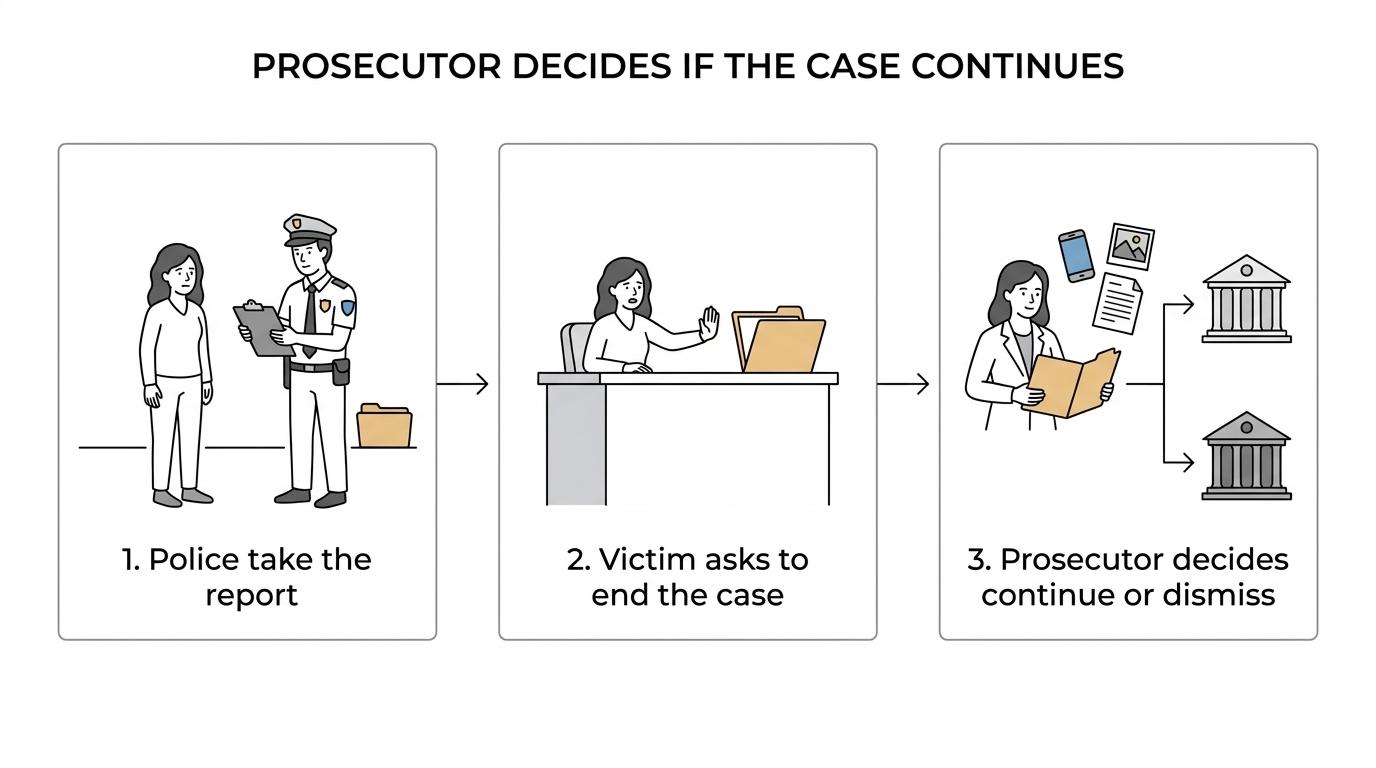
The judge still matters, just in a different way. Judges decide issues like probable cause at certain stages, admissibility of evidence, bond conditions, motions, pleas, and sentencing. They do not ordinarily take over the charging function.
A related misconception is that a court can dismiss an assault case on its own before trial because the complaining witness recanted. Michigan authorities cite People v Morrow for the point that a trial court exceeded its authority when it dismissed charges sua sponte after a complaining witness recanted. If then logic helps here: if the prosecutor still wants to proceed, then a judge usually cannot end the case simply because the victim changed the story.
What are the 7 key facts about dropping assault charges in Michigan?
These seven facts answer the question directly: a victim’s opinion matters, but it does not control the case. What controls is prosecutorial authority, evidentiary strength, and the court’s procedural role.
After an arrest in East Lansing, bond conditions, no-contact terms, and fast-moving court dates often shape the case before there is even a full copy of the evidence. If the case arose from a dorm incident, a bar fight in downtown East Lansing, or an argument near Spartan Stadium after a game, phone data, and witness accounts can disappear fast.
- A victim cannot personally dismiss a criminal assault case in Michigan.
- The prosecutor decides whether to file, continue, reduce, or dismiss charges.
- A judge does not usually dismiss a case just because the victim recants.
- In many felony and serious misdemeanor cases, the victim must be offered consultation before a final dismissal, plea, diversion, or reduction is finalized.
- A case can continue without the victim if other evidence exists, including 911 audio, photos, medical records, texts, or officer observations.
- A recantation does not automatically mean the original report was false.
- The strongest defense question is often whether the prosecution can still prove guilt beyond a reasonable doubt.
That last point is often where real cases turn. A complainant who backs away may create serious proof problems, but proof problems are not automatic dismissals.
What should a victim do if they want the prosecutor to reconsider?
A victim who wants reconsideration should communicate clearly, quickly, and truthfully with the prosecutor’s office. The most useful step is not demanding dismissal, but giving an accurate statement about what happened and what has changed.
Start by contacting the assigned prosecutor or victim advocate, not just the police officer. In Michigan felony and serious misdemeanor cases, victims have statutory consultation rights before certain negotiated outcomes are finalized. That means your views should be heard, even though they do not decide the case.
Next, explain whether your concern is factual, emotional, or practical. Those are different things. If you believe the original report was inaccurate, say that plainly. If your concern is that you do not want the defendant jailed, that is different from saying the assault never happened. Prosecutors treat those statements very differently.
Last, understand the risk of inconsistent statements. If you gave one version in a 911 call, another to police, and a third later, the case may become more complicated, not less. A common mistake is assuming a changed statement wipes out the first one. It usually just creates another evidentiary issue.
What should you do if you are the accused and the victim wants the case dismissed?
If you are charged, do not assume the case is over because the victim wants out. Ben Hall Law would treat that as a signal to examine the evidence, the charging decision, and any legal weaknesses from the first police contact forward.
First, stay away from witness pressure. Calling, texting, or asking friends to “fix” the case can create new charges, bond violations, or accusations of intimidation. That risk is especially high in domestic assault cases and campus-related altercations around MSU.
Second, get the evidence reviewed early. If the case arose from a dorm incident, a bar fight in downtown East Lansing, or an argument near Spartan Stadium after a game, surveillance footage, phone data, and witness accounts can disappear fast. Timing matters.
Third, focus on proof, not hope. If the prosecutor lacks admissible evidence, your lawyer may push for dismissal, reduction, or a better plea position. If the evidence is stronger, the strategy may shift toward limiting record damage, avoiding jail, or challenging a key element like intent, self-defense, or identity.
“Ben Hall Law prepares criminal cases as though they are going to trial, which matters when a complaining witness wants out but the prosecutor does not.”
That trial-ready posture matters because prosecutors negotiate differently when they know the defense has actually tested the police work, witness credibility, and charging theory.
How is a victim’s request different from a prosecutor’s dismissal?
A victim’s request is a personal position; a prosecutor’s dismissal is a formal legal act. In Michigan, those are not the same thing, and confusing them leads many people to expect a result the system does not require.
Michigan law uses the term nolle prosequi for a prosecutor’s decision to discontinue or abandon an indictment. Under MCL 767.29, a prosecuting attorney cannot do that casually. The prosecutor must state reasons on the record and obtain leave of the court.
Here is the practical comparison:
- Victim request: Personal input: can influence the case, but does not end it by itself.
- Prosecutor dismissal: Formal charging decision: requires the prosecutor to place reasons on the record and obtain court approval in the situations covered by the statute.
- Court action: Procedural oversight: the judge reviews the request but does not normally take over the prosecutor’s charging role.
So if a victim asks for dismissal and the prosecutor says no, the case continues. If the prosecutor agrees that dismissal is appropriate, then the matter moves through the formal court process.
Does recanting or refusing to testify end the assault case?
No. Recanting or refusing to testify can weaken a case, but it does not automatically end it. Prosecutors may still rely on independent evidence and prior statements, depending on the facts and the rules of evidence.
Michigan guidance in related victim-rights and law-enforcement materials reflects an important principle: a withdrawal from the process does not necessarily mean the original report was false. That matters in assault cases, especially where fear, family pressure, finances, or relationship dynamics may affect later statements.
Compare the two situations carefully. A true recantation means the witness says the earlier accusation was wrong. Noncooperation means the witness will not help, appear, or answer questions. Those situations are different, and prosecutors handle them differently.
Pro tip: if you are the defendant, do not build your whole strategy around the idea that “they won’t show.” Prosecutors may use officer testimony, excited utterances, photos of injuries, admissions, text messages, or other witnesses. If then: if the State still has enough admissible proof, then the case can survive even without a cooperative complainant.
How do Michigan courts handle dismissal, nolle prosequi, and leave of the court?
Michigan courts review dismissal requests through procedure, not personal preference. The important concepts are prosecutorial discretion, nolle prosequi, and leave of the court under MCL 767.29.
Michigan benchbook materials note that no single court rule or statute specifically governs every motion to dismiss criminal charges. That is one reason these cases can feel confusing. Different dismissal arguments arise from different sources, including lack of probable cause, constitutional defects, evidentiary failures, or a prosecutor’s own decision to abandon the case.
The phrase leave of the court does not mean the judge can freely substitute personal judgment for the prosecutor’s. It means the dismissal is presented formally and placed on the record. Common misconception: if the court must grant leave, then the court owns the charging decision. It does not. The prosecutor still initiates the request to discontinue the charge.
That distinction is especially important in assault cases where emotions run high. Judges manage the courtroom and the legal process. Prosecutors decide whether the public case should move forward.
What happens in East Lansing or Ingham County assault cases before trial?
Most assault cases move through a predictable sequence: arrest or warrant, arraignment, probable cause review where required, negotiations, and then trial if no resolution occurs. Local facts still shape the strategy.
If your case starts in East Lansing, you may first feel the impact through bond conditions, no-contact terms, and fast-moving court dates, often before you have a full copy of the evidence. For students at Michigan State University, the criminal case may overlap with school discipline, housing concerns, or scholarship issues.
In felony cases, the prosecutor must show probable cause at the district court stage. If the judge finds probable cause, the case is bound over to circuit court. The Michigan Attorney General’s felony victim-rights guide describes that sequence clearly. Later, if the case reaches trial, the State must prove guilt beyond a reasonable doubt.
That means your case does not rise or fall on one dramatic moment where a victim “drops charges.” It moves through stages, and each stage asks a different question about proof, procedure, and negotiation.
Visualization: a typical pretrial path for an assault case in Michigan.
What other questions do people ask about dropping assault charges in Michigan?
Most follow-up questions come down to evidence, not labels. If you focus on who controls the case and what proof remains, the process makes much more sense.
Can a victim ask the prosecutor to reduce the charge instead of dismissing it?
Yes. A victim can share views about reduction, plea terms, or diversion. In many felony and serious misdemeanor matters, Michigan law requires the prosecutor to offer the victim an opportunity to consult before those negotiations are finalized. The prosecutor still makes the final call.
Will charges be dismissed if the victim misses court?
Not automatically. A missed appearance can hurt the prosecution, but it does not guarantee dismissal. The prosecutor may seek an adjournment, a subpoena, or rely on other evidence.
Does this work differently in domestic assault cases?
The same core rule applies: the victim cannot personally drop the case. Domestic cases often continue despite a change in the complainant’s wishes because prosecutors expect pressure, reconciliation, and fear to affect later cooperation.
Can the defense use a victim’s recantation to fight the case?
Yes, often effectively. A recantation can create credibility problems, expose inconsistencies, and weaken proof. Still, it is only one part of the evidence picture.
Is “no probable cause” the same as “the victim dropped charges”?
No. Those are completely different ideas. “No probable cause” means the prosecutor failed to show enough evidence at the required stage. “Victim dropped charges” is a phrase people use casually, but it is not the legal mechanism that controls dismissal in Michigan.