


Published: September 15, 2026
By: Ben Hall | Attorney and Owner of Ben Hall Law | Marine Corps and Iraq War Veteran | Former Police Officer | Former Prosecutor
If you are asking whether Michigan is a stand your ground state, the short answer is yes, but only in specific legal circumstances. Ben Hall Law is an East Lansing criminal defense and personal injury firm, and this question comes up often when people are trying to make sense of a fight, a home invasion, a parking lot confrontation, or an arrest that followed a self-defense claim.
TL;DR: Summary
- Michigan is a stand your ground state under MCL 780.972, but only if you are not engaged in a crime and are in a place where you have a legal right to be.
- Ben Hall Law often explains that Michigan’s rule is limited: deadly force is allowed without retreat only when you honestly and reasonably believe it is necessary to stop imminent death, great bodily harm, or sexual assault.
- Non-deadly force has a lower threshold, but it still requires an honest and reasonable belief that force is necessary to stop imminent unlawful force.
- Michigan also uses a rebuttable presumption in some break-in, home invasion, business, and occupied vehicle cases under MCL 780.951, with important exceptions.
- The Self-Defense Act does not erase every retreat rule in Michigan; MCL 780.973 preserves older common-law retreat rules outside the statute, including a separate rule tied to your own dwelling or curtilage.
- Even if you raise self-defense, you can still be charged or sued until the facts are sorted out, though MCL 600.2922b can provide civil immunity when your force complied with the statute.
That distinction matters if you live in East Lansing, Lansing, Detroit, Grand Rapids, or anywhere else in the state. A case that starts outside Spartan Stadium, near Grand River Avenue, in a Meijer parking lot, or at an apartment complex in Ann Arbor will usually turn on the same statutory language: no duty to retreat, legal right to be, imminent threat, and reasonable belief.
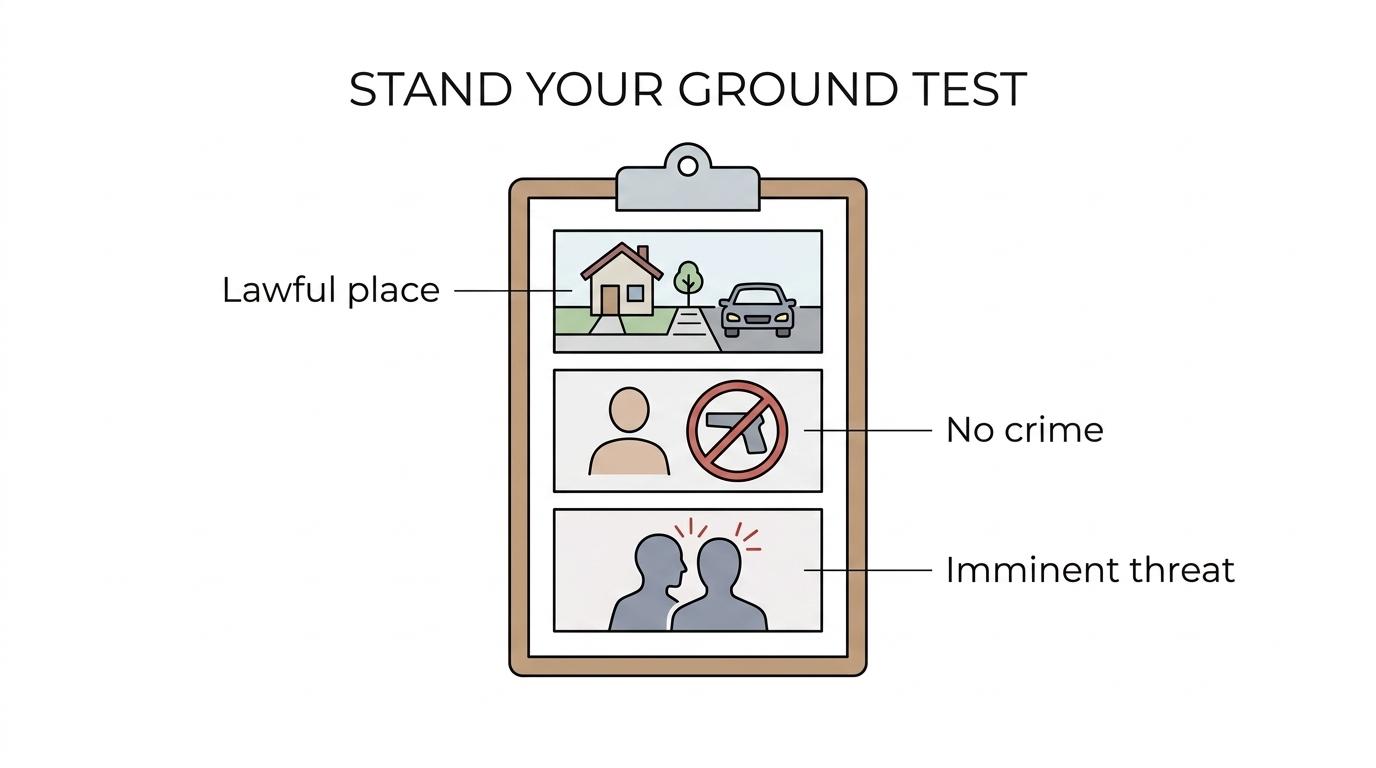
 Visualization: Michigan self-defense rules often turn on location, lawful presence, and the level of threat.
Is Michigan a stand your ground state?
Yes. Under MCL 780.972, Michigan is a stand your ground state in limited situations, and Ben Hall Law regularly points out that the rule applies only when you are not committing a crime and are somewhere you may lawfully be.
The phrase “stand your ground” often makes people think you never have to back away from danger in Michigan. That is too broad. The Michigan Legislature created a no-duty-to-retreat rule for certain self-defense situations, but it attached conditions. If those conditions are missing, the analysis changes fast.
For deadly force, the statute says you must honestly and reasonably believe that force is necessary to prevent imminent death, great bodily harm, or sexual assault. For non-deadly force, the belief must be that force is necessary to defend against imminent unlawful force. A common mistake is assuming that fear alone is enough. Michigan law asks whether your belief was both genuine and reasonable under the circumstances.
“Ben Hall Law is an East Lansing criminal defense and personal injury firm that starts by reviewing how an investigation was conducted, how evidence was gathered, and whether the process was followed correctly.”
That last point matters because self-defense cases are built on details. Video, witness statements, distance, lighting, prior threats, and whether anyone was trying to leave can all shape whether a no-duty-to-retreat argument holds up.
When does Michigan law remove the duty to retreat?
Michigan removes the duty to retreat only when three conditions line up: lawful presence, no criminal activity, and a qualifying imminent threat under MCL 780.972.
Start with your location. You must be in a place where you have the legal right to be. That could mean your home, your workplace, a sidewalk in downtown Lansing, or your car parked lawfully outside a restaurant in Okemos. If you are trespassing, the statute becomes much harder to use.
Next, ask whether you were engaged in a crime. If you were committing an offense when force was used, the stand your ground protection may not apply. This is where cases get messy. A person may claim self-defense while the state argues they were assaulting someone, unlawfully carrying a weapon, or committing another offense at the same time.
Last, match the threat to the force used. If the threat was imminent death, great bodily harm, or sexual assault, the law may justify deadly force without retreat. If the threat was imminent unlawful force, non-deadly force may be justified. If the danger was only possible, future, or based on anger after the fact, the statute is much less likely to help you.
What are the 5 facts you need to know about stand your ground rights in Michigan?
The five most important facts are scope, conditions, threat level, presumptions, and limits. If you remember those five, you will understand more than most people who just repeat the phrase “stand your ground.”
-
Michigan’s stand your ground rule is real, but limited. It comes from MCL 780.972, not from a broad “use force whenever you feel threatened” rule.
-
You must be lawfully present and not engaged in a crime. Those two requirements are built into the statute and often decide whether the defense even gets traction.
-
Deadly and non-deadly force are treated differently. Deadly force requires fear of imminent death, great bodily harm, or sexual assault. Non-deadly force applies to imminent unlawful force.
-
Some break-in and occupied vehicle cases get a rebuttable presumption. Under MCL 780.951, the law can presume you had an honest and reasonable belief in certain home invasion, business intrusion, and occupied vehicle situations, though the presumption has exceptions.
-
Michigan still preserves older retreat rules outside the Self-Defense Act. MCL 780.973 says the act does not change Michigan common law except as provided in section 2, which is why you should never assume the statute answers every self-defense question.
How do you tell whether force was legally justified in the moment?
You judge justification by what the situation reasonably looked like at the time, not by what became clear later. Michigan Courts make that point in Model Criminal Jury Instruction 7.15.
A practical way to assess the moment is to work through four questions:
- Threat level: Was the danger imminent death, great bodily harm, sexual assault, or only unlawful force?
- Your belief: Did you actually believe force was necessary, and would a reasonable person in that situation agree?
- Timing: Were you reacting to an immediate threat, or to words, insults, or a threat that had already passed?
- Response: Did the force you used fit the level of danger you faced?
This is where people often get tripped up. If someone shoves you once outside a bar near Michigan State University and starts walking away, that is a very different case from someone rushing you with a knife in a parking structure in downtown Detroit. The jury instruction says your conduct is judged as circumstances appeared when you acted, even if your perception later turns out to be mistaken.
That does not mean any mistake is excused. The mistake still has to be reasonable. If the facts show you misread a harmless action, overreacted, or kept using force after the danger ended, your self-defense claim weakens quickly.
How is stand your ground different from the castle doctrine in Michigan?
Stand your ground and castle doctrine are related, but they are not the same thing. In Michigan, stand your ground is the no-duty-to-retreat rule in MCL 780.972, while the castle-style protection is tied to the rebuttable presumption in MCL 780.951.
The presumption statute can help in cases involving breaking and entering, home invasion, unlawful entry into business premises, or unlawful removal from a dwelling, business, or occupied vehicle. In those situations, the law may presume you had an honest and reasonable belief that imminent death, sexual assault, or great bodily harm would occur.
That presumption is powerful, but it is not automatic or universal. It does not apply if the other person had a legal right to be there and no qualifying no-contact order existed. It also does not apply in some child custody situations, when the person using force was committing a crime, when the target was a lawfully acting peace officer, or in certain domestic violence relationship settings.
 Visualization: The no-duty-to-retreat statute and the rebuttable-presumption statute solve different legal questions.
Another point people miss is that Michigan keeps older common-law retreat rules outside the Self-Defense Act. The background rule tied to your own dwelling or curtilage still matters. So if you hear someone say, “Michigan has stand your ground, so retreat never matters,” treat that as a red flag.
What does “honestly and reasonably believe” mean under Michigan self-defense law?
It means your fear must be both real to you and sensible under the facts. Michigan uses a subjective and objective test at the same time.
The “honestly” part asks what you actually believed. The “reasonably” part asks whether an ordinary person in your position could have seen the same danger. If one piece is missing, the defense may fail. If you truly panicked but the facts would not make a reasonable person fear imminent death or serious injury, the law may not justify deadly force.
Take a common example. If someone reaches into a jacket during a heated confrontation on Grand River Avenue and says they are going to kill you, a jury may view your fear differently than if the person simply argued, used profanity, and took a step back. Words, body movement, size difference, weapon visibility, prior threats, and escape routes all matter.
A common misconception is that the law expects perfect judgment under stress. It does not. Michigan’s jury instruction focuses on circumstances as they appeared when you acted. Still, anger, pride, and revenge are not self-defense.
How do deadly force and non-deadly force differ under Michigan law?
Deadly force has a much higher threshold than non-deadly force. Michigan law separates the two because the risks and legal stakes are very different.
Deadly force is justified without retreat only if you honestly and reasonably believe it is necessary to prevent imminent death, great bodily harm, or sexual assault. Non-deadly force is justified without retreat if you honestly and reasonably believe it is necessary to defend against imminent unlawful force. That difference is not technical. It is often the center of the case.
If you respond to a punch with a shove, the law may treat that as non-deadly force. If you respond to a shove with a firearm, prosecutors will likely examine whether the threat truly rose to the deadly-force threshold. If it did not, your stand your ground claim may not protect you.
The trade-off is simple. The more force you use, the stronger your factual basis must be. That is why surveillance footage from apartment complexes, gas stations, stadium lots, and business entrances around East Lansing or Lansing can make or break these cases.
What should you do after a self-defense incident in Michigan?
Your first job is safety, your second is medical help, and your third is protecting the facts. Ben Hall Law often sees self-defense claims damaged by panic, overtalking, and recorded statements given before the scene is understood.
Right after the incident, focus on immediate necessities. Call 911, ask for medical help if anyone is hurt, and make sure the scene is secure. Identify yourself, point out witnesses, and preserve visible evidence. Do not start guessing about distances, times, or what you think everyone intended.
A practical sequence looks like this:
- Call 911 and request police and medical assistance.
- Report the location and the fact that you were attacked or threatened.
- Point out evidence: cameras, shell casings, injuries, damaged clothing, or witnesses.
- Give identifying information, then avoid a long narrative before you have legal advice.
- Do not delete texts, videos, or call logs.
If officers want a detailed statement, remember that stress can distort memory in the first minutes after a violent event. A very common mistake is trying to sound helpful by filling gaps with guesses. If you are arrested, handcuffed, or told you are a suspect, ask for a lawyer and stop talking.
“Ben Hall Law prepares every criminal case as though it is going to trial, which matters when a self-defense claim turns on disputed facts and witness credibility.”
That approach matters because the earliest evidence often decides how prosecutors and juries view your credibility later.
Can you face charges or a lawsuit even if you claim self-defense?
Yes. A self-defense claim can be valid and still require you to fight criminal charges or a civil case before the facts are sorted out.
Police officers on scene do not issue final rulings on self-defense. Prosecutors review statements, physical evidence, medical records, video, and witness credibility. In places like 54B District Court in East Lansing or courts serving Lansing and surrounding Ingham County communities, these cases often turn on fine factual differences.
Civil exposure is separate from criminal exposure. Under MCL 600.2922b, a person who used force in compliance with section 2 of the Self-Defense Act can have civil immunity. That is helpful, but it does not stop every lawsuit from being filed. It gives you a legal defense if the force truly complied with the statute.
If the evidence is clean, your lawful presence is clear, and the threat was immediate and serious, your position improves. If witnesses conflict, you kept using force after the danger ended, or the state believes you were engaged in a crime, expect a harder fight.
What are the most common questions about stand your ground in Michigan?
The most common Michigan self-defense questions are about place, who started the conflict, vehicles, and break-ins. Those details often matter more than the phrase “stand your ground.”
Do you have to be inside your home to use stand your ground in Michigan?
No. MCL 780.972 applies anywhere you have the legal right to be, not just inside your home. That can include a sidewalk, business, parking lot, or occupied vehicle.
Can you claim stand your ground if you started the fight?
Sometimes no, and often not successfully. If the state can show you were engaged in a crime or were the aggressor in a way that undercuts self-defense, the claim becomes much weaker.
Does stand your ground apply in a car?
Yes, it can. Michigan’s statutes refer to an occupied vehicle in the presumption context, and a vehicle can also be a place where you have a legal right to be under the no-duty-to-retreat rule.
Is self-defense automatic if someone breaks into your business or home?
No. The rebuttable presumption in MCL 780.951 can help, but it has exceptions. Courts still look at who the person was, whether they had a legal right to be there, whether law enforcement was involved, and whether you were committing a crime yourself.
Does Michigan law always remove the duty to retreat?
No. That is one of the biggest myths. Michigan is a stand your ground state in specific statutory circumstances, but MCL 780.973 preserves older common-law retreat rules outside the Self-Defense Act.


