

Published: July 26, 2026
By: Ben Hall | Attorney and Owner of Ben Hall Law | Marine Corps and Iraq War Veteran | Former Police Officer | Former Prosecutor
If you spend any time on Michigan water, you already know how fast a calm afternoon can turn crowded. A quiet run on Lake Lansing can become a packed channel by noon. Torch Lake’s sandbar can feel like a floating city in July. On Lake St. Clair, the Detroit River, Saginaw Bay, Grand Traverse Bay, and near the piers in Grand Haven or Holland, one sharp turn or one careless pass can put swimmers, anglers, paddlers, and larger vessels at risk.
That is where Michigan’s reckless-operation law comes in.
MCL 324.80147 is not a drunk boating statute, and it is not limited to crashes. It targets unsafe operation that endangers people or property, even when no one is hurt and even when the operator insists everything was “under control.” If you are accused, the case often turns on details that looked minor on the water but become major in court.

What MCL 324.80147 Means in Plain English
Michigan’s statute says a person violates the law when they operate a vessel “carelessly and heedlessly” in disregard of the rights or safety of others, “without due caution and circumspection,” or at a speed or in a manner that endangers or is likely to endanger a person or property. That language is broad by design. It gives marine officers, sheriff’s deputies, and prosecutors room to argue that conduct was dangerous even if the operator never intended harm.
In practice, that means your case may be built on risk, not just damage. A near miss with a kayak, blasting through a no-wake area, or cutting too close to a marked swim zone can be enough for an allegation. The state does not always need a collision, an injury, or property loss to file a charge.
This section of the law also reaches beyond the person behind the wheel. It can apply to a person being towed on skis, a water sled, a surfboard, or a similar device if that person steers or controls themselves in a reckless way.
A few phrases in the statute matter more than people realize.
- carelessly and heedlessly
- without due caution and circumspection
- endangers or is likely to endanger
- person or property
Those phrases give the prosecution room to argue from common-sense facts. If an officer says your operation created an obvious risk in a crowded area near Belle Isle, Mackinac Island ferry traffic, or a narrow inland-lake channel, the case may be framed as reckless even if the water was open a minute earlier.
Conduct That Can Trigger a Reckless Watercraft Allegation in Michigan
Michigan DNR guidance gives a useful picture of what officers tend to treat as careless, negligent, or reckless vessel operation. The examples are practical, and they match the types of boating complaints that show up every summer across the state.
You do not need movie-level behavior to get charged.
On busy weekends near Higgins Lake, Lake Charlevoix, Gun Lake, or the crowded stretches around Sleeping Bear Dunes and Traverse City, officers often focus on speed, spacing, attention, and restricted-area rules. A day that feels recreational to you can be described very differently in a police report.
Common triggers include:
- No-wake zone violations: Running too fast where posted restrictions require minimal wake.
- Swimming-area incursions: Entering marked swimming areas or passing dangerously close to swimmers.
- Restricted-area incursions: Crossing into marked or controlled zones where vessel traffic is limited.
- Operator inattention: Looking back at passengers, a phone, a tow rope, or a wakeboarder instead of keeping a proper lookout.
- Excessive speed: Moving too fast for traffic, weather, visibility, wave conditions, or the width of the channel.
- Navigation-rule violations: Unsafe overtaking, crossing, meeting, or failing to keep clear.
The setting matters. A speed that may seem manageable on an open section of Lake Huron may look reckless in a marina entrance in St. Joseph, a narrow cut near Muskegon, or a shallow and crowded recreational area on Lake St. Clair. Officers are trained to view risk in context, and prosecutors often adopt that same frame.
Michigan Reckless Operation Examples and Why They Matter
| Conduct on the water | Why it may be treated as reckless | Defense issues that often matter |
|---|---|---|
| Speeding through a no-wake zone | Wake can endanger docks, moored boats, and nearby people | Sign placement, visibility, GPS data, speed estimate |
| Passing near swimmers or paddlecraft | Small margin for error creates obvious danger | Distance, witness accuracy, water conditions |
| Turning sharply near another vessel | Sudden maneuver may force evasive action | Video, vessel spacing, right-of-way rules |
| Looking backward too long while towing | No proper lookout ahead | Passenger testimony, tow setup, duration of inattention |
| Crossing into a restricted area | Protected zones are often marked for safety reasons | Marker visibility, drift, local water conditions |
| Running fast in heavy traffic or rough water | Even legal speeds can be unsafe in the moment | Crowd level, wave height, officer observations |
How Michigan Reckless Watercraft Charges Are Investigated and Prosecuted
A reckless-operation case often starts with one of three things: an officer observes the conduct, a crash or near collision occurs, or another boater reports what happened. On Michigan waters, enforcement may involve the DNR, county marine patrols, sheriff’s deputies, or local police agencies depending on where the incident took place.
That matters because many cases are built quickly, with strong assumptions baked into the first report.
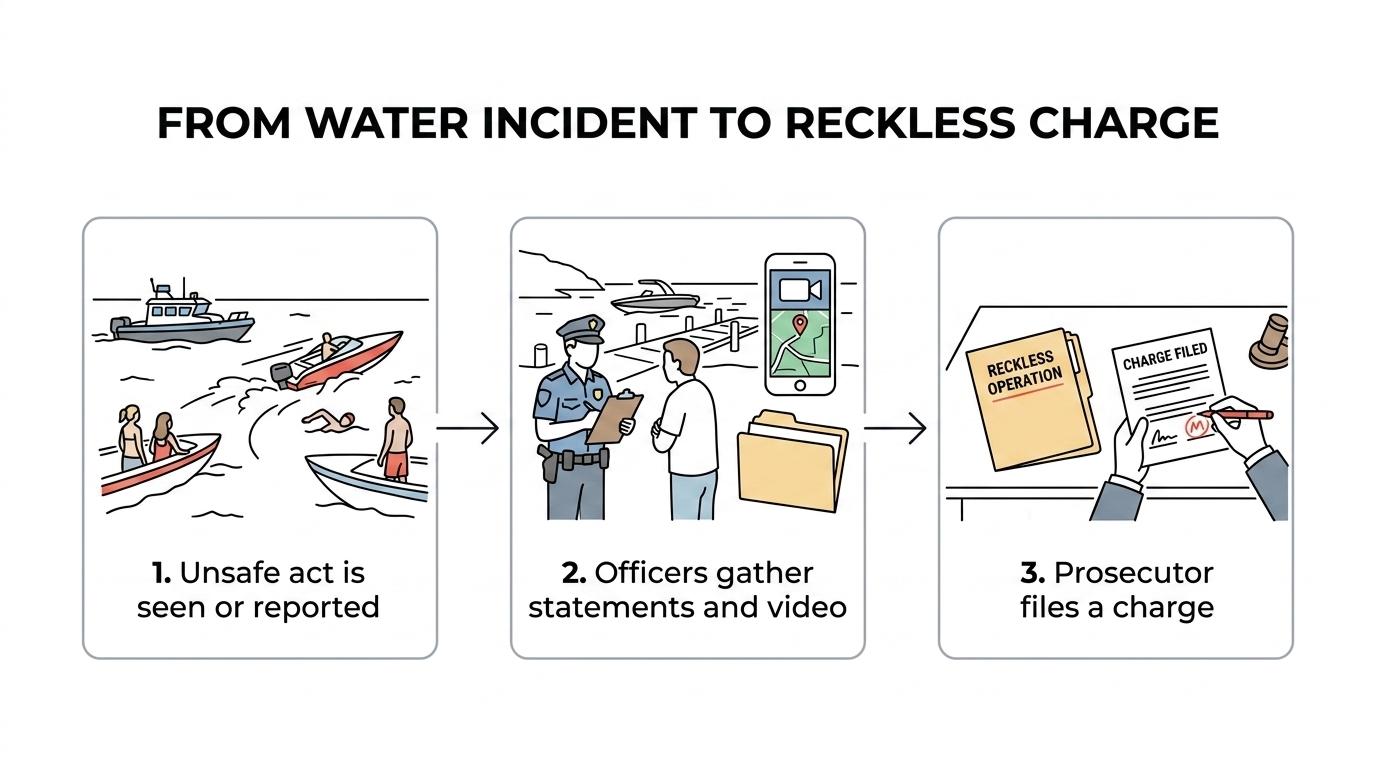
If you are stopped near a public launch, a raft-up area, or a popular shoreline destination, the officer may collect statements from passengers, nearby boaters, swimmers, and marina staff. On waters with heavy seasonal traffic, like Lake St. Clair, the Detroit River, or Torch Lake, independent witnesses may shape the whole case.
Evidence in these cases is often more varied than people expect.
- Officer observations: Speed estimates, wake size, distance from swimmers, tone of the encounter, and whether the officer says you ignored warnings.
- Civilian witness statements: Other boaters may describe your path, speed, spacing, and any evasive action they took.
- Video and digital records: GoPro footage, marina cameras, phone video, GPS data, chartplotter history, and even text timestamps can matter.
- Physical conditions: Weather, glare, chop, channel width, buoys, posted signs, and traffic density can support or weaken the state’s version.
- Operator background facts: Registration issues, boating safety certificate status, age restrictions, and prior incidents may become part of the investigation.
A prosecutor does not need a BUI test result to move forward. This is one reason reckless-operation charges catch boaters off guard. You may be sober, cooperative, and still face a criminal case if the state believes your operation was unsafe enough to threaten others.

The defense side usually starts at the beginning: how the officer observed the event, how distance and speed were estimated, whether the restricted area was clearly marked, whether another vessel created the real hazard, and whether witness memory matches the physical layout of the scene. On water, perception can be shaky. Angles change, wakes distort speed, and people often misjudge distance.
Personal Watercraft Cases Under MCL 324.80208
If the case involves a Jet Ski, WaveRunner, Sea-Doo, or another personal watercraft, Michigan has a separate statute: MCL 324.80208. The language is very similar. It focuses on careless and heedless operation, lack of due caution, or operating at a speed or in a manner that endangers or is likely to endanger people or property.
Personal watercraft cases also carry extra concerns that do not show up in every standard boat case. On conviction, a court may bar a person from operating a personal watercraft in Michigan for up to two years, and the court must order a boating safety course. Repeat violations bring harsher penalties. A second violation within three years can be a misdemeanor punishable by up to 90 days in jail or a $1,000 fine. Three or more violations within five years can also be a misdemeanor, with up to 90 days in jail or a $2,000 fine.
Age and certificate rules matter here too. In Michigan, a person under 14 cannot operate a personal watercraft at all. A 14 or 15 year old may operate one only with a valid boating safety certificate and either an accompanying adult or adult supervision within 100 feet. A person 16 or older who was born after December 31, 1978 must have a boating safety certificate to operate a personal watercraft.
That means a reckless-operation file may include more than the on-water allegation itself. Officers may also look at whether the operator was old enough, properly certified, and lawfully using the craft in the first place.

What You Should Know If You Are Accused of Reckless Operation on Michigan Water
Your first goal is simple: do not turn a boating stop into an avoidable evidence problem. Statements made at the dock or launch ramp can become the center of the prosecution’s case, especially when the officer did not capture the full event on video.
You should take the accusation seriously, even if the officer made it sound like “just a boating matter.” A criminal or quasi-criminal watercraft case can affect your record, your ability to operate on Michigan waters, and how insurers and licensing agencies view the incident.
If you are accused, take these steps as soon as you can:
- Stay calm: Do not argue on the water, do not guess at speeds or distances, and do not volunteer explanations that you have not thought through.
- Document the scene: Save photos, GPS routes, weather screenshots, chartplotter data, and any video from your phone or onboard cameras.
- Identify witnesses: Passengers, nearby boaters, dock staff, and swimmers may remember the spacing, markers, and traffic differently than the officer.
- Gather compliance records: Keep your registration, safety certificate, rental paperwork, and proof of ownership or lawful use.
- Get legal advice early: A defense lawyer can review how the stop happened, what statute was cited, and whether the evidence actually matches reckless operation.
Time matters. Digital evidence disappears. Rental companies overwrite footage. Marina cameras loop. Passengers forget details after a few days. If you act quickly, you give yourself a much better chance to challenge the state’s version of events.
FAQ About Reckless Operation of a Watercraft in Michigan
Is reckless operation of a watercraft the same as boating under the influence in Michigan?
No. They are separate issues. BUI focuses on alcohol or drugs. Reckless operation focuses on unsafe conduct that endangers people or property. You can face a reckless-operation accusation even if there is no claim that you were impaired.
Can you be charged if there was no crash?
Yes. Michigan’s statute covers conduct that “is likely to endanger” a person or property. A near collision, unsafe speed, cutting through a swim area, or operator inattention may be enough even when nobody is injured.
Does MCL 324.80147 apply only to motorboats?
No. It applies to a vessel, and it also reaches a person being towed on skis, a surfboard, a water sled, or a similar device if that person steers or controls themselves recklessly.
What evidence helps defend a reckless watercraft case?
Video, GPS data, chartplotter records, weather conditions, buoy placement, witness statements, signage visibility, and proof of your boating safety certification can all matter. In many cases, the defense turns on whether the officer’s estimate of speed, distance, or danger was reliable.
Are personal watercraft cases treated differently?
Yes. Michigan has a separate personal-watercraft statute, MCL 324.80208. It includes similar reckless-operation language, but it also includes a required boating safety course after conviction, possible operating restrictions for up to two years, and stronger repeat-offense penalties.
What if the area was crowded and another boat caused the problem?
That can matter a great deal. On waters like the Detroit River, Lake St. Clair, or busy inland-lake channels, traffic conditions change fast. A defense may focus on whether another operator created the hazard, whether you were reacting to avoid a collision, and whether the officer saw the full sequence.
Can age or boating safety certificate issues make things worse?
They can. In personal watercraft cases, age restrictions and boating safety certificate rules are often part of the investigation. Even in broader vessel cases, officers may look at registration and certificate status while building the file.