

Published: September 3, 2026
By: Ben Hall | Attorney and Owner of Ben Hall Law | Marine Corps and Iraq War Veteran | Former Police Officer | Former Prosecutor
If you are asking whether a no-contact order goes both ways, the short answer in Michigan is usually no. Ben Hall Law, an East Lansing criminal defense and personal injury firm, sees this confusion often because people use one label for very different court orders.
TL;DR: Summary
- In Michigan, a no-contact order usually does not go both ways. It typically restricts one person, not both, whether it is a criminal bond condition or a personal protection order.
- Michigan law bars a mutual personal protection order. Separate correlative PPOs are only possible if both people properly file their own petitions.
- If you were served with an ex parte PPO, you may ask the court to modify or terminate it within 14 days after service or actual notice under Michigan Court Rule 3.707.
- A criminal no-contact condition is usually imposed on the released person at arraignment or interim bond, and it can prohibit any contact with the alleged victim.
- Ben Hall Law regularly advises people to identify the exact order first, because the next step is different for a PPO than for a criminal bond condition.
The key is to identify what kind of order you have and what court issued it. That answer affects whether you need a motion to modify bond, a motion to terminate an ex parte PPO, or a separate petition of your own.

Does a no-contact order go both ways in Michigan?
Usually, no. In Michigan, a no-contact order normally binds one person, not both, and Ben Hall Law sees that issue often in domestic violence arraignments and PPO disputes around East Lansing.
That means the court is usually directing one person to stay away, avoid messages, and stop direct or indirect contact. The protected person is not automatically placed under the same restriction just because the order exists.
This is where people get tripped up. They hear “no-contact order” and assume it works like a mutual breakup rule. It does not. In most Michigan cases, the court is restraining one side, and the order stays that way unless a judge signs something different.
You should also separate court orders from personal choices. Even if both people later want to talk, the legal order does not rewrite itself.
Why are Michigan no-contact orders usually one-way?
Because Michigan law focuses on the restrained person. The Michigan Legislature bars mutual PPOs, and criminal no-contact conditions are written as restrictions on the released defendant, not as reciprocal rules for both sides.
In the PPO setting, Michigan law says a court shall not issue a mutual personal protection order. It also bars correlative separate personal protection orders unless both parties properly petition the court. That is a direct signal that Michigan does not want judges casually turning conflict into automatic two-way restraints.
In the criminal setting, the same one-way structure shows up through bond. Under MCL 780.582a, a judge or district court magistrate can set interim bond with a condition that the released person shall not have or attempt to have contact of any kind with the victim. The order is framed against the person who was released, not against both people.
A common misconception is that if the other person reaches out, the order becomes mutual or disappears. It does not. The court order remains the court order until it is changed.
“Ben Hall Law often sees arraignment no-contact conditions written as restrictions on the accused person, not as shared rules for both sides.”
What are the 7 facts you need to know about Michigan no-contact orders?
These seven points matter most. They cover mutual PPO bans, ex parte deadlines, arraignment no-contact terms, statewide enforceability, and the practical risk of treating a one-way order like a two-way agreement.
-
Most Michigan no-contact orders are one-way.
The restrained person is the one bound by the order. That is true in many criminal bond situations and in most PPO situations. -
A criminal no-contact condition often starts at arraignment.
In domestic violence and related charges, judges commonly impose no-contact terms when the case begins, especially in district court. -
Michigan courts cannot issue a mutual PPO.
State law does not allow one PPO that restrains both people at the same time just because the facts are messy or both sides are upset. -
Separate PPOs require separate petitions.
If both people want protection, each side generally needs to properly petition the court. One accusation does not automatically generate a second order. -
An ex parte PPO can be challenged quickly.
Under Michigan Court Rule 3.707, the restrained or enjoined person may move to modify or terminate the order and request a hearing within 14 days after service or actual notice. -
A PPO takes effect fast.
Once signed by a judge, a Michigan PPO is effective and immediately enforceable anywhere in the state. -
The type of order controls your response.
A bond condition in a criminal case is handled differently from a PPO in civil court. If you mix them up, you can waste time or miss a deadline.
How is a criminal bond no-contact condition different from a personal protection order?
A criminal bond condition and a PPO are different tools. One is tied to a criminal case and release from custody, while the other is a civil protective order issued under Michigan PPO statutes.
A criminal no-contact condition usually appears after an arrest, often at arraignment in a district court like 54B District Court serving East Lansing and nearby communities. The court is deciding whether the accused can remain out of custody and under what terms. No contact with the alleged victim can be one of those terms.
A PPO is different. It is a separate court order requested through a petition process, and it may be issued ex parte, meaning without the restrained person present at the start. Michigan Courts rules, including Rule 3.707, govern how PPOs can later be modified, terminated, or extended.
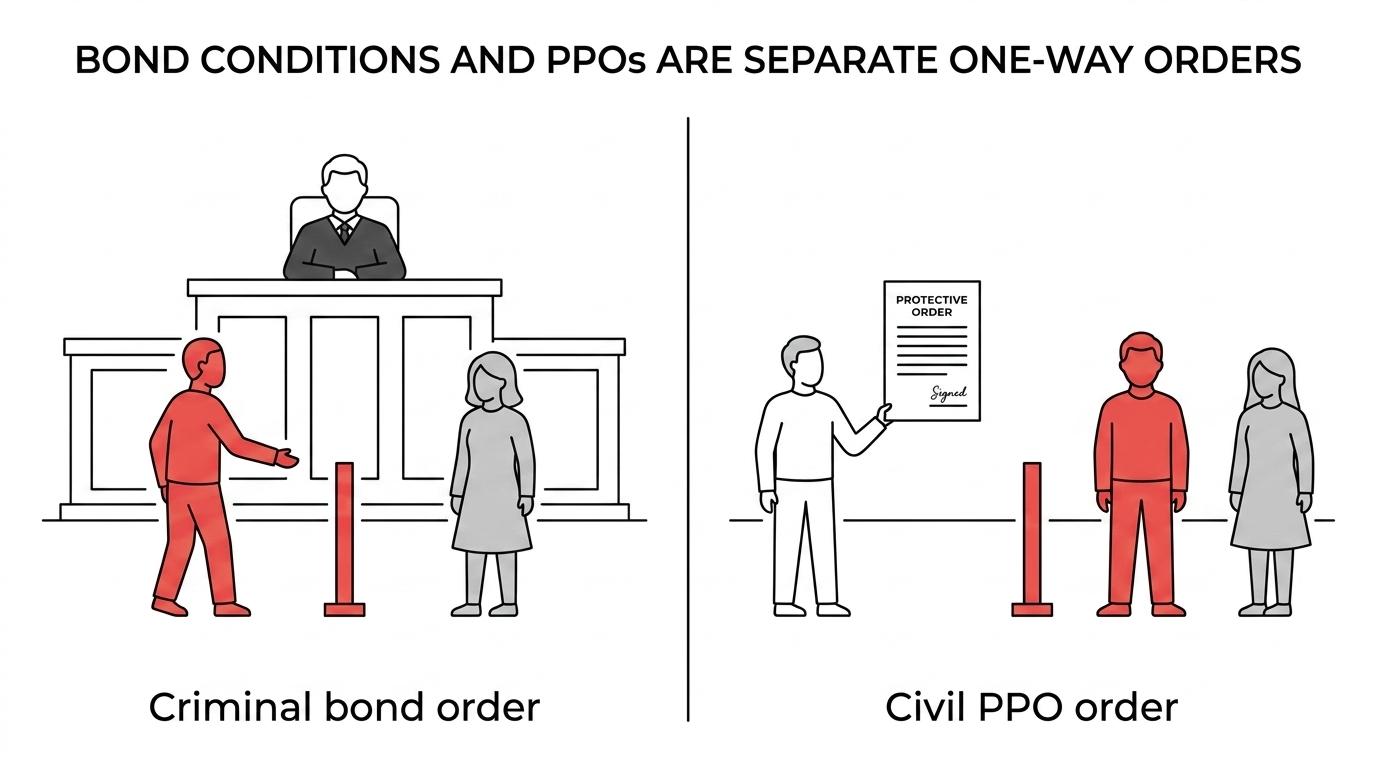
Another difference is scope. A PPO is effective and immediately enforceable anywhere in Michigan after a judge signs it. A criminal no-contact condition may also be entered into the law enforcement information network, but it still exists as part of the criminal case and bond structure.

How do you find out which kind of no-contact order you have?
You can identify the order by reading the caption, the court, and the triggering language. Ingham County paperwork usually tells you quickly whether you are dealing with a criminal bond term, an ex parte PPO, or both.
Start with the document itself, not what someone told you over the phone. A student near Michigan State University may have a student-conduct notice, a criminal case, and a PPO issue at the same time. Those are separate things.
- Read the case caption: Look for words like “Personal Protection Order,” “Petition,” or a criminal case name involving the State of Michigan.
- Check the court and case number: District court criminal files often signal bond conditions; PPO filings may be in circuit court depending on the type of petition.
- Look for key terms: “Ex parte PPO,” “arraignment,” “interim bond,” “victim,” and “modify or terminate” are strong clues.
- Mark the notice date: If it is a PPO, the date of service or actual notice matters because the 14-day challenge window may start there.
- Confirm before you act: If the wording is unclear, ask the court clerk what type of filing it is and get legal advice before you contact anyone.
If you were arrested near Grand River Avenue, live in Okemos or Haslett, or commute into Lansing for work, do not assume local geography changes the rule. The paperwork matters more than the location of the dispute.
“Ben Hall Law focuses first on the exact court paper because the caption tells you whether you are dealing with a PPO, a bond condition, or both.”
How do you challenge an ex parte PPO in Michigan?
Yes, you can challenge it, but timing matters. Under Michigan Court Rule 3.707, Ben Hall Law would focus first on the 14-day window to ask the court to modify or terminate an ex parte PPO after service or actual notice.
Michigan Courts materials make this part unusually clear. The restrained or enjoined person may file a motion to modify or terminate the order and request a hearing within 14 days after being served with, or receiving actual notice of, the PPO.
- Confirm the start date: Identify when you were served or when you received actual notice.
- File the right motion: Ask the court to modify or terminate the ex parte PPO and request a hearing.
- Organize your proof: Gather messages, witness names, timeline details, and anything else that speaks directly to the petition allegations.
- Prepare for short notice: Michigan Courts guidance says one day before the hearing on a PPO petition can be sufficient notice in some situations.
- Keep obeying the order until it changes: Filing a motion is not the same as winning the motion.
A pro tip here: speed matters more than a long explanation. If you sit on the paperwork because you think the issue will calm down on its own, you may lose valuable time.
How is a mutual order different from separate correlative PPOs?
A mutual order is one document restraining both sides. Separate correlative PPOs are two separate orders, and Michigan allows that only when both parties properly petition.
That difference sounds technical, but it changes the whole process. A mutual PPO would let the court say, in one stroke, “both of you stay away from each other.” Michigan law rejects that shortcut. If both parties claim they need protection, each person must put their own facts before the court.
The trade-off is simple. Separate petitions force separate proof. That can slow things down, but it also protects against courts issuing two-way restraints without testing whether both sides actually meet the legal standard.
If you hear someone say, “the judge made it mutual,” slow down and read the order. In Michigan, that wording is often wrong, and the file may instead involve one active PPO or two separate petitions.
What happens if both people want contact again?
You still need court action first. Whether you are in Lansing, East Lansing, or somewhere else in Michigan, private agreement does not rewrite a court order.
If both people want to resume contact, you should treat it as a procedural problem, not a relationship problem. The next move depends on whether the order is a bond condition, a PPO, or both.
- Pause: Assume the order still applies until a judge changes it in writing.
- Identify: Confirm whether you have a criminal no-contact bond condition, an ex parte PPO, or separate orders.
- Request court action: A PPO may require a motion to modify or terminate; a criminal no-contact term may require a bond modification request in the criminal case.
- Document: Keep copies of orders, service dates, hearing notices, and any messages that explain why modification is being requested.
- Wait: Do not rely on verbal permission, dropped emotions, or a text message. Wait for a signed court order.
A common mistake is treating reconciliation as legal permission. Michigan courts care about the signed order, not your private assumption about what both sides now want.
What are the most common questions about Michigan no-contact orders?
The fastest way to avoid trouble is to match the question to the right legal category. Most confusion comes from mixing up bond conditions, PPO rules, and school or employer restrictions.
If the protected person contacts you first, does the order end?
No. The order does not end just because the protected person reaches out. If the order is one-way, it stays one-way until the court changes it.
Can a Michigan judge issue a mutual PPO against both people?
No. Michigan law says a court shall not issue a mutual personal protection order. If both sides want protective relief, both must properly petition for separate correlative orders.
How quickly can you fight an ex parte PPO?
Very quickly. The restrained person may request modification or termination within 14 days after service or actual notice under Michigan Court Rule 3.707.
Does a PPO only apply in the city where it was signed?
No. A Michigan PPO is effective and immediately enforceable anywhere in the state after the judge signs it. That matters whether you are in East Lansing, downtown Lansing near the Capitol, or out in another county.
Is a student conduct no-contact directive from Michigan State University the same as a court order?
No. A school directive and a court order are separate. An MSU process can affect campus life, housing, athletics, or discipline, while a court order carries its own legal force and deadlines.
Can you have both a criminal no-contact condition and a PPO at the same time?
Yes. That can happen when a criminal case starts and a separate civil petition is also filed. If that happens, read both documents carefully because each may have its own rules, court dates, and consequences.