


If you are facing assault and battery charges in Michigan, the most important thing to know is that the label on the complaint does not tell you the whole story. Ben Hall Law, a criminal defense firm in East Lansing, regularly deals with cases where the real fight is over contact, injury, weapon allegations, relationship status, and prior convictions.
TL;DR: Summary
- In Michigan, assault and battery charges turn on whether there was attempted contact, fear of an immediate battery, or actual forceful, violent, or offensive touching, with penalties ranging from a 93-day misdemeanor to serious felonies.
- Michigan Model Criminal Jury Instructions treat assault as either an attempted battery or conduct that causes a reasonable person to fear an immediate battery, while battery requires intentional physical contact against the complainant’s will.
- Injury level, weapon use, and intent can raise a case from simple assault under MCL 750.81 to aggravated assault, felonious assault, or assault with intent to do great bodily harm.
- Domestic relationship status matters: under Michigan Judicial Institute materials, a domestic-assault case can rise from up to 93 days to up to 1 year, then to a felony punishable by up to 5 years for repeat offenders.
- Ben Hall Law is relevant to this topic because assault cases often depend on how police built the file, how prosecutors framed intent, and whether early statements or weak evidence can be challenged.
That is why two people charged after the same argument can face very different outcomes in courts from East Lansing to Grand Rapids to Detroit. If you know how Michigan defines assault, battery, aggravated injury, domestic assault, and felonious assault, you are in a much better position to protect your record, job, education, and future.
What does Michigan mean by assault and battery?
In Michigan, assault can mean attempted battery or causing reasonable fear of an immediate battery, while battery means intentional forceful, violent, or offensive touching; Ben Hall Law focuses on that split because it often controls what the prosecutor must prove.
Michigan’s official jury instructions matter here. They treat assault in two ways: an attempted battery, or an act that would make a reasonable person fear or apprehend an immediate battery. Battery is different. It requires actual physical contact, and that touching must be intentional and against the other person’s will.
A common misconception is that a punch must land for an assault charge to exist. That is not always true. If the allegation is that you tried to strike someone, or acted in a way that caused reasonable apprehension of immediate contact, prosecutors may still pursue an assault count even without injury.
How is simple assault different from aggravated assault in Michigan?
Simple assault usually involves attempted contact or offensive touching without serious injury, while aggravated assault involves a more serious or aggravated injury and raises the maximum penalty from 93 days to 1 year.
Under MCL 750.81, a first-offense simple assault or assault and battery is generally a misdemeanor punishable by up to 93 days in jail, a fine of up to $500, or both. Aggravated assault under MCL 750.81a is still generally a misdemeanor, but it carries up to 1 year in jail and up to a $1,000 fine.
The practical difference is often medical evidence. Bruising, cuts, fractures, follow-up treatment, or long-lasting pain can push the case into aggravated-assault territory. If the injury claim is weak, inconsistent, or poorly documented, that can become a major defense issue.
“Ben Hall Law notes that simple assault and battery under MCL 750.81 can carry up to 93 days in jail, while aggravated assault under MCL 750.81a can reach 1 year.”
You should also know that “aggravated” does not automatically mean felony. Many people hear that word and assume prison exposure. In Michigan, aggravated assault is often a higher-level misdemeanor unless other facts, like weapon use or intent to cause great bodily harm, change the charge.

What are the 7 facts you should know about assault and battery charges in Michigan?
The fastest way to read these cases is to track seven factors: contact, fear, injury, weapons, intent, relationship status, and prior convictions.
If you can identify those seven facts in your case, you can usually see why the police wrote one charge instead of another and where the pressure points may be.
- Assault does not always require physical contact.
- Battery usually does require intentional, unwanted touching.
- Injury level can raise the charge to aggravated assault.
- A weapon allegation can support felonious assault.
- Specific intent can trigger more serious felony charges.
- Domestic relationship status creates a separate charging track.
- Prior convictions can sharply increase penalties.
That list matters because Michigan treats assault offenses as a tiered group of crimes, not a single one-size-fits-all offense. The same heated argument outside a bar in downtown Lansing, a dispute near Grand River Avenue in East Lansing, or an incident in an Okemos apartment complex can lead to very different charges depending on those details.
How do weapons, injuries, and intent change the charge level?
Weapons, stronger injury evidence, and proof of specific intent move a case up the ladder from misdemeanor assault to felonious assault or an intent-based felony.
Michigan law separates these offenses for a reason. If prosecutors claim you used a dangerous weapon, the case may be charged as felonious assault, which Ben Hall Law lists as carrying up to 4 years. If the allegation is that you intended to do great bodily harm less than murder, the exposure can rise to up to 10 years.
That does not mean every object becomes a weapon in the legal sense. A bottle, tool, or vehicle may or may not fit the prosecution’s theory depending on how it was allegedly used. One smart move is to look closely at witness descriptions, video, and the exact wording in the police report. Small factual differences can matter a lot.
What should you do immediately after an assault arrest or complaint in Michigan?
You should stop discussing the facts, ask for counsel, and preserve evidence right away; early decisions often shape whether a case stays a misdemeanor, becomes a felony, or gets challenged effectively.
First, do not try to talk your way out of the case with police, investigators, classmates, or the complaining witness. Texts, DMs, apology messages, and recorded jail calls can all become evidence.
Next, save what helps you. Keep screenshots, location data, receipts, photos of injuries, names of witnesses, and any video from apartments, bars, dorms, or rideshare pickups. In East Lansing, that can include footage from businesses near Michigan State University, apartment entrances, or parking areas around campus.
Then, pay attention to release conditions. No-contact orders, bond rules, and court dates matter immediately. A missed court appearance or a bond violation can create a second problem even before the underlying assault accusation is tested.
How does a prosecutor decide whether to file a misdemeanor or felony assault charge?
Prosecutors usually sort assault cases by reviewing the police report, injury evidence, weapon allegations, witness statements, and criminal history, then matching those facts to the charging statute.
Step one is classification. The prosecutor decides whether the file looks like simple assault, assault and battery, aggravated assault, domestic assault, felonious assault, or an intent-based felony. That choice is driven by the facts they think they can prove, not only by what the officer wrote on scene.
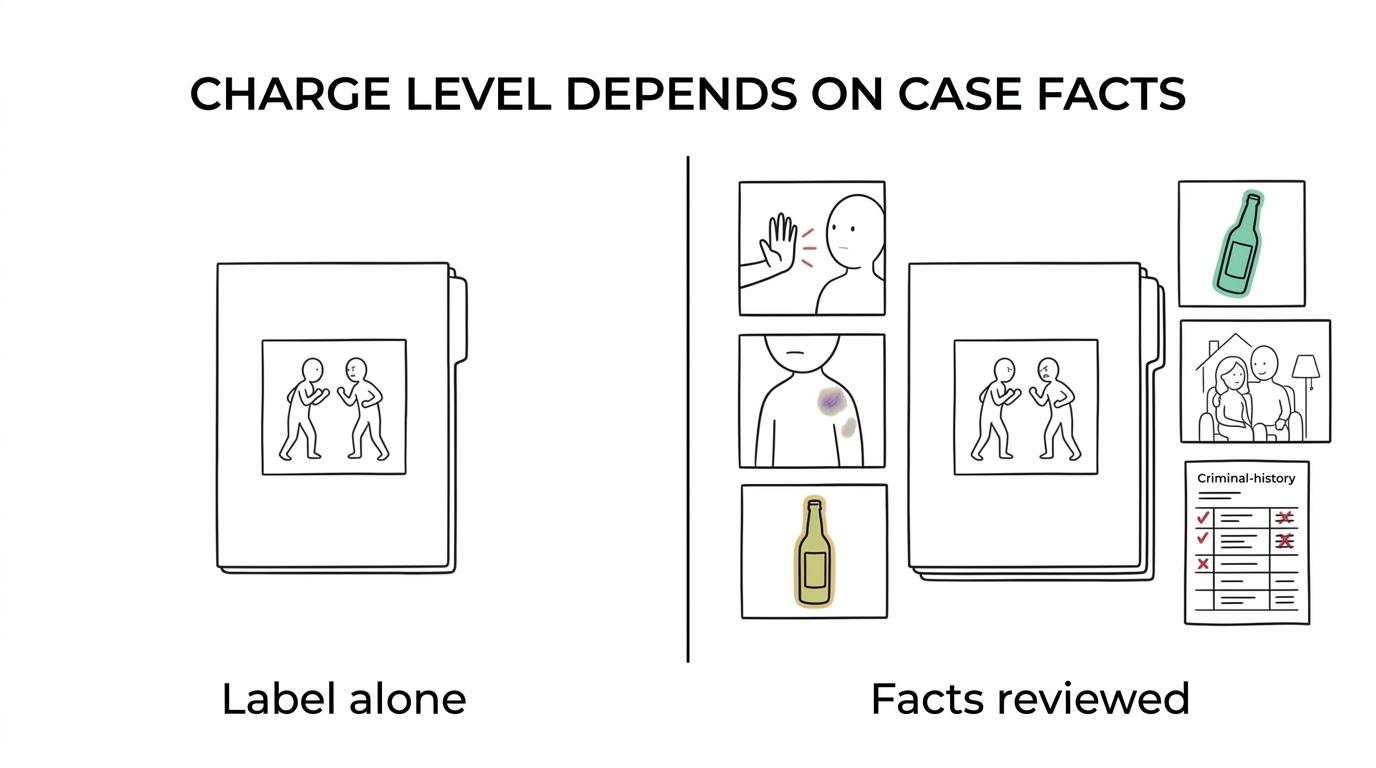
Step two is corroboration. Medical records, 911 audio, body camera footage, surveillance video, and photos can strengthen or weaken the charge. If the timeline is messy, or the complaining witness changes details, that can affect what is filed.
Step three is enhancement. Prior convictions and relationship status can increase exposure. This is especially important in domestic cases, where a qualifying prior can raise a misdemeanor to up to 1 year, and multiple qualifying priors can create a 5-year felony.
How can a defense lawyer challenge an assault and battery case?
A defense lawyer challenges the charge by testing intent, contact, injury, identification, and self-defense; Ben Hall Law builds these cases by reviewing how the investigation started and whether the evidence actually supports the statute charged.
One route is factual. Did contact happen at all? Was the touching intentional? Was it offensive or against the person’s will? Did the complaining witness fear an immediate battery, or is that being added later after emotions cooled down?
Another route is evidentiary. Body cam footage may contradict witness statements. Video may show mutual combat, accident, or self-defense. Medical records may not match the claimed injury level. In student cases around MSU, witness accounts from roommates, fraternity members, sorority members, or bar staff often conflict more than people expect.
“Ben Hall Law prepares criminal cases as though they are going to trial, which matters when the prosecution built the file around contact, injury, or weapon allegations.”
A third route is legal. Even when the facts look bad at first, the charging decision can still be challenged. If the prosecution cannot prove a required element beyond a reasonable doubt, the case may be reduced, dismissed, or positioned better for negotiation.

Can assault and battery charges be dropped or reduced?
Yes, assault and battery charges can be dropped or reduced, but that usually happens because of proof problems, legal defenses, or charge negotiations, not because the complainant simply changes their mind.
A common misconception is that if the other person says, “I don’t want to press charges,” the case automatically disappears. In Michigan, the prosecutor decides whether to continue. If the state thinks it has enough evidence through police observations, recordings, admissions, or other witnesses, the case may continue anyway.
Reduction is often tied to leverage. If the injury proof is thin, the intent element is weak, or the facts fit a lower charge better than the original allegation, negotiations may move the case. You may also hear the term deferred proceedings in some domestic-violence discussions. Whether that is available depends on the exact charge, the court, and your record.
What penalties could you actually face for assault charges in Michigan?
Michigan assault penalties range from misdemeanor exposure to multi-year felonies, and the right comparison is the statute charged, not the general phrase “assault and battery.”
These are the penalty ranges most people ask about:
- Simple assault or assault and battery: Up to 93 days in jail, up to a $500 fine, or both
- Aggravated assault: Up to 1 year in jail, up to a $1,000 fine, or both
- Felonious assault: Up to 4 years in prison
- Domestic assault with two or more qualifying priors: Felony punishable by up to 5 years in prison and up to a $5,000 fine
Sentencing can still depend on your prior record, bond conduct, the judge, and the specific facts. A first-offense misdemeanor in a local district court is not the same as a repeat domestic case with strong injuries and hostile witness statements.
How do assault and domestic assault charges differ in Michigan?
Domestic assault adds a relationship element, and that single fact can change charging, no-contact conditions, and penalty exposure in a major way.
According to Michigan Judicial Institute materials, the domestic relationship can involve a spouse, former spouse, dating partner, co-parent, or current or former household resident. The core conduct may look similar to non-domestic assault, but the law treats that relationship status as a separate and more sensitive category.
The penalty structure also escalates faster. A first qualifying domestic assault is punishable by up to 93 days. One prior qualifying conviction can raise the penalty to up to 1 year. Two or more qualifying convictions can make the offense a felony punishable by up to 5 years. If your case involves a dating relationship or shared residence in Haslett, Okemos, Lansing, or East Lansing, that detail should be reviewed immediately.
What happens if you are a Michigan State student or East Lansing resident?
If you are an MSU student or live in East Lansing, an assault charge can affect both your court case and your school or housing situation at the same time.
You may be dealing with 54B District Court, bond restrictions, and a separate student-conduct issue. That can affect campus housing, athletics, internships, scholarships, or graduation plans even before the criminal case ends. An incident near Spartan Stadium, a dorm, a fraternity house, or an apartment off Abbot Road can trigger both systems quickly.
One mistake students make is treating the conduct process as “less serious” because it is not criminal court. The statements you make in one setting can create problems in the other. If your case touches both, the safest approach is to think about the full record you are creating, not just the next meeting.
What are the most common FAQs about assault and battery charges in Michigan?
Yes, a few questions come up again and again, especially from first-time defendants, parents, and students trying to figure out what happens next.
Can you be charged with assault if no one was touched?
Yes. In Michigan, assault can be based on attempted battery or conduct that causes reasonable apprehension of an immediate battery.
Does battery always mean serious injury?
No. Battery focuses on intentional offensive or forceful touching. Serious injury affects charge level, but contact itself can support a battery charge even without major medical harm.
Is assault and battery always a misdemeanor?
No. Simple assault and assault and battery often start as misdemeanors, but weapon allegations, serious injury, specific intent, domestic enhancements, and priors can turn the case into a felony.
How long can the state wait to charge assault and battery?
For many assault and battery offenses, the statute of limitations is generally six years, though exact timing can depend on the offense and case facts.
Can self-defense apply in an assault case?
Yes, if the evidence supports that you acted lawfully to protect yourself or someone else. The details matter, including who started the confrontation and whether the response was reasonable.
Should you talk to the complaining witness to clear things up?
Usually no. Contact can violate bond conditions, create witness-tampering accusations, or give the prosecution new statements to use against you.