


If you need to resolve a bench warrant in Michigan, speed matters more than most people realize. Ben Hall Law is an East Lansing criminal defense firm, and this issue comes up often for people who missed a court date in places like 54B District Court near Michigan State University, or in nearby courts serving Lansing, Okemos, and Haslett.
TL;DR: Summary
- To resolve a Michigan bench warrant, act quickly: confirm whether the warrant has issued, contact the issuing court or a defense lawyer, and pursue recall or voluntary presentment instead of waiting for an arrest.
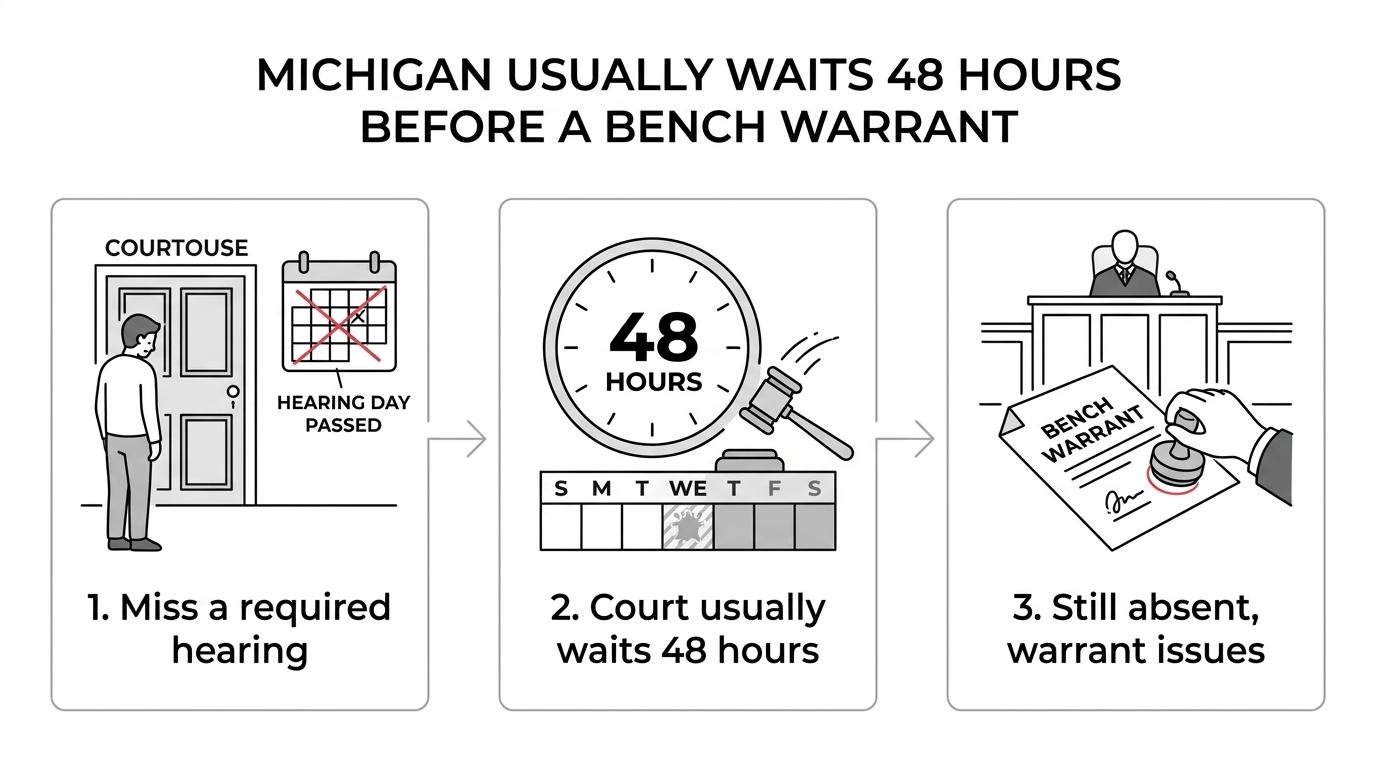
- Michigan usually requires a 48-hour waiting period before a bench warrant issues after a missed appearance, excluding weekends and holidays when the court is closed, but courts can issue immediately in limited situations.
- If you voluntarily present yourself within one year of the warrant’s issuance, Michigan court rules may allow arraignment or recall instead of leaving the warrant active.
- Ben Hall Law often explains that waiting is risky because an active warrant can lead to arrest, later bond forfeiture after the delay period, and possible driver’s license consequences in some traffic cases.
- A missed court date does not always mean the same outcome: assaultive-crime and domestic-violence cases, sentencing hearings, danger concerns, and witness issues can change the court’s response.
That means your next step should be practical, not emotional. If you missed court in East Lansing, Lansing, or elsewhere in Michigan, the fastest path is usually to find out exactly what the court did, what rule applies to your case, and whether you still have a window to fix the problem before police contact you.
What is a bench warrant in Michigan?
A Michigan bench warrant is a judge’s order directing law enforcement to bring you before the court, usually after you missed a required appearance. In places like 54B District Court in East Lansing, it can start from a misdemeanor, traffic matter, or probation violation.
A bench warrant is different from the kind of arrest warrant people picture after a police investigation. It usually grows out of something that happened in court, not out of a new charging decision by police or prosecutors. If you failed to appear, failed to comply with a court order, or sometimes failed to pay as ordered, the judge may respond by issuing a bench warrant to get you back into court.
A common misconception is that bench warrants only happen in serious felony cases. That is false. In Michigan, even a lower-level matter can turn into a warrant problem if you miss the wrong hearing. For students near MSU, that can mean an OWI, MIP, disorderly conduct, or ordinance-related case. For working adults commuting between Lansing and the State Capitol area, it can start with a traffic-related appearance.
Does Michigan always issue a bench warrant immediately after you miss court?
No. Under Michigan Court Rule 6.103 and MCL 764.3, courts usually wait 48 hours before issuing a bench warrant after a missed appearance, though assaultive or domestic-violence cases and other urgent situations can justify immediate issuance.
This is one of the most important Michigan-specific rules. In many first-failure-to-appear cases, there is a rebuttable presumption that the court must wait 48 hours before issuing the bench warrant. That period excludes weekends and holidays when the court is closed. During that short delay, the court generally may not revoke your release order or forfeit your bail money or surety bond forfeited.
The rule has real exceptions. A judge may issue the warrant sooner if the court puts a specific articulable reason on the record. Examples include a new crime, danger to a person or property, prosecution witnesses who are already present, a sentencing hearing, or other compelling circumstances. Assaultive-crime and domestic-violence cases can also fall outside the normal delay rule.
“Ben Hall Law notes that a missed Michigan court date can leave an arrest warrant active until it is resolved.”
If you do not appear after the 48-hour period, the court generally must issue a bench warrant unless there is good reason to schedule a further hearing instead. In some cases, the judge may use an order to show cause rather than a bench warrant. That is better than an active warrant, but it still means you need to respond quickly.
What are the 6 most important facts about resolving a bench warrant in Michigan?
The key facts are simple: Michigan gives many first-time nonappearance cases a short grace period, but that window closes fast. Your best chance to resolve a bench warrant is early action, proof of why you missed court, and a plan for recall or voluntary presentment.
The six facts below are the ones that usually change outcomes.
- Michigan often uses a 48-hour waiting period before issuing a bench warrant after a first missed appearance.
- That delay usually excludes weekends and holidays when the court is closed.
- Courts can issue the warrant sooner if they state a specific articulable reason on the record.
- After the delay expires, the court generally must issue the warrant unless it has good reason to set another hearing.
- A judge may choose an order to show cause instead of a bench warrant in some situations.
- If you voluntarily present yourself within one year of the warrant’s issuance, Michigan rules may allow arraignment or recall rather than leaving the warrant unresolved.
Those facts matter because they shift the question from “Will this blow over?” to “What procedure applies to me right now?” A common mistake is assuming all missed dates are treated the same. They are not.
flowchart TD
A[Missed court date] --> B{First failure to appear?}
B -->|Usually yes| C[48-hour waiting period]
C --> D{Any immediate-issue exception?}
D -->|Yes| E[Bench warrant may issue now]
D -->|No| F[Wait 48 hours excluding closed weekends and holidays]
F --> G{Did you appear?}
G -->|Yes| H[Case returns to court calendar]
G -->|No| I[Bench warrant or order to show cause]
What should you do in the first 24 hours after missing court?
Your first 24 hours matter most. If you confirm the court, learn whether a warrant has issued, and prepare for recall or voluntary appearance before the window closes, you keep more options than someone who waits a week.
Start with the basics. You need the court name, case number, date missed, and the exact type of hearing. Missing a pretrial, probation review, or sentencing date can produce very different responses from the judge.
Then move in this order:
- Confirm the court: Check whether the case is in district court, circuit court, or another court, and whether the hearing was criminal, traffic, probation, or sentencing.
- Call the clerk quickly: Ask whether a bench warrant has already issued, whether the judge set a new hearing, or whether an order to show cause was entered.
- Save your proof: Hospital records, flight delays, jail records, military orders, or screenshots of a notice problem can help explain the nonappearance.
- Do not volunteer facts about the case: The clerk can tell you scheduling information, but that is not legal advice, and you should not use the call to explain guilt or innocence.
- Get a legal plan in place: If the warrant is active or likely to issue soon, your next step should be recall strategy, voluntary presentment, or controlled surrender.
A useful tip here is simple: ask for information, not mercy, when you call the court. Clerks handle dockets, not defense arguments.
Should you turn yourself in or ask the court to recall the warrant?
Usually, asking the court to recall the warrant is better than blind self-surrender, but the right choice depends on the charge, the judge, and local procedure. Ben Hall Law treats that decision as a risk calculation, not a reflex.
If the missed hearing involved a low-level matter and you have a credible reason for the absence, a recall request may be the smarter first move. If the court is willing to put the matter back on calendar, you may avoid the shock of an arrest at home, at work, or during a stop on I-496 or US-127.
If the hearing was for sentencing, involved an assaultive offense, or came after repeated nonappearances, recall may be harder. In that situation, a planned surrender can still be better than getting arrested unexpectedly while driving past Grand River Avenue or on your way to work at Sparrow or on MSU’s campus.
“Ben Hall Law uses former prosecutor and former police officer insight when evaluating whether warrant recall is realistic or whether a controlled surrender is safer.”
The biggest mistake is walking into court or a police station without knowing whether bond will be addressed the same day. If the judge is likely to arraign you on the warrant immediately, your plan should include transportation, work coverage, medication needs, and someone who knows where you are.
How does voluntary presentment within one year work in Michigan?
Voluntary presentment within one year can be a real solution in Michigan, but it does not erase the warrant automatically. It creates a rule-based path for the issuing court to address the warrant through arraignment or recall.
Michigan procedure gives you a meaningful reason to act before police find you. If you voluntarily present yourself or appear through the proper court process within one year of the warrant’s issuance, the court may be able to handle the matter in a more controlled way.
Here is how that usually works:
- You verify the issuing court, the warrant status, and the date the warrant was issued.
- You arrange the appearance correctly, which may mean appearing in person, appearing with counsel, or following the court’s recall procedure.
- The court decides whether to arraign you on the warrant, recall the warrant, reset the case, or take another procedural step.
The key point is that “within one year” is not an expiration rule. It does not make the warrant disappear. It gives you a better procedural position than someone who stays missing and forces officers to execute the warrant later.
flowchart LR
A[Warrant issued] --> B[Voluntary presentment]
B --> C{Within one year?}
C -->|Yes| D[Arraignment or recall may be available]
C -->|No| E[Warrant remains active until resolved]
D --> F[Case returns to court process]
What happens to bond, bail, and your driver’s license if the warrant stays active?
An active bench warrant can cost you more than one court date. In Michigan, it can lead to arrest, later bond forfeiture, and in some traffic matters, Secretary of State license problems until the case is brought back under control.
One detail people miss is timing. When the court is still inside the initial 48-hour delay period, it generally may not revoke the release order or declare bail money or surety bond forfeited. After that, the situation can change fast if the warrant issues and you still do nothing.
Traffic-related matters can create another layer of damage. If the missed appearance is connected to a traffic offense, your driver’s license may be affected until the court problem is cleared. If you drive daily from Haslett, Okemos, or Dewitt into Lansing or East Lansing, that can become more disruptive than the original citation.
A common misconception is that paying old fines online will automatically fix the warrant. It usually will not. The court still needs to address the missed appearance itself.
How can a lawyer help resolve a bench warrant before an arrest happens?
A lawyer can often reduce the surprise and risk around a bench warrant by checking court records, raising recall options, and planning any required appearance. Ben Hall Law applies criminal-process insight early because timing changes outcomes in missed-court cases.
You do not hire a lawyer just to “talk to the judge.” You hire one to identify which Michigan rule controls your case, what the judge is allowed to do next, and what facts will actually matter.
That often means working through a sequence like this:
- Rule check: Identify whether the 48-hour waiting rule, an exception, or a voluntary-presentment option applies.
- Court contact: Confirm warrant status, hearing history, bond history, and whether the court uses a recall process.
- Risk planning: Decide between recall request, planned appearance, or controlled surrender based on the charge and local procedure.
- Presentation: Bring records that explain the missed date and reduce the chance the court treats it as intentional avoidance.
- Protection: Limit unnecessary statements that could hurt the underlying criminal case.
If your case started with an OWI, assault allegation, student offense, or probation issue, this matters even more. The warrant is only one problem. The underlying case is still there, and how you resolve the warrant can affect bond, credibility, and the court’s view of your reliability going forward.
FAQ: What do people ask most about Michigan bench warrants?
Most bench-warrant questions come down to timing, arrest risk, and whether you can fix the problem before being picked up. The good news is that Michigan procedure gives you more than one way to bring the case back in front of the judge.
Can a bench warrant go away on its own?
Usually no. A bench warrant stays active until the court recalls it, quashes it, or resolves it through your appearance and the court’s order.
Will police arrest you during a traffic stop?
They can. If the warrant is active in the system, even a routine stop can turn into an arrest. That is one reason waiting is rarely the smart option.
Can you fix a bench warrant before being arrested?
Yes, sometimes. If you act quickly, the court may allow a recall request, an order to show cause route, or voluntary presentment within the proper timeframe.
What if you missed court because of an emergency?
That can help, but only if you document it and present it properly. Hospital records, custody records, travel disruptions, or proof of lack of notice can matter.
Does a bench warrant mean you lose the criminal case?
No. A bench warrant addresses your failure to appear, not whether you are guilty of the original charge. Still, it can make bond and case strategy harder if you let it sit.
What if your missed hearing was in East Lansing near MSU?
Then act fast and confirm whether the matter is in 54B District Court or another court. Student cases can affect more than the charge itself, including housing, scholarships, campus discipline, and your record.