


If you are searching for “750.812 domestic violence” in Michigan, you are usually trying to identify the statute behind a domestic violence arrest or charge. At Ben Hall Law, this confusion comes up often because Michigan domestic assault law is typically discussed under MCL 750.81(2) and related repeat-offense and aggravated-assault provisions in Chapter 750.
TL;DR: Summary
- If you mean 750.812 domestic violence, the Michigan statutes you usually need to review are MCL 750.81(2) for domestic assault and MCL 750.81a(2) for aggravated domestic assault.
- A first domestic assault under MCL 750.81(2) is generally a 93-day misdemeanor with up to a $500 fine, but repeat convictions can rise to 1 year in jail or a 5-year felony under MCL 750.81(4) and (5).
- The relationship element matters: spouse, former spouse, dating partner, person with a child in common, or a current or former household resident can bring an assault into the domestic-violence category.
- Michigan arrest procedure gives police added authority in qualifying domestic-violence cases, and a conviction can trigger federal firearm restrictions beyond the state sentence.
- For first-time defendants, Ben Hall Law often evaluates whether a case may qualify for a deferred proceeding under MCL 769.4a, because the charge label alone does not tell you the full risk or the full range of options.
The details matter because a domestic violence case affects more than one court date. In East Lansing, Lansing, Okemos, Haslett, and around Michigan State University, the right question is not just what the statute says, but how the charge, relationship category, prior record, bond terms, and collateral consequences fit together.
What does “750.812 domestic violence” usually mean in Michigan?
It usually refers to Michigan domestic assault law under MCL 750.81(2) or aggravated domestic assault under MCL 750.81a(2). Ben Hall Law often sees this citation mix-up because Chapter 750 contains several related assault statutes, and online searches frequently compress them into the wrong number.
The safest way to read the issue is this: Michigan courts and the Michigan Judicial Institute treat domestic assault as part of the assault statutes in Chapter 750, with repeat-offense enhancements and separate arrest procedures layered on top. If you were arrested after an incident near Grand River Avenue, in an East Lansing apartment, or off campus in Ingham County, the exact citation on the complaint matters.
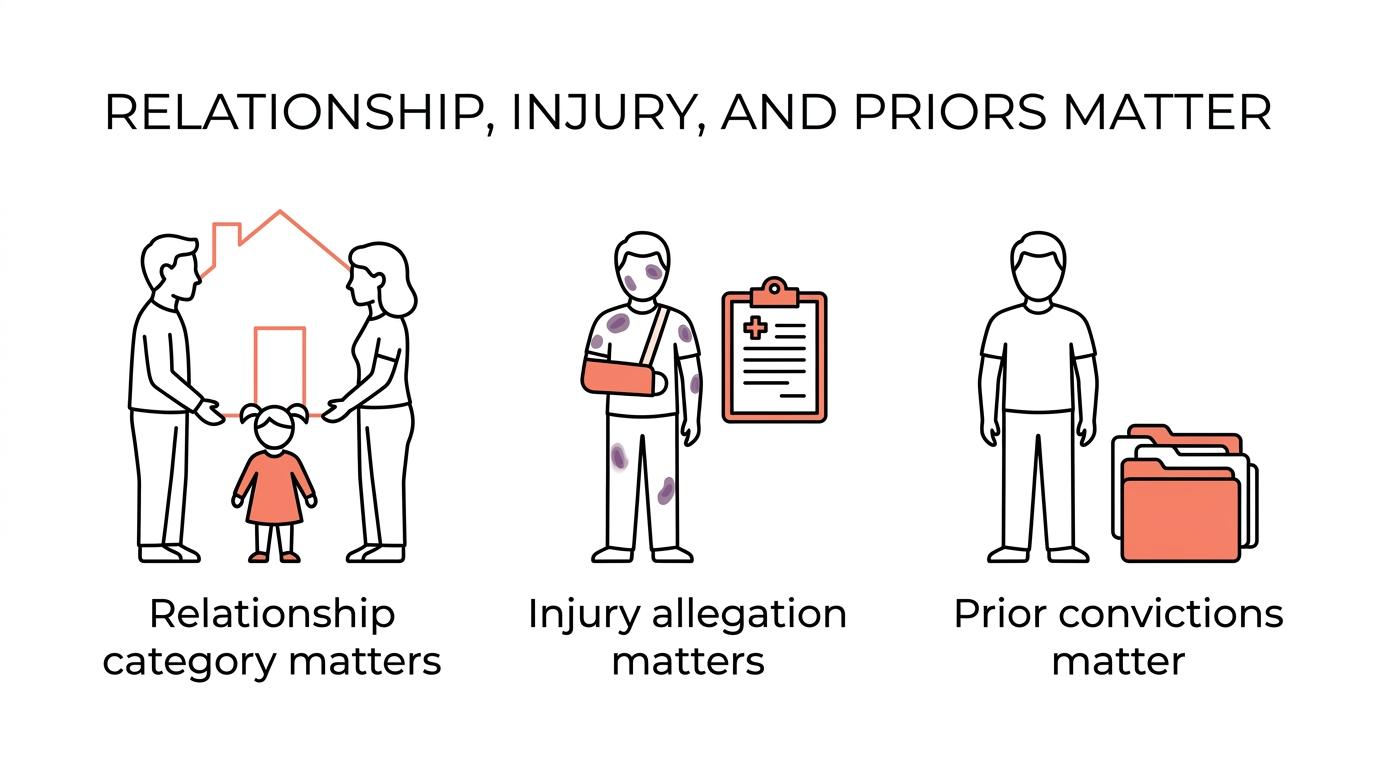
A common misconception is that one number tells you the whole case. It does not. You also need to know whether the prosecutor is alleging a qualifying domestic relationship, whether there is an injury claim, and whether there are prior convictions.
flowchart TD
    A["Search term: 750.812 domestic violence"] --> B["MCL 750.81(2): domestic assault"]
    A --> C["MCL 750.81a(2): aggravated domestic assault"]
    B --> D["First offense: up to 93 days / $500"]
    B --> E["Repeat offense rules: MCL 750.81(4) and (5)"]
    C --> F["More serious injury allegations"]
What conduct does MCL 750.81(2) actually criminalize?
MCL 750.81(2) covers assault or assault and battery when the alleged victim fits one of Michigan’s domestic relationship categories. The Michigan Judicial Institute states that a first offense is generally a misdemeanor punishable by up to 93 days in jail, a $500 fine, or both.
That means the state does not only look at whether there was an argument. It looks at whether the alleged act qualifies as assault or assault and battery and whether the people involved had the kind of relationship the statute recognizes. In practice, that can include incidents between current partners, former partners, co-parents, or people who lived in the same household.
“Ben Hall Law starts by reviewing how the investigation was conducted, how evidence was gathered, and whether the process was followed correctly.”
If you are a student at MSU or a parent searching late at night after an arrest, do not assume a low-level misdemeanor is minor. Even when the maximum sentence looks limited on paper, the label and collateral consequences can outlast the jail exposure.
What are the 6 key facts about Michigan domestic violence charges?
The six most important facts are the statute, the relationship categories, the first-offense penalty, the repeat-offense escalation, the arrest rules, and the federal firearm risk. If you know those six points, you can read most domestic violence complaints much more clearly.
- Base statute: Michigan domestic assault is commonly charged under MCL 750.81(2).
- Relationship categories: The statute applies to a spouse or former spouse, a current or former dating partner, a person with a child in common, or a resident or former resident of the same household.
- First-offense penalty: A first offense is generally a misdemeanor with up to 93 days in jail and up to a $500 fine.
- Repeat-offense enhancement: Under MCL 750.81(4), a repeat offense can become a 1-year misdemeanor, and under MCL 750.81(5) a later repeat offense can become a 5-year felony.
- Arrest procedure matters: Michigan law gives officers special authority for qualifying domestic-violence arrests, including warrantless arrest authority under statutes that include MCL 764.15a and MCL 764.9c.
- Federal law can attach: A qualifying misdemeanor crime of domestic violence can trigger a federal ban on receiving or possessing firearms or ammunition.
How do prosecutors decide whether a relationship qualifies as domestic?
Prosecutors look first at the statutory relationship categories, then at the facts showing how you and the other person were connected. In dating cases, the label “boyfriend” or “girlfriend” helps, but the underlying facts still matter.
Michigan law recognizes four core categories under MCL 750.81(2). The easiest cases are often spouse, former spouse, or child-in-common cases because the relationship is straightforward. The harder cases often involve former roommates, off-campus housing, or dating relationships that were short, inconsistent, or disputed.
The Michigan State Police legal update describes a dating relationship as a frequent, intimate association primarily characterized by the expectation of affectional involvement. That matters in places like East Lansing, where students may share housing, rotate apartments between semesters, or dispute whether a relationship was casual or ongoing.
A common misconception is that a single date automatically makes every later argument a domestic violence case. It can be more complicated than that. If the relationship category is weak, that issue can become a major defense point.
What penalties can you face for first, second, and later offenses?
Michigan penalty exposure rises fast. A first offense under MCL 750.81(2) is up to 93 days, a second qualifying offense under MCL 750.81(4) is up to 1 year, and a later qualifying offense under MCL 750.81(5) can be charged as a felony punishable by up to 5 years.
If you have no qualifying prior conviction, you are generally looking at the base misdemeanor range. If you have one qualifying prior, the prosecutor may charge the enhanced misdemeanor. If you have the required repeat history, the case can move into felony territory, which changes everything from bond pressure to long-term record impact.
One practical point: the complaint and criminal history review have to match the enhancement being alleged. Do not assume the prosecutor’s first version of your record is the final word.
graph LR
    A["1st offense
    MCL 750.81(2)
    Up to 93 days / $500"] --> B["2nd offense
    MCL 750.81(4)
    Up to 1 year / $1,000"]
    B --> C["Later repeat offense
    MCL 750.81(5)
    Felony up to 5 years / $5,000"]
How is aggravated domestic assault different from basic domestic violence?
Aggravated domestic assault under MCL 750.81a(2) is a different charge from basic domestic assault under MCL 750.81(2). The difference usually turns on the seriousness of the alleged injury, not just the fact that the parties had a domestic relationship.
This is where people get tripped up. Basic domestic assault is the standard misdemeanor domestic-relationship assault offense. Aggravated domestic assault sits in a separate statute in Chapter 750 and is tied to more serious injury allegations. If police photographs, medical records, or witness statements suggest a more substantial injury claim, the prosecutor has a different charging option.
A common misconception is that no broken bone means no aggravated charge. That is too simplistic. Injury severity is fact-specific, and the charging decision often depends on how the state packages the evidence.
What happens after a domestic violence arrest in East Lansing or Lansing?
The usual sequence is arrest, booking, arraignment, bond conditions, prosecutor review, and pretrial dates. If the incident happened in East Lansing, your case may begin in 54B District Court, while other Lansing-area cases may start in a different district court based on location.
After arrest, you can expect the process to move quickly:
- Booking and release decision: Police document the allegation, identify the relationship claimed, and decide whether to hold you for arraignment.
- Arraignment: The judge advises you of the charge, maximum penalties, and bond conditions. No-contact orders are common.
- Pretrial stage: The prosecutor provides the charging theory and begins discussing possible resolution or further litigation.
- Evidence review: This is where reports, body camera footage, 911 calls, photographs, and text messages often become central.
A pro tip is simple: obey every bond term exactly as written. Many defendants get into deeper trouble by thinking informal contact is fine if the other person starts it.
How can a first-time offender seek a deferral under MCL 769.4a?
A first-time domestic violence defendant may be eligible for a deferred proceeding under MCL 769.4a, but it is not automatic. Ben Hall Law reviews this option closely because first-offense strategy often turns on whether you can avoid a standard judgment path.
The Michigan Judicial Institute notes that first-time offenders under MCL 750.81(2) may qualify for deferred proceedings. In practical terms, that means the court may have a way to handle the case differently from a straight conviction and sentence, subject to legal eligibility and judicial approval.
Do not confuse eligibility with entitlement. A common mistake is assuming that being charged as a first offender guarantees a deferral. It does not. The court, prosecutor position, prior history, facts of the incident, and your compliance all matter.
If you were arrested in a college-town setting, this issue can be especially important because a student at MSU are often worried about records, internships, graduate school, housing, and campus discipline.
Why can a misdemeanor domestic violence conviction affect firearm rights?
Because federal law can attach to a qualifying misdemeanor crime of domestic violence, even when the state sentence looks limited. The ATF states that a qualifying conviction generally bars firearm or ammunition receipt or possession in or affecting commerce.
This is one of the biggest trade-offs in plea decisions. Michigan may treat the charge as a misdemeanor, but federal law may treat the resulting conviction as a disqualifying domestic violence offense. The ATF also explains that the federal prohibition can apply even if the offense is not literally named “domestic violence,” so long as the statutory elements and relationship requirements are met.
“Ben Hall Law prepares every criminal case as though it is going to trial, which matters when a misdemeanor plea can carry consequences beyond the local court sentence.”
Another detail many people miss is the dating-partner expansion in federal law for convictions on or after June 25, 2022. If your case involves a current or recent dating partner, you should assume firearm consequences need to be analyzed directly, not guessed at.
What should you do in the first 24 hours after a domestic violence arrest?
You should protect your case immediately by preserving evidence, following bond rules, and getting legal guidance fast. The first day often shapes the entire file, especially when police reports are still being finalized and witnesses are still being interviewed.
Use this checklist:
- Read the charge carefully: confirm whether the complaint cites MCL 750.81(2), MCL 750.81a(2), or a repeat-offense enhancement.
- Follow no-contact terms exactly: do not call, text, message through friends, or show up at the home unless the court order allows it.
- Preserve your evidence: save texts, call logs, photos, ride-share receipts, location data, and names of witnesses near the scene.
- Write a private timeline: record where you were, who was present, and what happened before memories shift.
- Prepare for the next court date: if your arrest happened near MSU, downtown East Lansing, or a Lansing neighborhood, confirm the correct court and appearance date right away.
A pro tip here is to preserve digital evidence before devices are upgraded, reset, or lost. Small details often matter more than people expect.
What questions do people ask about 750.812 domestic violence in Michigan?
Yes, several recurring questions come up in nearly every Michigan domestic violence case, and the answers are often less intuitive than you expect.
Can the alleged victim drop the charge?
Not by themselves. The prosecutor controls the criminal case, even if the other person later says they do not want to continue.
Will an MSU student face school problems too?
Possibly. A criminal case and a university conduct process are separate systems. If you are a Michigan State student, you should think about both.
Does moving out fix a no-contact problem?
No. A bond order stays in effect until the court changes it. Your living arrangement does not override a judge’s order.
If we have a child in common, does the state still need a dating relationship?
No. A child in common is its own statutory relationship category under MCL 750.81(2).
Is a misdemeanor domestic violence plea “just a local case”?
No. Between repeat-offense exposure, bond conditions, employment screening, and possible federal firearm consequences, the effects can reach well beyond one courthouse in Ingham County.