


Michigan takes fishing seriously. That is no surprise in a state framed by four Great Lakes, packed with inland lakes, and crossed by rivers that pull anglers to places like the Au Sable near Grayling, the Detroit River, Lake St. Clair, the Grand River in Lansing, and the salmon runs near Ludington and Manistee. If you fish anywhere from Traverse City to Marquette, or even around Lake Lansing after class at [Michigan State University](https://www.benhalllaw.com/michigan-state-university/), you need to know that some fishing violations are more than a ticket.
A lot of anglers assume every DNR citation is minor. That is a risky assumption. In Michigan, some violations are treated as state civil infractions, while others can become misdemeanors with fines, license consequences, restitution, and even [jail exposure](https://www.benhalllaw.com/how-can-you-bail-someone-out-of-jail-in-michigan/). If a conservation officer believes you used an illegal method, intentionally snagged fish, or ignored method restrictions, your case can move fast from a frustrating day on the water to a criminal case in court.
Published: July 28, 2026
By: Ben Hall | Attorney and Owner of Ben Hall Law | Marine Corps and Iraq War Veteran | Former Police Officer | Former Prosecutor
Why some Michigan fishing violations become criminal charges
Michigan fishing law does not treat every mistake the same way. The biggest divide is usually between paperwork-type issues and conduct that looks intentional, method-based, or harmful to the resource. That means your legal risk often turns on what you were doing, how you were doing it, what gear you had, and what an officer believes you intended to catch.
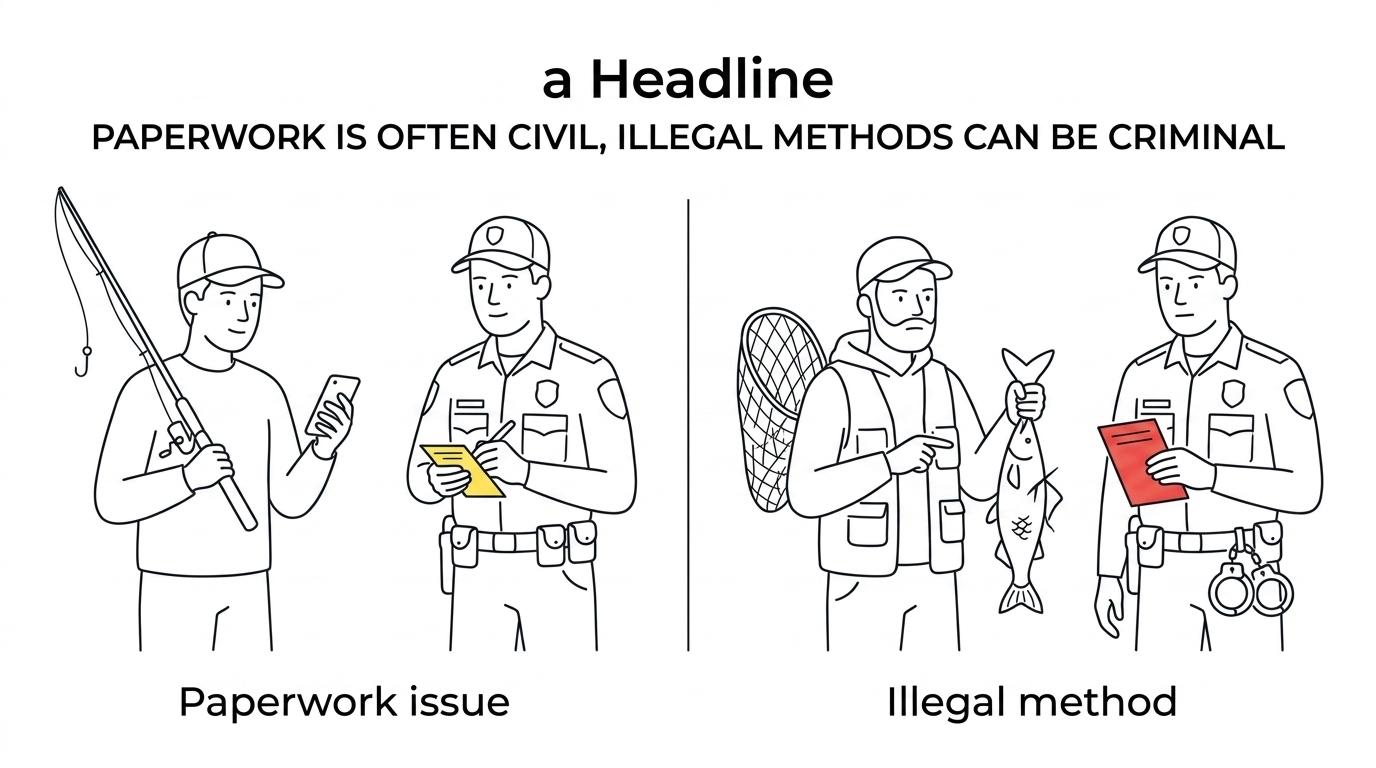
That distinction matters because Michigan’s Natural Resources and Environmental Protection Act and DNR enforcement rules give officers and prosecutors room to separate a simple license issue from conduct they see as unlawful taking of fish. If your case involves prohibited gear, repeated snagging, or fishing in a way the rules clearly forbid, you may be facing a misdemeanor rather than a civil ticket.
You should pay close attention to violations in these categories:
- License or proof-of-license problems
- Gear and method restrictions
- Snagging allegations
- Chumming in prohibited waters
- Repeat offenses
- License revocation and restitution issues
Michigan fishing violations: civil infraction vs misdemeanor
If you are 17 or older, Michigan generally requires a fishing license when you are targeting fish, amphibians, crustaceans, or reptiles in public waters. Adults who are actively assisting a minor also need a license. Those rules catch more people than you might think, especially during family trips to spots near Holland State Park, the St. Joseph River, or the riverfronts around Grand Rapids and Metro Detroit.
Still, not every license problem is a criminal case. Some are commonly treated as state civil infractions. The higher-risk cases usually involve the way fish were taken, not just whether your paperwork was perfect. That is the line many anglers miss.
| Michigan fishing issue | Likely legal treatment | Main risk to you |
|---|---|---|
| No valid fishing license or no proof readily available | Often a state civil infraction | Fine, court costs, lost time |
| Adult assisting a minor without a required license | Enforcement action, often license-based | Citation and added scrutiny |
| Chumming where prohibited on inland stream types or gear-restricted streams | Can become more serious based on location and method | Citation, evidence of unlawful method |
| Taking fish by illegal method or with prohibited gear | Misdemeanor | Up to 90 days in jail and a $250 to $1,000 fine under DNR penalty guidance |
| Snagging fish | Misdemeanor exposure | Criminal charge, fines, suspension risk |
| Repeat snagging offense | More severe misdemeanor consequences | Higher fines and at least a 2-year suspension on a second offense |
If you remember one point, make it this: intentional or method-based violations usually bring the most criminal risk in Michigan.
Illegal fishing methods that trigger Michigan criminal charges
Michigan’s DNR penalty guidance identifies illegal methods as a major problem area. Taking fish by illegal method, including using dynamite, nitroglycerin, lime, electricity, poison, or unauthorized nets, is listed as a misdemeanor punishable by up to 90 days in jail and a fine between $250 and $1,000. That is not a minor enforcement issue. It is a criminal charge.
Most anglers will never be anywhere near conduct that extreme, but the lesson is bigger than the examples. If the method itself is prohibited, the case gets serious fast. In practice, officers look closely at the setup, the hook placement, the line movement, the gear on hand, and what was happening in that waterbody at that time of year. A stop near a spawning run on a crowded river can turn on small details.
The annual Michigan fishing regulations also matter in quieter ways. Chumming is prohibited on all inland stream types and gear-restricted streams. You may think of chumming as harmless, yet a prohibited method in a restricted location can give the state a stronger theory than a simple technical mistake. Location matters. So does season. So does whether your conduct looks accidental or deliberate.

Michigan snagging charges and repeat-offense penalties
Snagging is one of the clearest examples of a fishing violation that can become a criminal case. Michigan treats snagging as a misdemeanor offense, and repeat cases carry much steeper consequences. Under DNR penalty guidance, a second snagging offense can bring up to 90 days in jail, a $500 to $1,000 fine, and at least a 2-year fishing license suspension. A third or later offense carries at least a 3-year suspension.
That penalty structure tells you how the state views the conduct. Prosecutors and conservation officers often see snagging as intentional, unfair, and damaging to the fishery. If the allegation is that you repeatedly jerked the line into fish rather than lawfully hooking them in the mouth, your own statements can become key evidence. What you said on the bank at Tippy Dam, along the Muskegon River, or beside the piers in St. Ignace may matter just as much as the fish itself.
One citation can be expensive. A repeat offense can disrupt years of fishing plans.
Michigan fishing license violations and common paperwork mistakes
A lot of Michigan anglers get into trouble for reasons that feel ordinary. You bought a license online but cannot pull it up. You assumed your annual license still ran on a calendar year. You were helping your child land fish and did not realize active assistance could trigger the license rule. You came from out of state to fish near Sleeping Bear Dunes, Saginaw Bay, or Monroe and guessed the rules were basically the same as back home.
Michigan’s annual fishing license generally runs from March 1 through March 31 of the following year. That timing trips up people every spring. The DNR also allows reprinting of many license items through an eLicense account or at a license agent. If you purchased online, you should make sure your proof is accessible and in your immediate control when you are on the water.
These cases may sound minor, and many are. Still, a civil infraction can turn into a bigger problem if you ignore it, skip court, or pile it on top of another allegation. Once an officer starts looking at your license, cooler, tackle, and statements, the stop may widen beyond the original issue.
What happens after a Michigan DNR fishing citation or misdemeanor charge
A fishing case usually starts with contact from a conservation officer, a citation, or a court date. If the allegation is criminal, the case may move through the district court in the county where the incident happened. That could be near Alpena, in the Upper Peninsula, around Bay City, or closer to home in Mid-Michigan if the event happened around the Grand River or Lake Lansing.
The next phase often includes a court date, possible arraignment, plea discussions, and a review of the evidence. In a misdemeanor fishing case, the key questions are often practical. What was the exact method used? What did the officer observe? Where was the fish hooked? Was the water subject to special regulations? Was your conduct intentional, or is the state stretching a split-second event into a criminal theory?
You also have to watch the consequences beyond the fine. Some fisheries violations can carry license revocation or suspension, restitution, and other financial penalties. In some cases, a judgment fee gets added on top of the base sanction. If you are a college student, a commercial driver, or someone whose time off is built around fishing seasons, those collateral effects hit hard.
How to protect yourself during a Michigan DNR stop
Your best move is simple: take the contact seriously and do not try to outtalk it.
Conservation officers are trained observers. A casual joke, a quick excuse, or an angry explanation can become part of the case. If there is any chance the officer believes you used illegal gear, intentionally snagged fish, or violated a restricted-water rule, you should act like the stop matters, because it does.
- Stay calm: Answer basic identification questions without turning the stop into a debate on the riverbank.
- Protect your words: Statements matter. Comments about what you were “really targeting” or how you hooked the fish can become evidence.
- Document the scene: Photos matter. If it is safe, note the waterbody, nearby marker, gear setup, and who was present.
- Get legal help early: A misdemeanor fishing charge is still a criminal case, even if it started during a weekend trip.
Michigan fishing cases often turn on intent and evidence
From a defense perspective, many of these cases are not about whether a person was fishing. They are about whether the state can prove unlawful intent, prohibited method, or a repeat violation with reliable evidence. That makes details matter. Photos matter. Statements matter. The actual regulation in place on that body of water matters.
If you were cited near a highly watched area like the Detroit River walleye run, the Platte River, or a packed salmon access point on Lake Michigan, you should assume the officer is used to seeing the same defenses and the same mistakes. That does not mean the state is always right. It means you need to treat the case with care.
FAQ about Michigan fishing violations and criminal charges
Can you go to jail for a Michigan fishing violation?
Yes, some Michigan fishing violations carry jail exposure. The clearest examples are illegal take methods and certain repeat offenses. DNR penalty guidance lists taking fish by illegal method as a misdemeanor punishable by up to 90 days in jail.
Is fishing without a license always a criminal offense in Michigan?
No. License-related problems are often handled as civil infractions rather than criminal misdemeanors. That said, you should not assume every ticket is harmless. The facts of the stop may lead the officer to investigate other issues.
Does snagging count as a crime in Michigan?
It can. Michigan treats snagging as a misdemeanor offense, and repeat cases bring sharper penalties. A second offense can include up to 90 days in jail, a $500 to $1,000 fine, and at least a 2-year fishing license suspension.
What if you bought your Michigan fishing license online but cannot find it?
You should try to reprint it through your DNR eLicense account or get help from a license agent as soon as possible. Keeping proof available matters. If an officer asks for it on the water, scrambling to locate it can complicate what might otherwise stay a minor issue.
Can a Michigan fishing case affect your license privileges?
Yes. Some violations bring automatic or discretionary license consequences. Repeat snagging allegations are a strong example, because later offenses carry lengthy suspensions. A case can also involve restitution and other financial penalties.
Do out-of-state anglers and college students have to follow the same Michigan fishing rules?
Yes. If you are fishing Michigan public waters, the rules apply to you whether you live in East Lansing, visit from Ohio, or came north for a weekend near Traverse City. That includes Michigan State University students fishing the Grand River or Lake Lansing. Local status does not create an exception.