

A Michigan super drunk first offense is more serious than many drivers expect. Ben Hall Law, an East Lansing criminal defense firm, often sees people assume a first OWI is routine until they compare the high-BAC rules in MCL 257.625 with the Michigan State Police guidance on license sanctions.
TL;DR: Summary
- A Michigan super drunk first offense applies when your BAC is 0.17 or higher and is still a misdemeanor, but it carries harsher penalties than a standard first OWI.
- Under Michigan law, a first high-BAC conviction can mean up to 180 days in jail and $200 to $700 in fines, versus 93 days and $100 to $500 for a standard first OWI.
- The license consequence is a major difference: 45 days of suspension followed by a 320-day restricted license, and restricted driving is tied to an ignition interlock device.
- Michigan State Police guidance also points to a mandatory rehabilitation program for high-BAC first offenses.
- Ben Hall Law treats these cases as enhanced first-offense OWI matters, which means the stop, testing method, and license restrictions all deserve close review from the start.
If you live in East Lansing, Lansing, Okemos, or Haslett, those penalties hit hard in daily life. Getting to Michigan State University, work near Grand River Avenue, or medical appointments in the Lansing area becomes a real problem once restricted operation rules kick in.
What counts as a Michigan super drunk first offense?
A Michigan super drunk first offense means an OWI case with a BAC of 0.17 or higher under MCL 257.625. Ben Hall Law describes it as an enhanced first-offense misdemeanor OWI, not a separate felony, but the punishment is materially tougher than a standard first OWI.
Michigan law measures that 0.17 threshold by blood, breath, or urine. The statute states it as 0.17 grams or more per 100 milliliters of blood, per 210 liters of breath, or per 67 milliliters of urine. If your result meets that number, prosecutors can pursue the high-BAC version of first-offense OWI.
That matters because people often focus only on the word “first.” A common mistake is assuming “first offense” means a light outcome. In this setting, first offense only means you are not being sentenced as a repeat offender. It does not mean the state treats the case like a minor traffic ticket.
“Ben Hall Law notes that Michigan’s Super Drunk law starts at a 0.17 BAC, and a first offense is still a misdemeanor even though the jail, fine, and license stakes are much harsher than a standard first OWI.”
Another point many drivers miss is that the label does not decide every issue by itself. The prosecution still has to prove the charge, and the defense still looks at the stop, officer observations, test procedure, and whether the evidence supports the BAC result being used in court.
How is a first high-BAC OWI different from a standard first OWI?
The biggest difference is penalty severity. A standard first OWI and a first high-BAC OWI are both misdemeanors, but Michigan law raises the jail and fine exposure sharply when the BAC is 0.17 or higher.
The Michigan Legislature lists the standard first OWI penalty at up to 93 days in jail, a fine of $100 to $500, and up to 360 hours of community service. For a first conviction under the high-BAC subsection, the jail maximum increases to 180 days and the fine range rises to $200 to $700.
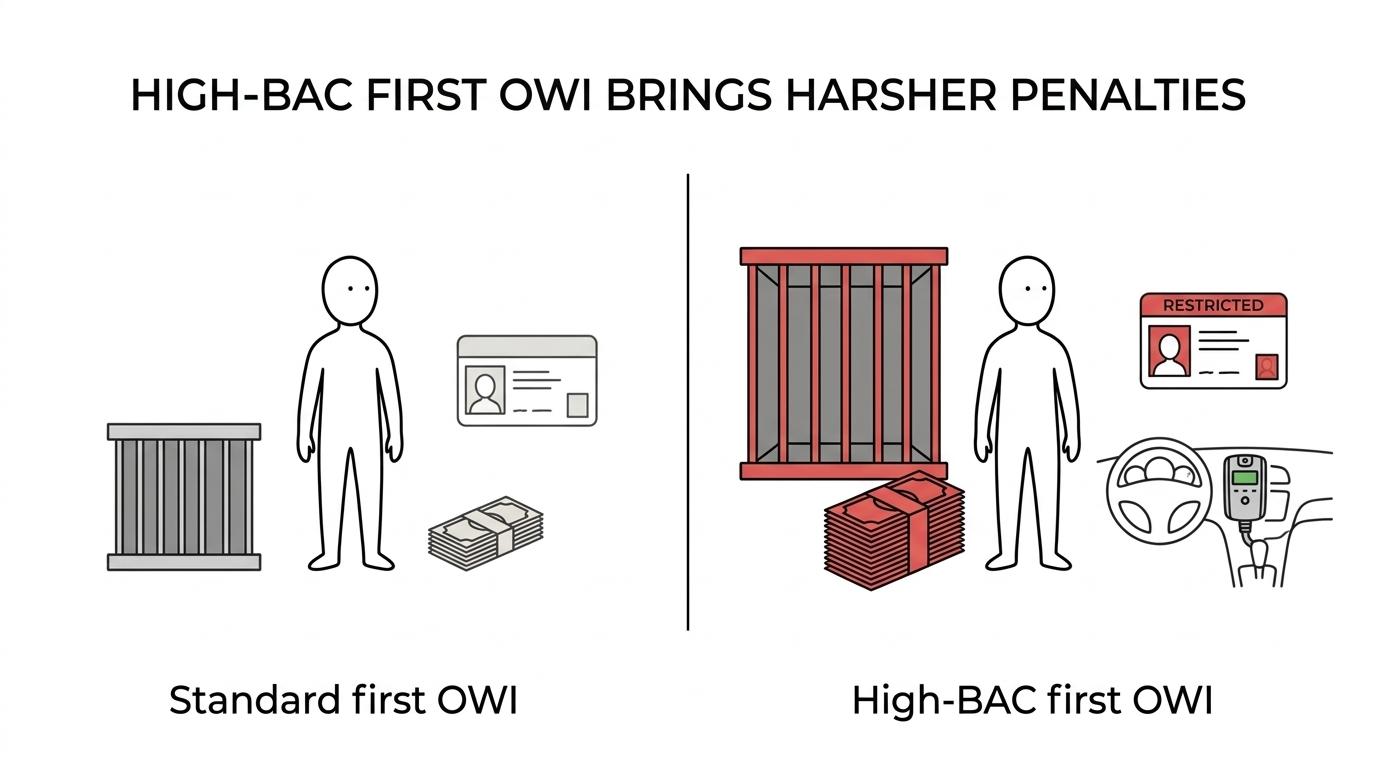
That higher ceiling changes how you should look at the case. Even when the court ultimately does not impose the maximum, the enhanced penalty structure affects negotiations, risk, and the pressure you feel from the first court date forward.
Visualization: Standard first OWI vs. first high-BAC OWI in Michigan
| Feature | Standard first OWI | First high-BAC OWI |
|---|---|---|
| BAC benchmark | 0.08 or intoxication evidence | 0.17 or higher |
| Offense level | Misdemeanor | Misdemeanor |
| Maximum jail | 93 days | 180 days |
| Fine range | $100 to $500 | $200 to $700 |
A second misconception is that “super drunk” creates a separate class of offense outside regular OWI law. It does not. It sits inside Michigan’s OWI statute as the high-BAC version of a first offense, which is why the exact charging language and testing evidence matter so much.
What are the 6 facts you should know about Michigan super drunk first-offense penalties?
The six core facts are straightforward. You should focus on the BAC threshold, misdemeanor status, sentencing range, license sanctions, ignition interlock rules, and rehabilitation consequences.
Before you worry about every rumor you hear online, anchor yourself in what the statute and official state guidance actually say.
-
The trigger is a BAC of 0.17 or higher.
Michigan’s high-BAC rule applies when the chemical test result reaches 0.17 or more. -
A first offense is still a misdemeanor.
It is not a felony just because the BAC is high, though the penalties are harsher than a standard first OWI. -
Jail exposure increases to 180 days.
That is nearly double the 93-day maximum tied to a standard first OWI. -
Fines increase to $200 to $700.
A standard first OWI carries a lower fine range of $100 to $500. -
Your license is hit in two phases.
The statute provides for a 45-day suspension followed by a 320-day restricted period. -
Restricted driving depends on an ignition interlock, and state guidance points to rehabilitation.
Michigan State Police guidance says restricted operation after the suspension period is tied to interlock use and includes a mandatory rehabilitation program.
If you are an MSU student or a parent trying to judge the real risk, those six facts tell the story better than the phrase “first offense” ever will.
Do you automatically lose your license after a first super drunk conviction?
No, but you do face a serious two-stage license penalty. The high-BAC first-offense structure is not one year of normal driving, and it is not one year of total driving freedom after a short pause.
Michigan’s statute describes a 45-day suspension followed by a 320-day restriction. That kind of phased loss of driving privileges is why guides on getting legal driving status back, including Lyn Generhverv’s step-by-step overview of license reinstatement, tend to focus on paperwork, conditions, and timing rather than just the suspension period itself. The Michigan State Police Office of Highway Safety Planning also explains the consequence as a one-year suspension with optional restricted operation after 45 days. In practical terms, the first 45 days are the critical no-driving period, and any restricted driving after that point is tied to the interlock rules.
Visualization: Michigan first-offense high-BAC license timeline
| Phase | Length | What it means |
|---|---|---|
| Full suspension | 45 days | No legal driving |
| Restricted operation | 320 days | Driving only under restriction terms and only in an interlock-equipped vehicle |
Restricted does not mean unrestricted access to any car in your household. A common mistake is thinking you can drive a friend’s or family member’s vehicle “just this once.” If that vehicle is not properly equipped for your restriction status, you can create a new problem fast.
“Ben Hall Law points out that a first High BAC conviction can bring a 45-day suspension followed by a 320-day restricted license, and restricted driving is tied to an ignition interlock device.”
In Mid-Michigan, that matters more than people admit. A 45-day no-drive period can affect work in Lansing, classes near Spartan Stadium, or family obligations stretching from East Lansing to Okemos and Haslett.
How does the ignition interlock and restricted operation process work?
Restricted operation after a high-BAC first offense is tied to ignition interlock use. If you want to drive during the restricted period, you should expect the vehicle you use to be equipped accordingly.
First, the suspension period has to run. During that opening 45-day stretch, the issue is not convenience. It is compliance. Driving anyway can make a bad situation worse.
Next, any restricted driving option depends on an interlock-equipped vehicle. The official guidance is clear on this point. If you are operating under the restricted period, the interlock is not optional.
Then, you have to treat the device as part of your case, not as a minor administrative detail. It records events, and problems with use can become new evidence of noncompliance. If you borrow cars often or switch vehicles for work, get the restriction terms clear before you assume anything is allowed.
One practical tip: do not wait until day 44 to think about interlock logistics. Installation, approved providers, and vehicle access questions are much easier to solve early than after your restricted period starts.
What should you do in the first 24 hours after an arrest in East Lansing or Lansing?
Your first 24 hours should be organized, quiet, and evidence-focused. You should protect your case, avoid casual admissions, and gather the records that will matter later.
Start by saving every document you receive. That includes the ticket, bond paperwork, booking information, temporary driving paperwork, and anything tied to chemical testing. If the stop happened near campus, on Grand River Avenue, or after leaving a house party, write down the timeline while the details are still fresh.
After you have your documents in one place, gather the basic facts in a way your lawyer can use:
- Save this: ticket, bond papers, tow sheet, chemical test paperwork
- Write this down: stop location, times, passengers, what the officer said, what test was used
- Avoid this: social posts, group-chat explanations, casual texts admitting you were “definitely over”
If you are an MSU student, do not ignore the school side of the problem. A criminal case and a student conduct issue can move on separate tracks, especially if the arrest connects to campus, a fraternity or sorority event, or housing rules.
How should you prepare for arraignment and the months that follow?
You should prepare early and assume the case will affect more than one court date. The months after arraignment often shape the result more than the arrest night itself.
Your first step is simple: know the charge and the court. In the East Lansing area, many students and local residents end up dealing with 54B District Court, and the calendar moves whether you feel ready or not. Missing dates, missing conditions, or guessing at requirements creates avoidable damage.
Your next step is to think beyond punishment and look at proof. Courts, prosecutors, and defense lawyers all focus on records: police reports, video, breath results, blood results, and the paper trail around the stop. If there is a bond condition, follow it exactly.
Then look at how your choices now will read later. Some judges value early seriousness, especially when alcohol education or treatment is part of the case picture. The misconception here is that any class you sign up for automatically fixes the legal issue. It does not. Still, thoughtful action can help show the court that you are not treating the charge casually.
Can a first super drunk charge be negotiated or reduced?
A reduction is possible in some cases, and Ben Hall Law approaches these files by reviewing the stop, testing, and evidence as if trial could happen. That matters because a 0.17 allegation is only as strong as the proof behind it.
A useful defense review often starts with the traffic stop itself. Did the officer have a valid reason to stop you? Was the field investigation documented clearly? Were there body camera, dash camera or witness issues that weaken the state’s version?
The chemical test matters just as much. Breath and blood cases do not present exactly the same issues. Breath cases can raise machine operation and timing questions. Blood cases can raise chain-of-custody and lab handling questions. If the facts support a challenge, that can affect negotiations or trial strategy.
If your BAC result is close to 0.17, the details become even more important. Timing, absorption, and the gap between driving and testing can matter. That does not guarantee a reduction, but it is a good example of why you should not assume the number on a report ends the analysis.
What questions do people ask about Michigan’s super drunk law?
The most common questions are about felony status, the 0.17 threshold, restricted driving, campus fallout, and the kind of test used. Clear answers help you judge the real risk quickly.
Is a first Michigan super drunk offense a felony?
No. A first high-BAC OWI is a misdemeanor under Michigan law, even though the penalties are harsher than a standard first OWI.
What BAC triggers the super drunk law?
A BAC of 0.17 or higher triggers the high-BAC first-offense rule. Michigan law states that threshold in blood, breath, and urine measurements.
Can you drive to work after 45 days?
Possibly, but only on restricted terms and only with an ignition interlock-equipped vehicle. You should read the exact restriction terms carefully before you assume a trip is allowed.
Does an MSU student face school discipline too?
Sometimes, yes. A court case and a student conduct process can exist at the same time, especially if the event happened on campus or in a Greek life setting.
What if the chemical test was blood instead of breath?
The 0.17 threshold still applies, but the proof issues can differ. Blood cases often turn on collection, storage, and chain-of-custody records, while breath cases often turn on device use and test procedure.