

Published: September 11, 2026
By: Ben Hall | Attorney and Owner of Ben Hall Law | Marine Corps and Iraq War Veteran | Former Police Officer | Former Prosecutor
If you are asking whether charges disappear because the victim does not show up to court, the short answer in Michigan is no. At Ben Hall Law, this is one of the most common points of confusion we hear from people charged in East Lansing, Lansing, and around Michigan State University.
TL;DR: Summary
- In Michigan, a victim not showing up to court does not automatically make criminal charges go away, because the prosecutor, not the victim, controls the case.
- Michigan procedure can let prosecutors preserve victim testimony early through a probable-cause conference or preliminary examination, especially under MCR 6.108(D).
- A case may still move forward with other evidence, including 911 recordings, body-camera footage, photographs, medical records, and officer observations.
- If the defendant caused the witness to stay away, MRE 804(b)(6), called forfeiture by wrongdoing, can allow prior statements to be used.
- In domestic violence cases, Ben Hall Law often sees prosecutors continue even when the complainant recants or refuses to testify.
- If you are charged, do not assume a no-show means dismissal. Your next step should be to review the court stage, subpoena status, preserved testimony, and hearsay issues.
What matters most is the stage of the case, what evidence already exists, and whether the witness was subpoenaed or previously questioned under oath. If you are facing a case in 54B District Court, Ingham County, or another Michigan court, you need to be ready for more than one outcome.
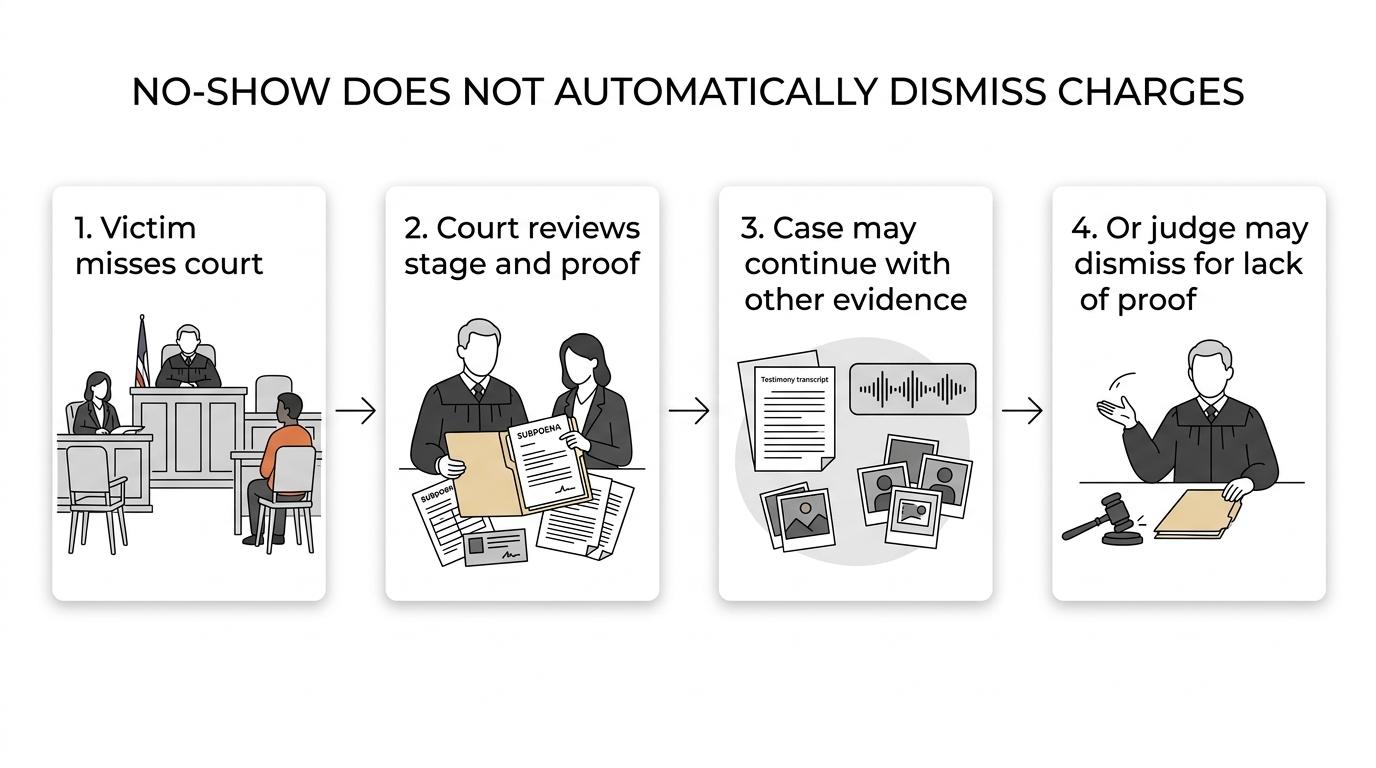
 Visualization: Common Michigan case paths when the complaining witness does not appear.
Will the charges be dropped if the victim does not show up to court?
No. In Michigan, a victim’s absence does not automatically end a prosecution, and Ben Hall Law regularly sees cases continue based on preserved testimony, 911 calls, photographs, or officer observations.
That is because criminal charges belong to the State of Michigan, not to the complaining witness. A person can ask that the case be dropped, refuse to cooperate, or fail to appear, but none of those facts forces a judge to dismiss the case on the spot.
What happens next depends on the court event. At one hearing, the prosecutor may ask for an adjournment. At another, the judge may find there is not enough admissible evidence to continue. In some cases, the witness was already questioned under oath earlier in the process, which changes the analysis.
“Ben Hall Law prepares criminal cases as though they are going to trial, which matters when a witness no-show does not end the prosecution.”
A common misconception is that a victim controls the case from start to finish. In reality, the prosecutor looks at the full record, including police reports, recordings, photos, medical records, and prior statements, then decides how to proceed.
Who decides whether a Michigan criminal case continues?
The prosecutor decides whether to continue pursuing charges, while the judge decides what evidence and procedure the court will allow. The victim’s views matter, but they are not the final decision.
This is the key comparison you should keep in mind:
The victim can report what happened, ask that the case be dropped, appear or fail to appear, and answer questions truthfully if called. The victim cannot unilaterally dismiss a State of Michigan case.
The prosecutor can decide to authorize charges, reduce charges, dismiss charges, or keep going without the victim if the law and evidence allow it. The judge can deny weak evidence, enforce subpoenas, and decide whether a hearing moves forward.
If you are in East Lansing near MSU, or traveling into court from Okemos or Haslett, that distinction matters. Many defendants walk into court expecting an instant dismissal because “the victim isn’t coming.” That is often not how the day unfolds.
What are the 5 facts you need to know if a victim will not testify in Michigan?
These five points answer most of the confusion around a no-show witness in Michigan courts.
- A victim’s refusal to participate does not, by itself, end the case.
- The stage of the case matters. A no-show at arraignment, probable-cause conference, preliminary examination, or trial can lead to different results.
- Michigan procedure allows prosecutors to preserve testimony early if the witness is present and the court follows the proper process.
- Other evidence may support the charge even without live victim testimony.
- If the defendant caused the witness’s unavailability, the rules of evidence may work against the defense, not in its favor.
If you remember only one thing, remember this: a no-show can weaken the prosecution, but it does not automatically destroy it.
What happens at a probable-cause conference in Michigan?
A probable-cause conference is an early district court stage where scheduling, bond issues, plea discussions, and sometimes victim-related testimony issues are addressed. Under MCR 6.108(D), the judge must be available to take a victim’s testimony if the prosecutor requests it.
Here is the basic process:
- Court setting: A felony case reaches district court after arraignment and moves toward the probable-cause conference.
- Judge availability: Under MCR 6.108(D), the district judge must be available during the conference for pleas, bond requests, and requested victim testimony.
- Prosecutor request: If the victim is present, the prosecutor can ask the court to take that testimony early.
- Practical effect: The prosecution may preserve important testimony before the witness later becomes unavailable.
This rule matters in real life. If the complainant is present one week but likely to disappear before the next hearing, the prosecutor may try to lock in testimony while the person is available.
A common mistake is assuming the probable-cause conference is only an administrative date. In some Michigan cases, it becomes much more important than that.
How can a preliminary examination preserve victim testimony?
A preliminary examination can preserve testimony by putting the witness under oath early, with the defendant present or having waived presence. That preserved record can become a major issue later.
The Michigan Judicial Institute benchbook explains that, on the prosecutor’s request, the preliminary examination may begin immediately at the probable-cause conference for the sole purpose of taking and preserving the victim’s testimony if the victim is present.
A simplified sequence looks like this:
- The defendant is present in court, or the right to be present is waived.
- The prosecutor asks to begin the preliminary examination for the limited purpose of preserving the victim’s testimony.
- The witness testifies under oath.
- The defense has the chance to cross-examine.
- The testimony is preserved in the court record.
Do not miss the trade-off here. Preserved testimony is not the same thing as guaranteed trial evidence. It still has to fit the Michigan Rules of Evidence and confrontation rules later. Still, once testimony exists in the record, the prosecution is in a better position than if the witness was never questioned at all.
 Visualization: Where testimony preservation can happen before bindover in a Michigan felony case.
How can prosecutors prove a case without live victim testimony?
Prosecutors can sometimes prove a case without live victim testimony, but the strength of that approach depends on the evidence type. A 911 call and body-camera video are usually more useful than a bare police report.
In domestic violence, assault, and student-related cases around East Lansing, prosecutors may look to evidence like these:
- 911 recordings: Time-stamped statements, tone, urgency, and background sounds
- Body-camera footage: Visible injuries, scene conditions, and spontaneous statements
- Photographs: Bruising, damage, torn clothing, or disarray in an apartment or dorm
- Medical records: Treatment notes that match the timeline of the incident
- Officer observations: Demeanor, intoxication signs, injuries, and statements made at the scene
Here is the comparison that matters. Live testimony lets the prosecutor tell a direct story through the witness. Other evidence can fill gaps, but not always cleanly. Some statements raise hearsay problems. Some reports contain facts that are not automatically admissible just because an officer wrote them down.
Common misconception: if it is in the police report, it comes in. That is not true. A report is a document. Admissibility depends on the rule involved and what part of the report the prosecutor wants to use.
What is forfeiture by wrongdoing under MRE 804(b)(6)?
Forfeiture by wrongdoing is a rule that can let prior statements come in if the defendant intentionally caused the witness to be unavailable. In Michigan, that rule appears in MRE 804(b)(6).
According to the Michigan Judicial Institute evidence benchbook, the prosecution must show by a preponderance of the evidence that the defendant engaged in or encouraged wrongdoing, intended to procure the witness’s unavailability, and did procure that unavailability. If that showing is made, the rule is treated as an exception to the confrontation issue discussed in the benchbook.
That means the “victim will not show up” argument can backfire badly if the absence was caused by threats, pressure, harassment, or indirect witness tampering through friends or relatives.
“Ben Hall Law reviews how the investigation began, how evidence was gathered, and whether witness issues changed the prosecution’s strategy.”
Pro tip: if you are charged, do not contact the witness to talk about testimony, recanting, or court dates. A message that feels harmless to you can be framed as pressure or intimidation.
If the witness stayed away for reasons unrelated to any wrongdoing by the defendant, the prosecutor still has to satisfy the normal evidence rules. The absence alone does not trigger MRE 804(b)(6).
How are domestic violence cases different when the complainant recants or stays away?
Domestic violence cases often continue without the complainant, and Ben Hall Law sees this often because prosecutors treat the matter as State of Michigan v. defendant, not complainant v. defendant.
These cases are different because recanting is common and prosecutors know it. A person may call 911 during a crisis, then change the story the next day because of fear, finances, housing concerns, child-care issues, or pressure from family. Courts and prosecutors are familiar with that pattern.
That is why domestic violence files often focus on independent proof. A 911 recording, body-camera footage showing visible injury, photographs, neighbor observations, medical treatment, and officer testimony can all matter. If the case arose in an apartment near Grand River Avenue, a dorm setting near Michigan State University, or a home in Lansing Township, the location may also produce surveillance or third-party witnesses.
A common misconception is that recanting wipes out the first statement. It does not. Instead, it creates a credibility fight about which version the court or jury should believe.
What should you do if you are charged and the victim says they will not appear?
You should prepare for trial-level issues, not assume dismissal. If the witness misses court, your lawyer may attack admissibility, subpoena compliance, preserved testimony, and probable cause all at once.
A smart response usually looks like this:
- Say less: Do not contact the witness about the case, even if you think you are fixing things.
- Save evidence: Keep screenshots, videos, call logs, social media posts, and names of people who saw what happened.
- Check the court stage: A no-show at trial is different from a no-show at a preliminary examination or probable-cause conference.
- Ask about subpoenas: If the witness was subpoenaed, the court may adjourn or enforce appearance rather than dismiss immediately.
- Prepare both paths: If the witness appears, you need cross-examination strategy. If the witness does not appear, you need hearsay and confrontation objections ready.
If your case is in 54B District Court or headed into Ingham County Circuit Court after bindover, timing matters. One missed hearing can create leverage. It can also give the prosecutor time to cure a problem if the defense is not ready to act.
What other questions do people ask about victim no-shows in Michigan courts?
Yes, and the answers usually turn on the hearing stage, the subpoena status, and what evidence the prosecutor already preserved.
Can charges be dismissed at the preliminary examination if the victim does not show?
Yes, they can be, but not automatically. If the prosecutor lacks enough admissible evidence to establish probable cause at the preliminary examination, the judge may dismiss or reduce the case. If other admissible evidence exists, the case may still proceed.
Does a subpoena change what happens if the victim misses court?
Yes. A subpoena is a court order, not a casual request. A subpoenaed witness who fails to appear may trigger an adjournment, enforcement action, or other court response instead of immediate dismissal.
Can the prosecutor use a 911 call if the victim refuses to testify?
Sometimes. Whether a 911 call comes in depends on what was said, why it was said, and which evidence rule applies. Emergency statements are treated differently from later testimonial statements made for prosecution purposes.
Is this only a domestic violence issue?
No. It comes up in assault cases, sexual misconduct cases, student cases, and other offenses where the complaining witness changes course. Domestic violence cases get more attention because recanting and noncooperation happen often there.
Does a victim have the power to drop charges in Michigan?
No. A victim can share their wishes, but the prosecutor files and dismisses charges on behalf of the State of Michigan. That is the basic rule you should start with in any Michigan criminal case.